


Node.js and NestJS Engineering
We build Node.js and NestJS backends using a modular structure and strict type safety to prevent technical debt.
We focus on high-performance runtime optimization and clean code standards, ensuring your system remains scalable and easy to manage from the first day of production.
Stop Scaling Hurdles and Technical Debt











It is easy to launch a JavaScript app quickly, but it is just as easy to end up with spaghetti code. This happens when business logic is scattered, parts of the app are too tightly connected, and fixing one bug creates two more. Most messy codebases do not start that way; they get there one shortcut at a time.
We use NestJS to solve this. It enforces a modular structure that keeps your core business rules separate from the database or the web layer. This makes the system easier to test and safer to update. We use Fastify to increase speed, BullMQ to handle background tasks, and Worker Threads to ensure heavy calculations do not slow down the rest of the app.
Client Results and Success

400M+ global payments processed annually
The system provides the scalability required to handle millions of transactions while maintaining data integrity and administrative control.
- Active Users in the UK, Canada, Europe, and Australia
- 120k+
- Global Payments Processed Annually
- 400M+
- Downloads Across iOS and Android
- 350k+

3x faster AI feature iteration
The modular backend architecture allowed the team to deploy new AI capabilities and personalized features significantly faster than industry benchmarks.
- Reduction in meal decision time
- 40%
- Increase in daily active usage during pilot
- 2x
- Faster iteration on new AI-driven features
- 3x
$57,000+ Annual Savings
The project achieved a 60% reduction in monthly cloud costs (from $8,100 to $3,300) without any loss in transaction speed or system security.
- Reduction in monthly cloud costs
- 60%
- Saved per month
- $4800
- Annual savings
- $57,000+
50% reduction in manual validation cycles
The integration of automated benchmarking frameworks and AI-driven process automation also resulted in 30% faster internal testing workflows.
- faster internal testing
- 30%
- reduction in manual validation
- 50%
AI-Powered Candidate Screening at Scale
Automated technical interviews with real-time voice interactions, adaptive questioning, and intelligent candidate evaluation to accelerate hiring and improve screening consistency.
- Candidate Screening
- 24/7
- Voice Interviews
- AI-Led
Transforming Pantry Data into Personalized Meal Experiences
Built an AI-powered platform that analyzes pantry inventory and user preferences to deliver personalized meal recommendations, reduce food waste, and simplify meal planning.
- Reduction in meal decision time
- 40%
- Higher Daily Usage
- 2x
- Faster Feature Delivery
- 3x
A Unified Platform for Vending Business Management
Built a modern SaaS platform that automates workflows, centralizes operations, and enables efficient management of leads, routes, users, and subscriptions.
- On-time Delivery
- 100%
- Week Delivery Completed
- 12
- Blocker Launch
- 0%
Our Node.js & NestJS Engineering Capabilities
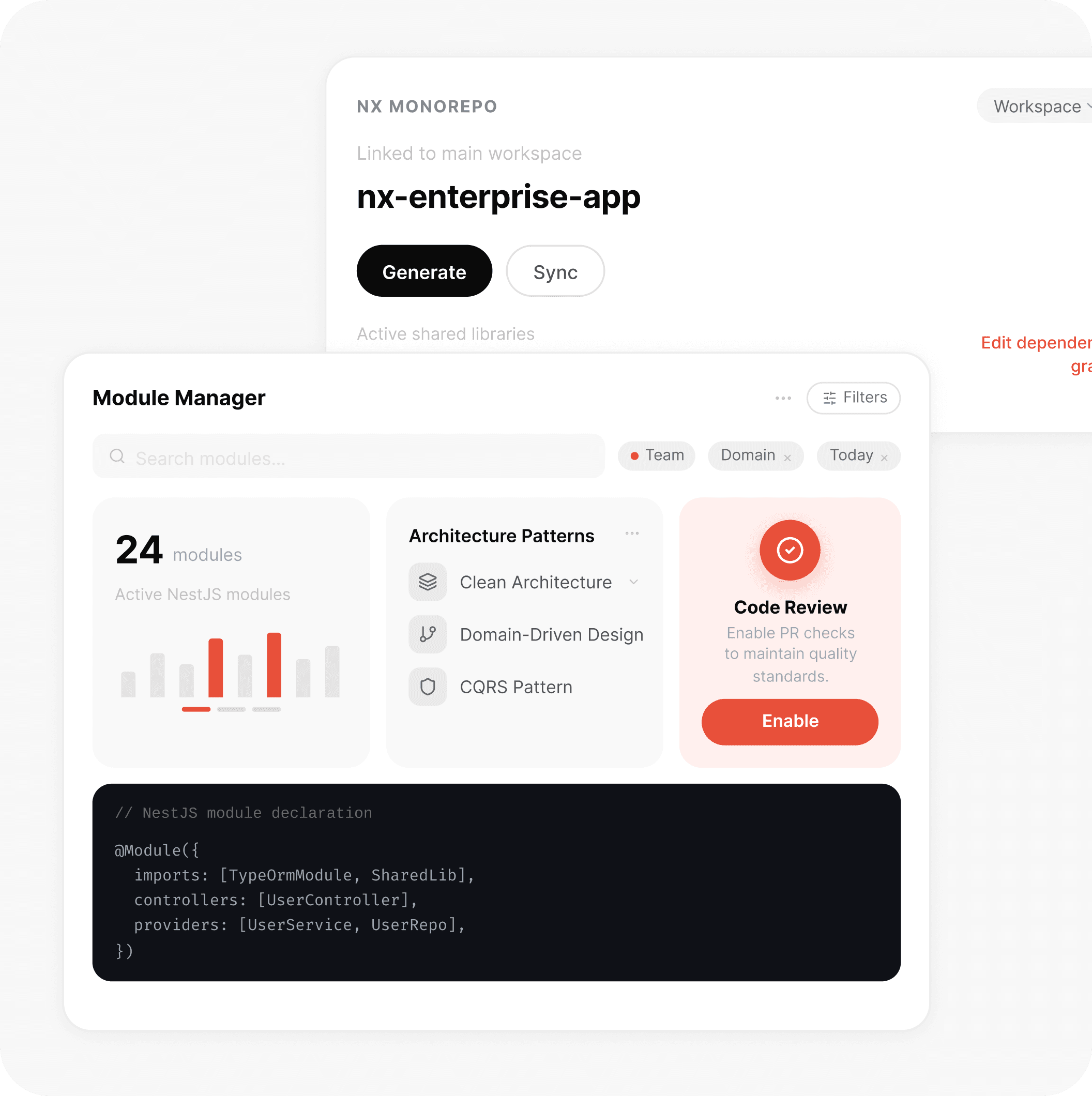
We use NestJS to build a clean Architecture. This means your business logic is protected from external changes. We also use Nx monorepos to help teams share code efficiently between the front end and back end.
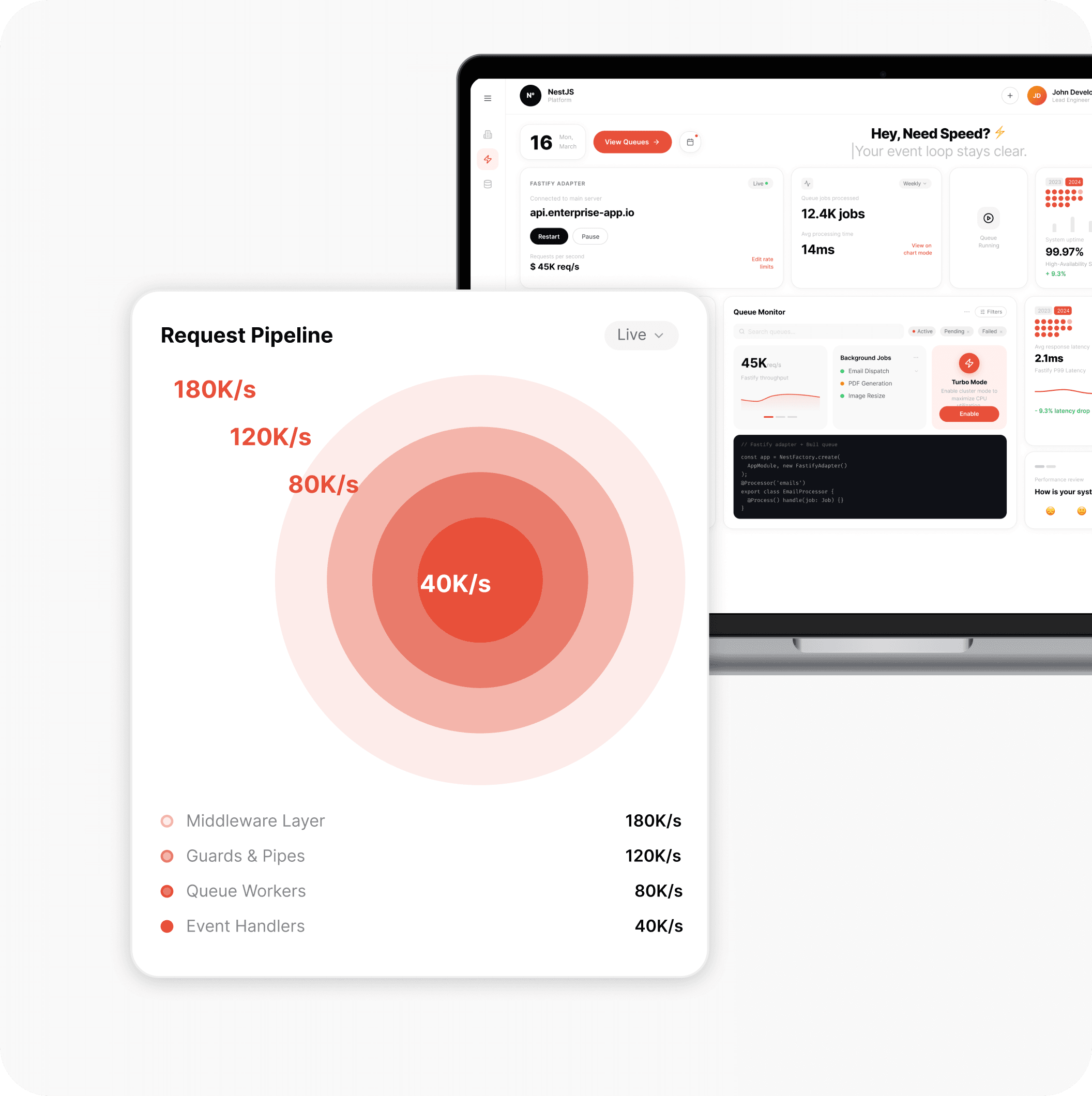
We focus on speed by using the Fastify adapter and offloading heavy tasks to background queues. This keeps the event loop clear, so your app stays fast even when thousands of people are using it at once.
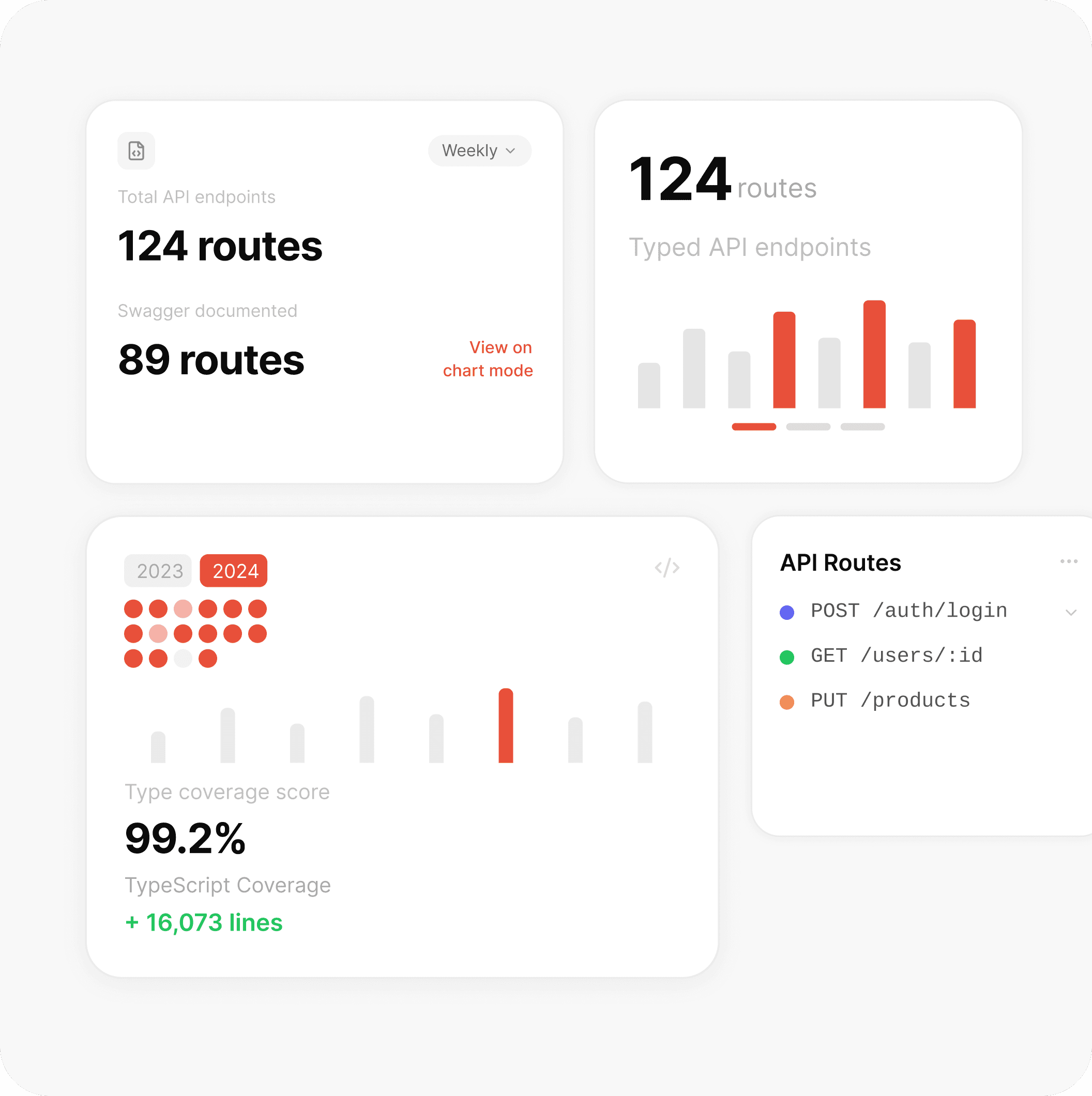
We use tools like Prisma or TypeORM, so your database code is clear and error-free. We also automate your API documentation with Swagger, so your developers always have an accurate manual to follow.
Complete Backend Engineering Services for Enterprises and Companies
Industries-Based Node.js & NestJS Engineering Services
We build backends that act as a competitive advantage. For SaaS companies, that means multi-tenant architectures that scale infinitely. For Healthcare, it means HIPAA-ready data silos and encryption. We tailor the Node.js event loop and database indexing to the metrics that matter most to your business, ensuring your tech supports your growth instead of limiting it.
Node.js and NestJS Engineering by Engineers Who Have Delivered 1000+ Projects
Fast code is easy to write, but maintainable code is an art. We have fixed systems where the entire app was one giant, confusing file. We know how to untangle these messes and build systems that stay organized for years.
The senior engineers who plan your architecture are the same ones who write the code.
We work with NestJS, Express, GraphQL, and more. We choose the technology that fits your team, not just what is trendy.
We provide clear documentation and Architecture Decision Records. When we finish, your team will have everything they need to run and grow the system without us.
Our Latest Thinking
FAQs About Node.js & NestJS Engineering Services
We cover application architecture design, NestJS module structure, event loop optimization, background job configuration, type-safe data layer setup, API documentation, and Nx monorepo configuration where relevant. The end state is a backend structured for the team and product complexity it needs to support — not the one it started with.
Most greenfield engagements deliver a production-ready foundation within four to eight weeks. Migration engagements — moving an existing monolith to NestJS microservices — depend on the size of the codebase and the number of domains being separated. We scope this during the discovery phase.
Both. For new products, we build the architecture from the start. For existing codebases, we assess the current structure, identify the highest-risk coupling points, and migrate incrementally — extracting modules and services without rewriting the entire application at once.
Yes. Every engagement delivers architecture decision records, API documentation via Swagger, and a module structure your team can follow for new features without guidance from us.
Having a Node.js backend and having a maintainable Node.js backend are different things. Most backends that grew organically carry tightly coupled route handlers, missing type safety, and event loop blocking that nobody has measured. Those problems are invisible until the team size or traffic load makes them visible.
Production-ready NestJS application with documented module structure, Fastify adapter configured, BullMQ job queues set up where needed, Prisma or TypeORM data layer, Swagger API documentation, and architecture decision records covering the key design choices.
We work across NestJS, Express, Fastify, Prisma, TypeORM, BullMQ, GraphQL via Mercurius, Swagger, OpenAPI, Nx, and TypeScript. Tool selection is based on the product requirements and team workflow.
Yes. Authentication and authorization via guards, rate limiting, input validation via pipes, audit logging, and data encryption are part of how we build backends for products operating under SOC 2, PCI-DSS, or HIPAA requirements.
Architecture improvements and boilerplate reduction are visible within the first two weeks. Full module structure, job queue setup, and API documentation typically complete within four to six weeks depending on scope.
An internal hire needs ramp time before making safe structural changes to a production backend. Our engineers arrive with that experience in place, deliver a documented and tested architecture on a fixed schedule, and carry none of the overhead of recruiting or onboarding.
