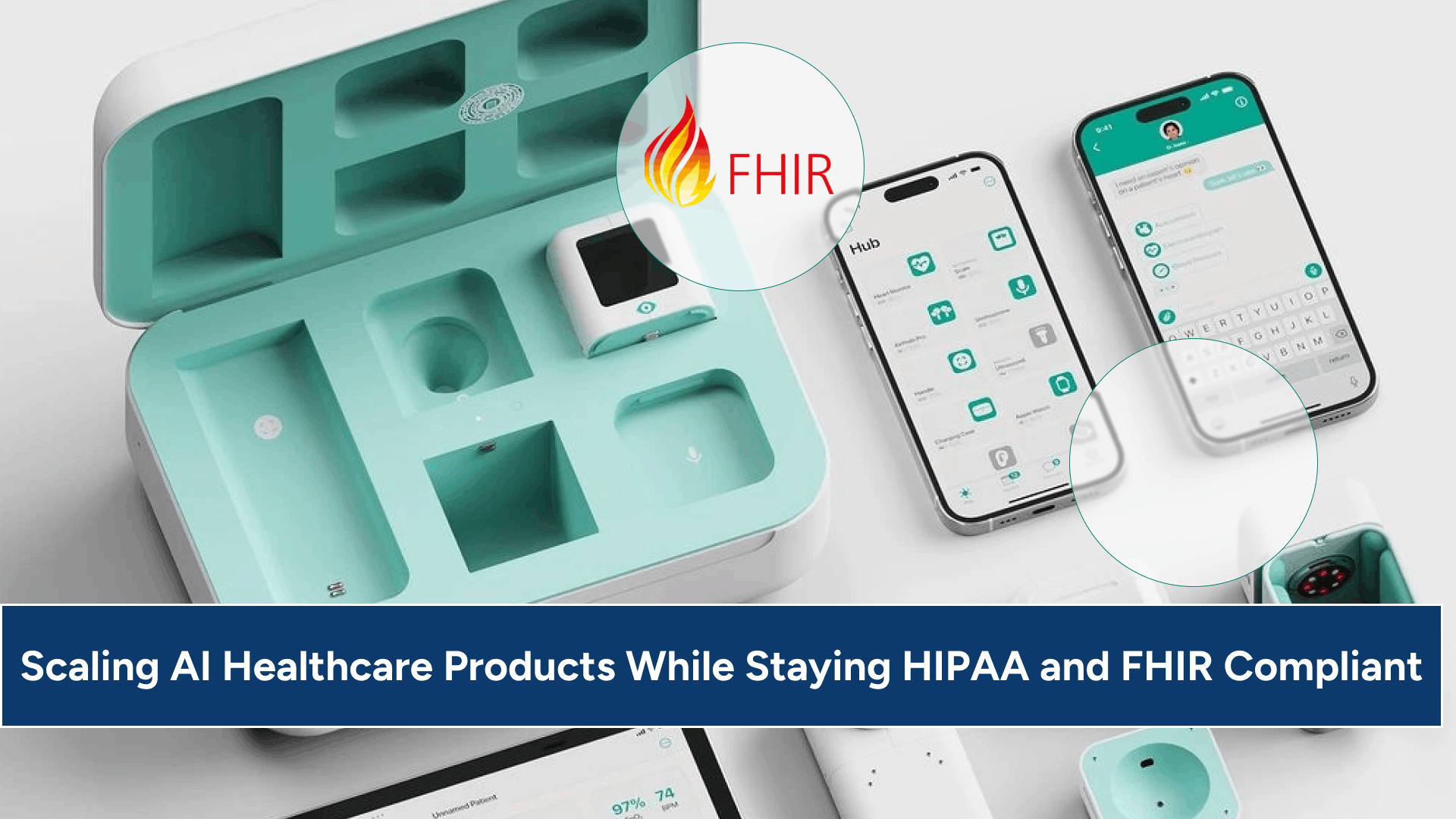

The global healthcare AI market has reached an astonishing $51.2 billion, with nearly 75% of U.S. health systems actively deploying AI platforms. Yet, behind this monumental surge lies what regulatory experts call the compliance paradox: the exact clinical narrative and patient telemetry that make AI transformative are the same data vectors that can trigger massive enforcement penalties if mishandled.
For software engineers, product managers, and healthtech innovators, scaling a product from a localized pilot to an enterprise-grade hospital network is rarely a challenge of algorithmic performance. Instead, it is a challenge of data governance, structural interoperability, and trust.
To scale successfully, you must satisfy two distinct but deeply intertwined pillars:
- HIPAA (Health Insurance Portability and Accountability Act): The legal boundary protecting the security and privacy of electronic Protected Health Information (ePHI).
- FHIR (Fast Healthcare Interoperability Resources): The technical framework allowing structured data to flow frictionlessly across disparate Electronic Health Records (EHRs).
At GeekyAnts, we specialize in architecting complex, highly integrated digital products. In this guide, we will break down how to design a scalable, enterprise-ready AI architecture that inherently respects patient privacy while achieving real-time clinical data exchange.
The Architectural Shift: Building for Zero-Trust and Shared Responsibility
Historically, software compliance relied on perimeter security—firewalls around a database. In an AI-driven ecosystem, data flows through continuous evaluation cycles, Vector Databases (for Retrieval-Augmented Generation), and LLM context windows. This complex lifecycle makes standard, static configurations obsolete.
The Myth of "HIPAA-Eligible" Clouds
A common engineering pitfall is assuming that because you build on AWS, Google Cloud, or Microsoft Azure—and have signed a standard Business Associate Agreement (BAA)—your AI product is automatically compliant.
Under the Shared Responsibility Model, cloud providers guarantee the security of the cloud, but you remain strictly responsible for security in the cloud.
If your AI pipeline accidentally leaks ePHI into a public model's training set, or logs raw clinical prompts in unencrypted application files, your team is liable.
Concrete Engineering Checklist for HIPAA-Compliant AI:
- Dedicated, Segregated Instances: Ensure that your LLM infrastructure utilizes zero-retention API endpoints where customer data is conceptually isolated. Under no circumstances should patient data be absorbed to train a vendor's global base model.
- Encrypting the Untraditional: Standard databases are encrypted at rest, but what about your vector embeddings? Because vector representations of patient histories can potentially be reverse-engineered or contain semantic traces of ePHI, vector databases must be treated as fully covered ePHI, complete with strict access controls and end-to-end encryption.
- The Minimum Necessary Standard: Per HIPAA regulation 45 CFR § 164.502(b), applications must limit ePHI access to the absolute minimum required to complete a task. If your RAG system needs to analyze a 2KB lab report, do not feed a 50KB complete patient file into the context window. Implement strict semantic filtering before the data reaches the LLM.
Breaking Data Silos with FHIR and SMART on FHIR
Scaling across multiple hospital systems requires semantic interoperability. If your engineering team has to build custom data pipelines for every Epic, Cerner, or Meditech installation, your scaling velocity will collapse under the weight of technical debt.
The industry solution is HL7 FHIR, a RESTful API standard that exposes healthcare information (such as patients, observations, and medications) as modular services.
Mapping AI Pipelines to FHIR Resources
Instead of injecting arbitrary JSON blobs into your AI workflows, parse inbound EHR data into structured FHIR resources.
AI Feature / Use Case | Primary FHIR Resource Target | What it Captures |
|---|---|---|
Predictive Diagnostics | Observation | Lab results, vital signs, clinical measurements |
ClinicalImpression & Encounter | Doctor's assessments, specific visits, clinical reasoning | |
Treatment Recommendation Systems | CarePlan & MedicationRequest | Prescriptions, dynamic care goals, workflows |
Patient Risk Stratification | Patient & Condition | Demographics, active problem lists, histories |
Implementing SMART on FHIR for Secure Access
To launch your AI product directly inside a clinician's workflow without creating separate login credentials, implement SMART on FHIR.
SMART on FHIR acts as the secure identity layer, leveraging OAuth 2.0 and OpenID Connect. This setup ensures that when a physician clicks on your app within their EHR interface:
- The app securely inherits the physician’s specific permissions.
- User authentications are checked natively against the hospital's Identity Provider (IdP).
- Strict, granular scopes (e.g., patient/Observation.read) are dynamically applied, inherently upholding the HIPAA Access Control requirement.
[EHR User Interface] --(Launch Request)--> [SMART App Launcher]
                                                  |
[SMART on FHIR App] <--(OAuth 2.0 Token)-- [OAuth Authorization Server]
        |
        +--(Scoped API Request with Token)--> [Secure FHIR Resource Server]
2026 Regulatory Landscape: Beyond the Checkbox
Compliance is no longer a static, one-time audit. Joint guidance issued by organizations like the Coalition for Health AI (CHAI) and the Joint Commission has shifted the compliance model toward continuous, post-deployment evaluation.
Algorithmic Bias and Local Validation
The Office for Civil Rights (OCR) actively regulates algorithmic bias under federal nondiscrimination laws. An AI model trained entirely on data from an urban demographic might fail or exhibit severe bias when scaled to rural medical practices.
When scaling your product, build automated pipelines for local validation. This involves auditing your model's performance thresholds against the specific demographic and equipment types of each new clinical site before turning on production features.
Immutable Audit Logging for OCR Defensibility
A baseline database log is entirely insufficient for AI system validation. If an AI tool suggests an incorrect diagnostic path, your product must be able to reconstruct the exact data state at the time of inference.
Your audit architecture should record:
- The exact inbound FHIR payload context.
- The precise system prompt and semantic context are retrieved via RAG.
- The explicit output of the LLM model is accompanied by confidence scores.
- The final action taken by the clinician (accept, reject, or modify).
Operational Strategy for Product Leaders
If you are scaling a healthtech startup or expanding an enterprise portfolio, focus on these tactical engineering choices:
- Adopt a Hybrid Interoperability Strategy: While modern hospital systems support native FHIR RESTful APIs, legacy components may still rely on HL7 v2 messages. Do not attempt to refactor the client's internal legacy systems. Instead, deploy a modern hybrid layer that automatically translates legacy HL7 v2 streams into clean FHIR data buckets before passing them to your AI ingestion pipeline.
- Pursue Third-Party Validation Early: Enterprise healthcare compliance officers look for recognized frameworks. Prioritize achieving SOC 2 Type II, HITRUST CSF, and ISO 42001 (the dedicated standard for artificial intelligence management systems).
- Enforce Clean Architectural Demarcation: Keep your core UI and AI logic loosely coupled from individual EHR communication layers. By wrapping integrations in an API gateway layer that explicitly validates incoming requests against defined FHIR profiles (like US Core), you ensure that changes to underlying models do not break live client systems.
Conclusion
Scaling an AI product in healthcare requires looking past basic algorithmic capabilities. By designing an ecosystem rooted in a Zero-Trust architecture, establishing SMART on FHIR identity delegation, and treating compliance as a continuous engineering lifecycle, you protect patient privacy while building a robust, interoperable system capable of transforming modern medicine.