

Key Takeaways
- AI healthcare products slow down when compliance is treated as a review stage instead of a design decision.
- Prompts, vendor pipelines, output logs, and feedback loops all become patient data risks when left unaddressed.
- Teams that set data boundaries at design stage face fewer audit surprises and close enterprise deals faster.
- Separating the patient data layer from the AI layer lets teams ship features without triggering compliance reviews.
Healthcare teams building AI products are caught between two demands that feel impossible to balance. Ship fast enough to stay competitive. Stay compliant enough to stay in business. Most teams try to do both and end up doing neither well.
The pressure to move fast pushes compliance to the end of the roadmap, and when it finally gets addressed, the cost is not just time. It is re-architecture, rework, missed enterprise deals, and audit risk that could have been avoided entirely.
Here is what that experience makes clear: HIPAA is not the reason AI healthcare products miss their delivery targets. The real cause is fragmented architecture, unclear data boundaries, and controls that get bolted on at the end of the build.
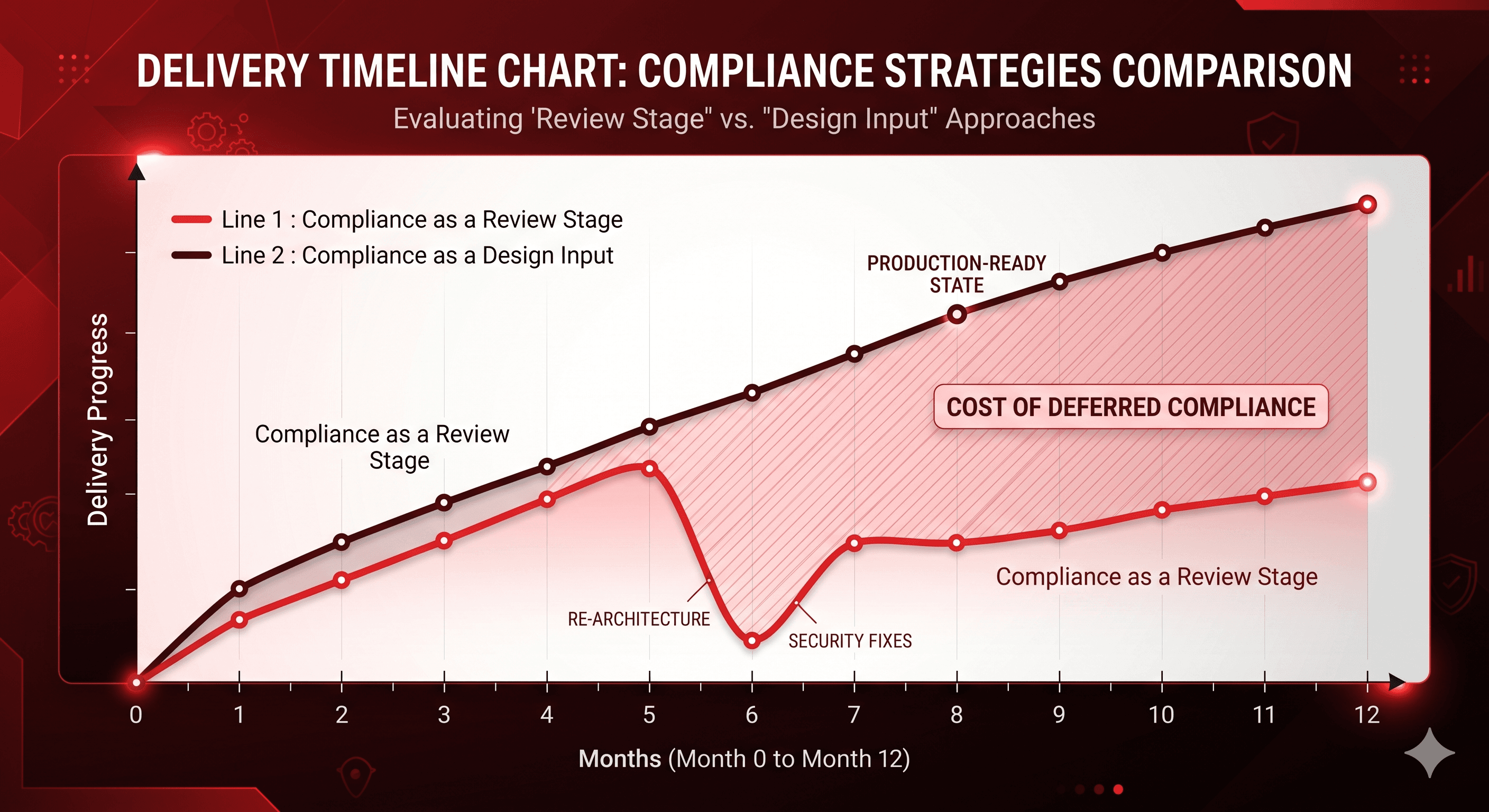
The fastest teams in this space treat compliance as a design constraint, not a review stage. They know exactly where patient data lives across their entire product, including AI pipelines, vendor tools, output logs, and feedback loops, and they build AI systems that generate audit evidence automatically instead of scrambling to produce it before a review.
This blog is for product and engineering leaders, and founders at US and Canadian healthcare companies building AI products that need to be fast, resilient, trustworthy, and ready for enterprise buyers. What follows is a practical look at how the best teams build AI healthcare products without letting compliance become the bottleneck.
Why AI Healthcare Products Struggle With HIPAA Readiness and Delivery Speed
When Compliance Gets Pushed to the End, It Costs More Than Time
Most AI healthcare product teams split their work into two categories without saying it out. Features go into one track, and compliance goes into another, usually later. By the time both tracks meet, the AI product has already been built around decisions that do not hold up under a security review.
Going back to fix those decisions is not a small task. It means pulling apart systems that work, rebuilding data flows that were never designed to handle patient information safely, and pushing launch dates that the business has already committed to. The cost shows up in budget, in team morale, and in enterprise deals that stall because the product cannot clear a vendor assessment.
AI Brings Patient Data Into Places Standard Security Never Accounted For
A traditional healthcare application has a manageable set of places where patient data lives, whereas an AI healthcare product is different. Model prompts, output logs, third-party AI APIs, and data sources that feed into AI pipelines all become places where patient data can surface unexpectedly.
Logging tools, analytics platforms, and support systems are three of the most common places where patient data ends up without any deliberate decision being made. AI development moves fast, and the governance structures that should sit alongside it almost never keep pace.
Collecting More Data Than Necessary Creates Compliance Problems That Compound
Every additional piece of patient data a product collects expands the compliance boundary of the entire system. Teams that collect broadly, thinking they will need the data later, end up with more systems to secure, more vendors to assess, and more documentation to produce before any audit.
Keeping the data footprint small is one of the most direct ways to keep delivery timelines intact. Teams that collect only what each feature genuinely requires spend less time managing scope and more time building the product.
Every healthcare team we speak to believes their compliance problem is unique, but it is not. They built a product first and assumed compliance could be layered on later. By the time they come to us, they have already spent six to nine months rebuilding what should have been right in the first sprint.
 Kumar PratikFounder & CEO
At GeekyAnts, we have seen a consistent pattern across AI healthcare products in the US market. The teams that hit enterprise sales walls are the ones whose architecture was never designed to produce the evidence that hospital procurement teams and health system CIOs ask for. That gap between a working product and an enterprise-ready product is almost always a compliance architecture problem, and it almost always traces back to decisions made in the first two weeks of the build.
A Practical Framework to Build HIPPA-Ready AI Healthcare Products Faster
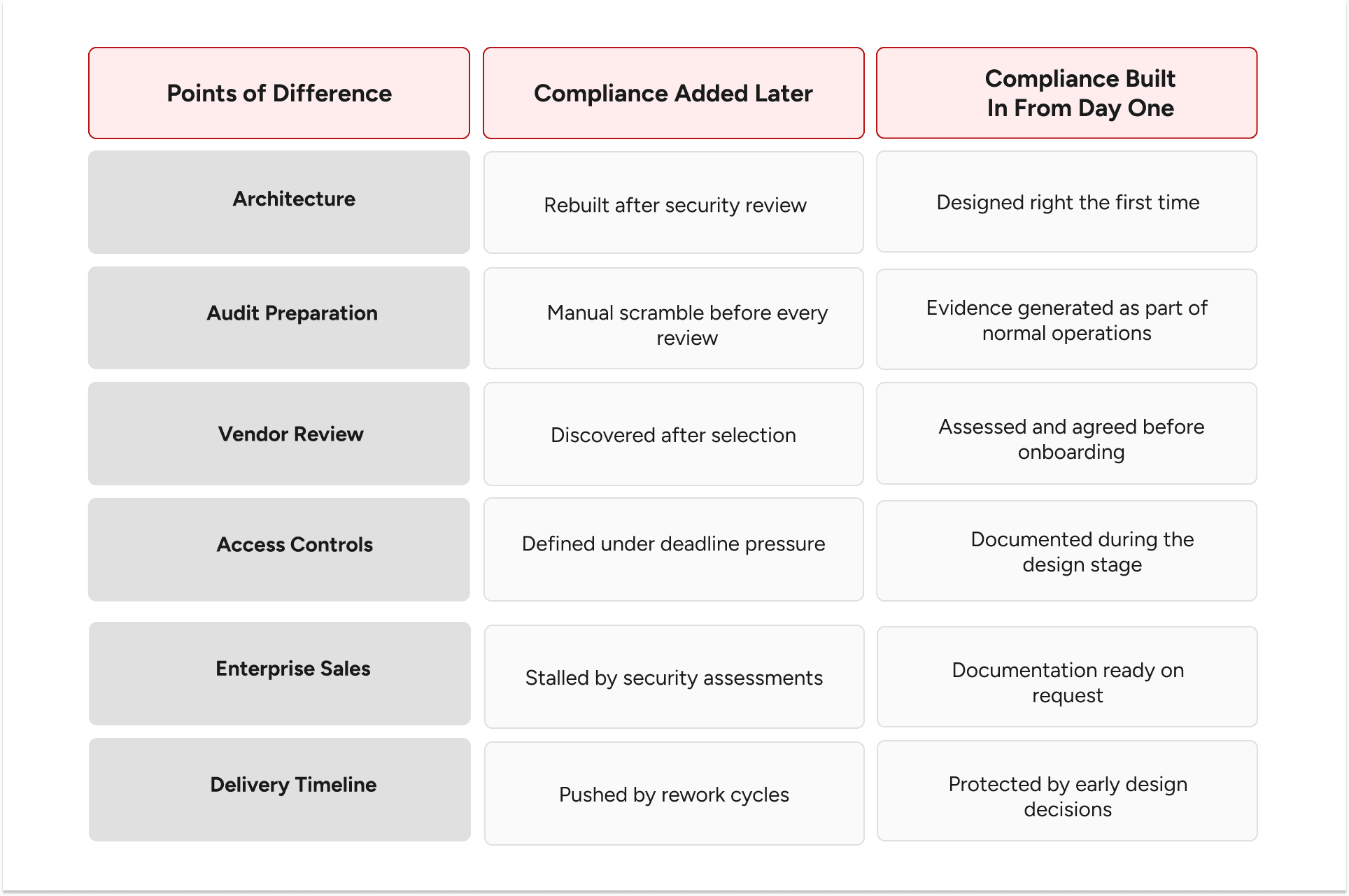
The dedicated teams that ship HIPAA-ready AI healthcare products on time make compliance part of the design, not a final gate. Three decisions consistently separate the teams that deliver from the teams that don't.
Know Where Patient Data Lives Before You Decide What to Build
Most product teams start with a list of features. In a healthcare product, that is the wrong starting point.
Before any feature work begins, the team needs to know exactly where patient data enters the product, where it gets stored, how it moves between systems, where it shows up in records and logs, and where it feeds into AI workflows. This exercise changes the shape of every decision that follows. Data boundaries get set early, vendor obligations become clear before contracts are signed, and audit surprises become rare because the team already knows what exists and where.
Collect Only What the Feature in Front of You Actually Needs
Every piece of patient data that a product collects makes the compliance boundary of that product larger. More data means more systems to secure, more vendors to evaluate, and more documentation to maintain.
The question every feature needs to answer before it goes into development is simple. What is the least amount of patient data this feature needs to function? If the answer includes data that might be useful later, that data should not be collected now. This applies to AI features as well. The data that feeds a model, the records that appear in an AI output, and what gets retained in logs all need to be as narrow as the feature requires.
Set User Access Rules During Design, Not During Development
When access decisions get made during development, they get made fast and without review. An AI developer decides which user type can see which data, and that decision becomes part of the product without ever being examined as a deliberate choice.
The better approach is to define user roles, access boundaries, and permission levels during the design stage. Physicians, administrators, and patients each need a clearly defined boundary before development begins. Developers then build to a precise specification rather than making judgment calls under deadline pressure. The documented access model that results also satisfies a significant portion of what auditors look for during a review.
Architecture Patterns That Make AI Healthcare Products Fast to Build and Easy to Keep Compliant
Mixing the patient data layer with the AI capability layer turns every feature update into a compliance event. At GeekyAnts, we establish that boundary before development begins, so the AI layer operates on data with identifying information already removed. That is what allows the AI side of the product to move fast without pulling the patient data side into every release.
 Sanket SahuCo-founder
Separate the Patient Data Layer From the AI Capability Layer
The most important structural decision in an AI healthcare product is keeping the part of the system that stores patient data completely separate from the part that runs AI features.
The patient data layer holds records, identity information, clinical notes, and access history. It needs strict controls and limited access. The AI capability layer sits alongside it and handles summarization, clinical copilots, triage assistants, RAG systems, recommendations, and analytics. It needs room to move fast and test new approaches.
When these two layers share the same space, every change to the AI side triggers a review of the patient data side. When they are kept separate, the AI layer can evolve without pulling the patient data layer into every release decision.
Replace Patient Identifiers With Non-Identifying References at the Boundary
Patient data should have all identifying details removed at the point where it moves from the patient data layer into any AI workflow. This is done by replacing real patient identifiers, such as names, dates, and record numbers, with non-identifying references that have no meaning outside a controlled lookup system. The AI system then works with these references rather than the real identifiers.
When a clinical copilot, triage assistant, or RAG system needs to process patient information, it receives a version of that data where every direct identifier has been replaced. If a real identifier is needed at any point, it gets resolved through a single controlled lookup at the boundary. It is never carried through the AI workflow itself. This keeps the AI layer outside the compliance boundary without restricting what it can do.
Isolate Patient Data Risk Using Independent Microservices
Breaking the product into independent microservices, where each service has a clearly defined boundary and handles one specific function, is what keeps patient data risk from spreading across the entire product.
Services that handle patient data operate under strict access controls, detailed logging, and no direct connections to services outside their defined boundary. Services that power AI capabilities, including clinical copilots, triage assistants, and RAG systems, connect only to the de-identified data they need and nothing beyond it. Because each microservice operates within its own boundary, a change in the AI capability layer does not require a review of the patient data layer. The two never share the same boundary, which is what makes this pattern effective for teams that need to move fast on AI features without widening their compliance obligations.
Use Separate Environments for Building, Testing, and Running the Product
Patient data should only exist in the live production environment. Development and testing environments should operate on data with all patient identifiers removed. Access to the production environment should be limited to people with a documented and approved reason to be there. Every access event should be recorded in a log that cannot be altered.
Understand What a Compliant Cloud Platform Does and Does Not Cover
Major cloud platforms offer services that meet the baseline requirements for handling patient data in the United States. Signing a formal data agreement with a cloud provider is a necessary first step. It is not the finish line.
The difference between a cloud platform that is eligible for healthcare use and a product that is compliant comes down to how that platform is set up. Encryption that is available but not correctly configured provides no protection. Access records that are turned on but never reviewed do not satisfy an audit. The cloud provider is responsible for the infrastructure. The product team is responsible for everything built on top of it.
HIPAA-Ready AI Healthcare Technology Stack for Scalable Products
The AI tools a team selects for an AI healthcare product shape how the product handles patient data, how it performs during a security review, and how quickly it can be cleared by enterprise healthcare buyers during a vendor assessment. Selecting the right stack at the start prevents the kind of structural rework that costs teams months later in the build.
The table below covers the core layers of a technology stack built for AI healthcare products, what each layer is responsible for, and where teams most often get it wrong.
Layer | Technology | What It Protects | Where Teams Go Wrong |
|---|---|---|---|
Application | Blocks unauthorized access to patient data through parameterized | Logging libraries that capture query parameters and expose | |
Logging libraries that capture query parameters and expose | Auth0, Okta with MFA | Unique user identification and controlled session management | Session timeouts configured beyond the 15-minute idle threshold |
AI Layer | LLMs (GPT-4 via API), RAG, Vector DBs (Pinecone, Milvus) | Prevents PHI leakage in prompts and ensures data isolation in retrieval-augmented generation | Sending unmasked PHI to non-HIPAA-compliant LLM APIs or failing to redact PII before embedding data |
Database | PostgreSQL, MongoDB with encryption at rest | Patient data secured in storage with encrypted backup copies | Encryption validation skipped when restoring from backups |
Interoperability | FHIR APIs, SMART on FHIR, HL7 | Secure, standardized data exchange between external health systems and patient apps | Over-scoped API permissions (e.g., granting "Full Patient Read" instead of specific resource scopes) |
Cloud Platform | AWS HIPAA services, Azure for Healthcare | BAA coverage and audit-ready access logging | Selecting platform services not covered under a healthcare BAA |
Monitoring | ELK Stack, Splunk | PHI-aware log redaction and tamper-proof audit trails | Centralizing logs in a way that aggregates patient data across environments |
A cloud certification from a vendor confirms they understand compliance frameworks. It does not mean they will make the right architectural decisions for your product. That responsibility belongs to the team building it.
The table below shows how compliance controls fit into each stage of the build and release process.
Build and Release Stage | Control | Tools | What Gets Validated |
|---|---|---|---|
Build | Secret scanning | GitGuardian, TruffleHog | API keys and credentials are not exposed in source code |
Test | PHI data masking | Delphix, Tonic.ai | Test databases run on synthetic or masked patient data |
Deploy | Auto-encryption | AWS KMS, Azure Key Vault | Data is encrypted both in transit and at rest |
Monitor | Real-time audits | Splunk, Datadog with HIPAA modules | Access logs captured with timestamps and user IDs |
These layers do not work in isolation. Their value comes from how they connect across the full product, keeping patient data protected at every point without requiring manual intervention before each release.
Embedding HIPAA Controls Into Sprint Planning and Release Cycles for AI Healthcare Products
Label Every Story by Its Patient Data Impact Before the Sprint Begins
Every story that enters a sprint in an AI healthcare product carries a different level of patient data risk. Treating all stories the same during planning is what allows compliance gaps to reach released code without anyone catching them.
Each story gets one of five labels before it enters a sprint:
- No PHI: The story has no contact with patient data.
- PHI Read: The story pulls patient data to display or process it.
- PHI Write: The story creates or updates patient data.
- PHI Transmit: The story moves patient data between systems.
- AI Inference with PHI: The story passes patient data into an AI model or pipeline.
Each label carries a defined set of requirements that must be met before the story ships. A PHI Write story requires encryption validation, access control verification, and an audit log entry as part of its acceptance criteria. These are not added during review. They are part of the story from the start.
Use Pre-Approved Components Across the Entire Product
When engineers make individual decisions about how to handle encryption, access logging, and audit records, the result is a product where different parts handle the same obligations differently. That inconsistency is what makes audits difficult and alignment expensive.
A library of pre-approved components that handle these functions the same way across the entire product removes that inconsistency. Security design happens once, gets validated once, and gets applied wherever it is needed.
Run Compliance Checks as Part of Every Build
Infrastructure changes get validated against a defined baseline on every commit. Credentials are scanned in source code before any build completes. Security testing runs against both the static code and the running application. Audit evidence is generated by the build process itself.
Problems caught during a build take hours to fix. The same problems caught during a pre-launch review take weeks.
Keep Audit Evidence Current So It Is Ready When Buyers and Auditors Ask for It
Enterprise healthcare buyers request security documentation before they sign contracts. Teams that generate this evidence manually spend weeks preparing for reviews that should take days.
Access records, configuration histories, and security posture data captured as a normal part of system operation mean that audit preparation stops being a project. It becomes a routine export. Enterprise sales cycles shorten because the documentation buyers ask for already exists.
AI-Specific HIPAA Guardrails Every Modern Healthcare Product Needs
Document What Patient Data Your Models Learn From
AI models improve by learning from data. In a healthcare product, that data often contains patient information, and without a written policy governing what is and is not permitted, teams make inconsistent decisions that create regulatory exposure.
Before any data trains or improves a model, the team needs documented answers to four questions. What patient data is being used? Has identifying information been removed from it? Does it stay within the customer's own environment? And is there any category of data that is off limits for model improvement?
These answers need to exist in writing. When a security review or enterprise buyer asks how the product handles training data, the answer needs to be a document, not a conversation.
Control What Enters and Exits Every AI Workflow
Prompts, completion records, trace logs, and support tools all need controls that prevent patient data from entering them. Outputs need to be reviewed against a defined policy before they reach the end user. In any workflow where a model output could affect a clinical decision, a qualified person reviews that output before it is acted on.
Experimentation with new AI capabilities happens in an isolated environment with no connection to real patient data.
Keep AI Decisions Traceable and Reviewable
Every AI output that touches a care workflow needs a record of what information was used, what the model produced, and who reviewed it before any action was taken. This keeps a human in the decision loop and satisfies the documentation requirements that auditors and enterprise buyers look for when assessing whether an AI healthcare product is ready for clinical use.
From AI Prototype to Production: A Build Sequence for Healthcare Engineering Leaders
Phase 1: Define What Is In Scope Before Anything Gets Built
The decisions made before the first line of code is written determine how much compliance work the team carries through every phase that follows. Three things need to be settled at this stage.
First, the team needs to agree on what qualifies as patient data in the context of this specific product. Second, every AI use case needs to be assessed and classified as either in scope for the current build or deferred. Third, every cloud service and third-party vendor that will handle patient data needs a formal data agreement in place before it is selected, not after.
Teams that skip this phase do not avoid the work. They defer it to a point where it costs significantly more to complete.
Phase 2: Build the Foundation That Every Feature Will Rely On
Before any AI feature gets built, the product needs a platform that can support it without creating compliance exposure. This means user identity and access controls, encryption across storage and data transfer, audit logging, separated environments for building, testing, and production, and secure connections between services.
Getting this foundation right is what allows every feature built on top of it to inherit the right controls by default rather than requiring each team to rebuild them from scratch.
Phase 3: Start With AI Workflows That Carry the Lowest Patient Data Risk
The first AI features to go into production should be the ones with the least direct contact with patient data. Document summarization, internal workflow support, operational reporting, and analysis that runs on data with identifying information removed are all good starting points.
These use cases allow the team to build confidence in the monitoring systems, evaluation processes, and operational controls before taking on features that carry higher patient data risk. They also generate real usage data that informs how the governance model needs to evolve before the product expands.
Phase 4: Expand Into Higher-Risk AI Only After the Foundation Proves Itself
Patient-facing and clinician-facing AI features that influence care decisions require a level of monitoring, evaluation, and governance maturity that takes time to build. Launching these features before that maturity exists is where the most serious compliance and patient safety risks emerge.
The threshold for moving into this phase is not a date on a roadmap. It is evidence that the monitoring systems catch problems before they reach users, that the evaluation process produces reliable results, and that the governance model has been tested against real situations rather than theoretical ones.
Five Engineering Mistakes That Slow AI Healthcare Product Delivery More Than HIPAA Itself
1. Patient Data Ends Up in Logs and Support Tools Nobody Is Monitoring
Application logs, prompt records, support tickets, and analytics platforms are four of the most common places where patient data surfaces without any deliberate decision being made. These gaps surface during audits and security reviews, at the point where they cause the most damage to timelines and enterprise deals.
2. AI Vendors Get Selected Before Data Agreements Are in Place
Third-party AI tools need formal data agreements that specify whether the vendor can use customer data to improve their own models, how long they retain it, and what happens to it when the relationship ends. Teams that select vendors before addressing these questions often find that the vendor's standard terms conflict with their compliance obligations, leaving them with a costly and time-consuming problem to resolve.
3. Test and Development Environments Stop Reflecting Production Standards
When development and test environments do not match the controls in the production environment, problems that should be caught during testing reach production undetected. Access permissions loosened for convenience during development stay loose. Data that should never have entered a test environment remains there and creates audit findings that take far longer to fix than they would have taken to prevent.
4. Access Control Gets Treated as a Detail to Finalize Later
Access boundaries left undefined during design and addressed after the product is in production cost weeks of remediation. Defined during the design stage, they cost the team a planning conversation.
5. AI Features Ship Before Monitoring, and Human Review Are Ready
An AI feature that goes live without monitoring and without a human review process for outputs that affect care decisions creates a patient safety risk, a documentation gap, and a compliance exposure at the same time. These are conditions that need to be met before launch, not features to add after it.
How GeekyAnts Builds HIPAA-Ready AI Healthcare Products That Enterprises Trust
Healthcare enterprises lose the deals because the product wasn't built to survive a procurement review. At GeekyAnts, every healthcare engagement starts with one question: Will this architecture hold up when an enterprise buyer's security team looks at it? That question shapes every decision we make.
Kumar PratikFounder & CEOGeekyAnts has been building healthcare technology since 2006, with 550-plus client engagements across the US, UK, and India. The healthcare practice brings together 20-plus dedicated healthcare engineers with 6-plus years of focused industry experience and over 10 healthcare products delivered across EHR and EMR systems, HIPAA-compliant software, telemedicine platforms, patient portals, clinic management systems, and AI-powered healthcare tools.
For healthcare clients, the results speak directly to what the work demands. A diagnostic leader saw website performance and best practice scores reach 99, with page load time brought down to 0.7 seconds, built to pass every key web performance standard.
Conclusion
HIPAA has not been the reason AI healthcare products miss their delivery targets. The teams that struggle are the ones that treat compliance as something to address after the product is built. The teams that ship on time, close enterprise deals, and scale without rework are the ones that made compliance part of the design from day one.
The architecture decisions, data boundaries, access controls, and vendor agreements covered in this blog are not obstacles to speed. They are what speed looks like in a healthcare product that is built to last.