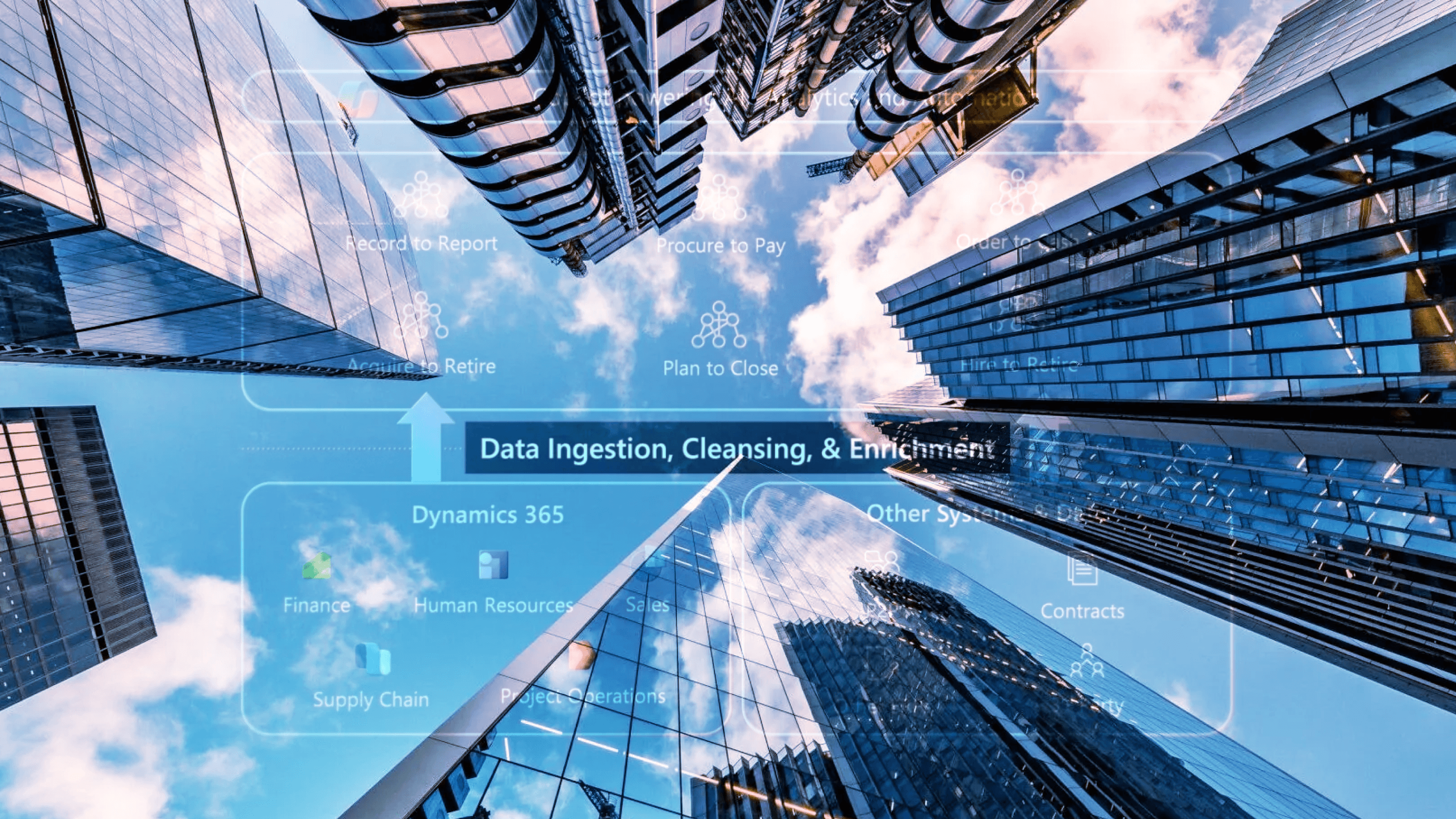


The story of ERP modernization is currently playing out most clearly in the United States.
The U.S. dominates the global ERP market, accounting for 49.7% of global spend with a valuation of $27.82 billion in 2025. Despite high adoption rates, a significant portion of these companies are still in a hybrid state, maintaining legacy ledgers while adding cloud innovation layers.
The tension, and the effect it has on ROI, differs because ERP modernization is a broad umbrella, comprising multiple transformation layers: Cloud Transition (the foundation), Composable Architecture (the flexibility), Integrated Agentic AI (the intelligence), Data Harmonization (the accuracy), and Modern User Experience (the adoption).
Each layer introduces a different kind of pressure—technical, financial, and cultural—and each impacts return on investment in its own way.
The Anxiety vs. Reward Matrix of ERP Modernization
- Most Stress / Tension: Data Harmonization — technical, messy, and high-stakes.
- Most Cultural Resistance: User Adoption — an emotional battle with the workforce.
- Fastest ROI: Cloud & Automation — immediate cost savings in IT labor and hardware.
- Best Strategic Value: AI & Analytics — insights that help organizations outperform competitors on price and speed.
Together, these forces explain why ERP modernization feels overwhelming and why success depends on addressing the right tension at the right time. They also explain the industry’s most sobering statistic: 70% of ERP modernization projects fail to fully meet their business goals.
In this blog, we explore these tensions by examining when ERP modernization is most required, when such initiatives fail, and how to prevent those failures—drawing on insights from over 20 years of hands-on experience.
Key Takeaways
- A successful ERP Modernization requires balancing high-stakes technical tasks, such as data harmonization, with high-resistance human factors, like User Adoption, to ensure the system is both accurate and utilized.
- Systems older than seven years begin to accrue compounding technical debt; proactive assessment is critical to avoid reaching a "legacy state" where compliance and revenue risks become unmanageable.
- Poor quality data is the leading cause of project failure; organizations must clean, map, and archive legacy information before migration to leverage the predictive power of modern AI-driven ERPs.
- To control costs and ensure future scalability, organizations should adopt built-in best practices and composable design over heavy custom coding, which often creates long-term operational friction.
The When’s and Why’s of ERP Modernization
Your ERP system should work for you, not against you. You need to modernize when your system creates more problems than it solves. Here are six triggers that signal it's time.
1. Compliance & Audit Pressure — The Legal Trigger
Your ERP must enforce compliance rules automatically, not through manual work. New CCPA regulations, effective January 1, 2026, require companies to let customers opt out and document risks for data processing. Old ERPs generate reports after events have happened. They do not enforce privacy controls as transactions occur. Tasks like fulfilling "Right to be Forgotten" requests require manual work, emails, and spreadsheets. This creates audit risk.
Financial audits face the same problems. SOX and GAAP (financial compliance standards) require companies to monitor all transactions, not just samples. Modern ERPs track every transaction and flag problems when they happen. This cuts SOX audit costs by up to 30% because teams spend less time collecting evidence manually. If your compliance work grows faster than your revenue, your ERP cannot keep up with current regulations.
2. Business Triggers & Workforce Change — The Operational Trigger
You need to modernize when your business grows faster than your system can handle. Mergers and acquisitions expose this problem. Cloud ERPs connect new companies in weeks using standard connections. Old systems take months of custom database work. When finance teams spend quarters reconciling charts of accounts instead of finishing monthly reports, the ERP blocks progress.
Remote work creates the same problem. Teams need mobile access to ERP systems. Systems that require VPN access to approve purchase orders, check inventory, or release payments delay work between factory floors and remote offices. Modern ERPs give each team mobile apps for their specific tasks. Teams work without network restrictions
3. Customer Experience & Revenue Flow — The Business Case
ERP modernization delivers the strongest financial return in the order-to-cash cycle (the process from receiving an order to collecting payment). This process connects sales, inventory, billing, and collections. Companies that modernize order-to-cash workflows reduce their Days Sales Outstanding by 15–30% reduction. They do this through automated invoicing, payment tracking, and collections.
Customer experience improves in the same way. Integrated ERPs let customers check inventory and track shipments without contacting support. This eliminates most order-status calls that take up that service team's time and delay response times. When revenue and customer experience require manual work across systems, the ERP blocks growth.
4. How to Make the Decision: A Risk-Based Framework
When companies decide to modernize, they use frameworks to manage risk while adding new capabilities. Forrester's REAP model (Retire, Encapsulate, Augment, Purchase) provides this structure. It separates systems based on business value and technical risk. The framework works this way: Retire old systems that no longer support core work. Add cloud features to stable systems. Move core functions such as finance and HR to SaaS (cloud-based subscription software). Keep high-risk custom code until you can safely move it.
Use this approach when your company has mixed cloud readiness, unclear ROI, or worries about disrupting revenue.
The framework shifts the conversation from "replace or not" to "how do we manage risk while we modernize?”
5. Competitive Pressure & Digital Capability — The Strategic Reason
Companies with modern digital tools have a large advantage over companies with old systems. As of 2025, 72.6% of companies use AI in operational workflows. They forecast demand, detect supply chain disruption, and model financial results.
Leading companies use digital twins (virtual copies of physical operations) to test decisions before they act. Companies with legacy ERPs react to problems after they happen. This difference lowers speed-to-market and compounds over time, creating competitive separation that pricing or headcount cannot offset.
6. Cost Structure & System Sustainability
Old ERPs' age shows their age through rising costs. Legacy systems create high maintenance fees, expensive custom integrations, and upgrades that cost as much as replacing the entire system. Each additional feature increases complexity rather than flexibility.
SaaS and modular ERP change this. Subscription pricing replaces high upfront costs. You add features in small steps instead of through major projects. Over time, organizations spend less on infrastructure, need fewer specialized skills, and experience less downtime during upgrades. When operating costs rise without adding new features, modernization becomes a financial necessity.
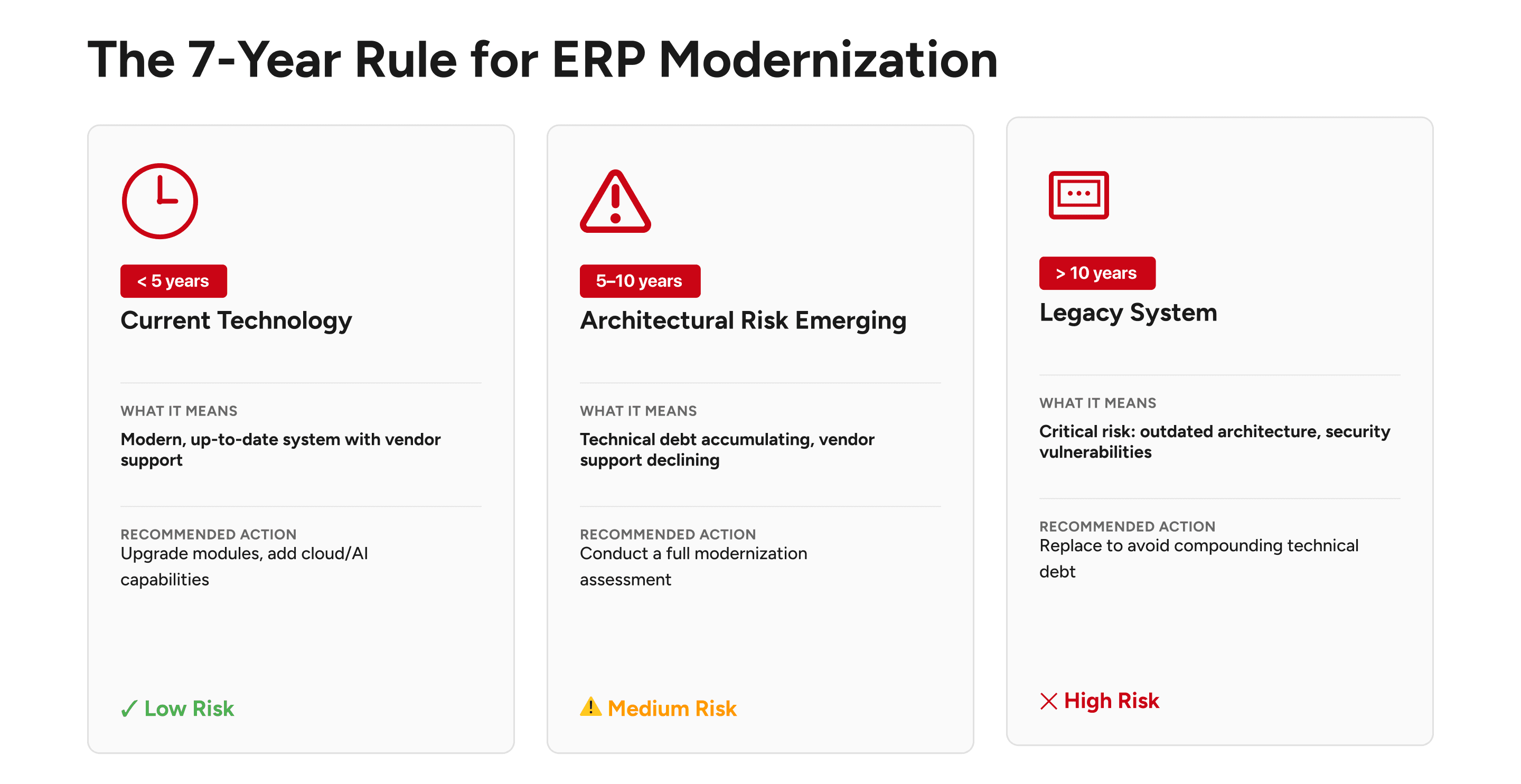
Compliance, revenue risk, workforce changes, and competition trigger modernization. The older the system, the fewer choices you have.
But what causes the 70% failure rate of ERP modernization?
Projects fail when companies deploy technology faster than their teams can adapt. The following paragraph explains the features that account for the 70% failure:
1. Poor Quality Data
Companies implement AI-driven ERP systems to gain predictive insights, but provide insufficient data foundations, i.e., poor quality data. Migrating legacy data—information containing duplicates, formatting errors, or missing fields—renders AI features inaccurate. Data corruption or loss affects 83% of ERP users during migration [Source: Strategies Group, Jan 2026]. When the system produces unreliable outputs, stakeholders deem the implementation a failure.
2. Standardization Resistance
Strategy misalignment occurs when organizations purchase modern cloud ERPs but refuse to adopt the built-in best practice workflows. Management often insists on heavy customization to mimic 20-year-old legacy processes. This creates technical debt and prevents the system from receiving standard cloud updates, leading to long-term operational friction.
3. The Acceleration Paradox
Unrealistic timelines drive failures. The drive to modernize faster than competitors causes teams to bypass deep-dive testing and user acceptance phases. While the project might meet a "Go-Live" date on paper, the resulting system is often operationally unstable, leading to post-launch crashes and business disruption [Source: SSON, 2025].
4. Integration Gaps
Modern ERPs must function within a massive ecosystem of CRM, IoT sensors, and third-party analytics. Failure occurs when the integration strategy is treated as a secondary task rather than a core requirement. Poorly mapped "middleware" leaves the ERP isolated, forcing manual data entry and breaking the "single source of truth" promise [Source: Astra Canyon Group, 2025].
5. Change Management as "Training."
Organizations often mistake technical training for change management. While users might learn which buttons to click via a tutorial, they often lack an understanding of why their workflows changed. Without deep psychological buy-in and clear communication, employees experience "adoption fatigue" and revert to using unauthorized spreadsheets outside the system [Source: ECI Software, 2025].
6. The Compliance-Security Gap
Security and compliance are frequently neglected during the rush to migrate. 62% of organizations report security vulnerabilities or compliance failures during transitions [Source: Cybersecurity Insiders, 2025]. Misconfigured cloud permissions or inadequate encryption during data transit create "leaks" that result in regulatory fines or data breaches, marking the project as a catastrophic failure regardless of its technical features.
Can you avoid these failures while modernizing ERP Systems?
Failure patterns explain why 70% of ERP initiatives stall or disappoint. Successful programs control costs before companies choose technology. These systems succeed by spending early in the right places, not by spending more.
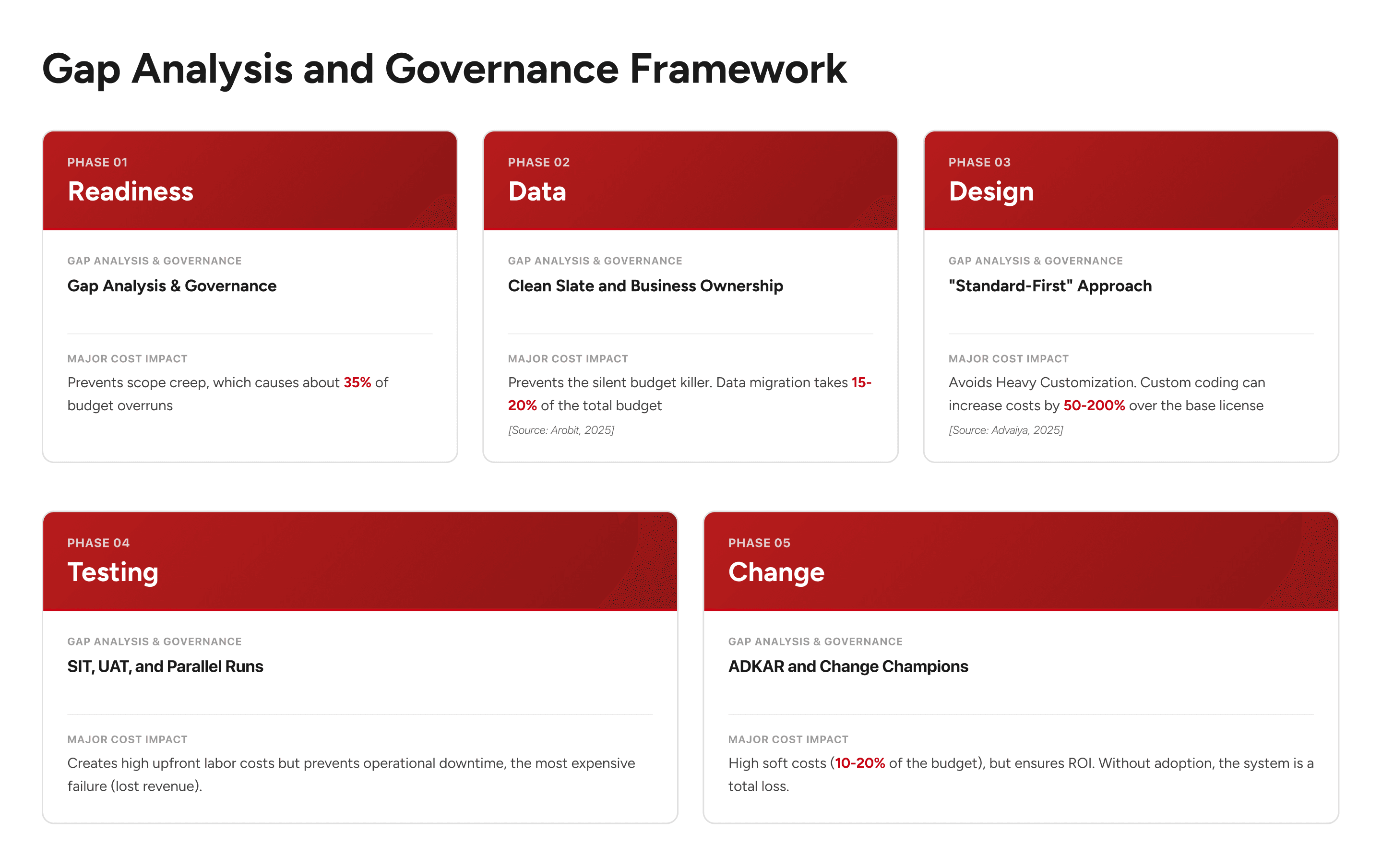
1. Readiness — Cost Control Before You Start
Define a clear goal that connects process problems to measurable outcomes. This prevents cost overruns. Companies run a gap analysis to compare current workflows with future goals. For example, reduce the month-end close from 15 days to 5. This prevents scope creep during the project. Governance reinforces cost control. A C-suite (executive) steering committee with clear escalation rules and 24-hour decision deadlines prevents delays. Delays increase consulting costs and extend timelines. When decisions stall, costs rise. Governance stops this.
2. Strategic Data Cleansing and Mapping: Prevent Rework Costs
In 2026, data quality is the highest hidden cost in ERP programs, especially as AI needs clean and structured data. Successful programs reduce migration cost by archiving historical data that does not support daily operations and focusing effort only on data that creates business value [Source: NetSuite, 2025].
For retained data, field-level mapping assigns each data element a validated destination in the new system. Business leaders, not IT teams, own and sign off on data accuracy. This accountability prevents late-cycle corrections, re-migrations, and downstream reporting fixes that multiply cost after go-live [Source: Uncanny CS, 2026].
3. Composable Design & Configuration — Containing Build Cost
Systems that succeed avoid customization-heavy builds. Instead, they adopt a standard-first, composable design approach. UX workshops surface usability issues early, when change is inexpensive. When processes conflict with the ERP model, organizations adjust the process rather than rewriting core software [Source: Synergix, 2026].
Minimizing customizations reduces initial implementation fees and protects future budgets. Out-of-the-box industry standards lower upgrade costs and reduce dependency on specialized development resources, while keeping AI and analytics extensions viable [Source: Unit4, 2024].
4. Rigorous Testing — Avoiding Go-Live Recovery Spend
Successful programs treat testing as cost insurance. System Integration Testing validates that the ERP exchanges data correctly with CRM, analytics, and third-party platforms. User Acceptance Testing places real employees into realistic scenarios before launch, uncovering operational issues while fixes remain inexpensive [Source: Hexaware, 2025].
Parallel testing, where new and legacy systems run side by side, exposes discrepancies early. This approach avoids post-go-live firefighting, emergency consulting extensions, and revenue disruption that often exceed the original project budget [Source: Jalasoft, 2025].
5. People-Centric Change Management — Protecting Adoption ROI
ERP cost is only justified if the system is used as intended. Successful organizations invest in structured change management rather than assuming training equals adoption. Using the ADKAR model, they connect system changes to individual roles and daily responsibilities, which reduces productivity loss during transition [Source: Prosci, 2025].
Change champions embedded in each department provide local support and reinforce adoption. This limits shadow systems, spreadsheet workarounds, and reversion to legacy tools that quietly erode return on investment [Source: Kefron, 2025].
What does a Technical Sales Consultant suggest?
Shreya Mago, Senior Technical Sales Consultant at GeekyAnts, recommends dividing your system into two categories:
- The company may have existing legacy code, typically built using Angular, .NET, or Java. These languages are not old by themselves. They become legacy when they run on old versions, use outdated structures that are hard to change, or lack documentation and tests.
- Your company might also have newer code built with React, Spring Boot, or Python. However, these technologies can also be poorly structured and may require significant refactoring.
In both cases, start with a design and code audit to check how stable your system is. This audit checks whether tools, frameworks, and engineering methods follow standards.
This step identifies all architectural, technical, and operational elements before moving on to the next phases after the code audit. Architecture quality, how systems connect, ability to grow, and upgrade options matter more than the programming language.
The Hidden Cost Iceberg
A complete budget must include these three major costs:
- Backfill Costs: Successful projects need your best people. Budget for temporary staff or contractors to do their regular work so they can focus on the ERP[Source: NetSuite, 2025].
- Contingency Buffer: 44% of ERP projects have cost overruns [Source: Arobit, 2025]. Include a 20-25% contingency fund for the scope that emerges during Phase 4 (Testing).
- Ongoing TCO (Total Cost of Ownership): Maintenance and support costs 15-20% of the initial software cost each year [Source: Perimattic, 2026].
Why GeekyAnts is the Partner for ERP Modernization
Modernization is about unlocking the data trapped inside legacy silos. At GeekyAnts, we build the bridge between the stability of your existing ERP and the speed of modern AI-driven customer experiences.
 Saurabh SahuChief Technology Officer (CTO)
Our Edge in the U.S. Enterprise Market:
- We specialize in migrating legacy UX to Modern CX. By separating the frontend from your legacy core, we deliver a 100+ performance score and modern usability without the downtime of a full backend migration.
- We prepare your data for the AI wave. Our frameworks ensure your ERP can talk to Agentic AI and modern middleware in real-time.
- We follow an Agile Modernization Framework. Instead of a "Big Bang" launch that disrupts your finance or ops teams, we modernize module-by-module (e.g., Inventory first, then Payroll), ensuring business continuity.
- From consolidating fragmented data for nationwide helicopter services to scaling diagnostic platforms for 1,200+ outlets, we have the battle scars and blueprints to handle U.S. compliance (SOX, GAAP, HIPAA) and enterprise-scale complexity.
Successfully delivered projects for ERP Modernization By GeekyAnts
Unified Data Management for Helicopter Services
We modernized a fragmented legacy system for a coast-to-coast helicopter service. They consolidated multiple disconnected data processes into a single, unified ERP-style system.
- The Modernization: They streamlined daily data workflows, approvals, expense tracking, and payroll generation into one platform.
- The Result: Significant improvement in operational efficiency and data supervision through a unified dashboard. A 90-% accessibility score was achieved at the end of the project.
ERP Revamp for a Global Diagnostic Leader
One of their standout enterprise projects involved transforming an outdated legacy platform for a diagnostic giant with over 1,200 outlets.
We turned a slow, legacy system into a high-speed digital engine. Achieved a 100+ performance score and drastically reduced maintenance effort by 30%.
Conclusion
By moving toward composable architectures and standard-first designs, enterprises can change their legacy systems from rigid anchors into flexible engines of growth. Ultimately, a successful modernization ensures that your technology environment evolves in lockstep with business goals, securing long-term technical sustainability and a measurable return on investment.
FAQs on ERP Modernization
1. What are the most common reasons ERP modernization fails in the U.S.?
ERP modernization often fails due to poor data quality (impacting 83% of migrations), standardization resistance fueling customizations, rushed timelines skipping tests, CRM/IoT integration gaps, weak change management causing shadow systems, and ignored compliance-security risks.
2. What budget should we allocate for ERP modernization?
Allocate based on phases: data migration (15-20%), customizations (50-200% over base), testing, and change management (10-20%). Include backfill costs, 20-25% contingency for overruns (44% of projects), and 15-20% annual TCO. Use tables for gap analysis, data cleansing, standard-first design, SIT/UAT, and ADKAR to control scope creep.
3. When is the right time to modernize our ERP system?
Modernize when facing compliance pressure (e.g., 2026 CCPA rules), business growth outpacing systems, revenue delays in order-to-cash (15-30% DSO reduction potential), competitive AI gaps, or rising maintenance costs. Follow the 7-year rule: assess at 5 years, replace over 10 to avoid technical debt
4. Is phased modernization better than a complete replacement?
Yes—use frameworks like Forrester's REAP (Retire, Encapsulate, Augment, Purchase) or GeekyAnts' Agile module-by-module rollouts (e.g., inventory first) to manage risk, ensure continuity, and avoid big-bang disruptions. This beats full replacement for mixed cloud readiness and unclear ROI.
5. How do we measure the success of ERP modernization?
Success shows in balanced technical accuracy (data harmonization), user adoption (via ADKAR/champions), ROI from cloud savings, DSO reductions (15-30%), cost cuts (30% SOX audits), and strategic edges like AI insights. Track via governance KPIs like the month-end close time dropping from 15 to 5 days.