

Key Takeaways
- Fintech products that deploy AI for KYC verification, AML transaction monitoring, or customer risk scoring must have compliance workflows built into the product architecture before launch, not added after traction.
- Global illicit financial activity reached $4.4 trillion in 2025, increasing regulatory scrutiny and fraud risk for fintech products entering the market.
- Enterprises building AI-powered fintech products need scalable KYC and AML systems that support multi-market regulatory requirements, vendor oversight, and audit evidence for regulatory examination and enterprise procurement cycles.
- Growth-funded startups need KYC AML compliance in fintech products to satisfy sponsor bank requirements, investor due diligence, and licensing applications before go-live.
- Every AI-assisted decision in a KYC or AML workflow, including risk scoring, alert prioritization, and fraud detection, must be explainable, logged, and subject to human review before the product launches.
The pressure on fintech teams building AI-powered products has never been more concentrated. Global illicit financial activity reached an estimated $4.4 trillion in 2025, growing by $1.3 trillion in just two years. AML enforcement penalties globally hit $4.6 billion in 2024 alone, with the first half of 2025 seeing a 417% spike compared to the same period the year before.
For enterprises and growth-funded startups preparing to launch or scale AI-powered fintech products, including payments platforms, neobanks, digital lenders, remittance services, and embedded finance products, this guide addresses one specific challenge: building KYC and AML compliance into your AI product before it goes live.
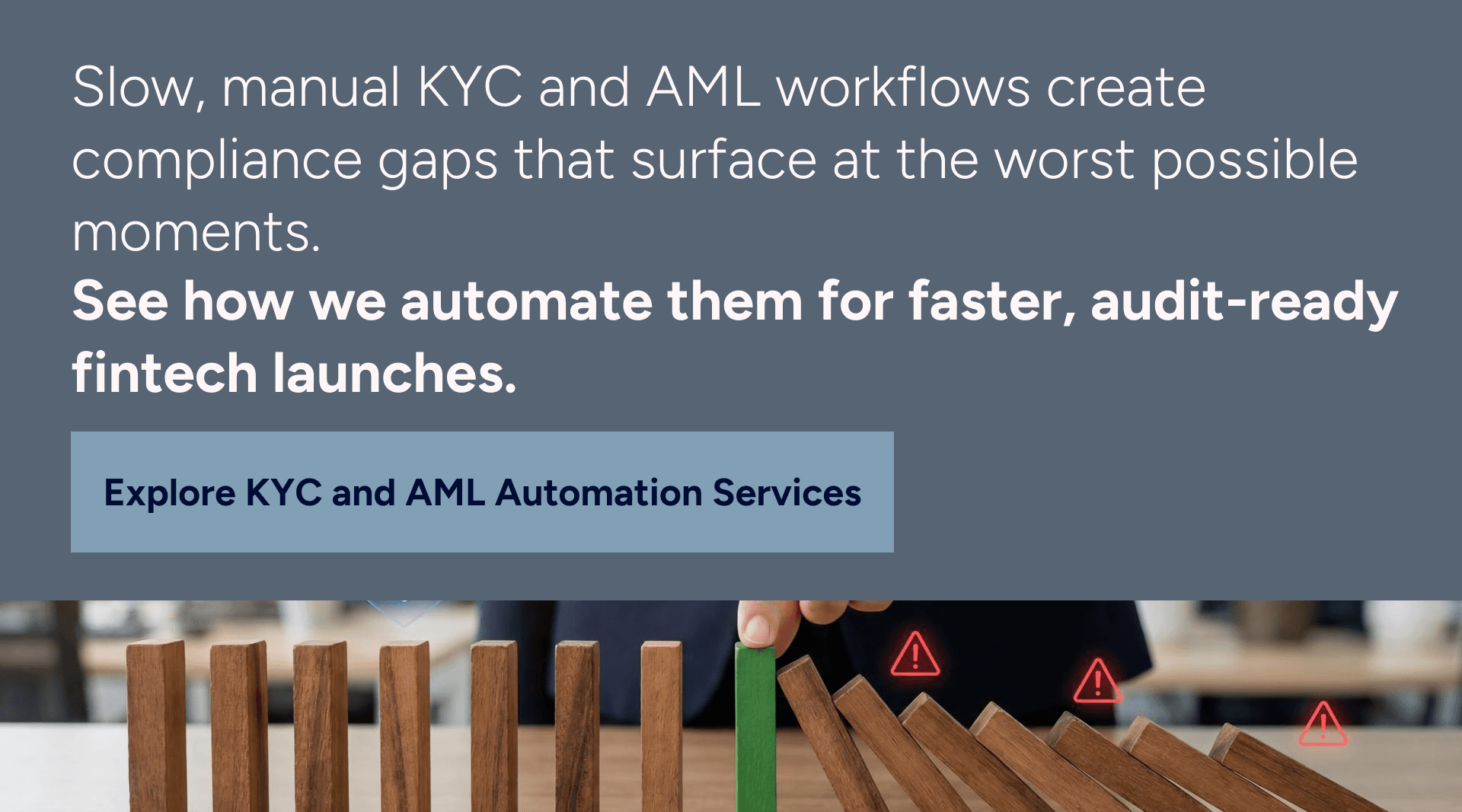
The business stakes are concrete and time-sensitive. A sponsor bank will not approve a product that cannot demonstrate a working compliance framework. An institutional investor will ask for evidence of regulatory readiness before closing a round. An enterprise buyer will walk away from a vendor that cannot answer questions about audit trails and data governance. Compliance gaps surface at the worst possible moments in a product's lifecycle.
AI changes the equation in both directions. It can automate identity verification, reduce alert volumes, improve risk scoring, and assist investigators, but it also introduces governance obligations that did not exist with manual workflows. Regulators now demand explainability and accountability for every AI-driven decision in a compliance workflow. Each outcome must be traceable, documented, and defensible.
The fintech teams that protect their launch timelines and market position treat compliance as a product requirement from day one. Compliance built into the architecture is faster to audit, easier to scale, and far less expensive to maintain than compliance added after the fact.
Across the US, UK, and UAE, the fintech teams that struggle most during bank-partner reviews and investor diligence are the ones that built the right product without compliance infrastructure that can withstand scrutiny. Regulatory expectations in these markets have moved faster than most product roadmaps, and the gap between what teams assume is sufficient and what regulators and bank partners actually require has grown wider over the past two years.
Every fintech team we speak to understands that compliance matters. The ones that run into trouble are the ones that treat it as something to sort out after the product gains traction. By that point, the cost of fixing it is three times higher, the bank-partner relationship is under strain, and the window for a clean launch has already closed.
 Kunal KumarChief Revenue Officer
What AI Fintech Teams Must Define Before KYC and AML Compliance Goes Live
Most fintech products reach late-stage development before compliance gets a seat at the architecture table. By then, the cost of fixing gaps is high, the timeline is compressed, and conversations with sponsor banks and investors become harder than they need to be. Compliance readiness is a product discipline that determines whether a launch proceeds on schedule or stalls in review.
Before any AI-powered fintech product goes live, six decisions must be made with precision and documented with evidence: the customer risk policy, the KYC and KYB scope, the AML monitoring model, the AI governance framework, reporting ownership, and compliance accountability. Each one becomes a product workflow, a backend rule, an API integration, a review queue, an audit log, or an escalation path inside the product itself.
Customer risk policy and KYC/KYB scope
The customer risk policy defines how the product classifies risk across its user base, which verification requirements apply to each risk tier, and when enhanced due diligence is triggered. This policy drives onboarding architecture, monitoring thresholds, and review queue design. Without a defined policy, the product has no basis for consistent, defensible decisions and no foundation for the audit trail that regulators and bank partners will ask to review.
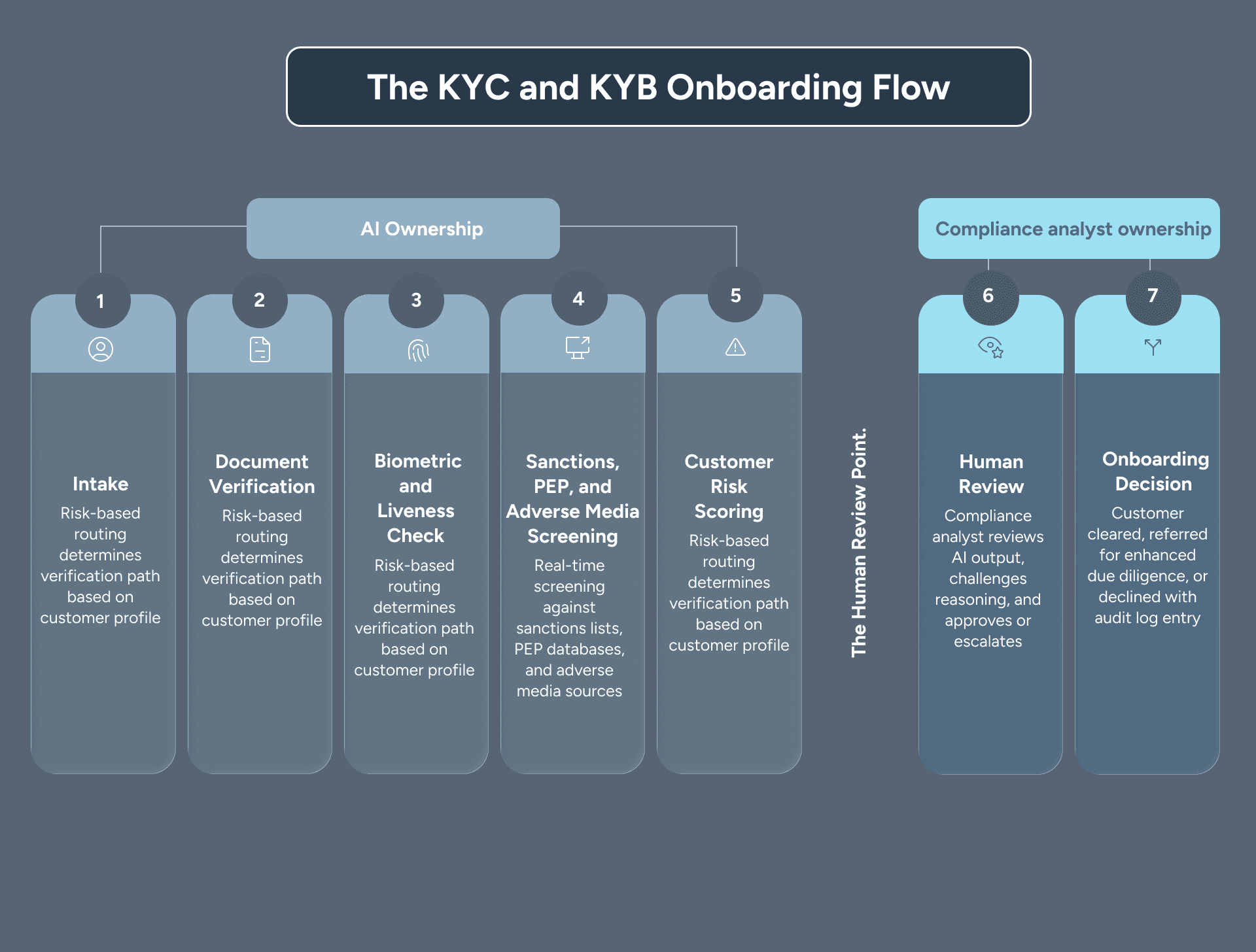
KYC scope covers individual identity verification: document checks, biometric and liveness detection, sanctions and PEP screening, and customer risk scoring. KYB scope covers business verification: entity validation, beneficial ownership identification, control structure mapping, and registry lookups. For B2B fintech products, embedded finance platforms, and corporate payment workflows, KYB is the larger and more under-addressed gap in early-stage compliance planning.
AML monitoring model
The AML monitoring model defines what transaction behaviors trigger alerts, how alerts are prioritized, who reviews them, and how cases are escalated and closed. Rule-based transaction monitoring systems generate false positive rates as high as 95%, which means a small compliance team faces an unmanageable review queue before the product reaches meaningful transaction volume. The monitoring model must be scoped, tested, and tuned before launch.
AI governance and human oversight
The EU AI Act, enforceable for high-risk AI systems from August 2, 2026, classifies fraud detection, AML monitoring, and customer risk scoring as high-risk applications. Non-compliance carries penalties of up to 35 million euros or 7% of global annual turnover, and deploying institutions bear this liability regardless of whether the AI was built in-house or purchased from a vendor. Every AI-assisted compliance decision must produce a reasoning chain, support human override, and generate a complete audit trail with version information and model outputs logged at every step.
Reporting ownership and compliance accountability
Reporting ownership determines who generates suspicious activity reports, who approves them, and who produces the evidence trail for regulatory examinations. In BaaS and sponsor bank arrangements, this accountability is shared. A product that processes transactions without a clear reporting chain is not launch-ready, regardless of how well the rest of the product functions.
For enterprises, compliance readiness affects multi-region deployment, vendor governance, policy versioning, data residency, and the audit evidence packages that enterprise procurement cycles require. For growth-funded startups, it determines sponsor bank approval, investor diligence outcomes, and licensing timelines. Compliance gaps at this stage raise the cost of the round, change the terms of the banking relationship, and create remediation work that competes directly with product development.
Customer trust is the business outcome that sits behind all of this. Users who encounter friction-free, transparent onboarding flows trust the product faster. Users who face unexplained rejections, inconsistent verification requests, or opaque risk decisions lose confidence and do not return. Compliance built into the product architecture from the start is what makes a frictionless, trustworthy customer experience possible at scale.
How to Build KYC, KYB, and AML Monitoring Architecture for AI Fintech Products
A compliant fintech product relies on more than isolated verification checks. KYC, KYB, and AML monitoring must be designed as interconnected components that support onboarding, risk management, fraud prevention, and regulatory oversight from day one.
KYC, KYB, and customer onboarding architecture
Individual KYC verification covers document checks, biometric matching, liveness detection, sanctions screening, PEP screening, adverse media review, and customer risk scoring. Each component must be configured before launch. The onboarding architecture that connects these components must balance compliance accuracy, fraud prevention, conversion rate, and manual review capacity. A verification flow that is too aggressive will drive abandonment. A flow that is too permissive will create regulatory exposure. The only way to hold that balance is through risk-based routing, where customers are directed to the right level of scrutiny based on their risk profile.
For enterprises, onboarding architecture must support configurable workflows, multi-entity onboarding, localization across jurisdictions, provider orchestration with fallback logic, and audit-ready data trails that satisfy both regulatory examination and enterprise procurement requirements. When one verification provider fails or returns an inconclusive result, the architecture must route the case to a fallback provider without breaking the customer journey or creating a gap in the audit record.
For growth-funded startups, the priorities are faster onboarding, reduced drop-off, modular integrations that avoid vendor lock-in, and a workflow design that can scale without requiring a full architectural rebuild when transaction volume increases. Industry data shows KYC abandonment rates can range from 25% to 40% when verification flows are slow, poorly sequenced, or not optimized for mobile. For a startup in early growth, that abandonment rate affects the revenue numbers that investors and bank partners are watching.
KYB is where most fintech products carry their most significant unaddressed compliance gap. Individual KYC is well-documented in most compliance frameworks. KYB covers entity validation, beneficial ownership identification, control structure mapping, and registry lookups across multiple jurisdictions. For B2B fintech products, embedded finance platforms, marketplaces, and corporate banking workflows, KYB is the primary compliance obligation, and it is the one that surfaces as a gap during sponsor bank reviews and regulatory examinations. Corporate entity structures are inconsistent across jurisdictions, registry data is often incomplete, and beneficial ownership chains can run several layers deep. These complexities require specialist provider integrations, manual review capacity for edge cases, and escalation workflows that are designed before onboarding goes live.
AML transaction monitoring and risk scoring
AML transaction monitoring defines which behavioral patterns trigger alerts, how those alerts are ranked and assigned, and how cases move through investigation and escalation to resolution. For AI-powered fintech products, where transaction velocity can increase fast and fraud patterns shift within days of a product launch, monitoring rules must be calibrated to the product's actual transaction profile.
The convergence of fraud and AML monitoring, referred to as FRAML, is becoming a structural expectation rather than an architectural preference. Fraud signals and AML signals come from the same behavioral data. A product that runs separate, disconnected fraud and AML monitoring systems will miss the patterns that only become visible when both data streams are analyzed together.
For enterprises, the primary monitoring challenges are fragmented data across multiple systems and geographies, high alert volumes that overwhelm investigation teams, and the complexity of assembling audit evidence across cross-border transaction flows. An enterprise compliance team managing alerts from multiple product lines, markets, and customer segments cannot operate at scale without AI-assisted alert prioritization that surfaces genuine risk and suppresses false positives that consume analyst capacity.
For growth-funded startups, the challenge is the inverse. The compliance team is small, the monitoring rules are new, and the pressure from bank partners to demonstrate a working AML program is present from the first month of operation. Rule-based monitoring systems generate alert volumes that a small compliance team cannot sustain. The monitoring model must be tuned to the product's risk profile and scoped to generate an alert volume the team can investigate within its stated SLA.
AI can support prioritization, anomaly detection, case summarization, and investigator workflows, but it does not replace the governance obligation. Customer risk profiles must be refreshed when behavioral changes, sanctions updates, or adverse media events are detected. Alert escalation paths must be documented and tested. Case management must produce investigation records that hold up during regulatory review. These requirements apply regardless of how much of the process is automated.
AI Governance, Explainability, and Audit Trails: What Fintech Teams Must Build Before Launch
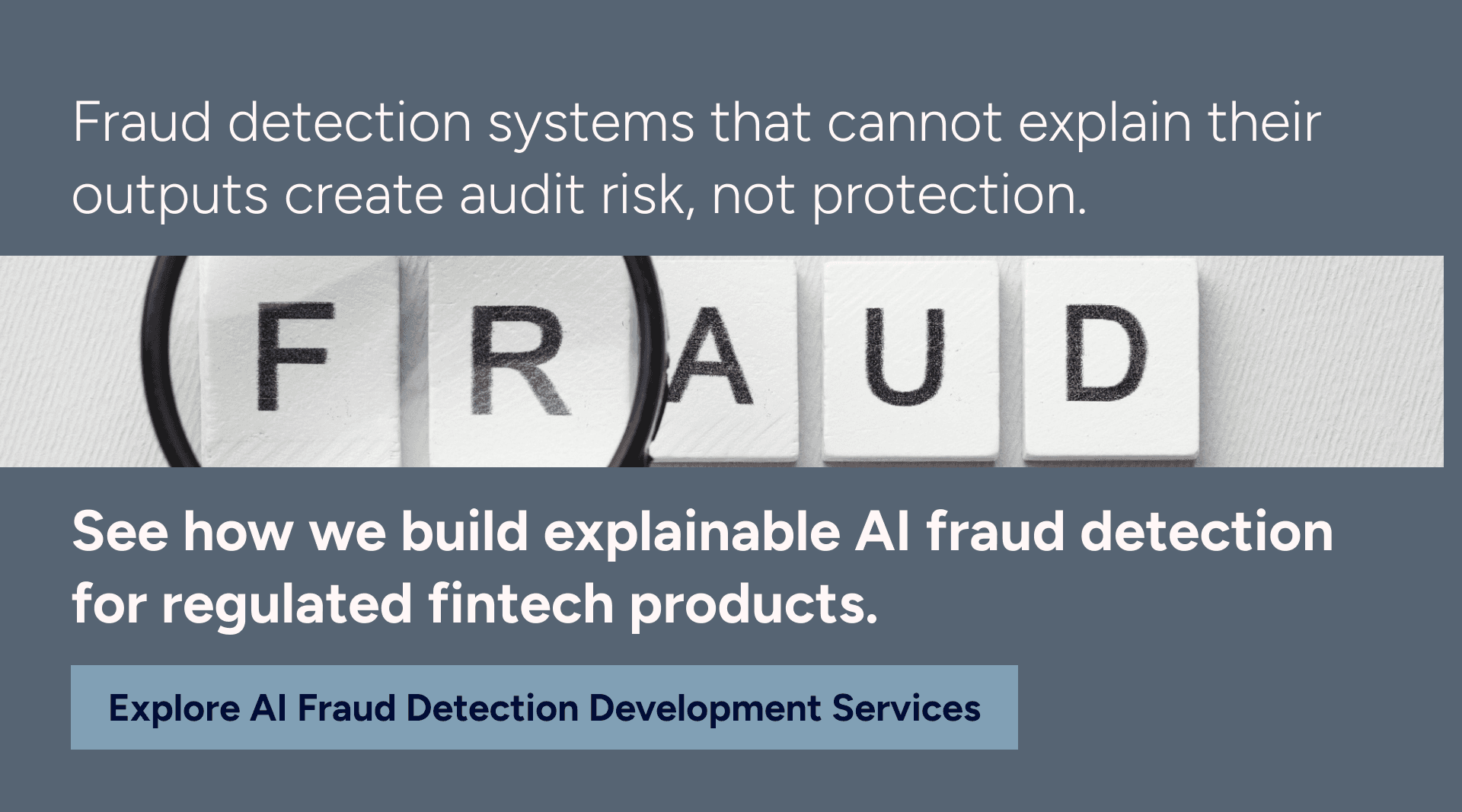
Across regulated fintech environments, explainability has shifted from a technical consideration to a business requirement. Regulators, bank partners, and enterprise buyers now expect AI-powered compliance systems to produce reasoning that can be examined, challenged, and documented. Organizations that deploy AI in KYC, AML, and fraud detection without audit-ready decision trails are carrying regulatory risk, procurement risk, investor risk, and operational risk that surfaces at the worst possible moments in the product lifecycle.
We were working with a fintech client who had built a strong AI-powered alert prioritization system. It was performing well by every internal metric. But when their sponsor bank asked them to demonstrate how a specific alert had been assessed and closed, they could not produce a clear answer. The model had made the right call, but there was no trail to prove it. That conversation delayed their launch by four months. Explainability is what separates a system that works from a system that can be trusted.
 Jani Hardik SanjayProduct Owner I
Despite rising compliance spending, According to Interpol, as cited in a McKinsey report on agentic AI in banking, the financial industry detects only about 2% of global financial crime flows. Part of that gap is a detection problem, and a large part is a governance problem. The AI systems deployed to improve detection are often built without the explainability controls, audit infrastructure, and human oversight frameworks that regulators and bank partners now require. For fintech teams preparing to launch AI-powered products, AI governance is a launch gate requirement that affects regulatory confidence, bank-partner approvals, investor diligence, enterprise procurement, and board-level AI risk oversight.
Where AI is used and what governance each use case demands
AI is deployed across multiple points in KYC and AML workflows. Document fraud detection uses computer vision to identify tampered documents and synthetic identity indicators. Liveness verification uses biometric models to detect presentation attacks and deepfakes during onboarding. Adverse media summarization uses large language models to process news and public records and surface risk signals for analyst review. Alert prioritization uses machine learning to rank transaction monitoring alerts by risk probability. Investigator copilots and case memo drafting use generative AI to assemble case facts and produce structured investigation summaries.
Each use case carries a distinct governance obligation. A biometric liveness model must be validated for accuracy across demographic groups to prevent bias. An alert prioritization model must be monitored for drift as fraud patterns change. A generative AI system drafting case memos must log every prompt input and output so the audit trail reflects what the system produced.
The risk of black-box AI in compliance workflows
A black-box AI system, where the reasoning behind a risk output or escalation decision cannot be reconstructed, creates liability that grows over time. During a regulatory examination, examiners will ask how a specific customer was cleared and on what basis a suspicious activity report was or was not filed. If the answer is that an AI system made the determination and the reasoning is unavailable, that is an audit failure.
The same problem surfaces during enterprise procurement and investor diligence. Enterprise buyers ask for documentation of AI decision logic before signing contracts. Investors ask for evidence that AI outputs can be explained and challenged. A product that cannot answer those questions will lose deals and raise diligence flags.
What governance infrastructure must be in place before launch
Model validation, drift monitoring, human-in-the-loop workflows, AI decision logs, model versioning, and incident response procedures must all be in place before the product goes live. Every AI-assisted compliance decision must have a defined point where a human reviewer can examine the output, challenge the reasoning, and override the recommendation. Every override must be logged with the reviewer's identity and the reason for the decision. Model versioning must track which version of a model produced which decision, so that past outputs can be reconstructed during audits or investigations. For generative AI components, prompt inputs and model outputs must be captured in full. These are baseline expectations in most bank-partner compliance reviews, and align closely with the governance, transparency, oversight, and risk management obligations introduced by the EU AI Act for high-risk AI systems.
At the board level, AI risk governance must be a standing agenda item before the product launches, not a topic that surfaces after a regulatory finding. Boards and leadership teams need visibility into which AI systems are in use, what decisions they influence, how performance is monitored, and what the escalation path looks like when a model fails or produces a biased output.
How to Select and Integrate KYC and AML Vendors Without Locking Your Fintech Into a Corner
Most fintech teams face a series of integration decisions that determine whether the compliance stack functions as one coherent workflow or as a collection of disconnected tools that require manual coordination to produce a defensible audit trail.
The build-versus-buy question applies differently across compliance capabilities. Identity verification, sanctions screening, adverse media data, transaction monitoring, case management, and regulatory reporting each have a distinct market of specialized providers. Building from scratch is a commitment most fintech teams cannot sustain alongside product development. A single end-to-end platform creates simplicity but often sacrifices configurability and regional coverage. The most effective approach selects best-fit providers for each capability, connects them through well-governed API architecture, and maintains clear data ownership and audit export capability across the entire workflow.
What the integration architecture must account for
API reliability, fallback providers, data residency, SLA expectations, security reviews, and audit exports must all be satisfied before go-live. If the primary verification provider is unavailable, a fallback route must maintain compliance coverage without halting onboarding. Security reviews must assess how each vendor stores and protects customer data. Vendor contracts must specify data storage locations, access controls, and export obligations so compliance evidence can be extracted without vendor cooperation during a regulatory examination.
Enterprise decision factors
Enterprises need documented vendor risk management programs, configurable rules across markets and customer segments, integration depth that supports multi-product compliance operations, global support coverage, and evidence export capability that satisfies regulatory examination and enterprise procurement requirements.
Startup decision factors
For growth-funded startups, the primary risk is selecting vendors on speed of integration without evaluating audit export capability or data residency compliance. Licensing costs, integration effort, and ongoing maintenance must be scoped before vendor selection. A modular architecture that supports future portability across providers and avoids vendor lock-in by keeping the integration layer independent of any single vendor's proprietary data model is the right foundation for a scalable compliance stack.
The engineering team's role extends beyond API connectivity to designing the data pipeline, maintaining the audit log, and building the reporting layer that regulators, bank partners, and investors will ask for. GeekyAnts helps fintech teams connect vendors, workflows, data systems, and compliance operations into one production-grade product that is audit-ready from day one.
Decision Area | Enterprise Focus | Startup Focus |
|---|---|---|
Vendor strategy | Specialized providers with deep configurability across markets | Fast deployment with manageable integration effort |
Integration architecture | Support for multiple products, jurisdictions, and customer segments | Modular architecture that can scale without rework |
Fallback providers | Continuity across regions and compliance programs | Prevent onboarding interruptions and revenue loss |
Data residency | Multi-market regulatory compliance | Meeting launch-market compliance requirements |
Audit exports | Regulatory examination and procurement readiness | Sponsor bank, investor, and licensing requirements |
Vendor lock-in | Long-term flexibility across complex ecosystems | Ability to switch providers as the business grows |
Pre-Launch KYC and AML Compliance Validation Checklist for AI-Powered Fintech Products
In regulated fintech environments, the definition of launch readiness has expanded beyond feature completion. Bank partners, regulators, and enterprise buyers now require evidence that compliance workflows have been tested, documented, and assigned to named owners before a product goes live. A product that has passed QA but cannot produce an audit trail for its compliance decisions is not launch-ready by the standards that matter most.
During an investor diligence process for one of our fintech clients, the investment team asked for evidence of AML program ownership and operating procedures. The product was well-built and the compliance logic was sound, but none of it was documented in a way that could be presented as evidence. The diligence process stalled for six weeks while the team scrambled to produce documentation that should have existed from day one. Features get built. Evidence gets built alongside them, or it becomes the reason a round does not close on time.
Jani Hardik SanjayProduct Owner I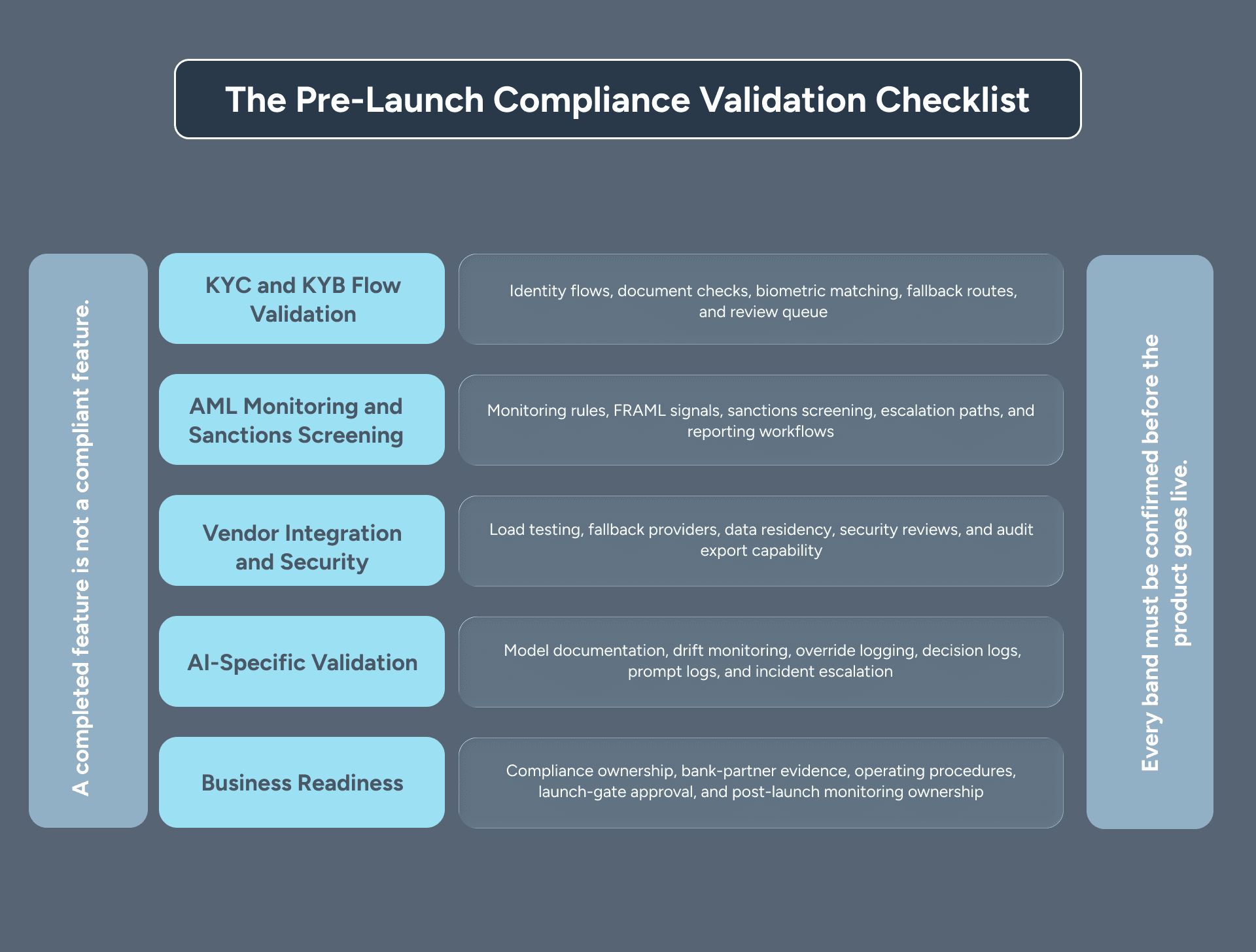
KYC and KYB Flow Validation
- Ensure identity verification flows complete end-to-end for standard cases.
- Validate that document checks, biometric matching, liveness detection, sanctions screening, PEP screening, and adverse media review generate audit-logged outputs.
- Assess KYB workflows for entity validation, beneficial ownership identification, and registry lookups.
- Test and validate configured fallback routes.
- Ensure manual review queues are adequately staffed and operating within defined SLAs.
AML Monitoring, Fraud Signals, and Sanctions Screening Validation
- Ensure transaction monitoring rules are aligned with the product's actual transaction profile.
- Validate the integration of fraud signals into the monitoring stack and test FRAML detection rules against realistic transaction scenarios.
- Ensure sanctions screening is performed in real time for every transaction.
- Review and test documented escalation paths.
- Establish regulatory reporting workflows and assign ownership before launch.
Vendor Integration and Security Validation
- Test all vendor integrations under realistic load conditions.
- Ensure fallback providers are configured for every critical compliance path.
- Validate compliance with data residency requirements across all served markets.
- Complete security reviews for all vendors with access to customer data.
- Test audit export capabilities and ensure compliance evidence can be extracted without vendor dependency.
AI-Specific Validation
- Complete validation documentation for all AI models, including accuracy assessments, bias evaluations, and known limitations.
- Ensure drift monitoring is configured with defined retraining triggers.
- Test human-in-the-loop workflows and validate override logging for reviewer identity, rationale, and final decision.
- Ensure full logging of prompt inputs and model outputs for generative AI components.
- Document, assign, and test incident escalation procedures.
Business Readiness Validation
- Assign compliance ownership across all components of the compliance program.
- Prepare bank-partner evidence packages before launch.
- Document operating procedures for all compliance workflows.
- Obtain launch-gate approval from the compliance officer and, where required, the sponsor bank.
- Assign post-launch monitoring ownership and confirm operational readiness of the responsible team.
Across the US, UK, and UAE, the demand for fintech products that can demonstrate compliance depth at the point of sale has grown over the past two years. Enterprise buyers and bank partners are no longer willing to onboard fintech vendors that treat compliance as a separate workstream from product engineering. The organizations that win regulated market opportunities are the ones that can show compliance, scalability, and speed as properties of the product itself, not as capabilities bolted on after the fact.
Why GeekyAnts Is the Engineering Partner Fintech Teams Need for Compliant AI-Powered Product Launches
The conversations we have with fintech founders and CTOs have changed. Two years ago, compliance came up at the end of the sales process. Now it comes up in the first meeting. Enterprises want to know how the audit trail works before they ask about the feature set. Bank partners want to see the compliance architecture before they discuss the commercial terms. The teams that build compliance into the product from day one do not just launch faster. They close deals faster, retain bank relationships, and spend less time in remediation and more time in growth.
Kunal KumarChief Revenue OfficerMost fintech compliance challenges are implementation problems. The frameworks exist and the vendor landscape is established, but what most enterprises and growth-funded startups lack is an engineering partner that can translate compliance requirements into production-grade architecture, connect the vendor stack into one coherent workflow, and deliver a product that is audit-ready from day one.
At GeekyAnts, we operate as a fintech product engineering and RegTech implementation partner. With over 50 fintech projects delivered and more than 40 dedicated fintech engineers, we bring implementation depth across KYC and AML automation, fraud detection systems, regulatory reporting, audit trail architecture, vendor integrations, and scalable cloud infrastructure. Our focus is on building to the standard that regulated product environments demand.
For enterprises, we deliver the engineering depth required to support multi-region compliance workflows, configurable risk policies, vendor orchestration across identity verification and monitoring providers, and the audit evidence infrastructure that enterprise procurement and regulatory examinations require. For growth-funded startups, we provide the implementation speed and architectural discipline needed to reach a compliant, bank-partner-ready launch. This includes onboarding flows designed to reduce friction and abandonment without weakening verification standards, so the product converts users and satisfies compliance requirements at the same time.
The gap we fill is the distance between compliance strategy and production delivery. A compliance framework defines what must be built. We engineer it into the product: the onboarding flows, the monitoring rules, the AI governance infrastructure, the review queues, the audit logs, and the reporting systems that make compliance operationally real. This work spans compliance, AI, UX, cloud architecture, integrations, and auditability, connecting every layer of the product into one coherent, launch-ready system.
Fintech products that launch with this level of engineering depth reach bank-partner approval faster, pass investor diligence with fewer flags, and give leadership teams the confidence that the product will hold up under regulatory scrutiny.
Related Case Study
Decentralized KYC on Blockchain
This GeekyAnts case study explores a blockchain-based approach to KYC, focusing on secure identity verification, user-controlled data, and streamlined compliance workflows.
Engineer KYC and AML Compliance Into Your AI Fintech Product Before It Goes Live
Compliance pressure increases after launch. Regulatory scrutiny grows with transaction volume, bank-partner expectations rise as the product scales, and investor diligence gets harder when compliance gaps surface during a raise. The fintech teams that protect their launch timelines and market position treat compliance as an engineering requirement from the start.
Getting compliance right before launch produces measurable business outcomes: faster bank-partner approval, customer trust built through frictionless and audit-defensible onboarding, lower total compliance costs, and audit evidence that regulators, investors, and enterprise buyers can act on when they need it.
The decision is whether to build it into the product architecture before launch or pay a higher price to fix it afterward.
- https://fintech.global/2025/09/01/regulatory-fines-surge-417-in-h1-2025-crackdown/
- https://www.mckinsey.com/capabilities/risk-and-resilience/our-insights/how-agentic-ai-can-change-the-way-banks-fight-financial-crime
- https://artificialintelligenceact.eu/the-act/
Sources & Citations
A product that has completed development is not the same as a product that is ready to launch. The gap between a working feature and a compliant, audit-ready workflow is where most fintech products face their highest pre-launch risk. This checklist covers the cross-functional validation that must be completed before go-live across product, engineering, compliance, AI governance, vendor management, and business readiness.