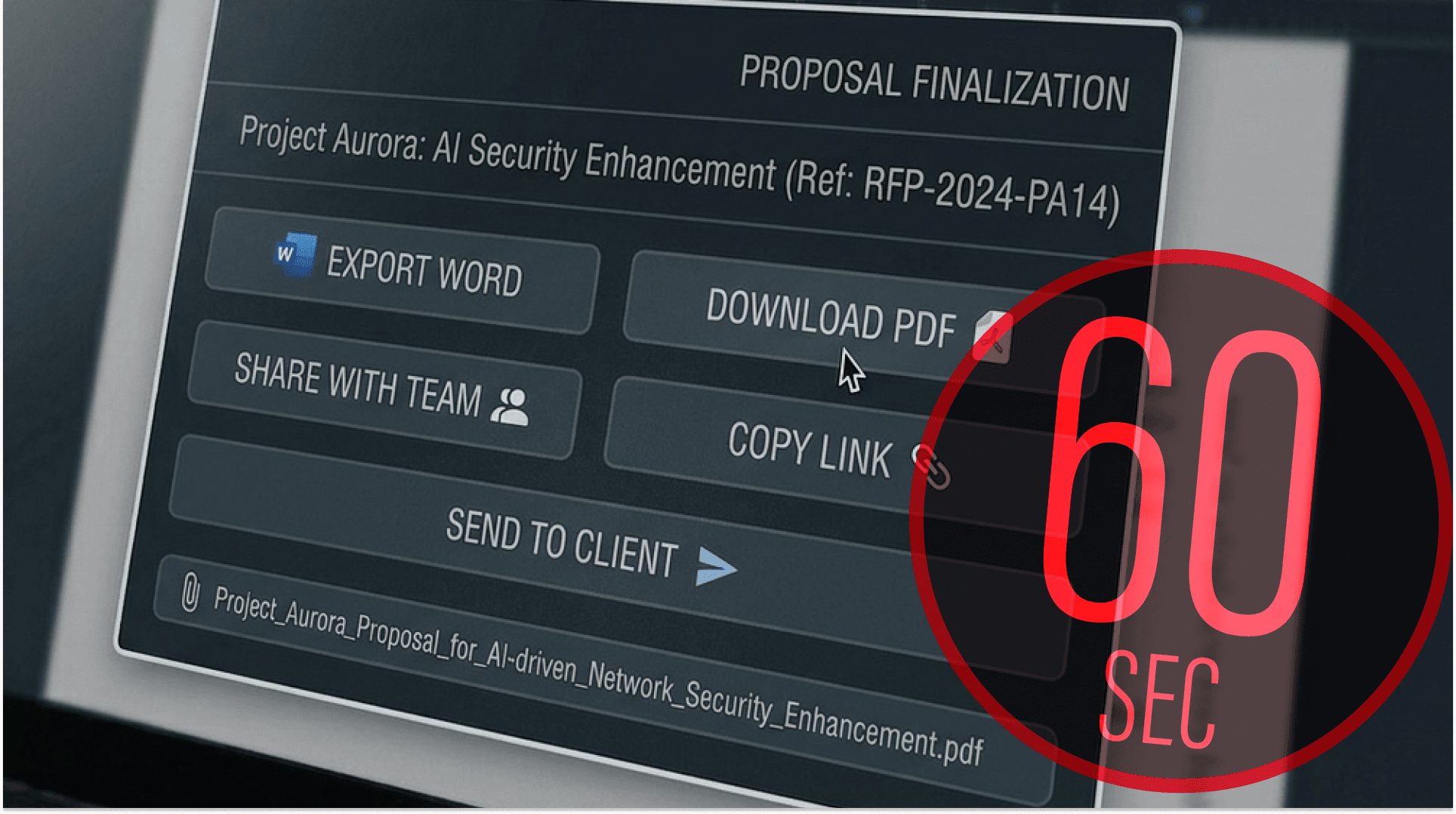

The presales proposal process costs software services companies 3 to 5 days per deal. DealRoom.ai reduces that to under 60 seconds using a pipeline of four coordinated AI agents without compromising estimation accuracy or proposal quality.
A technical proposal is the first deliverable a software company produces for a prospective client. It sets scope, cost expectations, and credibility. The process of producing one has not changed in years.
An RFP arrives. A discovery call follows. Requirements are distributed across a PDF brief, a Word document, follow-up emails, and meeting notes. A solutions architect spends 3-5 days synthesizing these inputs into a proposal. The output is a static document that can be outdated by client review.
This is where deals are won or lost, and the process is a bottleneck that companies accept as fixed. DealRoom.ai was built on the premise that it is not.
Where does the time go
The time cost of presales is distributed unevenly. Analysis of the process across software services teams shows a consistent breakdown:
- 40% — Reading and reviewing source documents
- 25% — Feature estimation
- 20% — Formatting and assembly
- 15% — Review and revision
Estimation carries the highest risk. Review of actual project sheets from delivered engagements found the same feature assigned 40 hours by one architect and 120 hours by another. Not because of error, but because there was no shared knowledge base, no institutional memory, and no standard method.
For organizations running 20 or more active deals per month, that variance affects more than proposal quality. It limits revenue capacity.
The gap lies in execution
Every presales team has a list of use cases. Delivery pipelines break down. The AI use case gets handed to an existing engineering team. Generalist developers spend months learning new toolchains. The result is a prototype that works in a demo and breaks in production. The initiative stalls. The use case gets deprioritized.
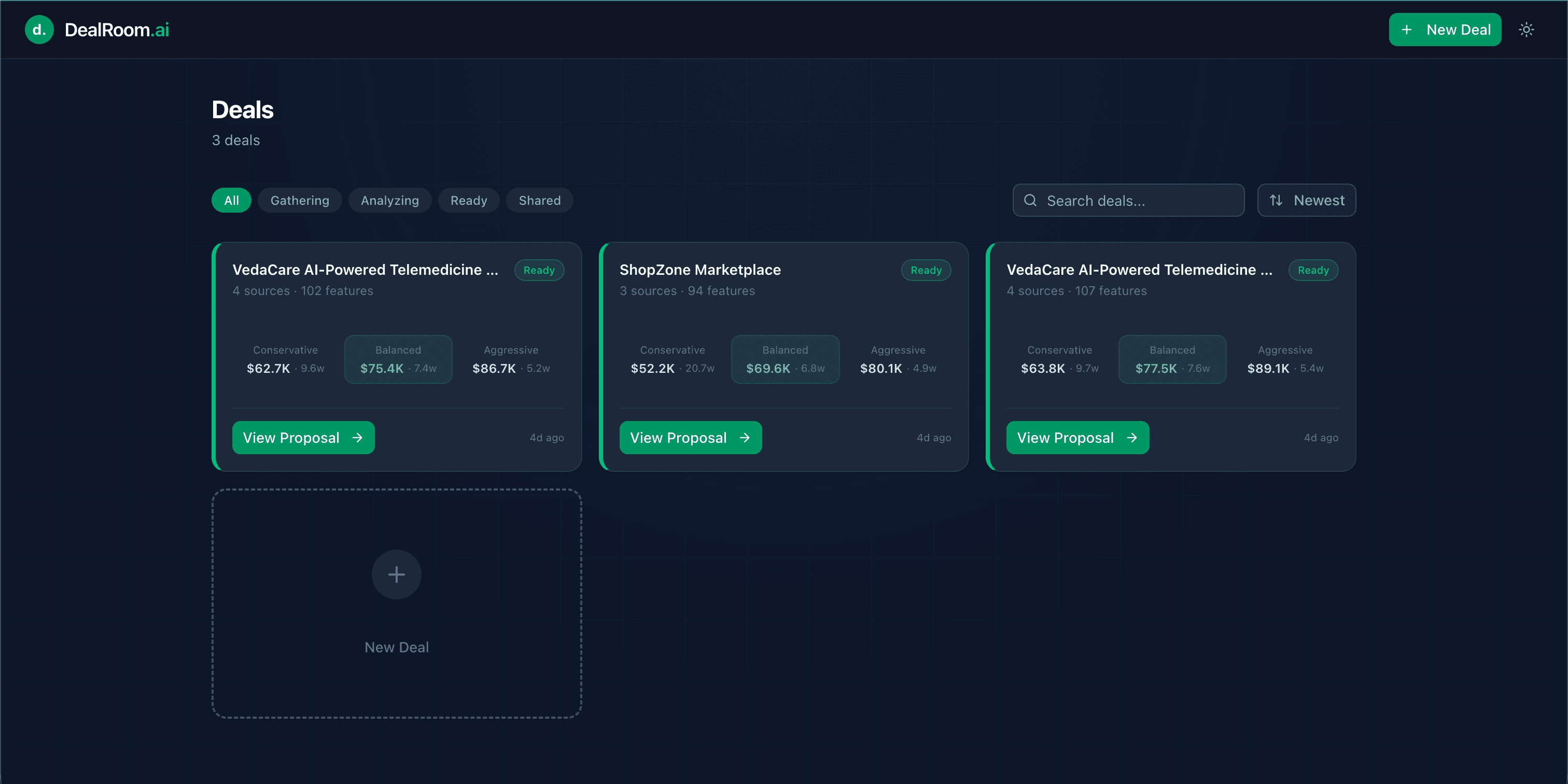
DealRoom.ai closes that gap at the presales stage, producing proposals that are accurate, structured, and ready to send.
Four agents. One coordinated pipeline.
DealRoom is not a single model that reads a document and returns a summary. It is four specialized agents, each with a defined role, passing structured output through a coordinated pipeline.
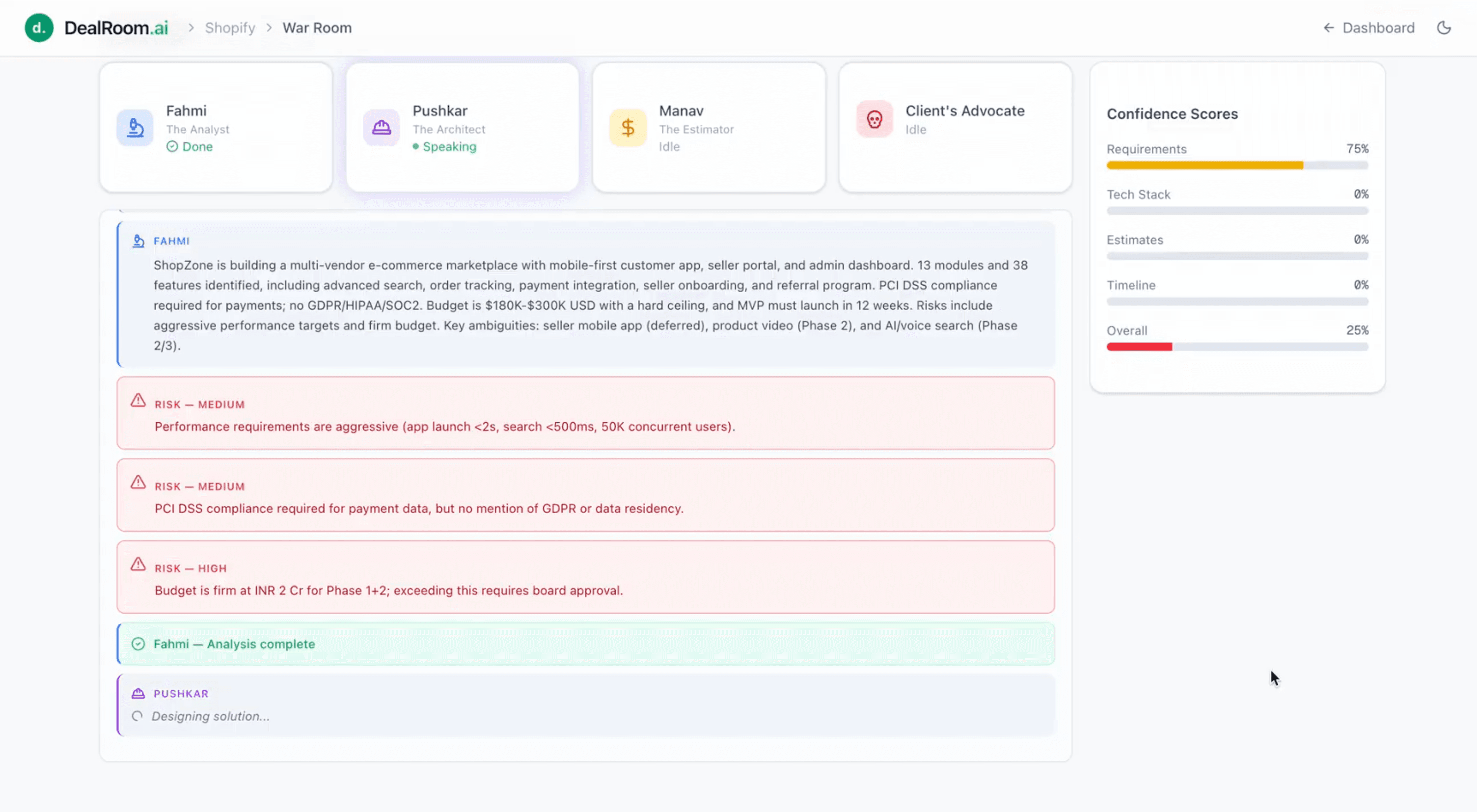
01 — The Analyst ingests source materials—PDFs, Word documents, and follow-up emails—and extracts structured data: features, user roles, priorities, technical constraints, and integration requirements. It interprets intent. A reference to a map-based tracking feature is translated into its technical components: real-time data requirements, relevant APIs, and backend service dependencies.
02 — The Architect maps the Analyst's structured output into systems, modules, and a recommended technology stack. Each feature is enriched with hours and complexity data from a knowledge base built on historical actuals from delivered projects. Estimates reference what similar features took in production, not inference from a language model.
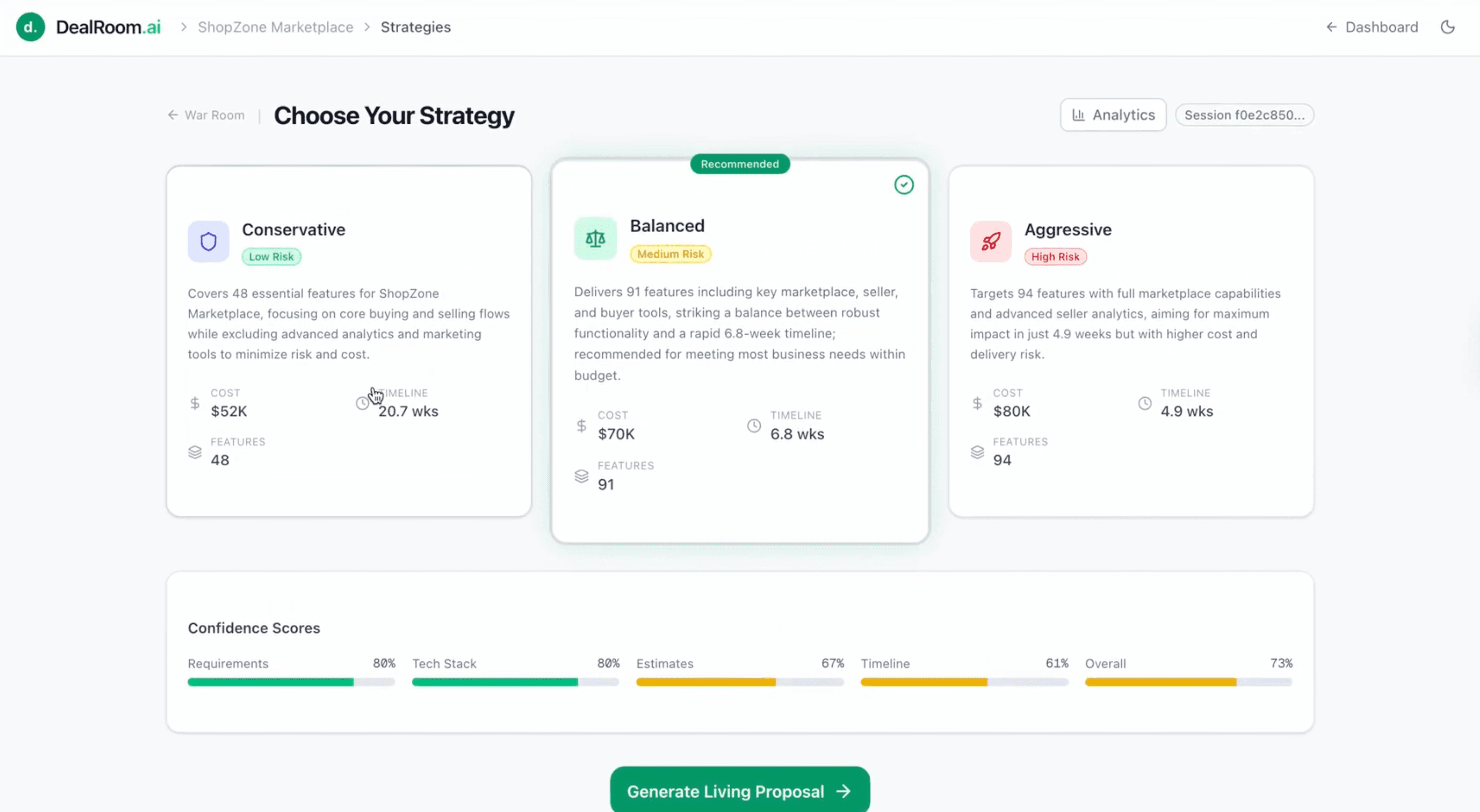
03 — The Estimator produces three delivery strategies. Conservative defines a minimum viable scope with a lean team. Balanced covers the full scope with a right-sized team and standard timeline. Aggressive deploys a larger parallel team to compress delivery at a higher cost. Each strategy includes a cost breakdown, timeline, team composition, and risk profile.
04 — The Devil's Advocate reviews the output of the preceding agents and challenges assumptions. It identifies timelines that do not account for third-party API stabilization, flags compliance requirements present in the brief that are absent from the feature set, and surfaces integration dependencies that were not addressed during architecture. The proposal survives internal challenges before it reaches the client.
The output is a working interface, not a static document
Most proposals are PDFs. Clients open them, scroll through, and send questions that take 48 hours to answer. That exchange delays decisions and adds friction to the close.
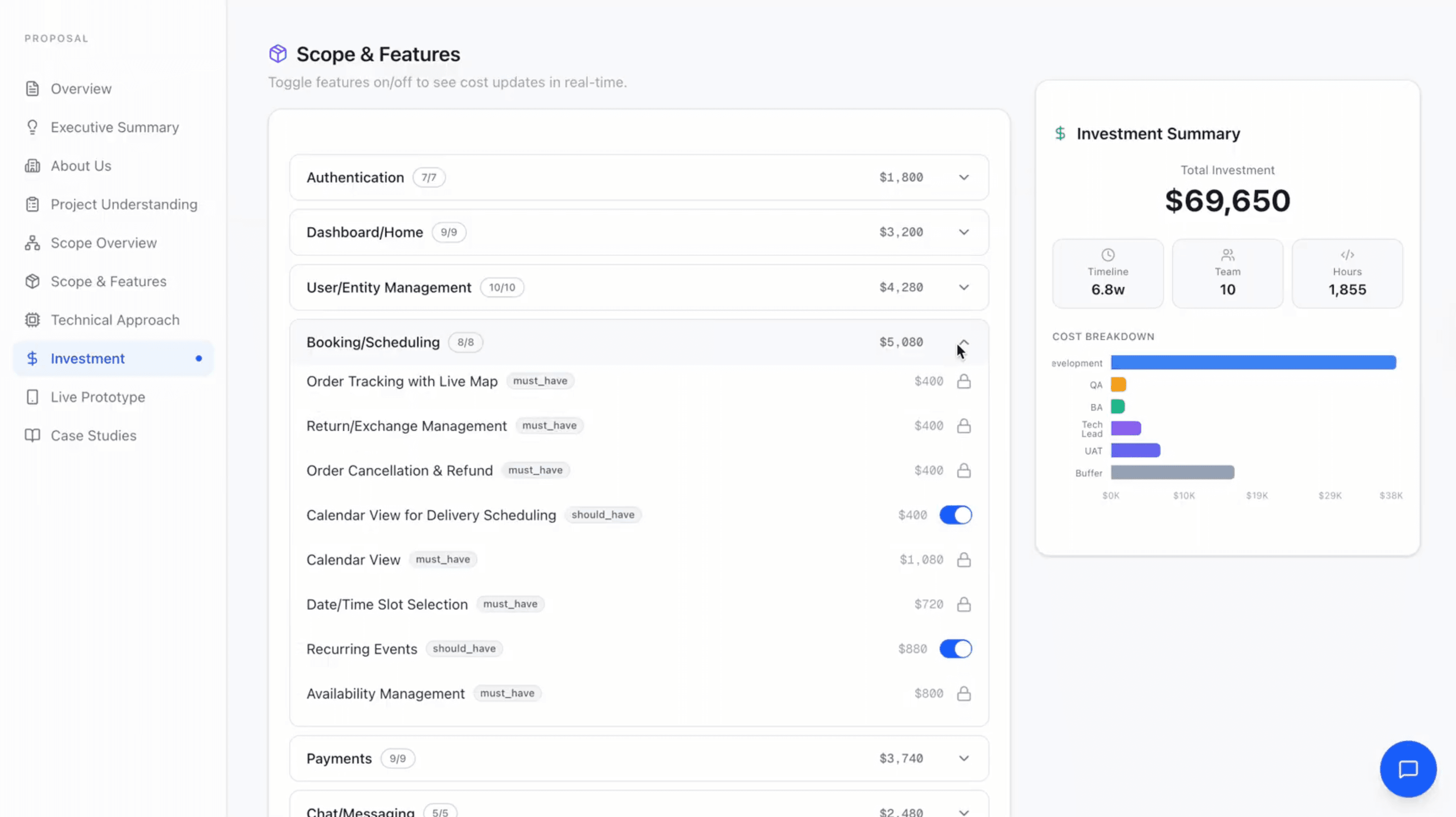
DealRoom produces a web-based proposal that clients can explore. A scope map presents project structure as an expandable hierarchy. A feature toggle table allows stakeholders to include or exclude individual features; each change updates cost, timeline, and team size in real time—no revised estimates, no back-and-forth.
The analytics section gives budget owners and technical decision-makers what they need to evaluate the proposal internally: cost distribution by system, effort by development phase, and team utilization across the delivery period. That data is part of the proposal itself, not a follow-up request.
Every estimate carries a confidence score. A high score indicates grounding in historical project actuals. A lower score flags features estimated without historical precedent—the areas a presales lead should review before submission.
Technical implementation
The frontend is built with Next.js, deployed on Vercel. The backend runs on Python with FastAPI, deployed on Railway, orchestrating agents through an asynchronous pipeline with Server-Sent Events streaming updates to the interface as work proceeds.
The architecture separates language model reasoning from deterministic computation. The Analyst and Architect use GPT-4.1 for document interpretation and system reasoning. The Estimator builds strategies through knowledge-base-driven computation. The Devil's Advocate runs on GPT-4.1-mini. Post-estimator agents execute in parallel via asyncio to maintain pipeline throughput.
The knowledge base underpins every estimate: feature libraries with historical hour ranges from delivered projects, pricing benchmarks by role and seniority, team composition templates, and overhead formulas covering QA, business analysis, tech lead, documentation, and deployment. When the system assigns 52 hours to a feature, that figure has a source in actual project data.
Three conclusions from development
1. Pure language model pipelines are not sufficient for production estimation.
Document interpretation and system reasoning require language model capabilities. Cost calculation and structured data assembly do not. Separating these concerns produces outputs that are analytic and contextually accurate. Conflating them produces outputs that are neither.
2. Internal challenge before client delivery is a quality mechanism, not an overhead.
Proposals processed through the Devil's Advocate review carried timelines 15 to 20 percent longer—and were more defensible. The review identified integration dependencies and compliance gaps that the Architect had not addressed. The cost of that review is low. The cost of a client finding those gaps after submission is not.
3. Presentation format determines how the analysis is acted upon.
An accurate proposal in a static document loses stakeholder attention before the scope is reviewed. The same content in an interactive format held attention through review and generated substantive questions from decision-makers. The format through which analysis is delivered shapes the quality of the decisions it produces.
Current scope and roadmap
DealRoom supports healthcare, e-commerce, and edtech domains, each with domain-specific knowledge bases and feature libraries. Fintech, logistics, and SaaS are next.
A feedback mechanism is in development to route accepted proposals back into the knowledge base. Each completed engagement would refine the estimation data available to future proposals. The objective is a system whose accuracy improves with use, not one that remains static after deployment.
GeekyAnts developed DealRoom.ai as part of the Age of Agents track. It applies multi-agent coordination to a high-frequency, high-stakes business process, demonstrating that autonomous agent pipelines can deliver production-quality outputs in commercial workflows where accuracy and consistency are non-negotiable.