
Editor’s Note: This blog builds on insights from Mirai: AI-Powered Personal Growth Assistant, a project from the Design AI Challenge at GeekyAnts. Created by the AIgnite Crew, Mirai showcases how AI can revolutionize self-improvement with personalized guidance and adaptability. While edited for clarity and structure, this blog captures their vision of using AI to make personal growth smarter and more effective.
Team Members: Adhitya, Chandravardan, chetan
Why Do Most People Fail at Self-Improvement? The Problem Is not You—It is the System. Every year, millions set ambitious New Year’s resolutions, yet 92% of them fail. The struggle is not about willpower—it’s about the flawed systems people rely on. Self-help books, online advice, and goal-tracking apps often provide generic solutions that do not adapt to individual lifestyles. Motivation fluctuates, and most habit-tracking tools merely log progress rather than guiding meaningful transformation.
Personal growth isn’t a straight path—it’s unpredictable, deeply personal, and ever-changing. Yet, most tools fail to account for this complexity. What if AI could do more than track habits? What if it could truly understand your journey and adapt to help you grow in a way that fits your life? Enter MirAI, an intelligent self-improvement companion designed to bring real, lasting change through hyper-personalized guidance.
The Real Challenge: Why Do People Fail to Achieve Their Goals?
Despite good intentions, people often struggle with personal growth for three key reasons. The first challenge is that most self-improvement advice is too generic. Many individuals seeking growth start by looking for answers online or in self-help books, only to find that these sources rarely offer personalized solutions. Studies show that only 8% of people believe self-help books lead to lasting change. Generic strategies fail because they do not consider an individual’s unique challenges, habits, or environment.
The second challenge is fluctuating motivation. It is easy to feel inspired when starting a new habit or setting a goal, but enthusiasm tends to wane over time. Research indicates that 43% of people abandon their goals due to loss of interest or focus. Without consistent and personalized reinforcement, staying on track becomes difficult.
Finally, most habit-tracking apps fail because they focus solely on tracking without offering meaningful guidance. While they allow users to log progress, they do not provide flexibility or adapt to setbacks. This rigidity leads to frustration, with 65% of users abandoning habit-tracking apps within three months. Growth requires more than recording progress—it needs adaptability, emotional intelligence, and the ability to adjust when things don’t go as planned.
The core insight behind Mirai is simple: People do not fail because they lack goals. They fail because their systems do not support them. Instead of tracking habits, Mirai acts as a personalized AI coach that adapts, guides, and helps users sustain long-term growth.
MirAI: AI-Powered Growth That Understands and Adapts to You
Mirai redefines personal growth by acting as an AI-powered coach that evolves with each user. Instead of following static templates, it learns from individual lifestyles, challenges, and career paths to create a hyper-personalized growth map. Even those unsure of their goals receive tailored insights that highlight areas for meaningful improvement.
By analyzing real-world obstacles, Mirai delivers AI-driven insights and intelligent course corrections. When motivation fluctuates, it goes beyond simple reminders, refining strategies to align with what works best for each user. It detects behavioral patterns, uncovers reasons for setbacks, and helps recalibrate progress without reinforcing a sense of failure. This adaptive approach makes growth more intuitive, effective, and sustainable.
How Mirai Works: Key Features That Make It Unique
Conversational AI: A Growth Coach That Talks to You
Mirai functions as an interactive personal coach, capable of having real conversations with users. Instead of static habit tracking, it engages in dynamic discussions to understand individual challenges. By asking smart questions, Mirai helps users define meaningful goals, identify roadblocks, and build sustainable habits. It also learns how a user best forms habits and what motivates them, ensuring that encouragement is tailored to their needs.
Multiple Interaction Modes for a Seamless Experience
Understanding that people engage with technology differently, Mirai offers both chat-based and voice-based interactions. Users can type messages when in public or speak directly to the AI when they prefer a more natural conversation. This flexibility ensures that users can interact with Mirai in a way that feels most comfortable to them.
Progress Tracking with AI-Powered Insights
Unlike traditional apps that merely log data, Mirai provides meaningful insights into progress. A dedicated dashboard allows users to track their growth daily, weekly, and monthly. AI-generated reports highlight trends, offer recommendations, and suggest adjustments when needed. This keeps users engaged while ensuring that their growth journey remains adaptable.
Adaptive Strategies for Lasting Change
What sets Mirai apart is its ability to change course when needed. If a user misses a milestone, it does not guilt-trip them. Instead, it analyzes why the setback happened and suggests alternative approaches that align with their lifestyle. This adaptability ensures that users do not feel discouraged but instead receive smarter strategies to stay on track.
Another key feature is the Growth Trail, which acts as a journal that visually maps a user’s self-improvement journey. Over time, users can see how they have evolved, track patterns in their behavior, and reflect on personal milestones. This feature reinforces motivation by showing tangible progress.
Real-Life Scenarios: How Mirai Supports Growth
Mirai’s potential extends to various aspects of personal development. For someone struggling with fitness, the AI can analyze routines and adjust workout plans to keep motivation high. A busy professional dealing with burnout can receive productivity tips, stress management techniques, and customized daily plans. Even individuals unsure about their personal or career goals can engage in conversations with Mirai to identify strengths, passions, and areas for growth.
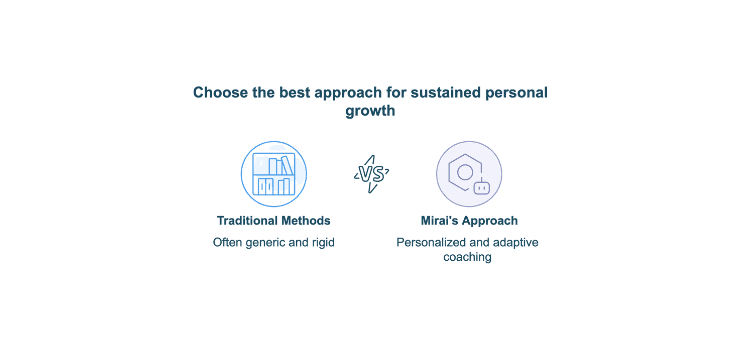
Unlike traditional self-improvement methods, Mirai’s strength lies in its ability to provide ongoing, adaptive support rather than one-time advice. This makes it an ideal tool for those seeking long-term, meaningful change.
Conclusion: The Future of AI-Powered Personal Growth
Achieving personal growth requires more than setting goals—it demands a system that evolves with you. Mirai brings intelligence and adaptability to self-improvement, acting as a dynamic guide rather than a rigid tracker. By understanding individual challenges, motivations, and habits, it provides personalized support that makes progress sustainable.
With its ability to learn, course-correct, and offer real-time insights, Mirai redefines the way people approach growth. Instead of relying on generic advice or inflexible tracking tools, users gain a coach that truly understands their journey and adjusts to keep them moving forward.
As AI continues to reshape self-improvement, Mirai is just the beginning. Stay tuned for more cutting-edge innovations from GeekyAnts, where we push the boundaries of AI-powered solutions.
Looking to build an AI-driven product like Mirai? GeekyAnts can help bring your vision to life.