

Key Takeaways
- AI lending products fail in production for operational reasons, not model reasons. Weak data pipelines, missing explainability, and compliance bolted on at the end kill more launches than bad algorithms ever do.
- The market rewards shipping, not piloting. AI in lending grows from $11.63 billion in 2025 to $14.71 billion in 2026, a 26.5% jump in a single year. The gap between lenders who ship and lenders who demo is widening at the same rate.
- Audit readiness is a design input. ECOA adverse action workflows, fair lending tests, and decision trails must exist in the architecture before the first borrower applies, not after the first regulator asks.
- Core banking integration decides whether AI lending products become infrastructure or shelfware. A credit model that cannot talk to the LOS, CRM, and Core Banking Systems is a science project with a dashboard.
Introduction: The Distance Between a Working Model and a Working Product
Every lending leader has seen the same demo. The model approves a loan in seconds. The room applauds. Six months later, the pilot remains as is, never moving towards production.
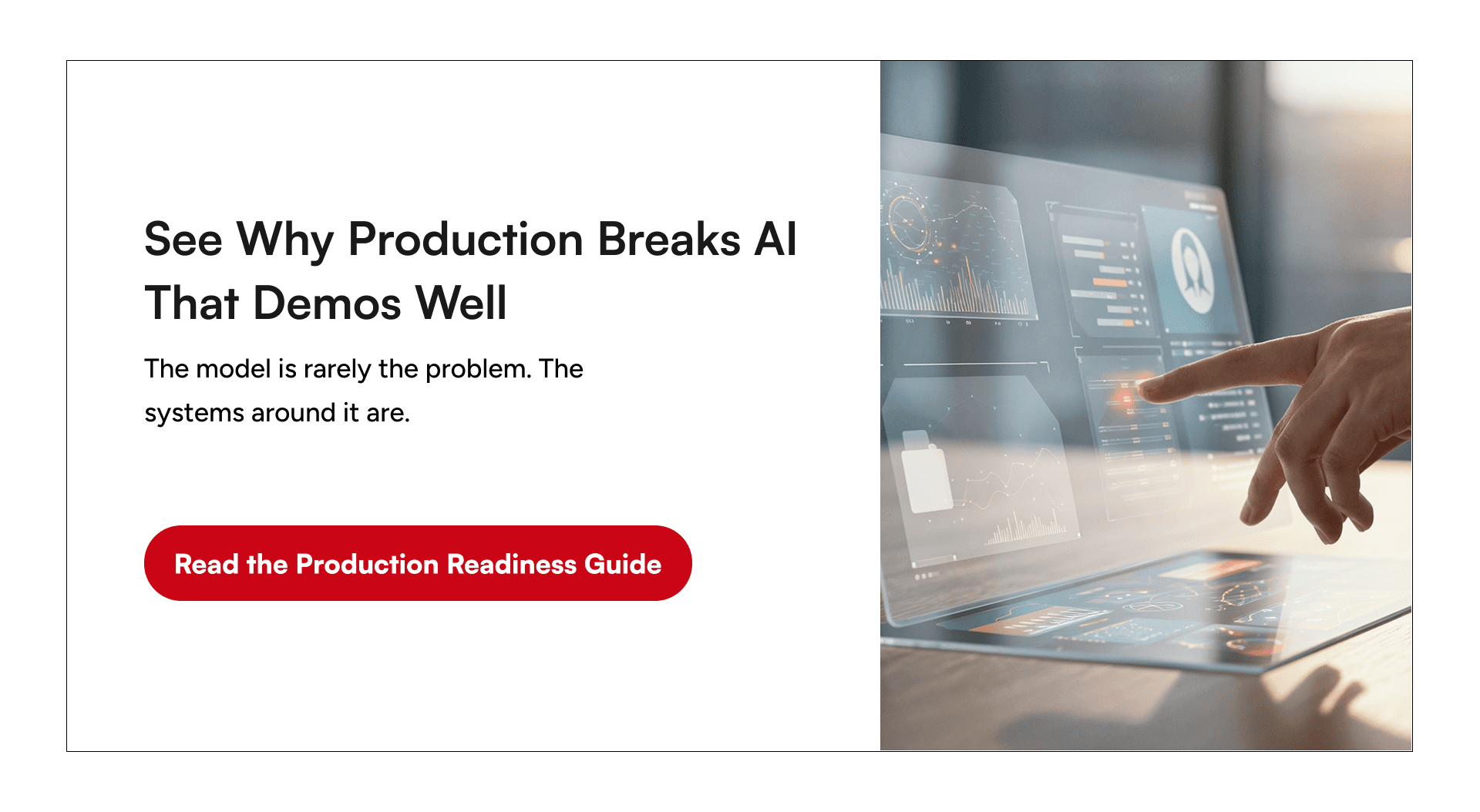
The reason is rarely the model. MIT research found that 95% of enterprise generative AI pilots deliver zero measurable return, and Gartner projects that 60% of AI projects without AI-ready data will be abandoned through 2026. The models are fine. But let's take a closer look at everything around the latter. What sinks these projects sits between the model and the money: data, integrations, and controls nobody scoped.
Meanwhile, the spend keeps climbing. Industry reports suggest that 83% of US lenders plan to increase their consumer lending GenAI budgets in 2026, and two-thirds will have a GenAI strategy live by year end. AI in lending has moved past recommendation engines into underwriting, fraud detection, document intelligence, portfolio monitoring, collections, and servicing.
So the hard question has changed. It is no longer "can we train a model?" It is "can we ship AI lending products that satisfy regulators, risk teams, auditors, security teams, and engineering operations at the same time?"
That is what this guide covers: how to move AI in lending from a promising pilot to a production system with credit risk discipline, compliance controls, and operational command built in.
The failure pattern is always the same, and it's not technical. A data science team builds a model that's statistically excellent, and nobody in the room asks the underwriter what they actually need to see to make the call. So you end up with a score that's accurate and a decision workflow that ignores it because accurate isn't the same as usable.
 Jani Hardik SanjayProduct Owner I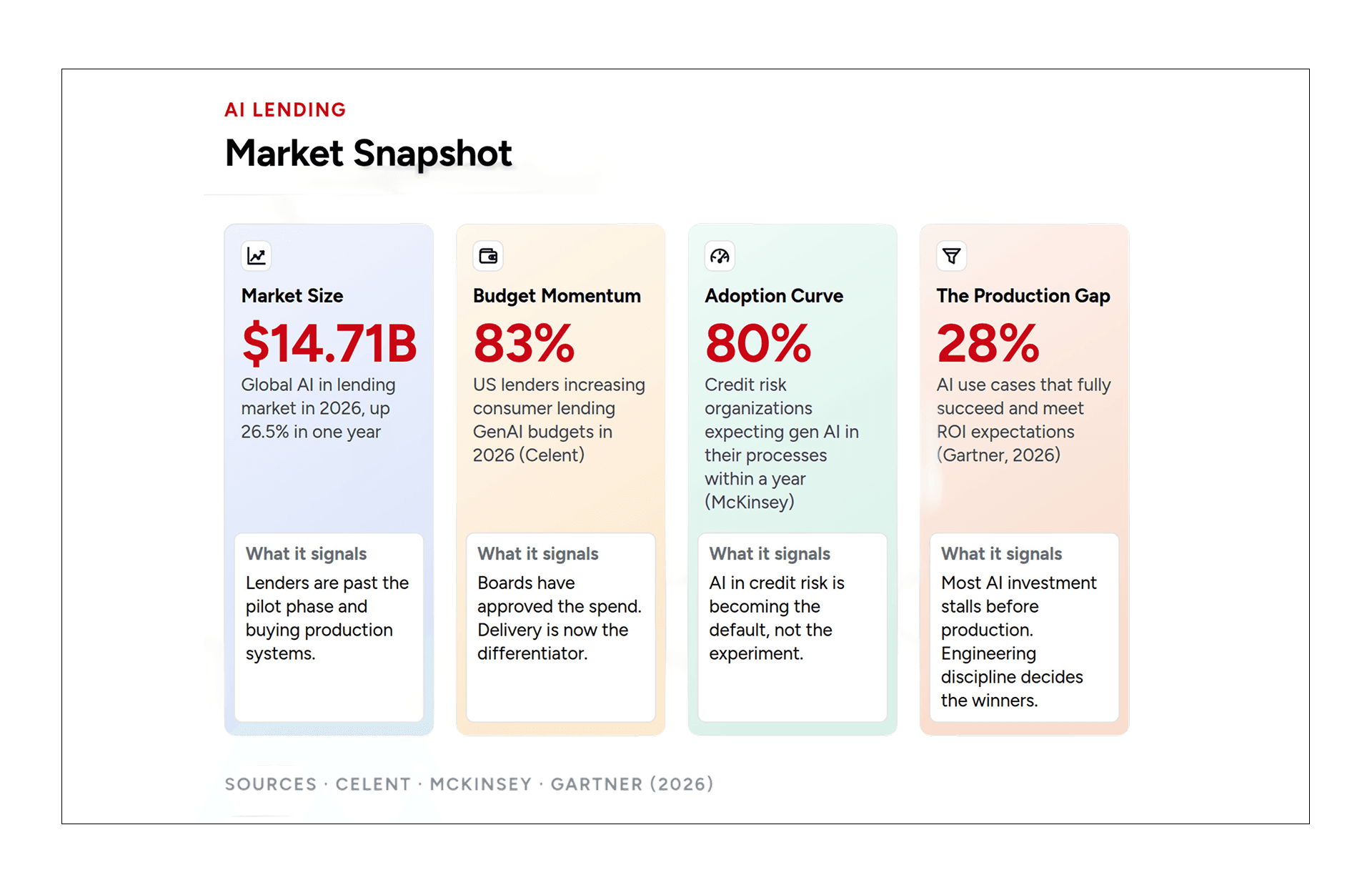
Why Do AI Lending Products Fail Before Production?
Most AI lending products die in the space between the data science team and the underwriting floor. The failure points repeat across banks, NBFCs, and fintechs with almost boring consistency:
1. Models built without operational context
A probability-of-default model tuned on clean historical data meets messy live applications and folds. Nobody asked the underwriters what a decision actually needs.
2. Fragmented borrower records
KYC data in one system, bureau pulls in another, bank statements in a third. The model sees a partial borrower and prices a partial risk.
3. Weak integrations
The LOS, CRM, KYC stack, and Core Banking Systems were never wired to the model. Scores get exported to spreadsheets. Spreadsheets are where AI in lending goes to retire.
4. No explainability
A credit decision that cannot produce reason codes cannot produce an adverse action notice. That is a regulatory violation waiting for a filing date.
5. No human-in-the-loop model
Every decision either goes fully automated (risk says no) or fully manual (finance says why bother). Nobody designed the middle.
6. No drift monitoring
The model that worked in Q1 quietly degrades by Q3, and nobody notices until delinquencies do.
7. Compliance arrives last
Controls retrofitted onto a finished product cost 3–5x what designed-in controls cost, and they still leak.
Gartner's April 2026 survey puts a number on it: only 28% of AI use cases fully succeed and meet ROI expectations. The winners share one trait — they integrated AI into existing workflows and systems from day one.
We have written about this pattern before in why AI insurance projects fail in production and why your AI works in the demo but will not survive production. Lending is the same story with higher stakes and stricter referees.
What Are the Key Components of AI in Lending Products? The Modern Agentic Stack
Modern AI lending products are less "one big model" and more a coordinated stack of specialized capabilities:
Component | What It Does in Production |
Intelligent document processing | Reads bank statements, payslips, GST filings, and tax returns; extracts structured data with confidence scores |
Credit risk models | Probability of default, loss given default, affordability, and cash-flow scoring |
Fraud and identity agents | KYC, AML screening, device intelligence, synthetic identity detection |
Decisioning engine | Applies credit policy rules on top of model scores; routes exceptions |
Agentic workflow orchestration | Chains verification, scoring, and review steps; escalates to humans on defined triggers |
Monitoring and governance layer | Drift detection, bias monitoring, audit logs, model performance dashboards |
The agentic part matters because lending is a workflow, not a prediction. An AI agent that verifies income, requests a missing document, re-scores, and routes to an underwriter completes a process. A standalone model completes a math problem.
What Does a Production AI Lending Architecture Actually Look Like?
The architecture question I ask every lending client is simple: what happens when the bureau call fails at 2 a.m.? A pilot has no answer. A production system has a cached fallback, a retry policy, and an alert. We design the failure paths before we design the happy path, because in lending the failure path is the one the regulator reads.
 Saurabh SahuChief Technology Officer (CTO)
Decision-makers do not need a network diagram.
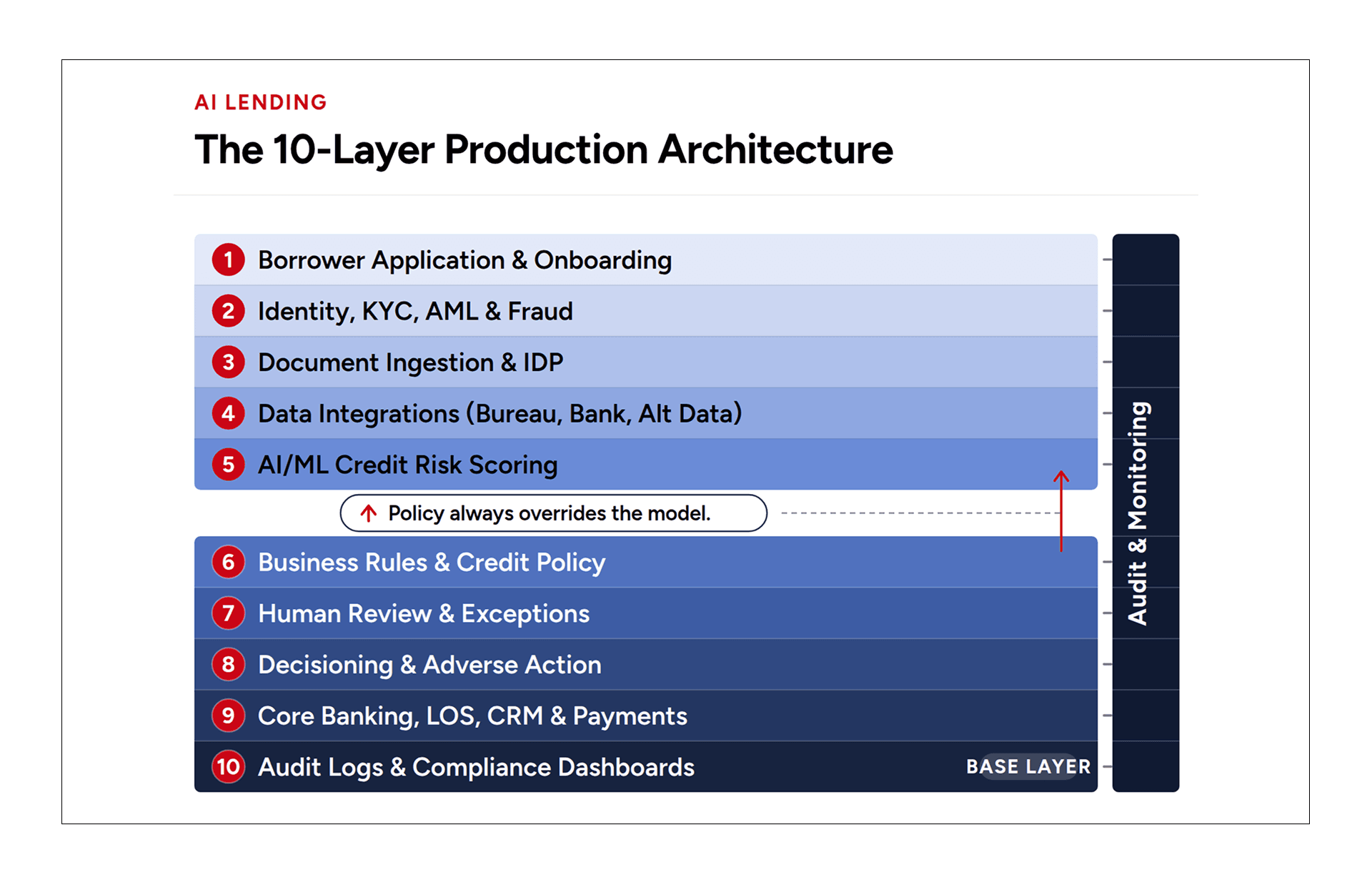
They need to know the layers, what each one owes the others, and where things break. A production-grade architecture for AI lending products has ten layers, and every one of them is load-bearing:
Layer | Role | Production Requirement |
1. Application & onboarding | Captures borrower intent and consent | Sub-second response, mobile-first, consent logging |
2. Identity, KYC, AML, fraud | Confirms the borrower is real and clean | Real-time checks with fallback providers |
3. Document ingestion & IDP | Turns paper into data | Confidence thresholds that trigger human review |
4. Data integrations | Bureau, bank statement, cash-flow, alternative data | Retry logic, caching, graceful degradation |
5. AI/ML credit risk scoring | Produces scores with reason codes | Versioned models, champion/challenger setup |
6. Business rules & credit policy | Encodes what the institution will actually lend | Policy always overrides the model |
7. Human review & exceptions | Handles the middle 20% | Queues, SLAs, override logging |
8. Decisioning & adverse action | Generates offers and compliant declines | Automated adverse action notices with specific reasons |
9. Core systems integration | Core Banking Systems, LOS, CRM, servicing, payments | Event-driven, idempotent, reconciled |
10. Audit, monitoring, compliance | Watches everything above | Immutable logs, drift alerts, compliance dashboards |
Two architectural rules separate systems that survive from systems that do not.
Rule one: the policy engine sits above the model. The AI proposes; credit policy disposes. When a score conflicts with policy, policy wins and the conflict gets logged.
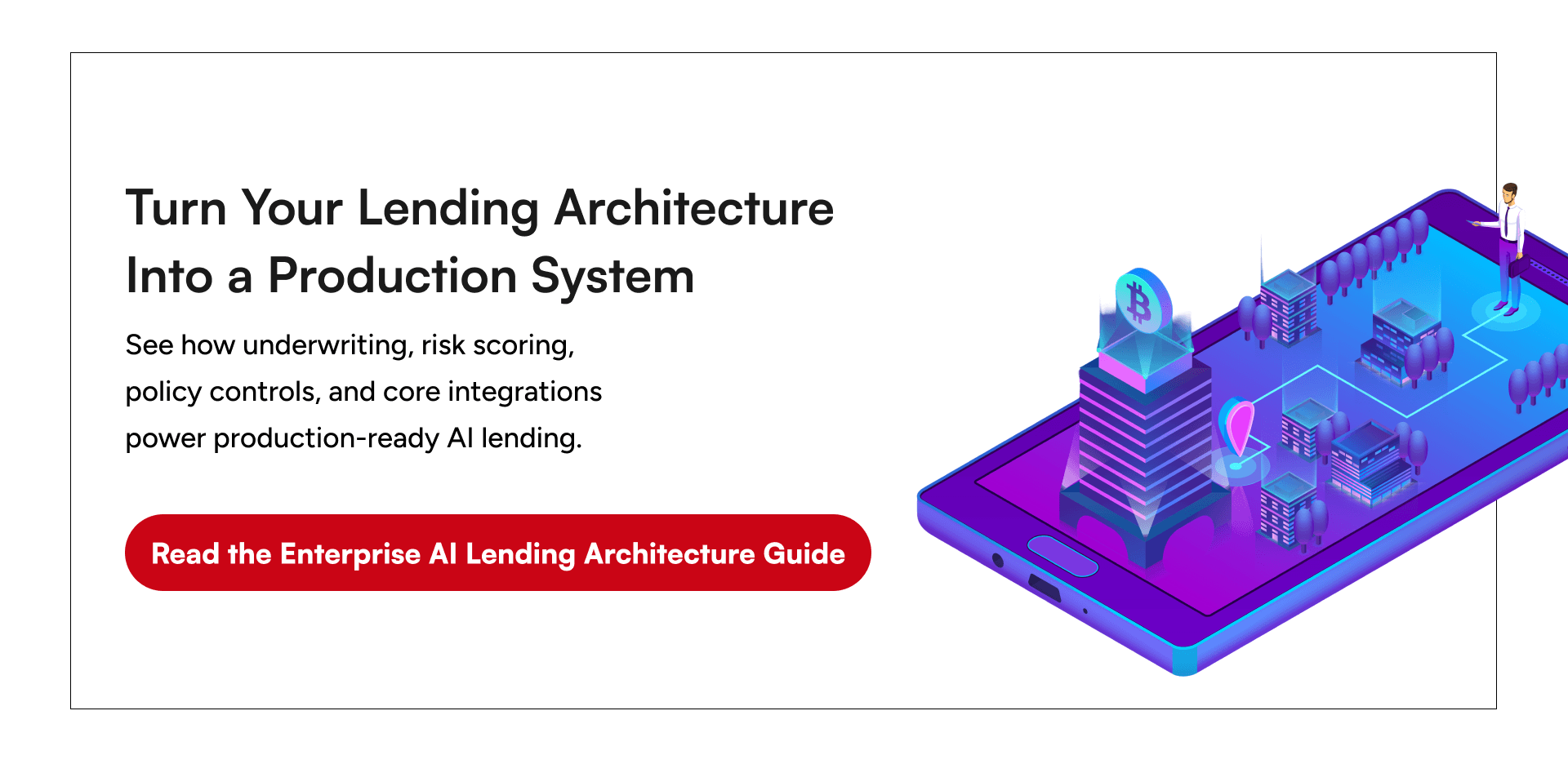
Rule two: core banking integration is a first-class layer, not an afterthought. The decision a model makes is worthless until it becomes a disbursed loan in the Core Banking Systems and a serviced relationship in the CRM. Core systems integration in banking is where most timelines slip, so it gets designed in Phase 2, not Phase 6.
How Do AI Credit Risk Models Improve Lending Decisions Without Losing Explainability?
AI improves credit risk by pricing risk on more signals — cash flow, transaction behavior, alternative data — while explainability tools like SHAP, feature attribution, and reason codes keep every decision defensible to underwriters, auditors, and borrowers. The two are inseparable. An accurate model that cannot explain itself is unshippable in lending.
The biggest accuracy gain is not a smarter algorithm. It is scoring on real cash flow instead of declared income. Where teams over-claim is explainability — a SHAP chart is not a reason code, and a reason code is not an adverse action notice. My test for any credit model is whether the borrower's decline letter can be generated from it. If it cannot, the model is not done.
Jani Hardik SanjayProduct Owner IWhere does AI in Lending Actually Move Credit Risk?
- Probability of default (PD) models trained on gradient boosting and richer feature sets consistently outperform scorecard-era logistic regression, particularly on borderline applicants where the margin lives.
- Loss given default (LGD) support improves recovery forecasting by modeling collateral behavior and borrower response patterns.
- Affordability and cash-flow analysis reads actual bank transactions instead of declared income. This is the single biggest accuracy gain for most lenders.
- Thin-file and SME lending benefit most. Alternative data — utility payments, GST filings, platform revenue — lets AI lending products score borrowers the bureau cannot see. This is a growth lever, not charity.
The pattern holds across the industry: the value sits in combining traditional and non-traditional data under governed model architecture. Black boxes that skip governance do not fail quietly. They fail in front of an auditor.
Why Explainability Serves Three Audiences, Not One
Every explanation your system produces has three different readers:
- Risk and model validation teams need feature attribution and stability metrics to approve the model.
- Compliance and audit teams need reason codes and decision trails to defend it.
- Borrowers need plain-language reasons in adverse action notices to trust it — and the law requires it.
SHAP values, LIME, and structured reason codes are how one model serves all three.
This is also where LLMs earn their place in AI lending products: explaining governed model outputs in natural language, drafting credit memos, summarizing borrower files. What LLMs must not do is make the credit decision.
McKinsey's survey of senior credit risk executives — covering nine of the top ten US banks — found 80% expect gen AI in their credit processes within a year, but data quality (cited by 79%) remains the top guardrail concern.
The industry consensus is clear: LLMs support explanation workflows; governed risk models make the call.
The question product leaders should ask before approving any AI credit risk model: "Show me the adverse action notice this model generates for a declined borrower." If the team cannot, the model is not ready.
How Do You Make AI Lending Products Compliant, Fair, and Audit-Ready?
Compliance is where AI in lending gets expensive to retrofit and cheap to design in. The regulatory floor in 2026 is concrete:
- ECOA and Regulation B require specific, accurate reasons for every adverse action. "The algorithm said no" is not a reason; it is an enforcement action.
- The EU AI Act classifies creditworthiness assessment as high-risk, with full obligations landing in August 2026 — documentation, human oversight, and bias controls become legal requirements, not best practices.
- Colorado’s Automated Decision-Making Law (effective January 1, 2027) imposes requirements on automated systems used in consequential decisions, including financial and lending services, covering technical documentation, consumer disclosures, recordkeeping, and human review.
What an Audit-Ready AI Lending Product Looks Like in the System, Not the Policy Binder
The pattern that survives audits connects every compliance requirement to a system control:
Compliance Requirement | System Design Control | Engineering Artifact |
Adverse action notices | Reason-code generation wired into decisioning | Notice templates + code mapping |
Fair lending testing | Scheduled disparate impact analysis across protected classes | Automated bias reports per model version |
Model documentation | Model cards generated at training time | Versioned docs in the model registry |
Model validation | Independent validation gate before deployment | Sign-off workflow with audit trail |
Human override controls | Underwriter override with mandatory justification | Override log with reviewer identity |
Decision trails | Immutable event log of every input, score, rule, and outcome | Append-only audit store |
Vendor governance | Third-party model risk assessments | Vendor model inventory + review cadence |
The test is simple: when a regulator asks "why was this borrower declined on March 14th," can your team answer in minutes with a complete trail — inputs, model version, score, policy rules fired, human touches, and the notice sent?
If the answer lives in seven systems and two people's memories, the product is not audit-ready, regardless of how accurate the model is.
Fair lending deserves special attention because AI can amplify bias at scale. Bias monitoring is not a launch checkbox; it is a recurring production job that runs against live decisions, per segment, per model version, with alerts wired to the risk owner.
Why Does Core Banking Integration Decide the Fate of AI Lending Products?
This section is for the people who get paged at 2 a.m. AI lending products cannot operate as isolated tools, because a lending decision only exists once it lands in the systems of record. That means engineered connections to:
- Core Banking Systems — account creation, disbursement, ledger entries
- Loan origination systems — application state, document status, decision recording
- CRM and support platforms — borrower communication, dispute handling; increasingly AI-Powered Banking CRM Platforms that carry decision context into every borrower conversation
- Payment rails — disbursement and collection
- Document management, data warehouses, and risk analytics platforms
The connective tissue is an API gateway plus event-driven architecture with workflow orchestration, role-based access control on every data movement, and observability across the whole chain. Core systems integration in banking is not glamorous. It is also 60% of the actual work.
Operational Control: What Happens When Things Go Wrong?
Production readiness is defined by failure behavior, not success behavior. Here is the control framework:
Failure Scenario | Uncontrolled System | Controlled System |
Credit bureau data fails mid-application | Application errors out or silently scores on partial data | Cached data or fallback provider; application flagged, held, and retried |
AI score conflicts with policy rules | Whichever executed last wins | Policy wins, conflict logged, threshold breaches reviewed weekly |
Borrower disputes a decision | Support escalates to engineering, who reads logs for two days | Complete decision trail retrievable by support in minutes; human re-review triggered |
Regulator requests a decision trail | Panic, screenshots, forensic archaeology | One query against the immutable audit store |
Core banking and CRM data disagree | Two teams argue about the source of truth | Automated reconciliation job flags mismatch; defined system of record resolves it |
Model drift crosses threshold | Nobody notices until portfolio metrics slip | Drift alert fires; champion/challenger swap or rollback executes |
Legacy Core Banking Systems make all of this harder — batch windows, closed schemas, and integration layers older than some of your engineers.
That is exactly why lenders pair AI initiatives with core banking modernization: modern APIs and event streams on the core are what let AI lending products operate in real time instead of overnight.

What Operating Model Does AI in Lending Require?
Technology stacks do not run themselves. Production AI in lending needs named owners, or every incident becomes a committee meeting.
Role | Owns | Accountable For |
AI lending product owner | The product outcome | Roadmap, borrower experience, business metrics |
Model owner | Each model's lifecycle | Performance, retraining, documentation |
Risk owner | Credit policy and risk appetite | Policy rules, override thresholds, portfolio limits |
Compliance owner | Regulatory alignment | Fair lending tests, adverse action, exam readiness |
Engineering owner | The platform | Uptime, integrations, incident response |
Data owner | Data quality and lineage | Pipeline health, source contracts, privacy |
Audit & control owner | The evidence | Logs, trails, validation records |
Underwriting, customer experience, security, legal, and infrastructure leadership plug into this structure — the point is that no decision type lacks a name attached to it.
Human-in-the-Loop: The Three-Tier Rule
- High-confidence, low-risk decisions move toward automation. This is where the efficiency gains live.
- Medium-risk decisions route to underwriter review with the model's reasoning attached. The AI drafts; the human decides.
- High-risk, disputed, edge-case, or policy-exception decisions require human approval with documented justification. Always.
The automation boundary moves over time as trust accumulates — but it moves on evidence, not enthusiasm.
What Is the Right Roadmap for Building AI Lending Products?
Enterprise buyers need a sequence, not a moonshot. Seven phases, each with a gate:
Phase | Focus | Exit Criteria |
1. Discovery | Lending workflow mapping, risk policy review, data source audit, compliance requirements | Signed-off scope and data inventory |
2. Architecture | System design, integration planning, model selection, security controls | Approved architecture including core banking integration plan |
3. Pilot | One workflow — pre-qualification, document review, risk scoring, or underwriting assistance | Live pilot with measured accuracy and cycle time |
4. Compliance validation | Model documentation, adverse action testing, human review workflows, audit trail testing | Passed internal audit dry run |
5. Core integrations | Core Banking Systems, LOS, CRM, servicing connections | End-to-end transaction reconciled across systems |
6. Production | Deployment, monitoring, drift detection, support model, retraining governance | Stable operations with alerting live |
7. Scale | New products, borrower segments, geographies, lending lines | Repeatable playbook per expansion |
Two notes from the field.
First, Phase 4 before Phase 5 — validate compliance on the pilot before wiring it into the core, because unwinding a non-compliant integrated system is misery.
Second, S&P Global found the average prototype-to-production journey takes eight months; teams that skip Phase 1 and 2 to "move fast" reliably take longer.
Why Choose GeekyAnts to Build Your AI Lending Products?
Clients do not hire us to build a model. They hire us because their last model never left the sandbox. What we sell is the unglamorous part — the integrations, the audit trails, the review workflows because that is the part that turns AI spend into disbursed loans.
 Kunal KumarChief Revenue Officer
GeekyAnts is a digital product engineering and AI transformation partner for organizations that need production-grade platforms, not experiments. For lenders, that means one team covering the whole distance:
- Build AI lending products from architecture through deployment
- Modernize lending workflows and the legacy systems underneath them
- Integrate with core systems — Core Banking Systems, LOS, CRM, payments through clean, event-driven core banking integration
- Create AI-assisted risk and underwriting workflows with human-in-the-loop controls designed in
- Build dashboards and control layers for monitoring, drift, bias, and audit readiness
- Improve borrower and operations experience across web and mobile
The pattern across our banking and insurance engagements is consistent: the model was rarely the problem. The data, the workflows, and the compliance layer were. We engineer those first.
Scaling a Global Payment Platform to 400 Million Transactions a Year
Problem: A global payment processing company needed to expand across the UK, Canada, Europe, and Australia without weakening compliance, performance, or user trust. Transaction volumes were growing faster than the existing systems could absorb. Every new market added its own billers, regulations, and testing burden.
Solution: GeekyAnts engineered Flowcash- the mobile and web platform on six Node.js services with AWS ECS autoscaling and Redis caching, so capacity follows demand instead of guesswork. A single shared codebase powers two mobile applications across all operating markets. Security was built in from the first sprint: scanning, runtime protection, and device controls, with data-driven automated testing covering every biller in scope. A content management layer lets business teams update customer communications without shipping a new app release.
Results:
- 400+ million payments processed annually
- 120,000+ active users across the UK, Canada, Europe, and Australia
- 350,000+ downloads across iOS and Android
- Every operating market covered by automated test flows, so releases ship without per-market regression risk
- Zero app releases needed for customer communication updates, cutting turnaround from weeks to hours
The same production discipline — autoscaling architecture, security from sprint one, automated compliance-grade testing — is what AI lending products need to survive contact with real borrowers and real regulators.
While this was a payments platform rather than a lending product, the same production requirements apply to AI lending: regulated workflows, high-volume transaction reliability, secure integrations, automated testing, observability, and audit-ready system design.
Conclusion: The Future of AI in Lending
The next phase of AI in lending is hardly glamorous and decisive: agentic workflows handling routine decisions end to end, humans concentrated on exceptions, and compliance evidence generated automatically as a byproduct of good architecture.
The AI lenders who win 2026 will not have the cleverest models. They will have the most operable ones.
Sources & Citations
- Artificial Intelligence (AI) in Lending Global Market Report 2026
- McKinsey — Embracing Generative AI in Credit Risk
- Gartner — 30% of Generative AI Projects Abandoned After Proof of Concept
- Gartner — AI Projects in I&O Stall Ahead of Meaningful ROI Returns (April 2026)
- McKinsey — Capturing the Full Value of Generative AI in Banking