
Conversational Analytics for Governed Enterprise Answers
Give business users an Enterprise AI Data Assistant that turns everyday questions into validated SQL, decision-ready visualizations, and traceable answers from approved enterprise data.
Bring AI-powered business intelligence to your organization while keeping database access, query safety, permissions, and auditability under enterprise control.
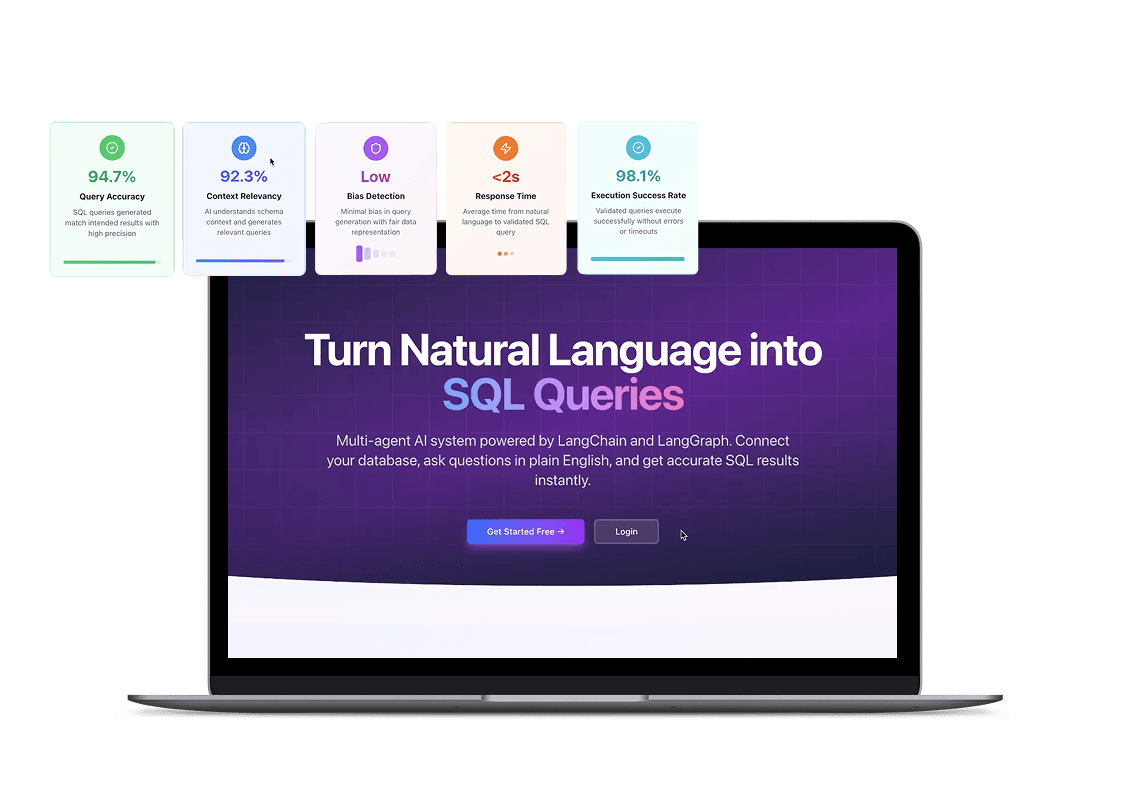
Close the Gap Between Business Questions and Data Answers
Enterprises have invested in ERP, CRM, HRMS, finance, project, and operational systems. Yet business leaders still depend on analysts to translate routine questions into database queries, dashboards, and reports.As reporting queues grow, decision-makers wait longer for answers while BI and data teams spend valuable time on repetitive requests—creating a strong case for conversational analytics that enables faster, more direct access to business insights.
Reporting Queues Delay Decisions
Routine operational questions compete with complex analytics and strategic data work for limited BI-team capacity.
Analysts Repeat Low-Complexity Work
Data teams repeatedly interpret business questions, identify the right source, write SQL, validate results, and format outputs.
Business and Database Language Stay Disconnected
Users describe metrics in familiar operational terms, while enterprise databases organize information through technical tables, fields, and relationships.
Uncontrolled Queries Create Risk
Ad hoc database access can expose sensitive information, produce inconsistent results, or create unnecessary performance pressure.
Follow-Up Questions Create More Tickets
Business users cannot easily investigate the next question without returning to the reporting queue.
Data Trust Declines
Duplicated query logic, inconsistent definitions, and slow responses reduce confidence in enterprise reporting.
How Natural Language to SQL Becomes Trusted Business Intelligence
The data intelligence accelerator converts business intent into validated SQL through a controlled workflow. Users gain a conversational BI experience without receiving unrestricted technical access to enterprise data.
- Step 01
Connect Approved Data Sources
Connect a governed database, warehouse, semantic layer, or read replica using read-only credentials. - Step 02
Curate the Available Data
Select the schemas, tables, and columns the Enterprise AI Data Assistant is permitted to use. Exclude sensitive or irrelevant data objects. - Step 03
Add Business Context
Review table and column descriptions. Align metadata with approved terminology, metric definitions, and business rules. - Step 04
Ask a Business Question
Users submit questions in familiar language. Identity, role, permissions, and controlled conversation context are applied. - Step 05
Generate SQL Query
The system retrieves relevant schema metadata and converts the user’s intent into a structured SQL query. - Step 06
Validate the Query
The query passes through dry-run checks, security scanning, prohibited-operation rules, and cost or performance validation. - Step 07
Execute Against a Read-Only Source
Only validated SQL is executed against an approved read-only database, warehouse, or governed data source. - Step 08
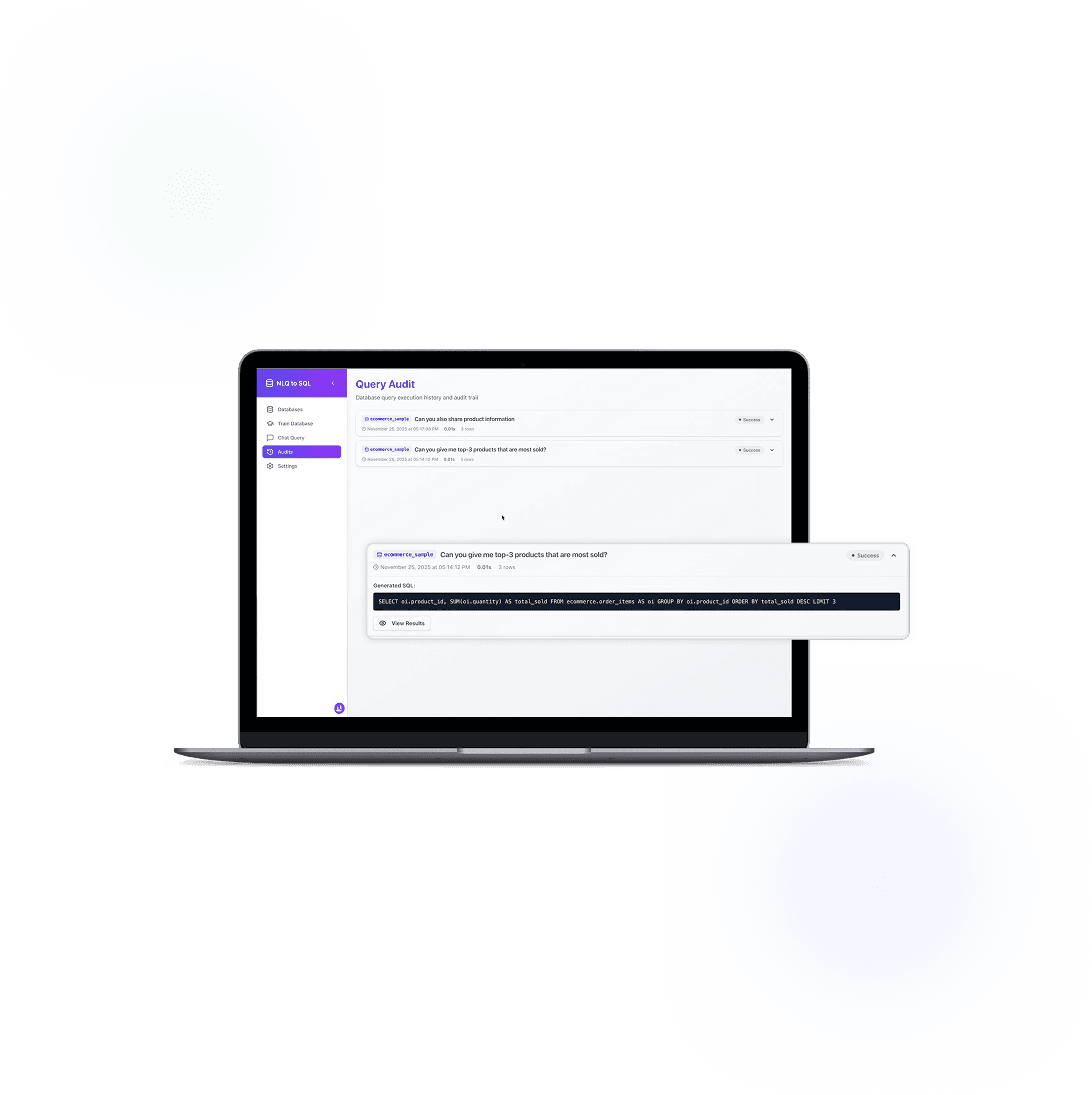
Present and Audit the Answer
Results are returned as charts, tables, HTML views, or JSON. Administrators can inspect the original question, generated SQL, execution details, and result history.
Meet the Enterprise AI Analytics Assistant
The Conversational Data Intelligence Accelerator provides focused experiences for business users, data teams, administrators, and product teams embedding conversational BI into existing applications.
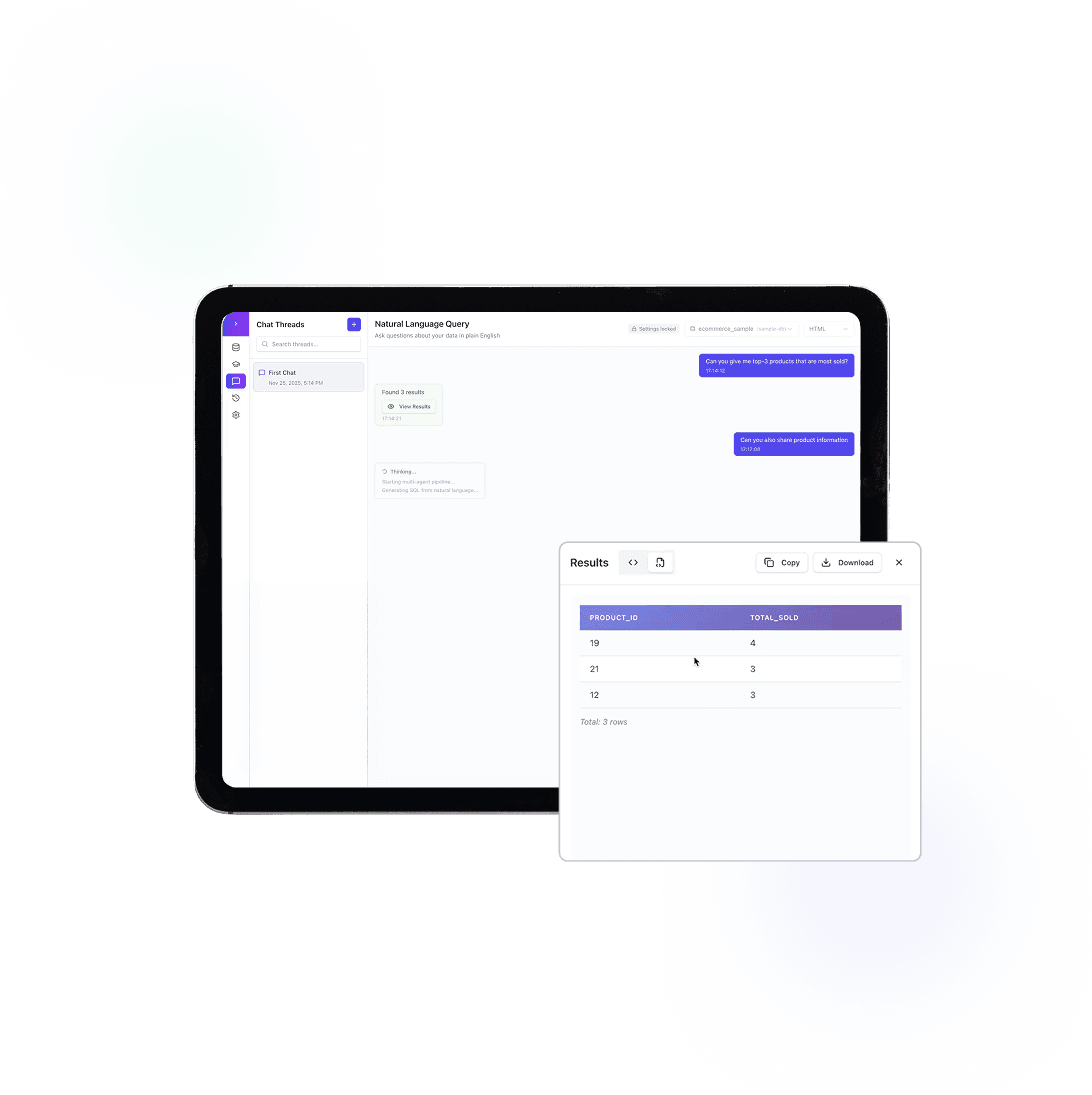
Ask natural-language questions, explore context-aware follow-ups, and receive answers as charts, tables, HTML reports, or JSON responses.
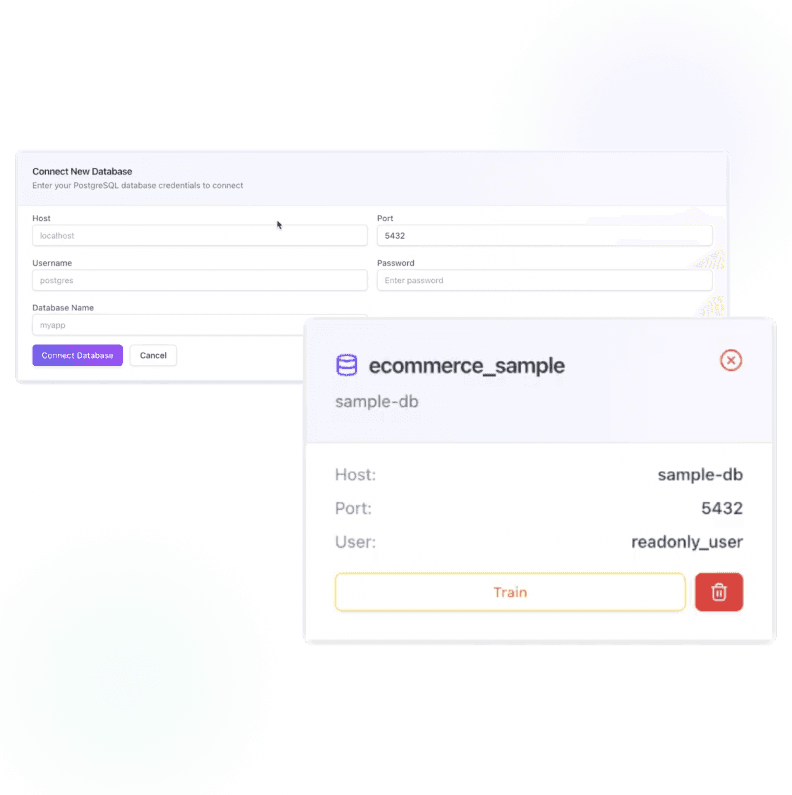
Select schemas and tables, control column-level scope, enrich metadata, manage business definitions, test priority questions, and review query quality.
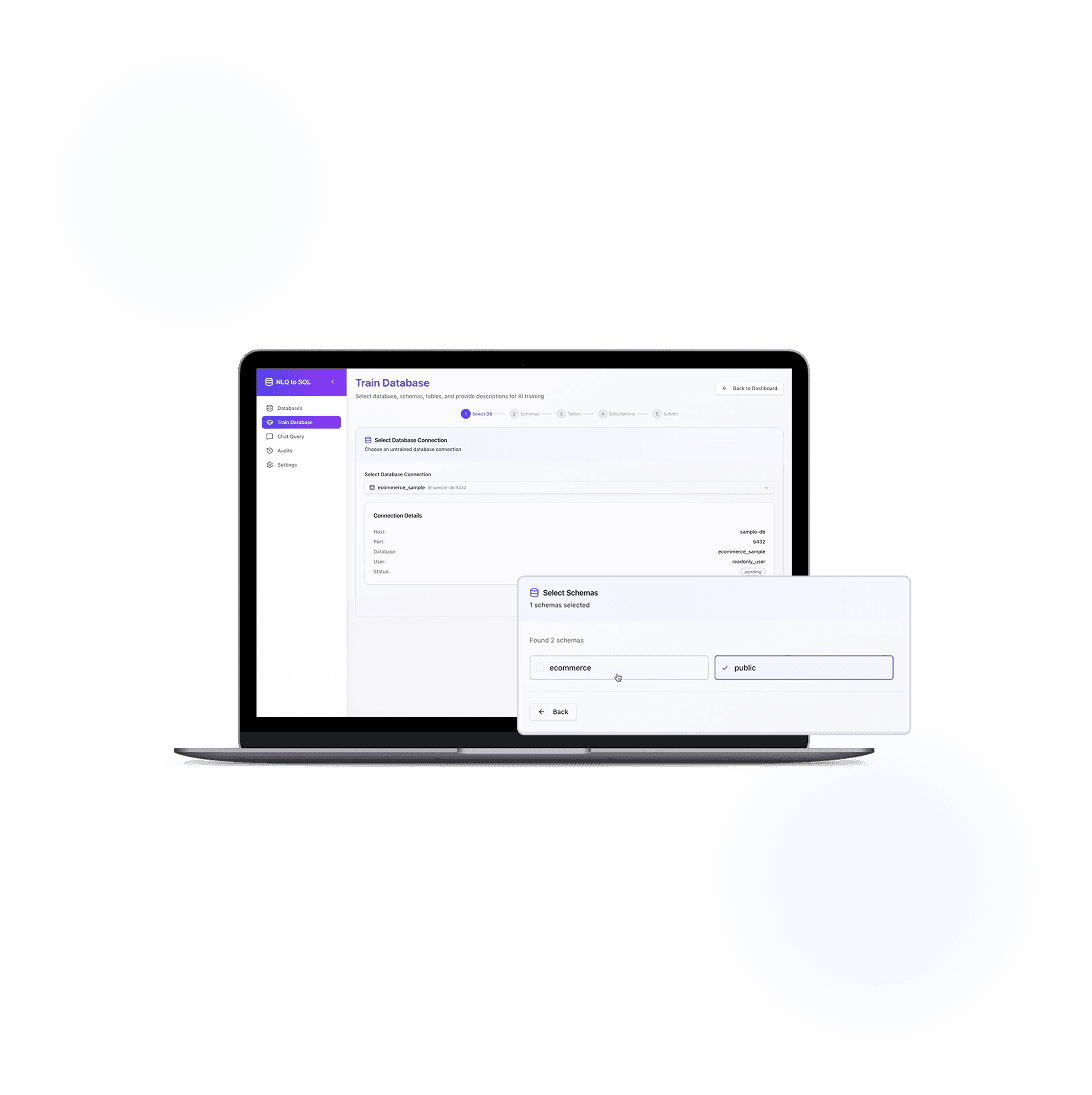
Manage identity, roles, read-only enforcement, validation thresholds, query approvals, audit history, schema changes, and platform observability.
Add governed conversational analytics to enterprise portals, internal tools, operational applications, and digital products through secured APIs and reusable interface components.
4
Embedded agents for schema training, SQL generation, validation, and execution
1-5
Minutes for suitable routine questions in the current POC
30-60
Minutes of manual analyst effort for comparable requests
AI-Powered Business Intelligence Built Around Enterprise Control
The AI Accelerator platform gives business users faster access to answers while preserving the controls required by enterprise data, security, and architecture teams.
Scale Governed Self-Service Analytics Across the Enterprise
Enterprise conversational analytics helps business teams move from static reporting queues to faster, governed access to trusted answers. It improves decision velocity while preserving data controls, metric consistency, and the role of BI teams in higher-value analysis.
Move suitable routine questions from analyst queues into a governed conversational analytics workflow.
Decrease the time BI teams spend translating common business requests into SQL and formatted reports.
Allow users to ask follow-up questions and investigate changing conditions without creating another reporting ticket.
Combine read-only access, schema allowlisting, query validation, identity controls, approvals, and audit logs.
Apply approved metadata descriptions and business definitions across repeated questions, functions, and teams.
Preserve analysts for complex investigations, data modeling, strategic analysis, and enterprise data products.
Make approved ERP, CRM, HRMS, finance, project, and operational data more accessible without replacing the underlying systems.
Tech Stack Behind the Conversational Data Intelligence Platform
The current POC combines an enterprise interface, embedded multi-agent orchestration, semantic schema retrieval, read-only database connectivity, and configurable security and deployment layers.Technology choices can be aligned with the client’s data platform, identity environment, cloud standards, and operating model.






Enterprise Conversational Analytics for Data-Intensive Industries
Organizations with complex structured datasets and frequent reporting demand can use the conversational data intelligence accelerator to improve access to answers without weakening governance.
Financial Services and Insurance
Explore revenue, portfolios, branch performance, collections, claims, underwriting, renewals, risk, and service operations.
Healthcare and Life Sciences
Provide role-aware access to capacity, billing, patient flow, inventory, research, and operational datasets.
Retail and E-commerce
Investigate sales, margins, promotions, inventory, stock-outs, returns, customer cohorts, and store performance.
Manufacturing
Analyze throughput, downtime, quality, maintenance, procurement, production yield, and shift-level performance.
Logistics and Transportation
Explore delivery performance, route variance, fleet utilization, operating costs, and service exceptions.
Energy and Utilities
Investigate consumption, outages, asset performance, maintenance, billing, and operational exceptions.
Technology and SaaS
Ask questions about product usage, revenue, churn, funnel conversion, reliability, support activity, and account health.
Professional Services
Improve visibility into utilization, bench, margin, billing, resource allocation, pipeline, and project delivery.
Government and Public Sector
Make program performance, budget utilization, service levels, and case-volume data accessible to authorized teams.
Conversational BI Across Enterprise Workflows
Designed for high-volume and repeatable business questions, the conversational data intelligence accelerator gives teams access to insights from approved structured data without requiring a new dashboard or analyst-built report for every request.
Executive and Board Performance Q&A
Ask cross-functional questions across approved finance, sales, operations, and portfolio data.
Finance and Variance Analysis
Explore plan-versus-actual performance by business unit, period, cost center, account, or reporting entity.
Sales and Revenue Intelligence
Investigate pipeline coverage, conversion, forecast risk, aging, slippage, churn, and account health.
Customer Support Operations
Analyze backlogs, service-level performance, resolution time, escalation patterns, recurring issues, and customer impact.
Project and Professional Services Visibility
Explore delayed milestones, utilization, staffing, delivery health, project economics, and margin risk.
Supply Chain and Manufacturing Analysis
Investigate stock-outs, purchase variance, lead time, downtime, defects, throughput, and shift-level performance.
Workforce and HR Analytics
Query approved headcount, attrition, tenure, location, function, and workforce-planning datasets.
Claims, Healthcare, and Regulated Operations
Analyze claims performance, policy trends, capacity, occupancy, wait times, utilization, and billing exceptions under controlled access.
Compliance Evidence Retrieval
Reproduce governed questions, generated SQL, approved extracts, and execution records through a traceable query history.
Embedded AI Analytics Assistant
Bring enterprise conversational analytics into portals, operational applications, customer products, and internal tools through secured APIs and reusable interfaces.
Data-Team Request Deflection
Route suitable routine questions through the AI accelerator while escalating complex analysis to BI and data specialists.
A Controlled Path to Production Conversational Analytics
The engagement starts with use-case and governance design, moves through a controlled pilot, and expands after accuracy, security, adoption, and business value have been validated.
Timing: Week 1: Timing: Week 1
Discovery & Value Design
Prioritize use cases, map systems, identify security constraints, establish KPI baselines, and define the pilot scope.Deliverables: Discovery brief, architecture hypothesis, pilot scope, and ROI measurement plan.Timing: Week 2: Timing: Week 2
Data & Governance Design
Assess data sources, establish read-only access, allowlist schemas, create the business glossary, and design user roles.
Deliverables: Approved data scope, metadata plan, role model, and governance controls.Timing: Weeks 3-4: Timing: Weeks 3-4
Configuration & Integration
Configure connectors, enrich metadata, generate embeddings, establish agent policies, configure the interface, and connect SSO.
Deliverables: Working client-configured pilot environment.Timing: Weeks 5-6: Timing: Weeks 5-6
Pilot Validation
Test golden questions, conduct user validation, review SQL accuracy, and complete performance and security checks.
Deliverables: Pilot report, prioritized fixes, and production recommendation.Timing: Weeks 7-10: Timing: Weeks 7-10
Production Hardening
Add scale, observability, private networking, disaster recovery, compliance controls, support processes, and release automation.
Deliverables: Production-ready release and operational runbook.Timing: Weeks 11-12+: Timing: Weeks 11-12+
Rollout & Adoption
Roll out by role, train users, review adoption, and establish the governance and operating cadence.Timing: Ongoing: Timing: Ongoing
Managed Optimization
Tune models and prompts, refresh schemas, monitor costs, support connectors, and maintain an enhancement backlog.
Bring Conversational Data Intelligence to Your Enterprise
See how an Enterprise AI Data Assistant can turn natural-language questions into validated SQL, decision-ready visualizations, and traceable results across approved enterprise data sources.
FAQs About the Conversational Data Intelligence Accelerator
Conversational Data Intelligence is an enterprise capability that allows users to ask questions in familiar language and receive governed answers from approved structured data. It combines natural-language interaction, metadata retrieval, SQL generation, validation, visualization, and auditability.
Conversational analytics allows users to explore data through natural-language questions and follow-ups rather than relying only on fixed dashboards or manually created reports. In this accelerator, conversational access is governed through approved data scope, read-only execution, query validation, and complete traceability.
No. It is an enterprise conversational analytics accelerator with controlled metadata onboarding, multi-agent query generation, security and performance validation, read-only execution, visual outputs, and auditability.
A standard dashboard usually answers a predefined set of questions. Conversational BI allows authorized users to ask new questions and investigate follow-ups while still using approved business definitions and data sources.
No. It is designed to reduce repetitive reporting demand and increase analyst leverage. Data modeling, metric governance, complex analysis, and strategic interpretation remain specialist responsibilities.
The Enterprise AI Data Assistant is the interface through which users ask questions, review results, and explore controlled follow-ups. It connects the conversational experience with the accelerator’s governance, validation, and data-access layers.
The current POC has been demonstrated with PostgreSQL. Production engagements can add connectors for other relational databases, warehouses, read replicas, and governed semantic layers based on client requirements.
The demonstrated approach creates embeddings from approved schema metadata, table descriptions, and column descriptions rather than operational row data. The production design can be adapted to the client’s data and AI policies.
No. The current architecture enforces read-only connectivity and rejects credentials with write permissions. Production deployments can reinforce this through database, network, identity, and policy controls.
Queries pass through dry-run checks, prohibited-operation rules, security validation, and performance analysis. PostgreSQL EXPLAIN and configured thresholds help identify exceptional workloads before execution.
Yes. Queries expected to exceed defined cost or duration thresholds can be routed for confirmation or approval before they run.
Only when authorized. Administrators can exclude schemas, tables, and columns. Production deployments can also apply role-based, purpose-based, and row-level controls aligned with enterprise IAM.
Accuracy depends on schema structure, metadata quality, business definitions, question complexity, and testing. Priority golden questions are evaluated during the pilot and used to improve the configured workflow.
Yes. Controlled thread summaries preserve enough context for users to refine, compare, or drill into earlier results without maintaining unrestricted conversational memory.
The POC includes scheduled schema-change detection. Production workflows can notify owners, review changes, and refresh semantic metadata before affected use cases continue.
Yes. The architecture can support configurable providers, approved enterprise models, private endpoints, and task-specific routing based on security, accuracy, residency, and cost policies.
It can be adapted for AWS, Azure, GCP, private cloud, on-premises, or hybrid deployment, depending on model, networking, identity, and infrastructure requirements.
Yes. Secured APIs and reusable interface components can bring governed conversational analytics into enterprise portals, operational applications, products, and internal tools.
Not in the current POC. The agents are modular Python components orchestrated through a LangGraph StateGraph inside the FastAPI backend. Components can be separated during productionization when independent scaling or isolation is required.
A configured pilot is typically scoped for four to six weeks. Production implementation and rollout depend on the number of data sources, integrations, security controls, deployment model, and user scale.
Track response time, analyst hours saved, request deflection, active users, query success, decision time, reporting-backlog reduction, and governance exceptions.
Managed services can include monitoring, schema refresh, model and prompt tuning, connector support, cost optimization, adoption reviews, and continued enhancement.
Start With Working AI. Adapt It to Your Business.
Start with proven AI building blocks and adapt them around your business, data, and systems. Tell us what you want AI to do, and we’ll show you a faster route to production.
