
At GeekyAnts, we spend a lot of time building intelligent workflows, sleek application ecosystems, and heavy-duty digital architecture. We usually look at technology through the lens of user experience, flawless code, and system efficiency. But when you look at the macro-economics of the healthcare industry, efficiency is a critical rescue mission.
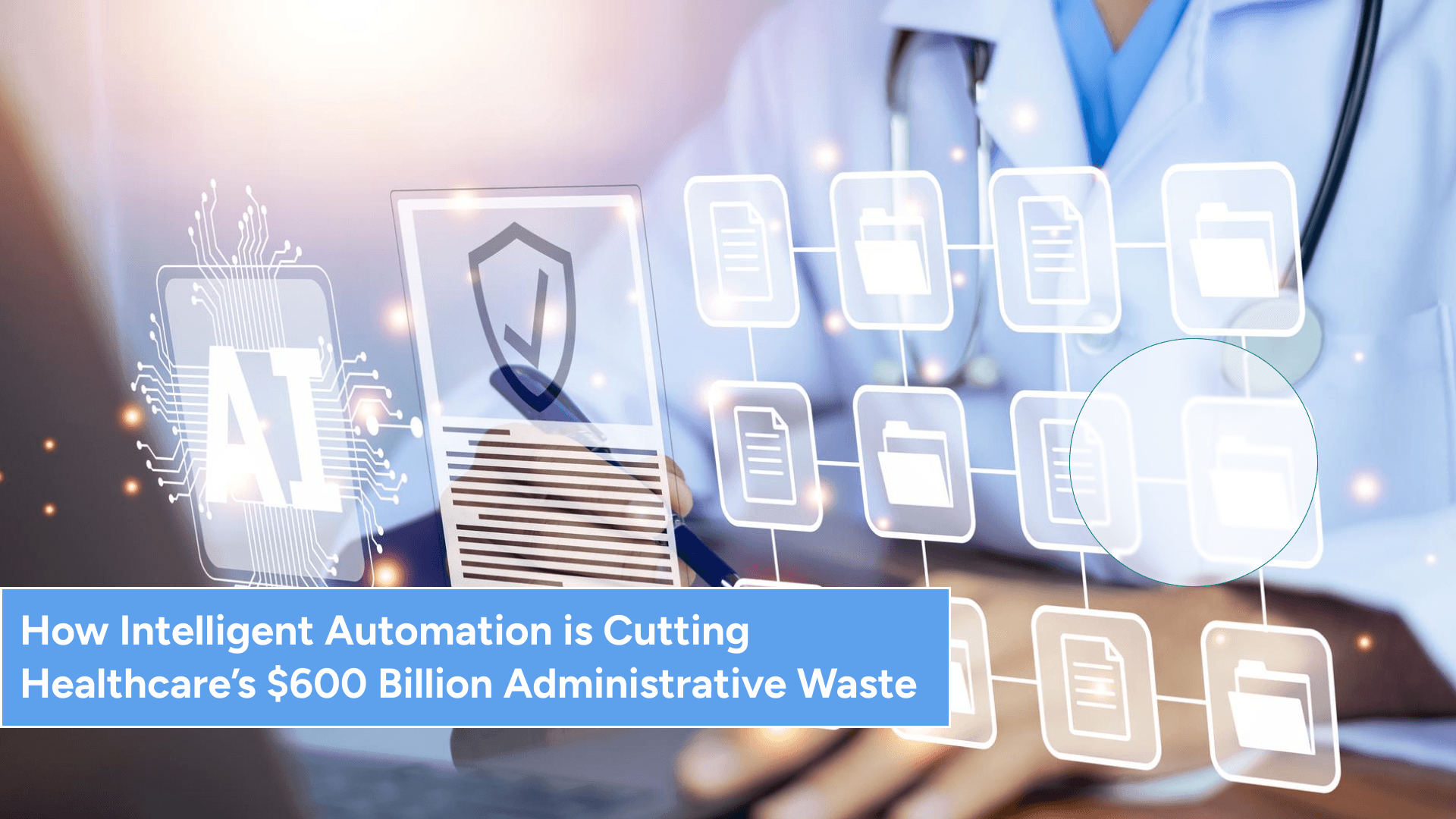
In the United States alone, administrative costs account for nearly 20% of total healthcare spending, translating to a staggering $600 billion wasted annually on manual paperwork, complex medical billing, and archaic workflows. Healthcare executives are grappling with shrinking margins, administrative burnout, and operational fragmentation.
The solution is not simply adding more human hands to handle data-heavy processes. The solution lies in Intelligent Automation (IA)—the convergence of Robotic Process Automation (RPA), Natural Language Processing (NLP), and Machine Learning (ML).
Here is how intelligent automation is quietly dismantling operational overhead and transforming healthcare administration from a legacy bottleneck into an automated pipeline.
The Core Bottlenecks: Where the Money Vanishes
Before throwing AI at a problem, it is vital to map out exactly where the operational leakage happens. According to global research, administrative tasks carry the highest density of repetitive, data-intensive workflows ripe for intelligent transformation.
[Legacy Operational Deficit] -> High Claims Denial -> Manual EHR Overhead -> Scheduling No-Shows
                                       │                      │                     │
                                       ▼                      ▼                     ▼
[Intelligent Automation Fix] -> GenAI Adjudication -> Ambient Medical Scribes -> Predictive Risk Models
1. Revenue Cycle Management (RCM) & Medical Billing
Medical coding is highly repetitive, manual, and expensive. When humans parse through hundreds of pages of unstructured clinician notes to extract diagnosis and procedure codes, discrepancies naturally arise. These discrepancies result in an avalanche of insurance claim denials.
- The AI Intervention: Modern Intelligent Automation combines optical character recognition (OCR) with Generative AI to parse unstructured accounts payable, purchasing data, and clinical charts. Generative AI models can automatically summarize denial letters, consolidate intricate denial codes, highlight the core reasons for non-payment, and contextualize immediate next steps for the billing team.
2. The Burden of Prior Authorizations
Few processes frustrate clinical operations more than the 10-day waiting loop required to verify insurance prior to authorizations. The friction of translating unstructured clinical documentation into structured compliance parameters creates an operational choke point for both private payers and provider networks.
- The AI Intervention: By converting unstructured data into structured clinical parameters, GenAI tools enable near-real-time benefits verification. They compute exact out-of-pocket expenses based on specific patient benefits and contracted rates, shaving days off the approval lifecycle.
3. Electronic Health Record (EHR) Bloat & Clinical Scribing
Clinicians spend hours typing up patient encounters—time stolen directly from face-to-face patient care. Manual inputs are slow, exhausting, and inherently prone to human error.
- The AI Intervention: Ambient voice recognition tools and NLP-powered AI scribes listen to conversational doctor-patient interactions and build structured, real-time clinical notes. Pilot implementations have demonstrated that these systems can automate up to 70% of note-taking activities. For a mid-sized clinic utilizing a group of 250 providers, this automation saves roughly 15,800 physician hours annually.
Quantifying the ROI: What the Data Says
The financial and operational impacts of transitioning to intelligent workflows are not theoretical; they are heavily backed by rigorous healthcare informatics and case studies.
Administrative Vector | Manual/Legacy Metric | Automated AI Workflow Impact |
|---|---|---|
Claim Processing Time | Baseline processing timeline | 35% reduction in overall turnaround |
Documentation Time | Hours of manual EHR inputs | 60% to 69.5% reduction in note-taking |
Provider Time Reclaimed | High clinical documentation fatigue | 1 to 2 hours reclaimed per day, per provider |
Patient Scheduling Hours | High staff overhead & coordination | 75% reduction in staff hours dedicated to booking |
Patient No-Show Rates | Average of 18% missed appointments | Dropped to 7% via predictive, smart reminders |
Beyond direct time metrics, automating these workflows establishes a rigid standard of data integrity. AI claims adjudication systems screen for anomalies and prevent billing fraud far more accurately than human eyes can, protecting healthcare infrastructure from financial leakage.
The Engine Under the Hood: Building a Sustainable Digital Architecture
As AI engineers and digital product builders, we recognize that deploying AI successfully within healthcare environments requires more than importing a pre-trained LLM API. Healthcare infrastructure demands a distinct, robust approach:
Interoperability and Cloud Infrastructure
Modern intelligent workflows rely heavily on cloud-based AI tools. These tools require minimal on-site infrastructure and integrate directly with legacy Electronic Medical Record (EMR) systems. This architecture fosters global standardization, facilitating clean data exchange across fragmented multi-provider environments.
The Critical Guardrail: Human-in-the-Loop (HITL)
AI does not operate completely autonomously in high-stakes healthcare systems. True intelligent automation relies on clinical and administrative oversight. Whether synthesizing care coordination profiles, generating automated discharge summaries in a patient’s native language, or drafting appeals for denied claims, the AI acts as an accelerator, while a human professional provides final validation.
Moving Forward Responsibly
While the scalability of Intelligent Automation is clear, long-term success requires careful attention to ethical AI frameworks, strict model validation, and absolute data privacy compliance. For healthcare organizations, the path to reducing operational costs is about deploying modern, intelligent workflows that take the robotic work out of human hands, allowing healthcare systems to return to what matters most: human care.
Sources
- Esteva, A., et al. (2019). The diagnostic and administrative landscape of AI technologies. Nature Medicine, 25(1), 24–29.
- McKinsey & Company. (2023). Tackling healthcare's biggest burdens with generative AI. McKinsey & Company Insights
- Sepetis, A., Rizos, F., Pierrakos, G., Karanikas, H., & Schallmo, D. (2024). A sustainable model for healthcare systems: The innovative approach of ESG and digital transformation. Healthcare, 12(2), 156.
- Verzantvoort, M., et al. (2021). Reducing administrative burden in primary care through intelligent workflow automation. International Journal of Advanced Technological Engineering, 1(7), 12–19.