
Ever feel like your AI assistant answers your questions—but never truly understands you? That’s because most AI systems today operate in isolation. Without context, even the most advanced large language models (LLMs) behave like amnesiac geniuses—brilliant, but forgetful.
Welcome to the emerging discipline of Contextual Engineering, where context isn’t an afterthought—it becomes the very foundation of the system.
The age of AI is no longer defined by model size alone—it’s increasingly about smarter, more meaningful interactions.
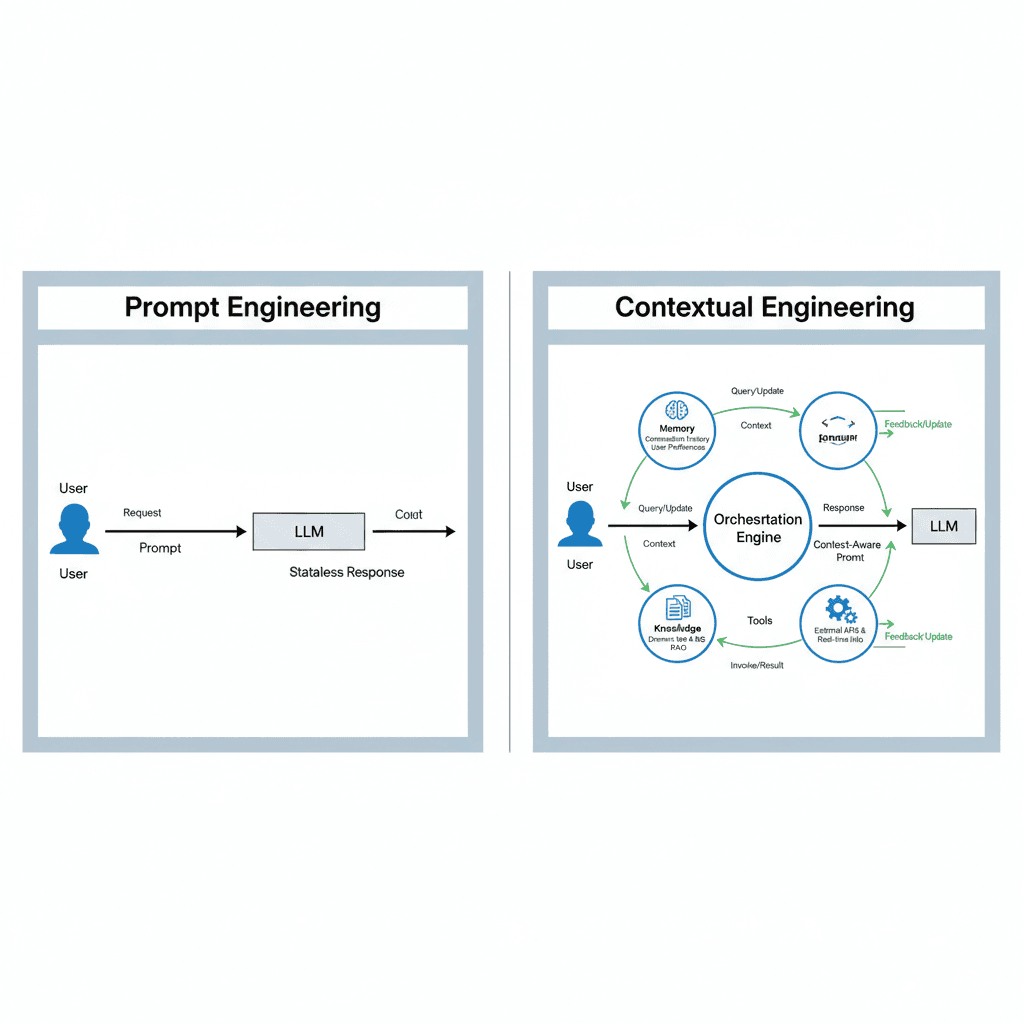
For years, developers relied on prompt engineering—crafting precise instructions to nudge LLMs into useful behavior. This worked for experimentation and small tasks, but the cracks appeared quickly in real-world applications: limited personalization, lack of memory, and brittle workflows.
The solution is Contextual Engineering. Instead of optimizing individual prompts, it focuses on system-level design: how memory, goals, domain knowledge, and external signals are orchestrated dynamically. It’s like upgrading from a calculator that solves single equations to a collaborator that remembers your entire project.
What Is Contextual Engineering?
Contextual Engineering is the discipline of embedding rich, evolving context into AI systems so they can act intelligently across sessions—not only within a single interaction.
It considers multiple layers of context:
- User identity and preferences → personalization
- Task goals and progress → long-term reasoning
- Conversation history → continuity
- Domain-specific knowledge → accuracy in specialized fields
- External tools and environment → real-world adaptability
In practice, this means designing memory pipelines, retrieval strategies, and context-refresh mechanisms rather than manually hacking prompts.
Think of it as the difference between asking a stranger for directions versus working with a personal guide who already knows your habits, constraints, and past journeys. One gives you a static answer. The other walks alongside you.
Why Context Matters: The Role of Context Size
At the heart of this shift is a critical insight: LLMs don’t inherently understand continuity—they operate within token limits.
What Is Context Size?
Every model has a maximum context window:
- GPT-3.5 → ~4,000 tokens
- GPT-4 →Up to 128,000 tokens in the latest high-context versions
- Claude 4→ ~Up to 1,000,000 tokens for specific use cases
These numbers are large but finite. Even with 200k tokens, you can’t load an entire textbook, project history, and knowledge base simultaneously.
The Challenge
- Too little context → the model forgets key details
- Too much context → irrelevant or noisy input overwhelms the model
The Solution
Contextual Engineering designs smart context managers that:
- Filter what matters most right now
- Compress long histories into summaries
- Refresh context dynamically as new goals emerge
This makes interactions not only efficient but also scalable for enterprise systems.
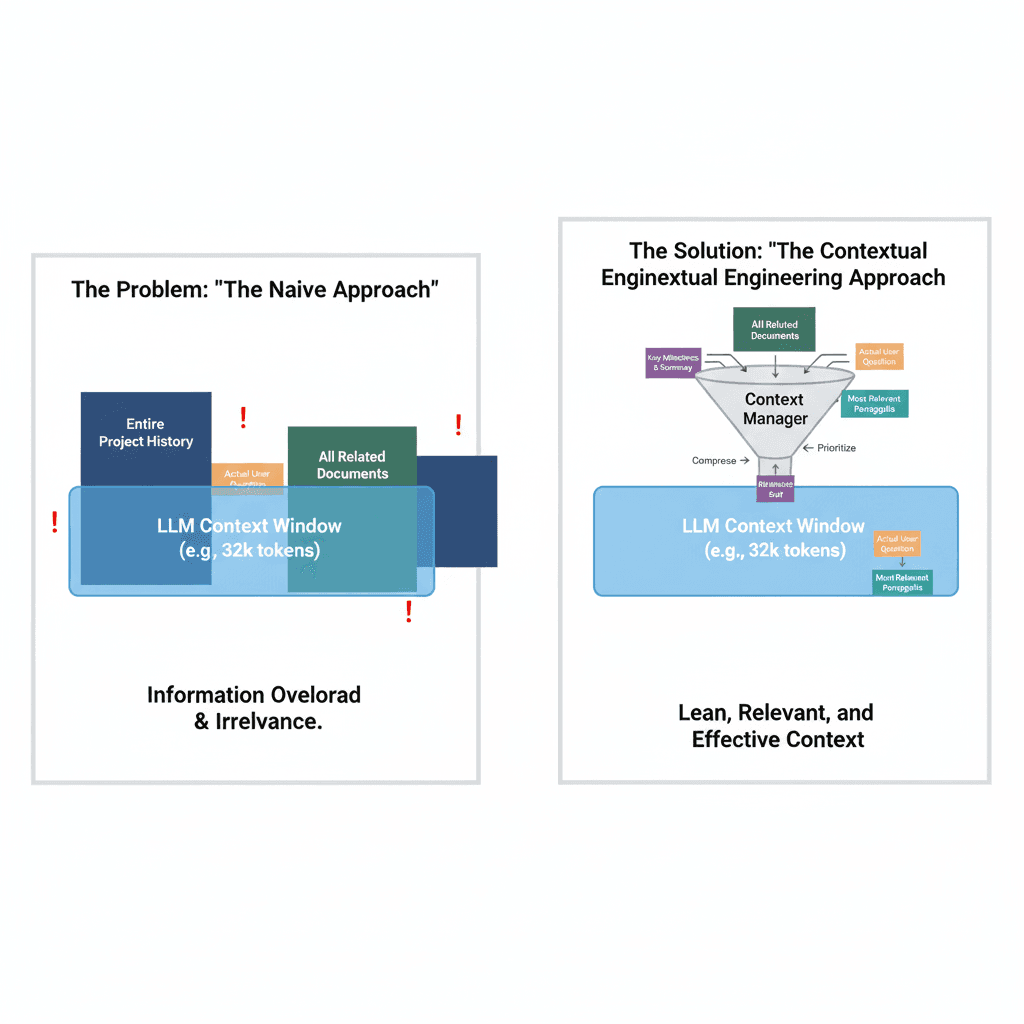
Think of it like memory in a human conversation. If you’re planning a trip with a friend, you don’t recall every word of every discussion. You retain the highlights—budget, dates, preferences—and use those to move forward. Contextual engineering gives AI this same selective memory.
Why Prompt Engineering Isn’t Enough
Prompt engineering taught us a lot, but it assumes:
- Every question is independent (stateless)
- The model has no recall of past tasks
- Inputs can be handcrafted every time
In real-world applications, this falls apart. Consider:
- Healthcare: A digital health assistant must remember medical history across sessions.
- Finance: A portfolio tracker must adapt to risk tolerance over time.
- Legal: An AI paralegal must recall earlier case references.
Without structured memory and continuity, users experience frustration, redundancy, and inefficiency.
This is why organizations adopting AI at scale are moving beyond prompts. Prompt tweaks might work for a demo, but scaling requires architectures that treat context as a first-class citizen.
A More Human-Like Model of Interaction
Humans communicate by carrying context forward:
- We don’t reset conversations every time we speak
- We adapt based on prior knowledge of people and tasks
- We build shared memory over time
Contextual Engineering mirrors this by combining:
- Short-term memory (session-level history)
- Long-term memory (persistent facts, preferences, knowledge)
- Real-time situational awareness (environment and tools)
This layered memory design allows AI systems to interact with the same fluidity as a human collaborator.
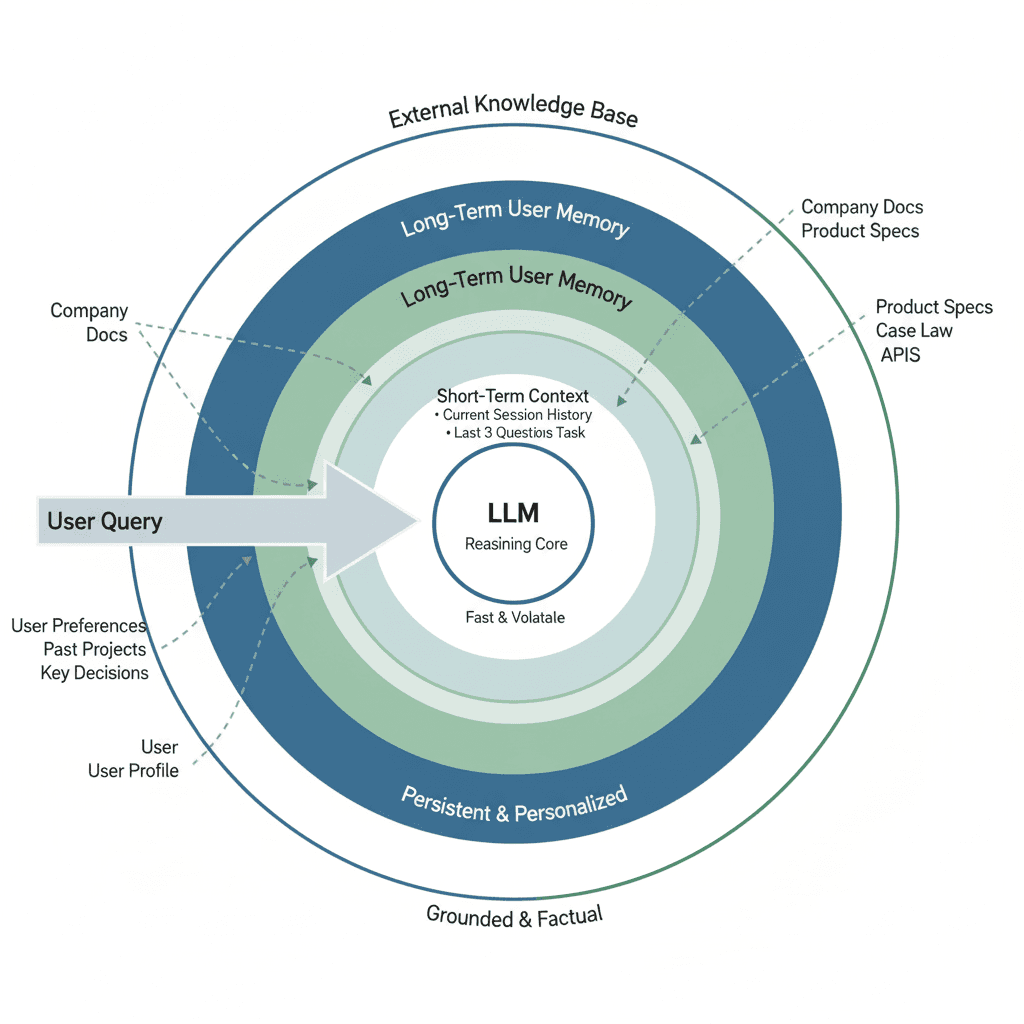
For enterprises, this means customers don’t have to repeat themselves every time they interact with a support bot. For researchers, it means queries can build upon prior discoveries. For individuals, it feels like AI finally “knows” them.
Case Study: Building a Context-Aware Research Assistant
Imagine designing an AI for academic literature review:
- Ingest Sources → Parse and semantically index papers.
- Track Goals → Persist with the researcher’s topic across sessions.
- Inject Memory → Bring back prior questions and notes.
- Summarize & Compare → Offer evolving synthesis, not isolated answers.
- Manage Context Window → Use scoring to decide which citations stay in focus.
The result: a dynamic assistant that evolves alongside the researcher instead of resetting each session.
Now imagine extending this to corporate knowledge assistants, patient care systems, or supply chain monitors. The same principles apply—contextual pipelines ensure continuity, trust, and reliability.
From Inputs to Intelligent Systems
The future of AI is not about bigger models or clever prompts—it’s about architected intelligence.
Contextual Engineering is emerging as the backbone of enterprise AI, enabling systems that:
- Carry forward memory
- Adapt to user identity and goals
- Scale across teams and organizations
- Deliver consistent, reliable outputs
For developers and engineers, this means a shift in mindset: from tinkering with inputs to designing contextual ecosystems.
In the same way software engineering matured from scripts to full-stack systems, AI development is maturing from prompts to context-aware architectures. The winners in this new era will be those who engineer for continuity, not convenience.
Conclusion
AI that forgets is useful, but limited. AI that remembers and adapts becomes transformative.
Contextual Engineering is not a buzzword—it’s a design philosophy reshaping how we build intelligent systems. It moves us from stateless interactions to context-driven architectures that feel natural, reliable, and human-like.
For practitioners who’ve felt the limits of prompt engineering, this is the signal to go deeper.
Because in AI, context isn’t optional—it’s everything.