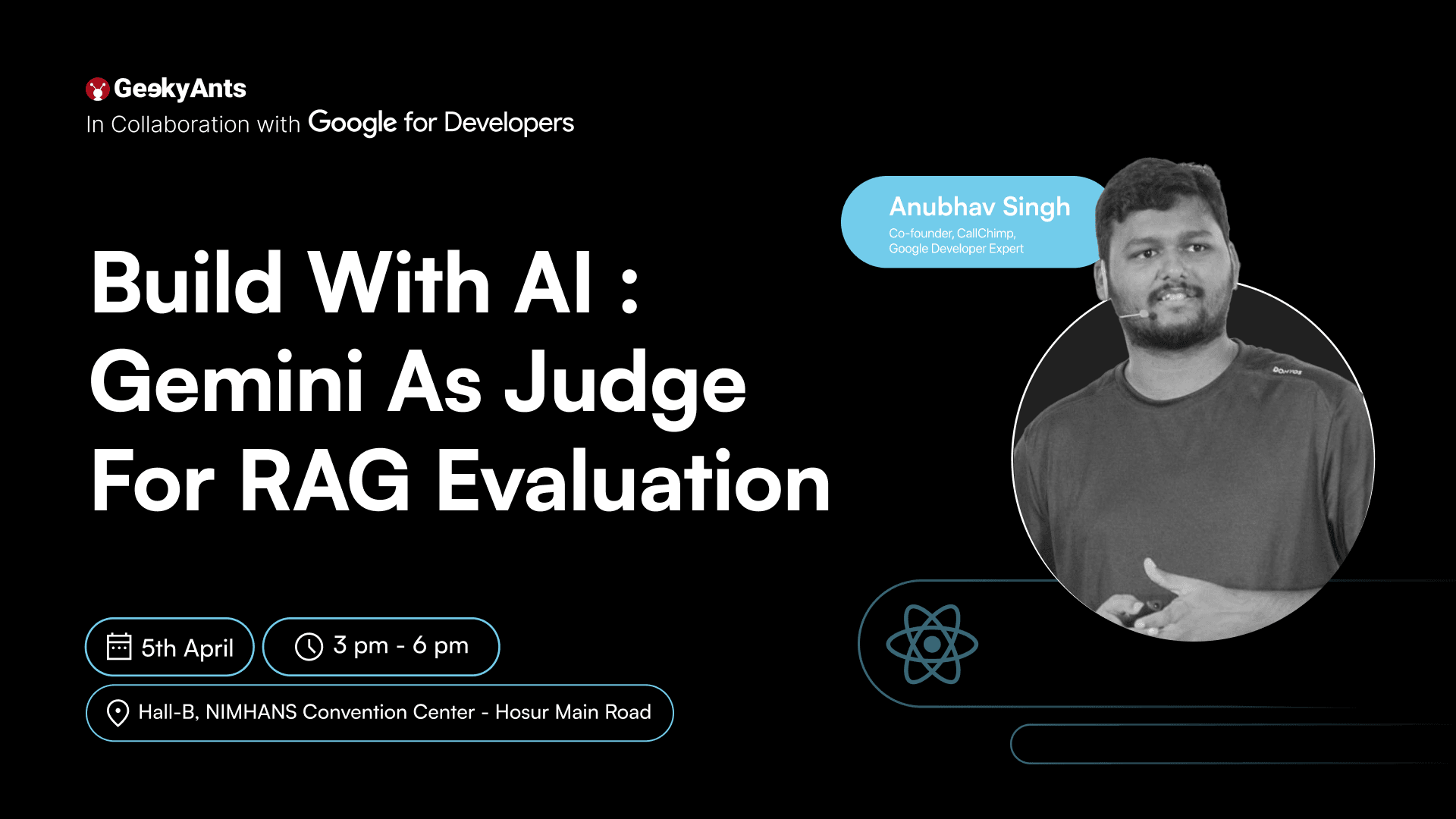

Editor’s Note: This blog captures insights from a talk delivered by Anubhav Singh, Co-founder of Callchimp.ai, at the React Native Meetup. His work represents a new class of AI innovation—one grounded not in gimmicks but in infrastructure, memory, and long-term reliability.
Despite a decade of progress, AI assistants remain stubbornly unreliable. Many still fail at the basics—forgetting conversations, misfiring commands, and leaving tasks half-finished. During the React Native Meetup, I challenged this status quo with a simple question: “We have had assistants for years. None of them have worked. Why are we okay with that?”
At Callchimp, we’ve reimagined the assistant paradigm—shifting from reactive bots to reliable agents that remember, plan, and execute. This blog explores how we have built that vision from LLMs and persistent memory to edge-first deployment and seamless integration with React Native.
The Real Problem: Memory and Reliability
It’s tempting to believe that the next wave of assistants will emerge from smarter language models or fancier interfaces. But the deeper issue is structural—most assistants lack state or continuity. They operate statelessly, responding to prompts without any persistent awareness of prior context or future goals.
There’s no memory. No understanding of state. A user interacts, the model replies, and five minutes later, everything is forgotten.
This makes it nearly impossible for assistants to handle multi-step workflows, maintain continuity, or build trust over time. Without memory, there’s no follow-through—and without follow-through, assistants fail to deliver meaningful utility.
A Smarter Architecture: Plans, Memory, and Action
At Callchimp, we approached this problem with a fresh lens. Memory and planning are not features—they are foundational. Assistants must behave like dependable partners, not reactive bots.
Our system architecture is designed with three key principles:
- Persistent Memory for every user—stored locally, encrypted, and always accessible.
- Planning before Generation—our agents start by understanding what needs to be done and only then invoke LLMs to carry out those actions.
- Edge-First Deployment—models run directly on-device wherever possible, minimizing latency and safeguarding privacy.
This is not about generating clever responses. It is about assistants that can coordinate a booking, reschedule a meeting, or manage long-term goals—without losing the thread.
React Native: The Backbone of Speed and Portability
To power this kind of intelligence at scale, we needed a framework that could support rapid iteration and performance without compromise. React Native emerged as the ideal fit.
Its cross-platform flexibility lets us build once and deploy everywhere—on Android, iOS, and the web. But more importantly, it supports a modular architecture where AI capabilities can be deeply integrated into the app layer.
We embed language models within the app binary. SQLite engines manage local memory. Agents can plan and act, even offline. This ensures assistants are fast, responsive, and resilient—without needing to call home to the cloud.
It’s our answer to growing concerns about data privacy and over-dependence on third-party APIs. Memory remains on-device. Control stays with the user.
Real-World Impact: Smarter Assistants for Smarter Teams
The real test of any assistant lies in how well it performs under real-world constraints. We have seen Callchimp shine in enterprise and B2B and B2C environments—where assistants don’t just answer questions but complete actual work.
Use cases include:
- Voice-led scheduling through automated calling agents.
- Memory of previous interactions, enabling contextual follow-ups.
- Multi-day task execution, driven by plans, not prompts.
In these scenarios, our assistants behave more like executive partners than bots. They remember. They adapt. And they deliver.
Beyond Chat: Rethinking the Assistant Paradigm
One of the biggest barriers to progress in this space has been the industry’s obsession with chat. Prompt-response interfaces are easy to build but hard to scale. They break down when tasks span time, involve decisions, or require nuance.
“Chat is a user interface, not a task execution model.”
We have flipped the paradigm. At Callchimp, assistants don’t wait to be told what to do. They act proactively. They check schedules, propose updates, and make changes autonomously. Users don’t have to micromanage. The system learns, adapts, and delivers with minimal friction.
It’s a quiet but radical shift: AI not as a novelty but as a dependable co-pilot.
Final Thoughts
The future of AI assistants lies beyond chat interfaces and clever prompts. It demands systems that can think, remember, and act consistently and autonomously. By combining persistent memory, edge-first architecture, and React Native’s cross-platform agility, we’re building assistants that are not just responsive but reliable. At Callchimp, we believe the next generation of AI will be defined not by what it says, but by what it gets done, quietly and effectively, in the background.