

Editor’s note: This article was originally written by Boudhayan Ghosh and published in June 2025. It was substantially updated by Shivangi Agarwal in July 2026 to include recent technology updates, implementation practices, updated statistics, and examples.
Key Takeaways
- Real-time fraud detection is now a business-critical function for U.S. enterprises operating in high-volume, high-trust environments such as finance, e-commerce, and digital services.
- This guide provides a complete implementation blueprint—from data ingestion and model training to real-time decision-making and system feedback loops.
- Designed for CTOs, FinTech founders, and security leaders, it outlines the AI tools, architectural choices, and design strategies needed to build scalable, adaptive detection systems.
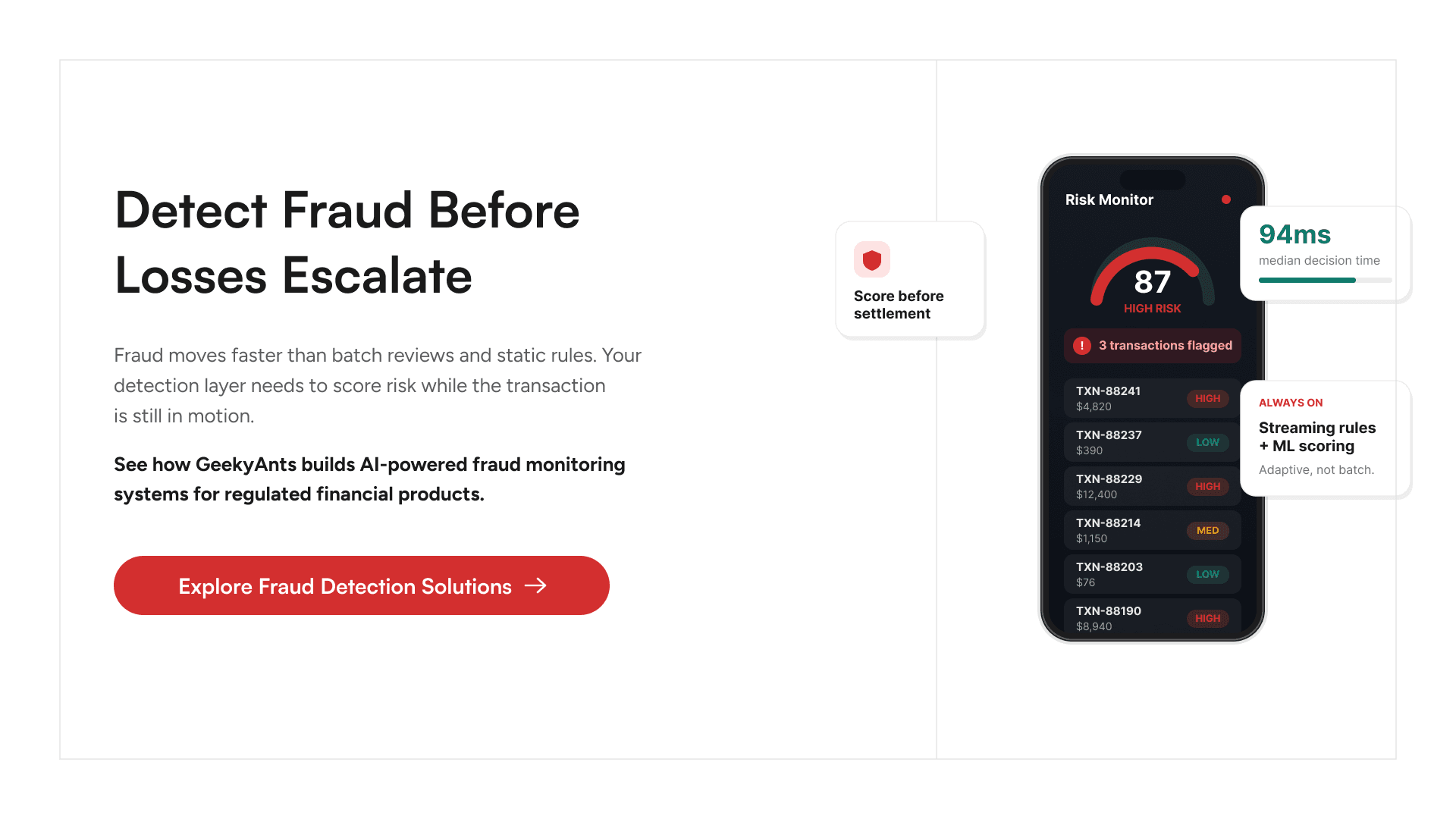
Every digital transaction must be made in milliseconds: approve it, block it, or send it for review. Legacy fraud systems constantly struggle to make that decision accurately at a large scale. While there is an increasing volume of transactions, fraudsters are already exploiting your fragmented data and patterns.
Users want instant approvals. Regulators demand swift, transparent responses. There is no room for delay. An AI-powered real-time fraud detection system is the best way to close this gap while providing the added layer of protection you require. It can assign risk, detect known and emerging patterns and trigger appropriate responses without slowing active users down.
Unlike rule-based systems, AI models can identify relationships and anomalies that static conditions may miss. This guide shows how to build an AI-powered fraud detection system with real-time decision-making, production-ready architecture, and the tools required to support scale and accuracy.
Understanding the U.S. Fraud Landscape
In the U.S., fraud thrives in complexity. High transaction volumes, a fragmented financial infrastructure, and the rise of digital-first platforms have created an environment where speed is essential, but here, gaps are easy to exploit.
Attackers understand this. They move between payment networks, digital wallets, and online marketplaces, adjusting tactics faster than traditional defences can respond. As fraud becomes more coordinated and less predictable, businesses face pressure not only to detect it quickly but to stay one step ahead.
Common Types of Fraud in the U.S
Fraud Type | Description |
|---|---|
Credit Card Fraud | Stolen card credentials used for unauthorised purchases or withdrawals. |
Identity Theft | Criminals access personal data to open or breach accounts. |
Synthetic Identity | Fake identities are created using blended real and fabricated details. |
Account Takeover (ATO) | Attackers gain control of legitimate accounts through stolen credentials. |
Business Email Compromise (BEC) | Targeted scams aimed at finance or HR teams to divert funds. |
These methods exploit weak verification flows, isolated data, and the growing need for instant user experiences.
Fraud Statistics: The Numbers Behind the Threat
Recent data confirms that fraud is rising fast.
- $15.9 billion in total losses were reported by consumers in 2025.
- $7.9 billion lost to investment scams alone, making it the costliest fraud category.
- $2.1 billion was lost to scams that began on social media platforms.
- $3.5 billion in losses tied to impostor scams, with more than 1 million reports.
These numbers, sourced from the FTC (March 2025 - 2026), highlight the scale of the crisis. Investment fraud generates some of the highest loss rates, while impersonation and social media scams remain the most widespread methods used to target consumers.
In addition, the CFPB reports a sharp increase in complaints linked to unauthorized transactions and identity fraud in fintech and peer-to-peer (P2P) payment services. Javelin Research notes a shift from basic fraud to more sophisticated threats involving synthetic IDs and ATOs
Challenges faced by Businesses in Real-time Fraud Detection.
Building a real-time fraud detection system sounds ideal, but in practice, most businesses run into a few core roadblocks:
- High Transaction Volumes: Large platforms process thousands of events per second. Screening this volume in real time without slowing down the user experience requires low-latency infrastructure and scalable architecture.
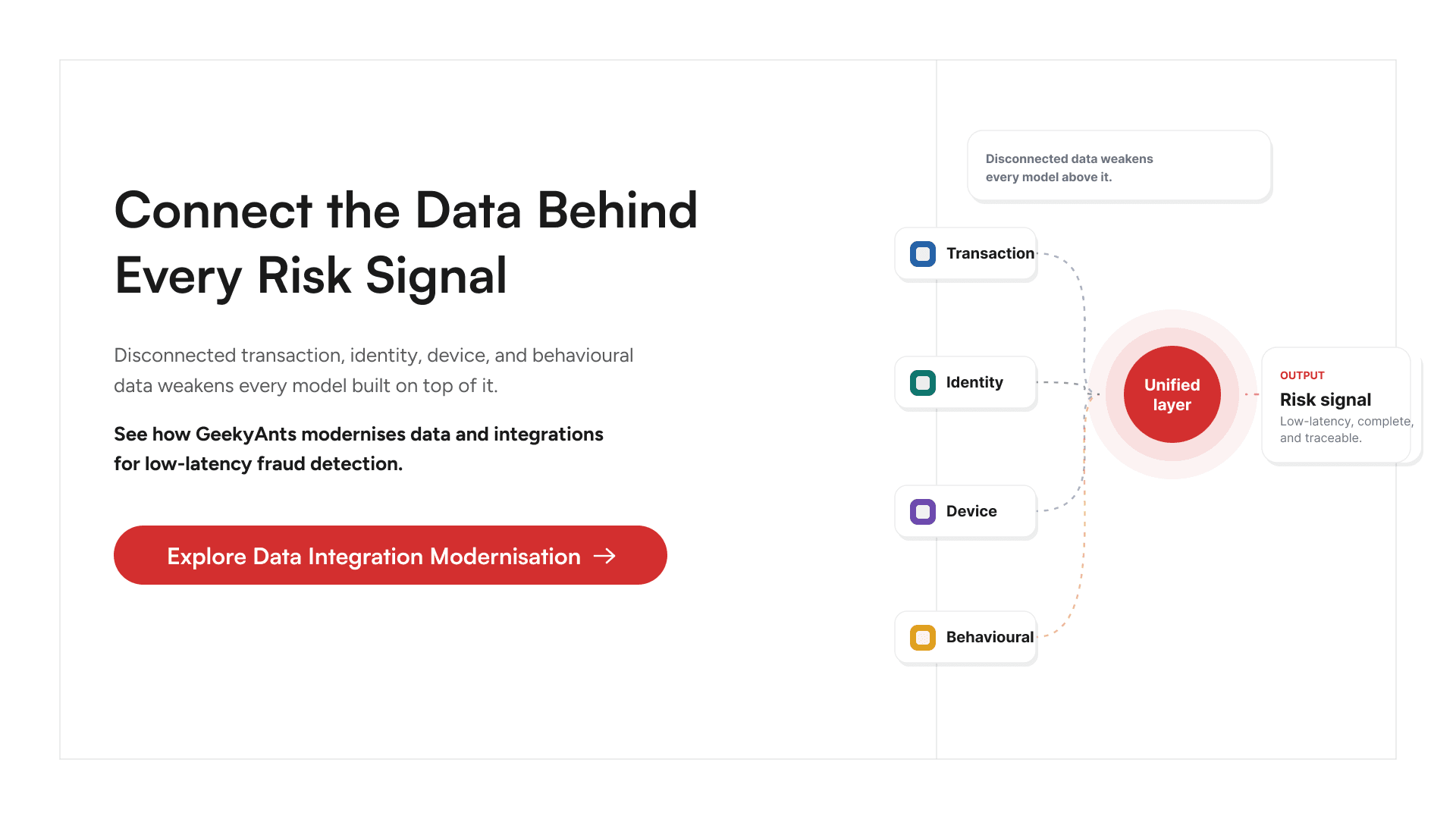
- Siloed Data Systems: Behavioural, transactional, and identity data often live in separate systems. Without a unified view, it becomes difficult to assess risk accurately or respond fast enough.
- Evolving Fraud Patterns: Fraud tactics shift constantly. Static rules become outdated quickly, and legacy models struggle to catch emerging behaviours like synthetic identity abuse or coordinated micro-attacks.
- False Positives and User Friction: Aggressive detection can trigger unnecessary alerts, leading to declined transactions or account freezes. This creates friction for genuine users and impacts retention and trust.
- Compliance and Audit Pressure: Real-time detection must also meet regulatory standards. Systems need to be explainable, traceable, and aligned with laws like CPRA, GLBA, and the FTC Safeguards Rule, without slowing down decision-making.
Barriers to Real-Time Fraud Detection in U.S. Enterprises
Even with awareness and available tools, execution remains a challenge. Most businesses face the following roadblocks:
- Volume Overload: Billions of transactions per year demand scalable, low-latency screening.
- Siloed Data: Legacy systems and third-party integrations make unified detection difficult.
- Evolving Tactics: Fraud patterns shift quickly, leaving static rules behind.
- False Positives: Incorrectly flagged users can disrupt genuine users and erode trust.
U.S. Regulations and Compliance
Overview of Relevant U.S. Laws
Gramm-Leach-Bliley Act (GLBA)
The GLBA mandates that financial institutions safeguard consumers' sensitive data. It requires financial institutions to implement comprehensive information security programs that include administrative, technical, and physical safeguards to protect customer data. Non-compliance can result in significant penalties, including fines up to $100,000 per violation for organisations and $10,000 per violation for individual executives.
Payment Card Industry Data Security Standard (PCI DSS)
PCI DSS sets security standards for organisations handling credit card information. Version 4.0 emphasises a risk-based approach, requiring entities to implement robust security measures, such as encryption and multi-factor authentication, to protect cardholder data. AI can aid in compliance by automating compliance management tasks, such as log monitoring and report generation, ensuring consistent adherence to the stringent requirements.
FTC Safeguards Rule
The FTC’s Safeguards Rule — part of the GLBA — requires financial institutions to develop, implement, and maintain a comprehensive information security program. Recent amendments mandate that institutions report data breaches involving 500 or more consumers to the FTC within 30 days of discovery. Non-compliance can result in severe penalties, underscoring the importance of robust data protection measures.
Compliance Considerations When Implementing AI in Fraud Detection
Bringing AI into fraud detection adds obligations on top of the technical build. Getting these wrong is to pay a heavy cost of regulatory exposure and lost trust.
- Data Privacy and Security: AI systems must handle personal data in compliance with privacy laws, ensuring data is collected, processed, and stored securely.
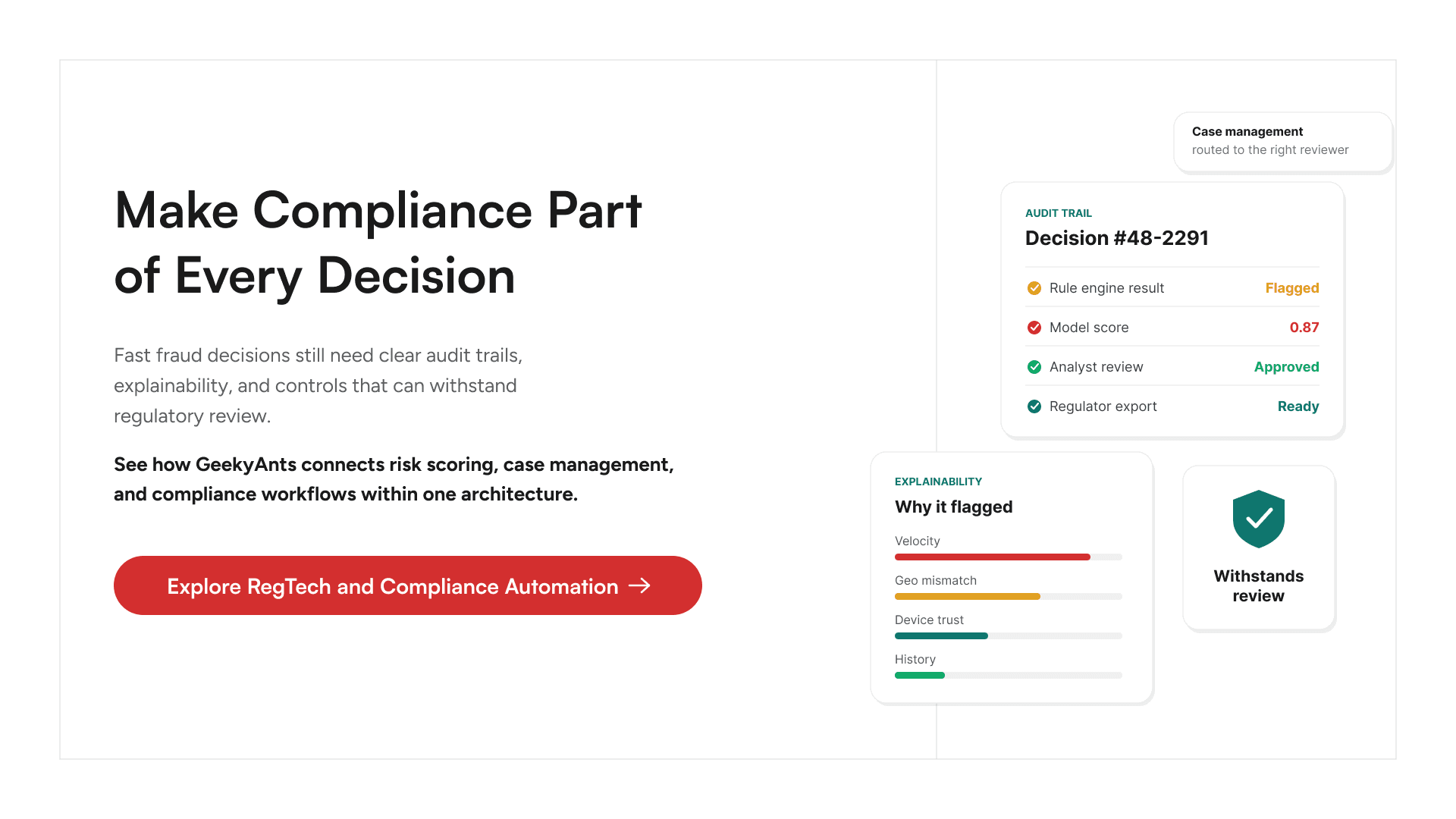
- Transparency: Organizations should ensure AI decision-making processes are transparent and explainable to stakeholders and regulators.
- Bias and Fairness: AI models require regular auditing to detect and mitigate bias that may result in discriminatory outcomes.
- Accountability: Define clear ownership to oversee AI systems and address any issues that arise.
Mitigating these risks demands a strong commitment to ethical AI — including regular audits, transparent governance, and strict adherence to regulatory standards.
Real-time fraud detection is not just a technology decision. It is a strategic investment that affects infrastructure, compliance, user experience, and long-term trust. Success depends on more than speed—it requires intelligent systems, connected data, and continuous learning.
Why Real-Time Fraud Detection Matters: A Strategic Priority
Legacy fraud systems were built for a world that moved more slowly. They scanned logs after the fact, flagged transactions hours later, and relied on fixed rules to distinguish between the good and the bad. That worked when threats were simpler and speed was a luxury.
Today, it is a liability. Fraud attempts unfold in milliseconds. Attackers test systems, adapt in real time, and slip past static defences before anyone notices. Meanwhile, businesses are left chasing alerts after the damage is done, handling false positives that frustrate users, missing new patterns that do not match old rules, and watching systems strain as volumes rise. What once served as a protective shield now risks becoming a bottleneck. To keep pace with modern threats, fraud detection must evolve from slow reaction to real-time intelligence.
The Cost of Delayed Detection
Legacy systems rely on rule-based logic and manual review processes. They function in delay cycles, not continuous streams. That lag creates space for threat actors to act undetected.
Financial Impact
Delayed detection leads to escalating losses. In 2025, U.S. consumers reported over $15.9 billion in fraud, $7.9 billion from investment scams and $3.5 billion from impostor fraud (FTC, March 2025- 2026). Much of this occurred before systems could respond. Chargebacks, unauthorized transfers, and recovery costs continue to strain sectors like banking and e-commerce.
Compliance Pressure
Regulatory frameworks such as the FTC Safeguards Rule require the timely detection, reporting, and mitigation of data breaches. Failure to meet these standards invites fines, legal scrutiny, and increased audit risk.
Trust Degradation
Users who experience fraud on your platform often lose confidence permanently. A single breach or false denial can lead to churn, negative reviews, and long-term damage to customer loyalty.
Operational Disruption
Fraud incidents demand cross-functional attention across legal, engineering, support, and security teams. In the event of a fraud, they are pulled into reactive mode, slowing down product delivery and diverting focus from strategic work.
Real-time detection helps prevent these outcomes by enabling faster decisions, earlier intervention, and more reliable fraud control.
Speed vs. Accuracy: Finding the Right Line
Effective fraud detection depends on how well systems can combine speed with precision. Both are essential, but each comes with trade-offs that must be addressed in system design.
Approach | Strengths | Drawbacks |
Speed-Focused | Reduces exposure. Limits time to act. | Can mislabel a valid activity. |
Accuracy-Focused | Maintains customer trust. Fewer false alarms. | May detect fraud too late. |
AI-Driven Balance | Fast, adaptive, and refined by real-world data. | Needs continuous training and monitoring. |
AI models trained on behavioral patterns help resolve this tension by enabling real-time decisions without overwhelming the system with false alerts.
Importance of Fraud Detection in Modern Business
The shift to digital-first operations has made fraud a persistent and high-impact threat. Businesses must treat detection as a core capability, not a background process.
Fraud has scaled with digital growth
- The rise of mobile wallets, embedded finance, and e-commerce has expanded the threat surface. Over 80% of U.S. consumers now use digital payments (McKinsey). Fraud tactics have evolved to exploit this velocity and volume.
It is a strategic business risk
- Fraud impacts more than operations. It affects customer trust, revenue stability, and legal exposure — all of which carry direct consequences at the leadership level.
Legacy defences are insufficient
- Traditional systems cannot keep pace with modern fraud patterns. Advanced attacks bypass static rules in milliseconds, often before detection begins.
Detection must be real-time and intelligent
- Effective systems monitor continuously, adapt to new behaviors, and limit false positives that disrupt genuine users.
Regulatory pressure is growing
- Laws like the Gramm-Leach-Bliley Act, FTC Safeguards Rule, and PCI DSS require companies to prove that fraud controls are active, predictive, and auditable.
Non-compliance is costly
- Penalties, investigations, and legal action often exceed the investment needed for real-time prevention.
Core Components of an AI-Powered Real-Time Fraud Detection System
Real-time fraud detection works by linking fast-moving signals with intelligent decisions. The system is built in layers — each designed to act within seconds and adapt over time.
1. Data Collection
Captures high-volume data from transactions, devices, user behavior, and external threat feeds. The goal is to build a unified view of risk in motion.
2. Stream Processing
Analyses live data as it arrives. Patterns are checked instantly to flag anomalies without waiting for batch cycles.
3. Machine Learning Models
Learn from historical and behavioral patterns. Models evolve continuously to catch new tactics and reduce false positives.
4. Risk Scoring Engine
Each transaction is evaluated and assigned a risk score. This score guides real-time decisions — approve, block, or escalate.
5. Automated Response
Triggers immediate actions: account freeze, step-up verification, or team alerts. Decisions happen before damage occurs.
6. Feedback Loop
Every outcome, whether flagged, dismissed, or confirmed, is fed back into the system to improve model accuracy and keep detection logic up to date.
7. Scalability Layer
The system runs across millions of transactions with minimal delay. It adapts to traffic spikes and meets uptime standards across regulated industries.
Before You Build: Prerequisites and Readiness
Before you start writing a model, understand that risk lives in what you have not yet put in place. A real system starts failing at its foundations when the data, infrastructure and ownership are not ready for it. Confirm these pointers first.
1. Unified Data
Consolidate transactional, behavioral, identity and device or session data in a single layer. This will allow your scoring engine to be able to reach in real time.
2. Labelled Fraud History
Supervised models require tagged datasets and confirmed cases to learn from. Plan for a heavy class imbalance because genuine transactions vastly outnumber fraud.
3. A Streaming and Feature-Store Baseline
Use event streamers: Kafka, Kinesis, or Pub/ Sub. Add that with a feature store that serves the same features to both training and live inference. The result will be a guaranteed model that behaves identically across production and testing.
4. Defined Latency and Uptime Targets
Agree the numbers up front. A sub-50ms scoring budget and 24/7 availability are typical for regulated, high-volume environments.
Step-by-Step Guide to Building the Fraud Detection System in the USA
Real-time fraud detection is not a single tool or model. It is a full-system approach that monitors, learns, and acts within milliseconds. From login events and payment flows to device signals and IP data, every action must be processed, scored, and addressed in real time.
The following steps are based on practical implementation experience, with a focus on AI integration, system performance, and operational scalability.
1. Real-Time Data Ingestion and Event Streaming
Fraud signals arrive from various sources — transaction logs, login attempts, user metadata, geolocation, device IDs, and external blacklists. To handle these in real time, the system must begin with a robust event ingestion layer.
Recommended Tools & Platforms:
- Apache Kafka, Amazon Kinesis, or Google Pub/Sub for stream ingestion.
- Apache Flink, Spark Streaming, or Kafka Streams for real-time processing.
AI Role:
Unsupervised models (e.g., autoencoders, k-means) can be applied at this stage to detect statistical outliers early in the stream. These models run lightweight scoring to flag anomalous sequences (like repeated failed logins followed by a high-value transfer).
2. Real-Time Feature Engineering and Storage
Raw data must be turned into features that machine learning models can understand. These include time-based aggregates, device risk scores, behavioural patterns, and transaction histories.
Recommended Tools:
- Feast for feature store management.
- Redis or DynamoDB for online feature retrieval.
- Snowflake, BigQuery, or S3 for offline aggregation.
AI Role:
AI enriches this layer with graph features (to detect collusion), vector embeddings (for email or IP patterns), and statistical anomaly scores. These derived features improve the model’s ability to generalise beyond basic thresholds.
3. Machine Learning Model Development
This is the analytical heart of the system. The models here are responsible for making the fraud/no-fraud decision in real time.
Recommended Algorithms & Frameworks:
- XGBoost, LightGBM, and CatBoost for tabular supervised learning.
- PyTorch, TensorFlow, or Scikit-learn for neural networks and experimentation.
- Autoencoders, One-Class SVM, or DBSCAN for unsupervised detection.
Recommended Platforms:
- AWS SageMaker, Google Vertex AI, or Databricks MLflow for training pipelines, hyperparameter tuning, and model versioning.
AI Role:
AI must evolve with incoming data. Techniques like online learning, cost-sensitive learning, and SMOTE help deal with imbalanced fraud datasets. Interpretability tools like SHAP or LIME support explainable decisions for compliance teams.
4. Low-Latency Model Inference
Trained models are deployed as fast, resilient APIs that return predictions within milliseconds. This step must meet sub-50ms latency thresholds without dropping accuracy.
Recommended Tools:
- FastAPI, Flask, or Node.js microservices for API deployment.
- TorchServe, TensorFlow Serving, or SageMaker Endpoints for model hosting.
- ONNX Runtime or TensorRT for optimised inference at the edge.
AI Role:
AI performance depends on deployment architecture. GPU-accelerated servers, edge inferencing (e.g., Lambda@Edge), and batch-inference batching must all be tuned for peak concurrency and speed.
5. Decision Making and Automated Response
Fraud scores alone do not block fraud. A decision engine is needed to combine scores with rules, thresholds, and business logic to determine action in real time.
Recommended Tools:
- Drools, Blaze Advisor, or custom in-house rule engines.
- Integrations with PagerDuty, Slack, or ServiceNow for alerts.
AI Role:
AI enables dynamic scoring thresholds, model ensembles (transaction + device + behavioural), and confidence-based routing (e.g., low-risk: allow, mid-risk: challenge, high-risk: block). This hybrid logic enables security without creating friction.
6. Monitoring, Feedback, and Continuous Learning
Once deployed, the system must be continuously monitored and improved. Fraud evolves fast — so must your models.
Recommended Tools:
- Prometheus, Grafana, and Datadog for infrastructure metrics.
- Neptune.ai, MLflow, or custom dashboards for model metrics and drift detection.
AI Role:
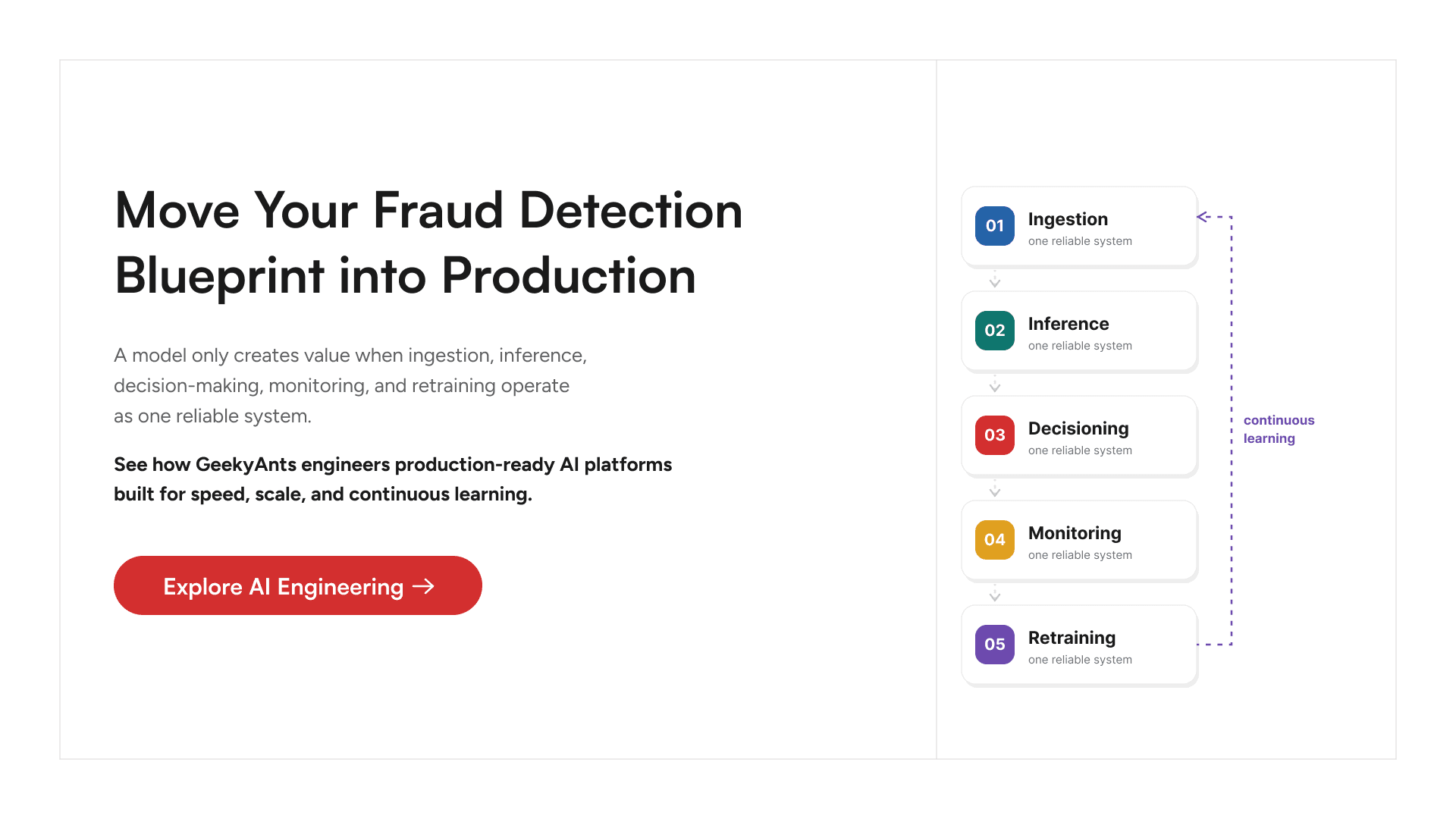
Feedback loops must power continuous retraining. Models should retrain weekly or daily using confirmed fraud cases. Active learning pipelines, concept drift detection, and A/B testing of models ensure your defences stay ahead of new threats.
Building an AI-powered real-time fraud detection system requires a modular, end-to-end pipeline covering data ingestion, feature engineering, modeling, low-latency inference, decision-making, and continuous learning.
Each layer must support speed, scale, and adaptability, with tools like Kafka, Flink, XGBoost, SageMaker, and SHAP enabling sub-second, AI-driven responses that evolve with every transaction.
Fraud Detection Systems: Challenges and Considerations
Modern fraud detection systems face pressure from both attackers and internal limitations. Scaling detection requires more than good models. It demands alignment across data, infrastructure, and regulation. These are the core challenges enterprises must solve for.
1. Imbalanced and Fragmented Data
Most transactions are legitimate. Fraud cases make up a small fraction of the total, which weakens model training. Many organisations also store behavioural and transactional data across separate systems, making it hard to evaluate risk in real time.
In a 2025 survey of 300 senior payment fraud and risk executives found that 83% said AI had helped their organisations reduce false positives and customer churn during the previous year.
This further proves how real-time pattern recognition, behavioural data, and more adaptive risk scoring can identify suspicious transactions much faster while allowing payment to proceed without delays.
2. Model Drift and Evolving Threats
Attackers constantly change tactics. Static models lose effectiveness quickly if they are not retrained on new behaviour patterns. In 2025, UK Finance reported a sharp rise in synthetic identity fraud. Many institutions traced incidents back to outdated models that failed to adapt to subtle changes in application and transaction behaviour.
Continuous learning and adaptive feedback loops are now considered foundational in every high-risk environment.
3. False Positives and User Friction
Systems that overcorrect for fraud can block genuine users. Declined payments, repeated authentication prompts, and account freezes create frustration. In sectors like e-commerce and digital banking, this friction directly impacts revenue and retention.
Reducing false positives requires models that factor in customer history, session behaviour, and context, not just transaction size or location.
4. Real-Time Detection at Operational Scale
Fraud happens fast. Detection must happen faster. This is difficult at enterprise scale, where systems must process thousands of events per second across APIs, mobile apps, and backend platforms.
Mastercard disclosed that it screens over 160 billion transactions annually using real-time risk scoring models that respond in under 50 milliseconds.
5. Infrastructure Constraints
Many organisations still rely on legacy systems that were built for batch processing. These systems are often too slow or rigid to support modern fraud detection workflows. Adding real-time scoring and automated response on top of legacy architecture introduces delays and integration issues.
Some teams now build modular fraud engines that operate independently from core systems to reduce impact and speed up rollout.
6. Privacy Risks and Compliance Pressure
Fraud detection depends on sensitive data, location, behavioural analytics, device fingerprints, and financial histories. Regulations like PCI DSS, GDPR, and the FTC Safeguards Rule require this data to be protected, auditable, and used responsibly.
By limiting data access to context-based use, they maintained real-time performance while meeting compliance standards across jurisdictions.
Real-World Use Cases & Case Studies: AI-Powered Fraud Detection in Action
AI is no longer theoretical in the fight against digital fraud. From fintech startups to global banks, real-time AI systems are actively preventing billions in losses, reducing false positives, and protecting customer trust. Below are four standout cases that show how AI-powered fraud detection delivers results at scale.
GeekyAnts
Challenge:
PayPenny needed to scale its cross-border money transfer platform securely across 5+ regions while staying compliant with regional regulations like FINTRAC (Canada) and preventing fraud.
Solution:
GeekyAnts built real-time AI safeguards into the app from day one. Every transaction was monitored for risk using machine learning models that assessed user behaviour, location, and anomalies like blacklisted accounts. Biometric KYC and adaptive risk rules reduced both fraud and manual review.
Impact:
- Over $400M processed securely across Canada, UK, Europe, and Australia
- 120K+ active users with minimal fraud incidents
- 350K+ downloads, driven by trust in secure and seamless transfers
- Significant reduction in false alarms and operational overhead
JPMorgan Chase
Challenge:
Rule-based fraud systems generated high false positives and could not keep up with evolving threats, straining customer experience and investigation teams.
Solution:
JPMorgan deployed machine learning to model customer behaviour, using real-time context like device, location, and even NLP analysis of chat logs. Alerts were scored and prioritised using predictive models.
Impact:
- Fraud alerts became 300x faster
- False positives dropped significantly
- $1.5B saved across fraud, credit, and ops
- Industry benchmark for AI-first fraud prevention
Mastercard
Challenge:
With 160 B+ annual transactions, Mastercard needed sub-second fraud detection that could scale globally and adapt to emerging attack vectors.
Solution:
Mastercard’s Decision Intelligence system uses deep learning, behavioural signals, and real-time scoring (~50ms) to flag or block suspicious activity. It learns from every transaction and syncs with issuers for immediate user verification.
Impact:
- $35B in fraud prevented over 3 years
- Fewer false declines, improving CX and merchant revenue
- Lower operational costs through automation
- Seamless, real-time fraud response at a global scale
Klarna
Challenge:
The BNPL giant needed to fight identity fraud and account takeovers without slowing down checkout or hurting conversion rates.
Solution:
Klarna built a behavioural AI engine that evaluates 100+ data points per transaction. It silently tracks how users type, swipe, or scroll, flagging anomalies instantly and triggering extra verification only when needed.
Impact:
- Sharp reduction in BNPL fraud
- Minimal friction for legitimate users
- Adaptive models that auto-adjust to new merchant and market behaviours
- Safer shopping, faster approvals, stronger trust
These cases prove that when AI-powered fraud detection is implemented with intent and precision, the benefits are tangible: stronger compliance, smarter operations, and scalable growth without compromise.
How GeekyAnts Can Help You in Building AI-Fraud Detection Systems
Let’s take a case to see how GeekyAnts, a leading mobile and web app development company, helped PayPenny, a cross-border money transfer platform, expand into the U.S. market with a fraud detection system built for regulatory compliance, scale, and real-time performance.
The Challenge
PayPenny, a Canada-based money transfer platform serving global corridors including India and the U.S., needed to expand into the American market. This meant navigating strict financial regulations, elevated fraud risk, and growing compliance complexity. Their rule-based monitoring system produced too many false positives, delayed operations, and lacked the sophistication to detect modern threats like synthetic identity fraud, transaction laundering, and coordinated low-value attacks.
The Partnership
GeekyAnts was brought in to engineer a real-time, AI-powered fraud detection system—purpose-built for high-speed, high-risk environments.
The Solution
A scalable, AI-first platform was developed with key components:
- Live Event Ingestion: Apache Kafka enabled real-time tracking of transactions, user behavior, and session data
- Dual-Model Risk Scoring: Supervised models handled known threats; unsupervised models surfaced anomalies in unfamiliar pattern
- Explainability: SHAP was used to make every decision traceable for audit and compliance
- Integrated Compliance: OFAC and BSA/AML checks were automated and tied directly into the scoring logic
- Analyst Dashboard: Analysts used a live dashboard with built-in case management, behavioral history, and investigation tools
- Continuous Feedback Loop: Analyst input fed directly into retraining pipelines, improving model accuracy with every case
- High-Performance Architecture: The system ran on containerized infrastructure with AWS SageMaker and TensorFlow Serving, supporting sub-second inference and 24/7 reliability
The result:
- Over $400 million processed securely across Canada, the UK, Europe, and Australia
- 120,000+ active users with minimal fraud incident
- 350,000+ app downloads, driven by trust in secure, seamless transfers
- 60% reduction in false positives, improving signal-to-noise ratio for fraud teams
- Improved fraud detection accuracy across diverse regions and transaction types
- Faster alerts and real-time intervention, enabled by sub-second model inference
- Clear audit trails for regulatory compliance, supported by SHAP-based explainability
- Automated OFAC and BSA/AML checks embedded into the live scoring pipeline
- Self-learning fraud engine, updated continuously through analyst feedback
- Cloud-native architecture delivering 24/7 uptime and scalability
- Stronger internal alignment, with fraud detection integrated across systems and teams

Future Trends in Fraud Detection
The next generation of fraud detection will prioritise speed, adaptability, and intelligence. As threats become more coordinated and fast-moving, systems must evolve to detect risk before it causes damage. Here are four trends shaping the future of enterprise-grade fraud prevention:
1. Adaptive AI Models That Learn in Real Time
Fraud detection is moving beyond static rules. Future systems will use advanced machine learning — including deep learning and reinforcement models — to identify new fraud signals without manual input. These models will retrain on live data, improving their ability to catch unknown threats and reduce false positives.
What it enables:
Faster threat response, improved accuracy, and fewer manual escalations.
2. Continuous Authentication Through Behavioural Biometrics
Keystrokes, gestures, scroll patterns, and touch behaviour create unique user profiles. These signals will play a larger role in silently verifying identity, detecting takeovers, and reducing friction.
What it enables:
Stronger account protection without constant OTPs or verification prompts.
3. Blockchain for Data Integrity and Verification
In sectors where transaction history is critical, like finance, insurance, logistics — blockchain will provide tamper-proof records. Smart contracts will reduce fraud in peer-to-peer processes by enforcing trust automatically.
What it enables:
Verified transactions, clear audit trails, and reduced manipulation risk.
4. Federated Threat Intelligence Across Ecosystems
Fraudsters move between platforms. Future-ready systems will learn from patterns seen across banks, payment processors, and marketplaces, without sharing raw data. Federated learning and secure collaboration frameworks will drive this shift.
What it enables:
Faster detection across channels and fewer blind spots.
These advancements signal a clear shift: fraud detection is no longer a defensive layer. It is becoming an intelligent, collaborative, and always-on capability that will define the next era of digital trust.
Real-Time vs Traditional Fraud Detection: A Strategic Comparison
Real-time fraud detection offers faster decision-making, adaptive learning, and tighter integration with digital systems. Unlike traditional models that operate on delay cycles and static rules, real-time systems analyze live behavior, act within milliseconds, and reduce exposure before damage occurs. Let’s find out some key differential factors.
Category | Real-Time Fraud Detection | Traditional Fraud Detection |
Risk Management | Proactive. Detects and blocks | Reactive. Identifies fraud |
Approach | Fraud, as it happens by monitoring live user behaviour and transaction flows. | after the event, often during audits or in response to customer complaints. |
Decision Model | Powered by AI and machine learning. Continuously adapts to new fraud patterns without manual intervention. | Rule-based and static. Depends on predefined logic and periodic updates that struggle to keep up with evolving tactics. |
Loss Prevention | Intercepts fraud attempts before they result in loss. Protects accounts, funds, and systems in real time. | Responds after damage has occurred. Businesses bear full financial and operational consequences before mitigation begins. |
Brand Trust | Builds customer confidence through secure, seamless experiences. Reinforces loyalty by acting quickly and invisibly. | Erodes trust when fraud is discovered late. Delayed action often results in negative sentiment and churn. |
User Experience | Adaptive and low-friction. Risk scoring enables fast approvals for trusted users while adding verification only where needed. | Inflexible and high-friction. Blanket rules and manual reviews frustrate legitimate users and delay service delivery. |

Conclusion: Turning Detection into a Competitive Edge
Real-time fraud detection is no longer a line item in the IT budget. It is a business-critical capability that touches everything from revenue protection to customer retention. In a market where threats evolve by the minute and user expectations leave no room for delay, waiting to detect fraud is the same as inviting it.
This is not just about catching fraudsters. It is about keeping your operations uninterrupted, your users protected, and your brand trusted. Fraud detection now sits at the intersection of compliance, product, and growth, and the companies that treat it that way will lead the market.
The shift is already underway. Boardrooms are no longer asking whether to invest in fraud detection but how fast it can be deployed, how seamlessly it can integrate, and how confidently it can scale.
The path forward is implementation. Fraud detection systems must now be treated as critical infrastructure—built with precision, governed by a clear data strategy, and designed to perform at scale.
This is a leadership decision as much as it is a technical one. For teams planning their next move, start with architecture. Define your detection layers, map the data flow, and identify where AI can deliver measurable speed and accuracy. The organizations that build with intent now will set the benchmark for secure, high-trust digital operations.