

Key Takeaways
- Manual loan origination has three failure points, and they tend to show up together: fraud gets missed, SAR deadlines slip, and BSA/AML gaps draw FinCEN or OCC attention.
- Loan origination automation brings fraud detection, identity verification, and SAR prep run through one workflow instead of five disconnected systems compliance teams have to chase down.
- Document checks run at intake, and behavioral analysis continues through underwriting, so fraud detection isn't limited to a single point in the process.
- SAR prep gets automated up to the filing decision, with the system building the case and drafting the narrative, while a compliance officer still has to sign off before anything gets filed.
Speed Meets Compliance: The Case for Loan Origination Automation
U.S. lending sits between two competing demands: borrowers want a fast answer, and regulators want a paper trail that holds up later. For a long time, the fix was adding more reviewers to a manual process that was already stretched thin.
Adding headcount to a manual process works only temporarily. When intake, document checks, credit pulls, and compliance review all run through a team doing it by hand, error rates climb, reviews drag, and SAR filings start missing their window. A BSA or AML violation costs more than money. It brings sustained regulatory scrutiny and, in serious cases, formal enforcement from FinCEN or the OCC.
Automation removes the tradeoff between speed and compliance because both run through the same pipeline. Fraud checks fire the moment an application is submitted rather than weeks later, and SAR prep begins as soon as a flag is raised rather than as a deadline approaches. Every step gets logged as it happens, so the record already exists when an examiner requests it.
What follows is a look at how automation reshapes loan origination end to end, where fraud detection and SAR prep actually sit inside that process, and why U.S. lenders can't keep treating either one as something to deal with later.
What Does Loan Origination Automation Actually Mean?
Stripped down, it's software handling the steps between a submitted application and funds hitting an account. Manual handoffs and paper trails get replaced by rule-driven workflows. A person barely needs to touch most of it.
Borrower submits an application online, system pulls credit data, checks identity, scans documents for anything off, and either clears the file or sends it up for a closer look.
For U.S. lenders, the advantage extends beyond speed. Automated systems embed compliance requirements directly into the workflow, so every application receives identical screening, every exception is captured with context, and every decision produces a record that holds up under examination.
What Regulations Govern Loan Origination in the United States?
Lending here doesn't happen in a vacuum. The Bank Secrecy Act, AML rules, FinCEN, and the OCC together set the floor every lender has to clear, whether that is a bank, a credit union, or a fintech, and none of it is optional.
The BSA requires institutions to catch and report suspicious activity. FinCEN, under Treasury, runs that reporting side and keeps the electronic system SARs get filed through. The OCC oversees national banks and federal savings institutions, and its exams look at whether AML controls actually work in practice.
What Are the Legal Requirements Around SAR Filing, and Why Does Manual Compliance Fall Short?
A SAR gets filed when a transaction throws up red flags tied to potential criminal activity: laundering, structuring, fraud. 30 days from the moment suspicious activity is identified. A 60-day extension exists, but only in limited cases.
Doing this manually means a compliance officer has to spot the activity, dig up records across systems, write a narrative that meets FinCEN's bar, fill out the form, file it, all while managing whatever else is sitting on their desk that week. File late, file something incomplete, skip the narrative detail regulators expect, and the institution is now looking at penalties, reputational damage, and repeat offenses can mean formal action from FinCEN or the OCC.
Does the OCC Permit Lenders to Automate SAR Filings?
This already has precedent in OCC Interpretive Letter 1166, where a regulated bank proposed automating its structuring SAR filings: system generates the alert, fills in the SAR fields from existing data, files the report, with risk-based exceptions routing higher-complexity cases to manual review. The OCC confirmed this approach is consistent with BSA reporting rules, provided the institution maintains documented controls, conducts periodic sample testing, and ensures human review for higher-risk and exception cases.
This isn't a gray area: pair automation with documented controls and regular sample testing, and the compliance posture holds up under current OCC guidance.
Every conversation we have with a U.S. lender eventually circles back to the same tension: they want to move faster, but their legal team is the one signing off on the roadmap. The lenders who get this right don't treat compliance as a constraint on the engineering. They treat the regulatory requirement as the starting spec, and everything else gets built around it.
 Kunal KumarChief Revenue Officer
How Does Fraud Infiltrate the Loan Origination System?
Fraud works its way into the process over time, sometimes starting the moment an application lands, sometimes not surfacing until funds are already gone. Manual workflows leave room for that to happen without anyone noticing.
Three patterns dominate. Identity fraud: stolen or fabricated identities used to qualify for something that wouldn't otherwise clear. Document fraud: income statements or bank records altered to look better than they are. Collusion: someone on the inside, or a third-party vendor, manipulating application data to push a fraudulent loan through.
Why Are Manual Origination Workflows Particularly Vulnerable to Fraud?
Manual review depends on a person catching inconsistencies across documents, identity records, and application data, which works at low volume but falls apart at scale. Fraudsters know this and build applications specifically to clear a surface glance while burying anything that would only show up under closer inspection.
It gets worse when fraud checks sit at the end of the process instead of the start. By the time something gets flagged, the application has already eaten underwriting time, triggered a credit inquiry, and sometimes made it all the way to funding before anyone caught it.
What Does Fraud Cost U.S. Lenders Beyond the Immediate Financial Loss?
The money lost upfront is usually the smallest piece of it. Lenders also face the cost of investigation, the SAR filing obligation once BSA thresholds are crossed, and potential liability if internal controls failed somewhere. For institutions under OCC or FinCEN oversight, fraud that keeps recurring without documented detection controls can lead to consent orders, mandatory remediation, and civil penalties that stay on public record long after the case is closed.
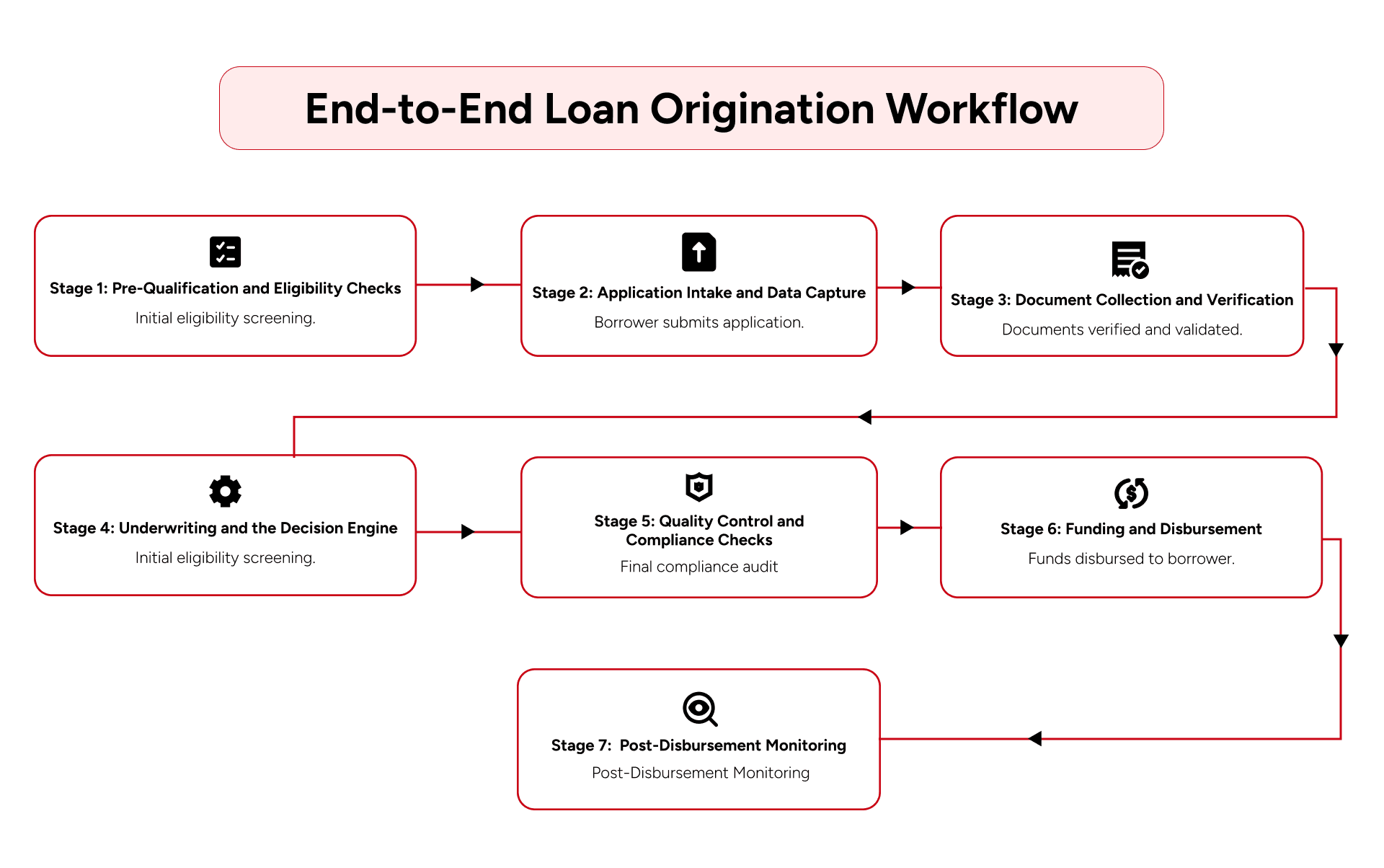
How Does a Modern Loan Origination Workflow Actually Work End to End?
A loan moves through a chain of stages, each one resting on the one before it, and each one carrying its own compliance weight that cannot get pushed down the line. Building automation into that chain from the start lets the whole process run with a consistency manual processing cannot match.
Here's what that looks like, stage by stage.
The mistake I see most when lenders map their own workflow for the first time is they assume the stages are sequential and isolated, but they aren't. Underwriting decisions depend on what happened during document verification, and document verification depends on what intake captured. Once a client sees that dependency mapped out, the case for automating the full chain becomes obvious.
What I have also seen is that lenders who automate only one or two stages often create new bottlenecks rather than eliminating existing ones. The efficiency gains from automating document verification, for example, get absorbed by a manual underwriting queue that was never designed to handle the increased throughput. The most durable automation outcomes I have worked on came from teams that mapped the full dependency chain before configuring a single workflow.
 Jani Hardik SanjayProduct Owner I
Stage 1: Pre-Qualification and Eligibility Checks
Before a full application even opens, the system runs a quick pass against minimum eligibility: credit thresholds, income requirements, identity verification. Unqualified applications get filtered out before they eat into underwriting capacity. Qualified borrowers get a clear read on where they stand before committing further.
Stage 2: Application Intake and Data Capture
The borrower fills out a structured digital form that feeds straight into the system. Every field captured, every entry timestamped, cross-checked against outside sources in real time. Data moves through API connections instead of someone retyping it, so the transcription errors that plague paper workflows don't happen here at all.
Stage 3: Document Collection and Verification
The system requests documents automatically based on loan type and borrower profile. As files come in, OCR pulls the key data points, and validation rules check completeness, consistency, and signs of tampering. Income statements, tax records, bank statements, all of it gets checked against the application before a loan officer even opens the file.
Stage 4: Underwriting and the Decision Engine
The underwriting engine runs verified data against a pre-set list of risk rules, debt-to-income, credit history, collateral value, risk signals pulled from third parties. Applications inside policy clear automatically. Anything outside the defined thresholds gets routed to a human underwriter, and that underwriter gets a full risk summary already assembled, ready to review instead of build from scratch.
Stage 5: Quality Control and Compliance Checks
One more compliance pass runs before approval goes out. Document completeness gets checked. Regulatory requirements specific to loan type and jurisdiction get confirmed. Anything inconsistent that could create exposure gets flagged. Call it a second review that takes seconds instead of days.
Stage 6: Funding and Disbursement
Once every condition clears and approvals are in, the system triggers disbursement through its connection to the institution's core banking platform. The system generates loan agreements, collects electronic signatures, and completes the transfer without anyone coordinating it manually between departments.
Stage 7: Post-Disbursement Monitoring
The workflow doesn't stop once the money moves. Monitoring tools keep tracking payment behavior and transaction activity against the risk profile built during underwriting. Something that looks like structuring, repayment activity that's off, volume crossing a BSA threshold, any of it raises an internal alert and kicks off SAR review right there.
Where Do SAR Prep and Fraud Checks Actually Belong in the Loan Origination Workflow?
Most lenders still treat fraud detection and SAR prep as something that happens at the end. Run a check before funding, flag whatever shows up, file afterward. That's exactly the model that creates the compliance gaps examiners find, because by the time something suspicious surfaces, the loan has already moved through several stages with no documented response anywhere along the way.
In an AI automated workflow, fraud detection and SAR preparation are embedded at every stage, from the moment an application enters the system to the point funds are disbursed and post-close monitoring begins.
What Fraud Signals Can Be Detected at Each Stage of the Origination Pipeline?
The pipeline surfaces fraud signals at four distinct layers. At intake, applicant data gets checked against identity databases and watchlists, and anything that doesn't match gets flagged. At document verification, validation rules catch altered income statements, mismatched employer data, and formatting that suggests tampering. At underwriting, behavioral analytics pick up patterns that mirror known fraud, including income figures landing suspiciously close to approval thresholds. After disbursement, transaction monitoring watches repayment behavior against the stated profile and sends anything unusual to compliance.
How Does an Automated System Flag Activity for SAR Preparation?
Once a fraud signal crosses a defined threshold, the system opens a case, pulls in the relevant transaction data and application records, and routes it to the compliance officer with a structured summary already attached. From there it's a human call: does this clear the BSA threshold for filing, escalate or close it with a documented reason either way. Every action inside that case gets timestamped and stored as part of the audit trail.
How Does Automation Build Compliance Traceability Into the Origination Process?
Every decision, every flag, every action inside a case gets recorded as it happens. Traceability isn't something assembled later, it is just there. An examiner asks for documentation on a specific application, and the institution hands over a complete chronological record from intake through SAR disposition. No scrambling through disconnected files, no reconstructing what happened from memory.
What Fraud and Risk Check Modules Does an Automated Loan Origination System Run?
Identity theft, document manipulation, synthetic credit profiles, coordinated collusion, each one needs its own detection approach. That is why automated systems run several independent modules across the pipeline instead of relying on one catch-all check.
Document Fraud Detection
Detection tools dig into uploaded files at the metadata level: pixel-level inconsistencies, font irregularities, formatting that suggests alteration. The system also cross-references data across documents, catching it when income on a pay stub does not line up with bank deposits, or employer details differ between a tax return and an employment letter.
How Do Automated KYC and KYB Checks Work in Loan Origination?
Identity verification kicks in right at application. Individual borrowers get checked against authoritative databases for government ID, screened against OFAC watchlists and FinCEN advisories. Business borrowers go through KYB: entity registration, beneficial ownership, any history of BSA violations, KYC/AML enforcement, or OCC sanctions tied to the business or its principals.
Collusion Detection, Network Graphs, and Alias Detection
Network graph analysis maps how applicants, employers, references, and IP addresses connect, looking for shared identifiers that point to coordinated submissions rather than separate applications that just happen to look similar. Alias detection catches it when the same person shows up under different names or ID numbers across multiple applications in the portfolio.
Behavioral Risk and Transaction Anomaly Signals
Behavioral analytics watch how someone actually moves through an application: time spent, how fields get edited, device used. Applications coming from a device profile already tied to fraud get flagged before they ever reach underwriting.
How Do Third-Party Fraud API Integrations Strengthen Risk Checks?
No institution's own data covers everything. Third-party fraud APIs and credit bureau feeds fill that gap, pulling real-time identity scores, synthetic identity flags, device reputation data, all of it extending coverage well past what internal transaction history alone could ever catch.
Real-Time Checks vs. Batch Checks: Which Does Your System Need?
Real-time checks happen during the application itself, instant decisions on identity and watchlist screening. Batch checks run on a schedule against the existing portfolio, looking for patterns that only show up once there's enough data and enough time to spot them. A serious fraud architecture runs both.
Fraud Module | Risk It Addresses | Stage It Operates In | Detection Method |
|---|---|---|---|
Document Fraud Detection | Altered income statements, tampered bank records | Document verification | Metadata analysis and cross-document data matching |
KYC/KYB Checks | Stolen identities, synthetic profiles, undisclosed ownership | Application intake | Database screening and watchlist validation |
Collusion Detection | Coordinated submissions, insider manipulation | Underwriting | Network graph analysis and alias mapping |
Behavioral Analytics | Anomalous application patterns, device-linked fraud | Intake and underwriting | Session behavior tracking and device fingerprinting |
Transaction Anomaly Monitoring | Structuring, irregular repayment activity | Post-disbursement | Real-time and batch transaction pattern analysis |
How Do You Automate SAR Preparation Without Losing Compliance Control?
Manual SAR prep eats an enormous amount of compliance staff time. Someone has to spot the activity, pull records from multiple systems, write a narrative that meets FinCEN's standards, fill out the form, and file it inside a 30-day window. At any real scale, this is exactly where bottlenecks form, and bottlenecks are what lead to late filings and inconsistent documentation.
Automated SAR workflows take the assembly and drafting work off someone's plate. The filing decision stays exactly where it should, with a person.
Compliance officers are usually the most skeptical people in the room when we propose automating SAR prep, and that's a good instinct. What changes their mind is seeing that every override, every edit to the narrative, every decision they make gets logged exactly the way it would if they'd built the case by hand. Automation handles the parts of the process that never required judgment in the first place, and their judgment stays exactly where it was.
Jani Hardik SanjayProduct Owner IHow Does Automated SAR Flagging, Narrative Assembly, and Data Population Work?
The moment activity crosses a predefined SAR threshold, the system opens a case and starts pulling it together. Transaction records, account data, identity verification results, prior case history, all of it gets pulled from connected systems and dropped into the right SAR fields. A draft narrative gets generated based on what triggered the flag, the timeline, and the specific risk indicators involved. What lands on the compliance officer's desk is a pre-built case with a draft already written.
How Does Automation Create a Defensible Audit Trail for SAR Compliance?
Every action inside a case gets a timestamp, a user ID, a logged decision. Review the case, edit the narrative, approve the filing, close it without filing, whatever happens becomes part of a permanent record that can't be altered after the fact. That record is what satisfies the BSA's five-year retention requirement for SAR documentation.
How Do Automated SAR Systems Integrate With FinCEN and AML Platforms Like Verafin?
Automated SAR workflows can connect to FinCEN's BSA E-Filing System through API integration, and AML case management platforms to reduce manual data entry and eliminate the need to log into separate portals for each filling. Platforms like Verafin combine transaction monitoring, case management, and SAR filing into one environment, consolidating the path from alert to filed report. The filing process, however, must still follow the institution’s approved compliance controls and review procedures, regardless of how much of the upstream assembly is handled by the system.
What Role Does Human Override Play in SAR Automation?
The compliance officer always has final say on whether a SAR gets filed. No system files anything without human review first, and that lines up with what the OCC laid out in Interpretive Letter 1166: elevated-risk cases route to a human before any automated action goes through. Every flag the system raises comes with the specific rule or indicator that triggered it, so whoever's reviewing it knows exactly why before making the call.
How Should U.S. Lenders Approach Loan Origination Automation Without Disrupting Operations?
Automation projects tend to fail for reasons that have nothing to do with the technology. Institutions that try to overhaul everything in one phase run into integration failures, compliance gaps, disruptions that set the whole project back, sometimes by months. Legacy core banking systems carry years of embedded logic. Ripping all of that out at once creates more risk than starting fresh ever saves.
Automate the pieces with clear inputs and outputs first, document collection, identity verification, pre-qualification, while the core system stays stable. Each phase builds on what came before, and compliance gets built in at every step instead of bolted on at the end.
Low-code platforms make this easier. Compliance and operations teams adjust workflows and update rules themselves instead of waiting on an IT backlog. Regulation changes, the workflow adapts, no full rebuild required.
Security has to be part of the design from the start. More automation means more interconnected systems, which means a bigger attack surface. Zero-trust models, role-based access, encrypted data in transit, none of this is optional for an institution under OCC or FinCEN oversight, it is the baseline.
What Are the Non-Negotiable Best Practices for Loan Origination Automation?
Loan origination automation delivers its full value only when the implementation is built on the right foundation. These are the practices that separate automation projects that hold up under regulatory scrutiny from those that create new operational risk.
Map the workflow before automating it
Automating a broken process just makes the broken process run faster. Every handoff, every exception path, every compliance checkpoint needs documenting and testing before any of it gets automated.
Build compliance into the design, not on top of it
Regulatory requirements should shape workflow logic from the start: AML screening, SAR thresholds, retention rules, audit trail generation, all of it.
Keep a human at the decision points that matter
Automation handles data assembly, routing, screening, fine. Credit decisions, SAR filing approvals, fraud escalations need someone with full context and the authority to override.
Design for auditability, not just speed
Every automated action needs a timestamped, tamper-evident record behind it. Examiners are asking whether every decision inside it can be explained.
Why Do U.S. Lenders Choose GeekyAnts for Loan Origination Automation?
Automating loan origination in the U.S. takes more than technical skill. It takes a partner that actually understands the regulatory environment these systems live in, BSA/AML requirements, OCC exam standards, FinCEN reporting obligations. We bring the engineering and the regulatory depth together.
What we hear most often from prospective clients is 'will this hold up when the OCC walks in.' That question changes how you scope a project from day one, and it's the reason our conversations with lending clients start with their compliance team before they ever reach engineering.
Kunal KumarChief Revenue OfficerFintech, Fraud Detection, and Compliance Automation Expertise
We have built AI-powered financial workflows covering fraud detection, identity verification, document processing, and compliance automation. Our team understands how these pieces fit together inside a loan origination pipeline, and how to build each layer so it meets U.S. regulatory standards without slowing down credit decisions.
Real-World Experience in the U.S. Regulatory and Secure Application Development
Building compliant financial software in the U.S. takes more than a checklist. We have worked across lending and fintech environments where security architecture, audit trail generation, and data residency are not negotiable. That track record produces systems that satisfy OCC exams and FinCEN reporting requirements once they are live, not just in a demo.
What This Looks Like in Practice
For a U.S.-regulated fintech modernizing its origination infrastructure, we connected identity verification, document processing, fraud signal detection, and audit logging into a single, unified workflow. The compliance team gained a clearer evidence trail for both internal review and external audits, and manual review dependency across the pipeline came down significantly, allowing the team to focus their attention on cases that genuinely required human judgment rather than routine processing.
Ready to Automate Your Loan Origination Workflow?
If your institution is still carrying the compliance risk and operational cost of manual origination, the next step is a workflow built for the regulatory environment you operate in, not adapted to it after the fact.
The Path Forward for U.S. Lenders
The cost of manual loan origination goes well past inefficiency. Missed SAR deadlines, inconsistent fraud screening, and undocumented compliance decisions accumulate across loan cycles. Institutions that delay addressing these gaps face growing audit risk that surfaces during regulatory examination.
Automated workflows address this by building fraud detection, SAR preparation, and compliance controls into the pipeline as structural components, so every application receives the same screening, every decision produces a timestamped record, and every suspicious signal becomes a documented case before the loan reaches funding.
Lenders building automation into their origination workflows are establishing the compliance baseline that OCC, FinCEN, and BSA examiners will expect across the industry.