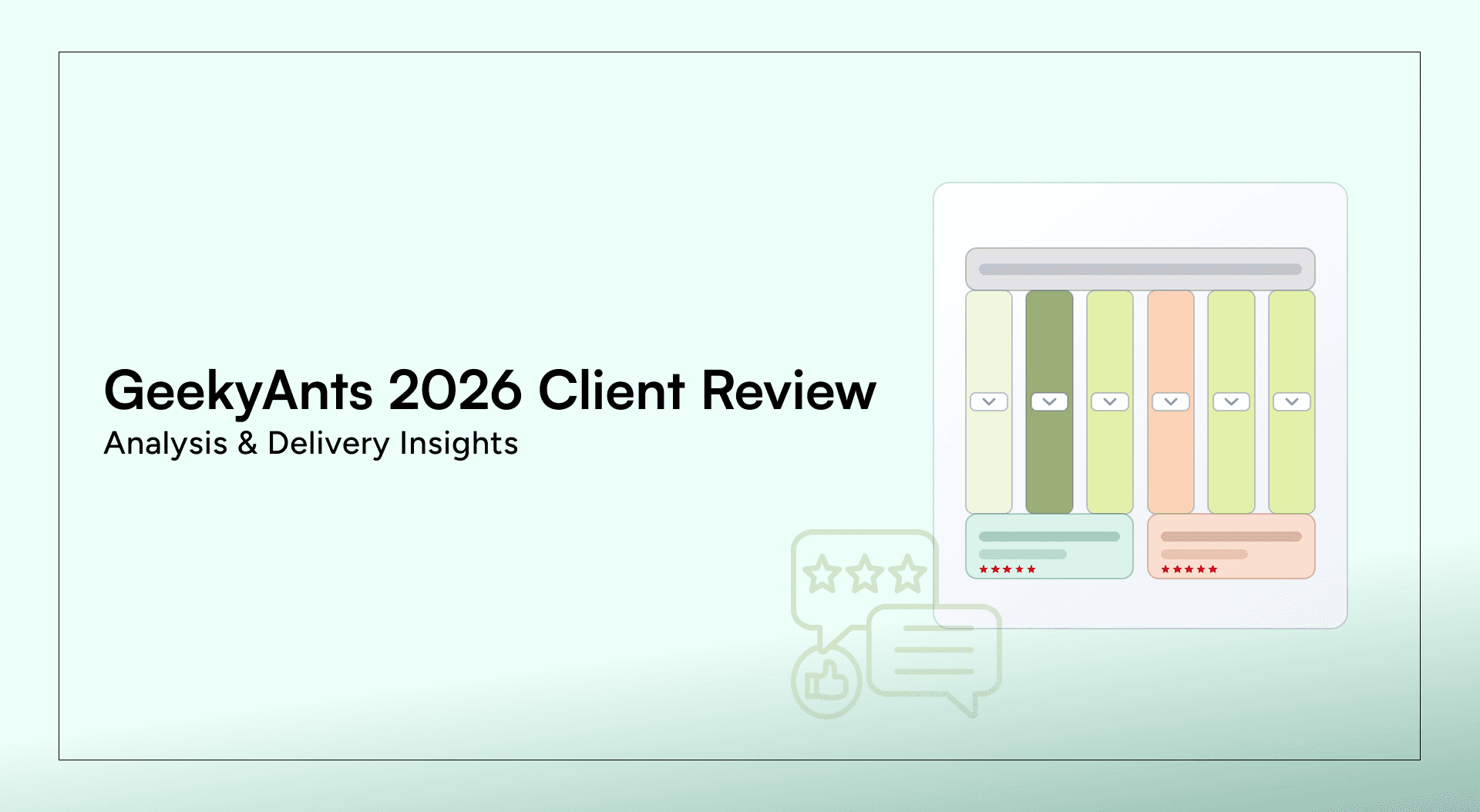

GeekyAnts has reviewed its 2026 client feedback record on Clutch, identifying the delivery practices buyers cite most often and the areas where reviewers ask for tighter execution.
San Francisco, CA – GeekyAnts, an AI-powered digital product engineering and consulting company, has published an analysis of its verified client review record for 2026, covering both the delivery practices buyers cite most frequently and the areas where reviewers ask for improvement. The company holds a 4.9-star rating on Clutch across 120 verified reviews. The analysis arrives as review platforms take on a larger role in vendor selection, with 75 percent of software buyers using them to build shortlists and 74 percent of technology buyers drawing on reviews to inform a final decision.
The review record breaks down into four sub-scores: 4.8 for quality, 4.8 for adherence to schedule, 4.7 for cost, and 4.9 for willingness to refer. Clutch collects this feedback through verified client interviews rather than self-reported data, and its Premier Verified designation confirms the company's legal registration and financial risk status alongside the review corpus.
"Review data is only useful if a company reads all of it, including the parts that sting," said Kunal Kumar, Chief Revenue Officer at GeekyAnts. "The willingness-to-refer score tells us clients would work with us again. The cost score tells us our early estimates need to be sharper. Both are worth publishing, because a buyer evaluating an engineering partner learns more from a specific weakness than from a general claim of excellence."
What Buyers Cite Most Often
Project management appears in client feedback as consistently as technical output. Reviewers describe daily stand-ups, structured sprint cycles, and responsiveness across time zones, and the use of Slack, Trello, and Jira to keep progress visible. Clients connect that visibility to predictable delivery rather than to reporting overhead alone.
Communication across time zones forms a second recurring theme. Clients working from North America and Europe with delivery teams in India note punctuality for scheduled calls and responsiveness to questions raised outside working hours. For distributed engagements, this operational detail often determines whether a project moves at a steady pace or stalls between handoffs.
A third theme is flexibility in team composition. Reviewers describe scaling teams and allocating resources flexibly to meet project demands, which keeps engagements adequately staffed throughout their lifecycle. Related feedback points to receptiveness during requirement changes, with clients describing the team as agile when priorities move mid-engagement.
Value for cost also appears frequently. Project investments in the review corpus range from roughly USD 9,000 to USD 100,000, and clients repeatedly connect the pricing to the quality delivered rather than treating the two as a trade-off.
Where Reviewers Ask for Tighter Execution
Timeline adherence is the most frequently raised concern. While many clients report timely deliveries, there are instances where the company faced challenges adhering to project timelines, often traced to unforeseen circumstances or resource changes. Clients generally credit the team with mitigating delays and protecting quality, but the pattern is consistent enough to register as a delivery risk rather than an isolated incident.
Scoping precision is the second area. Feedback points specifically to the UI/UX phase and the transition into development, where reviewers ask for tighter definition before work begins. Imprecise scoping at this boundary tends to surface later as rework, which compounds the timeline concern above.
Estimate accuracy is the third. At least one reviewer notes that the initial quote for project cost could have been more accurate, and the 4.7 cost sub-score, the lowest of the four, aligns with that feedback. Taken together, these three areas describe a single underlying issue: the earliest stage of an engagement carries less definition than the delivery stage that follows it.
Why Published Weaknesses Matter to Buyers
Buying behavior makes this kind of disclosure more useful than it once was. Research on B2B software purchasing shows that shortlists form early and rarely change, with 95 percent of eventual purchases coming from the list a buyer assembled on the first day of evaluation. By the time a buyer reads reviews in detail, the question has shifted from who else should be considered to what might go wrong.
Buyers reaching that stage can examine the full review record on the GeekyAnts Clutch profile, including individual project descriptions, sub-scores, and client-submitted commentary.
The analysis follows a sequence of external recognitions for GeekyAnts in 2026, including the No. 1 position in Clutch's "Top App Developers in California" directory, a Summer 2026 Clutch Global Award, and the Excellence in AI & Digital Transformation award at the ET Now Business Conclave & Awards 2026. Since 2006, GeekyAnts has delivered more than 800 projects for over 550 clients across financial services, healthcare, retail, logistics, education, and enterprise technology.
Supporting Resources
- Read the full GeekyAnts review profile on Clutch
- Also published on: LaGrange Daily News
- Follow GeekyAnts on LinkedIn, X, and YouTube.
About GeekyAnts
GeekyAnts is an AI-powered digital product engineering and consulting company that helps organizations build, modernize, and scale digital products and platforms.
Contact Information
US Office
GeekyAnts Inc.
315 Montgomery Street
9th & 10th Floors San Francisco
CA 94104, USA
+1 845 534 6825
India Office
GeekyAnts India Pvt Ltd
No. 18, 2nd Cross Road
N S Palya
2nd Stage BTM Layout
Bangalore – 560076
Karnataka, India
+91 80 4305 8884
UK Office
GeekyAnts UK Ltd
SPACES Finsbury Park 17 City North Place
London N4 3FU
England, UK
+44 1702 655221
Media Contact
GeekyAnts Inc.
press@geekyants.com
+1 845 534 6825