
Executive Summary
In digital banking, deployment availability is a business requirement as much as a technical one. A deployment that interrupts access to online banking can affect customers attempting to log in, view balances, initiate transfers, or perform other critical operations.
Our earlier rolling deployment model introduced problems around version coexistence. Every new frontend build generated build-specific resources such as runtime.1234.js and main.1234.js. During a rolling restart, old and new pods could coexist. A request for a resource from the new build could reach an older pod where that resource did not exist, producing a 404 response.
Static resources were cached at the CDN for about four minutes. We needed to consider application availability and version consistency across the application shell, static resources, CDN, and backend pods.
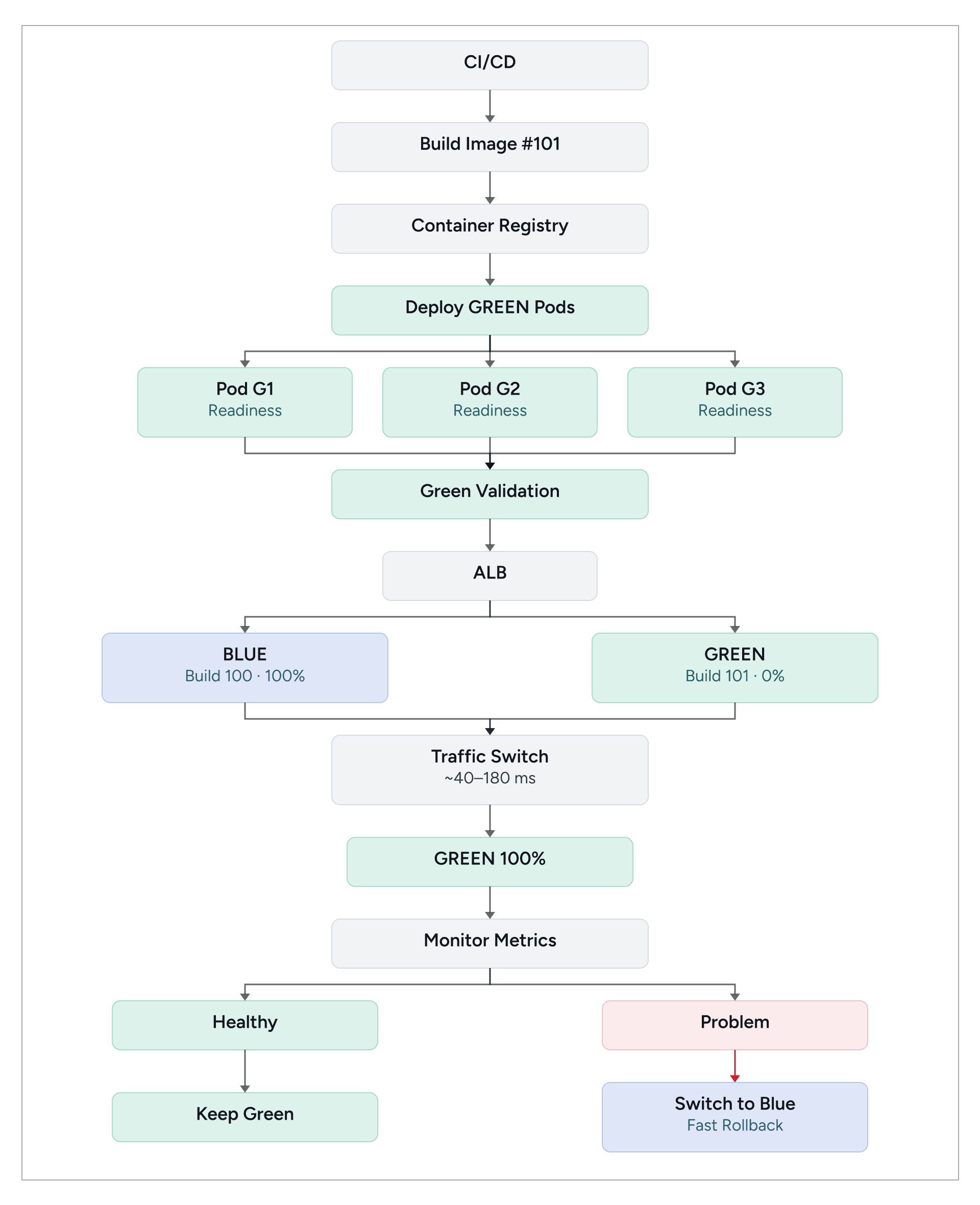
We moved to a Blue-Green deployment strategy. The new version is deployed into a separate environment, its pods start and pass readiness checks, and the environment is validated before customer traffic is switched. The existing environment continues serving production traffic until the cutover.
In our environment, the observed ALB traffic transition from Blue to Green was about 40–180 ms. The key benefit is not faster application startup. Pod creation, image pulling, startup, and readiness occur outside the customer-facing cutover window. The previous environment also remains available so that traffic can be routed back to it if a rollback is required.
A race condition remained during the ALB transition under high request volumes. A request for a build-specific static resource could reach the previous environment and receive a 404 response. We addressed this with a targeted NGINX retry for the affected static resources, with a delay of about one second before the retry.
1. Why We Needed a Different Deployment Strategy
1.1 The Rolling Deployment Model
A rolling deployment replaces application instances in stages. This avoids replacing every instance at once, but it also means different application versions can coexist during the deployment.
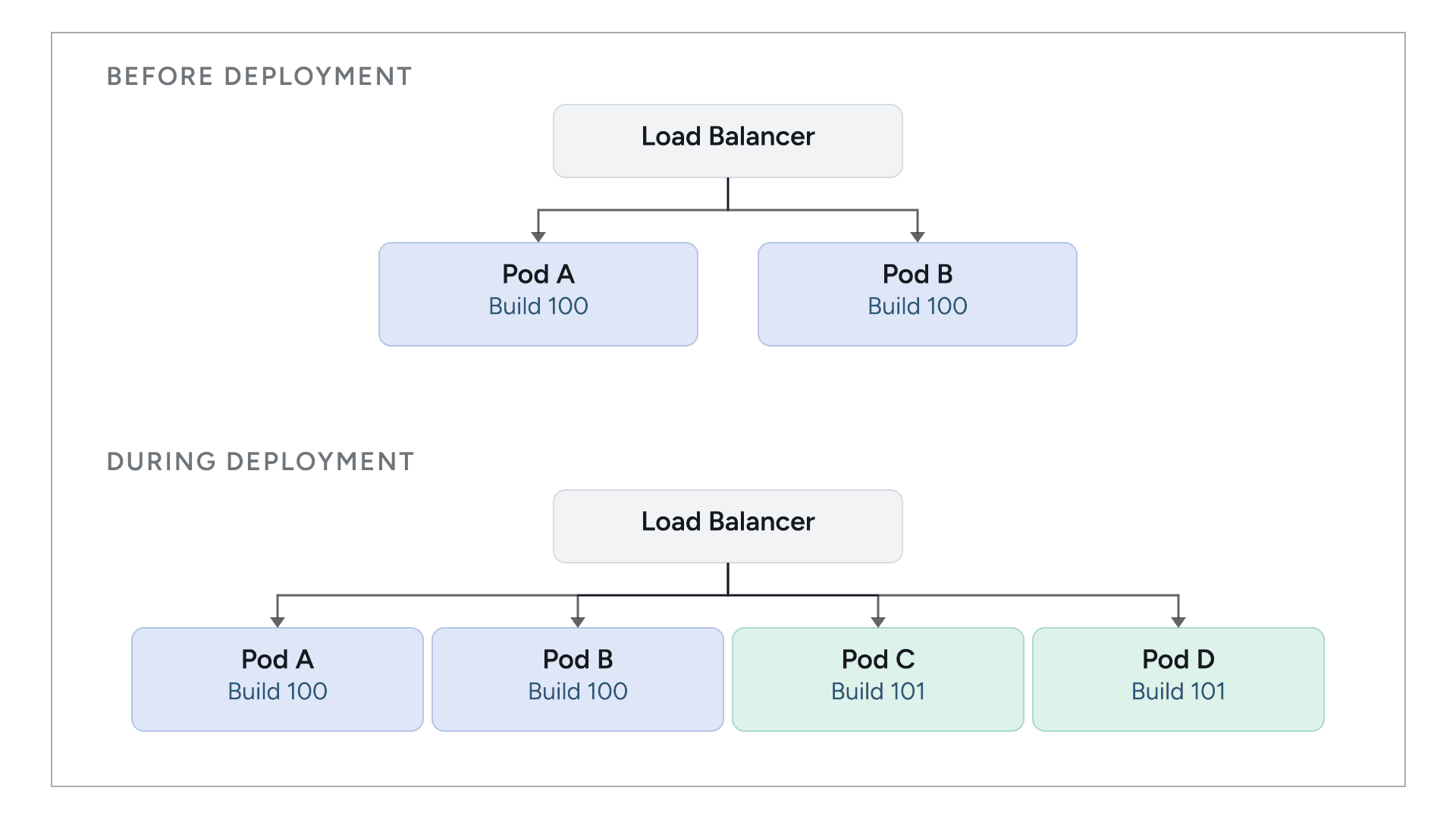
For backend APIs, teams can manage this coexistence through backward-compatible API contracts. For a frontend application whose resources are build-specific, the situation is more sensitive.
1.2 Build-Specific Static Resources
Every application build generates resources associated with that build. For example:
Build 100:
runtime.100.js
main.100.js
styles.100.css

Build 101:
runtime.101.js
main.101.js
styles.101.css
The browser receives an application shell that references a particular build's resources. If a request for runtime.101.js reaches a Build 100 pod, the resource does not exist there, and the server can return a 404 response.
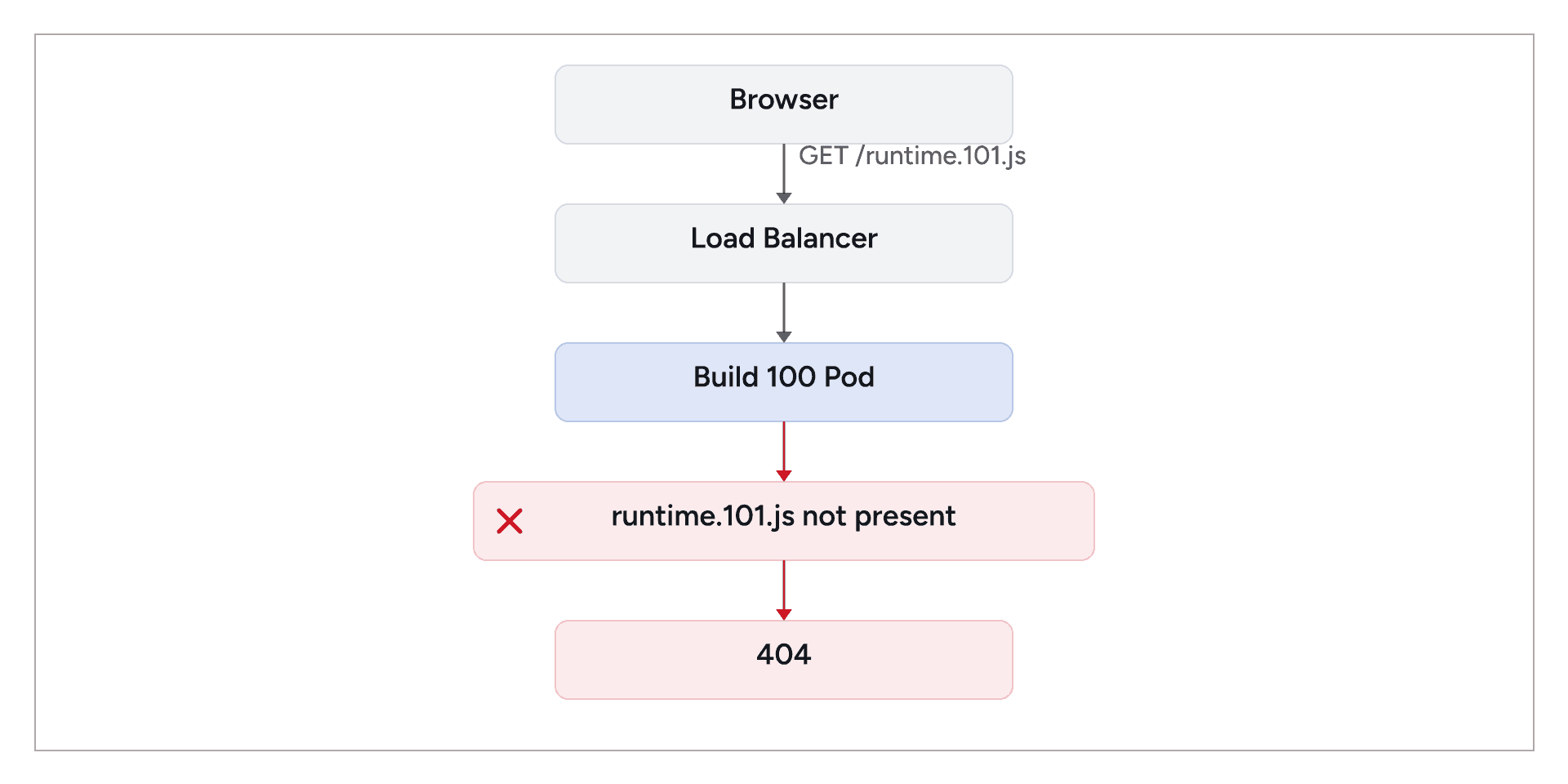
The pod itself could be healthy. The failure was caused by a version mismatch between the resource requested by the client and the application instance handling the request.
1.3 CDN Caching Added Another Timing Dimension
Static resources were cached at the CDN for about four minutes. The application origin could move to a new version while cached resources from the previous version remained available at the edge.
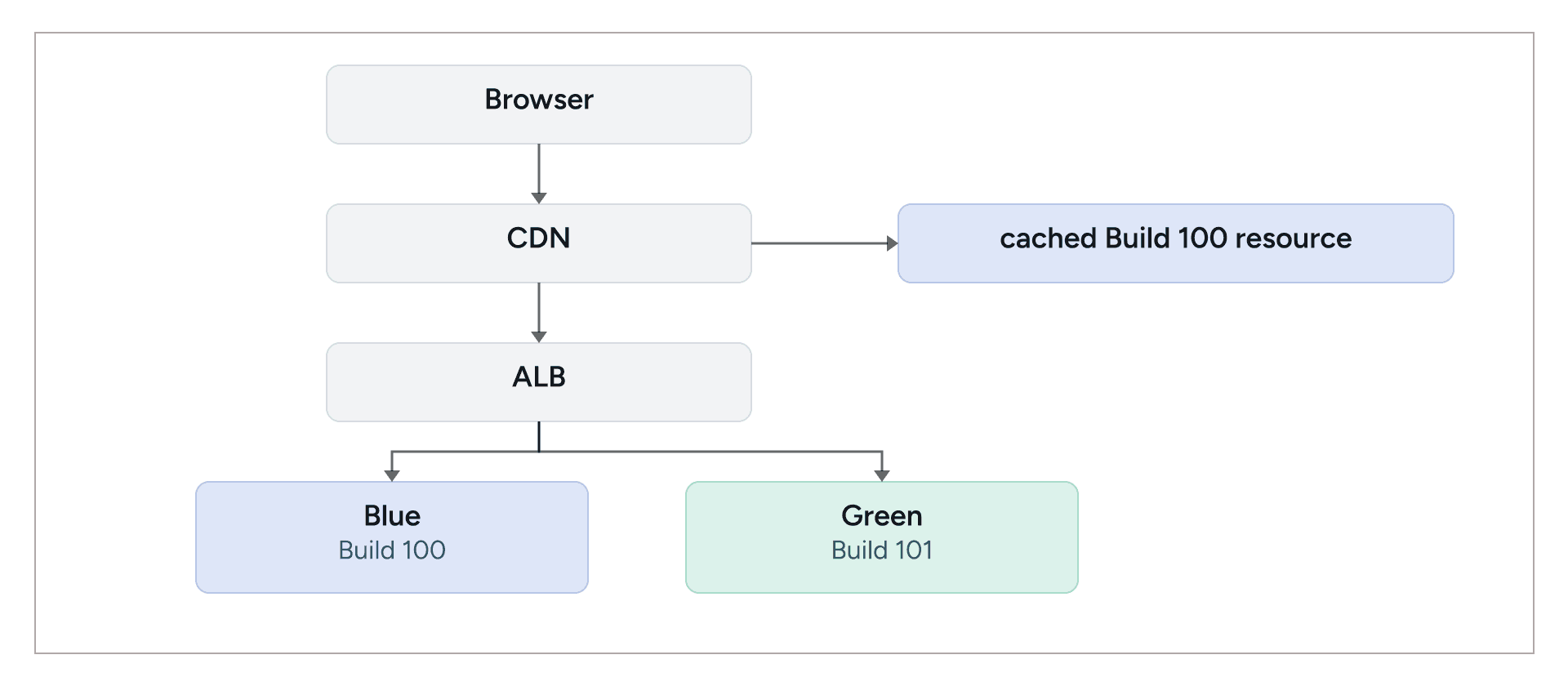
Deployment correctness had to account for three independent timing domains: application and pod readiness, ALB traffic convergence, and CDN cache lifetime.
2. Blue-Green Deployment Architecture
Blue-Green deployment introduced two complete application environments. Blue is the active version, and Green is the new version.
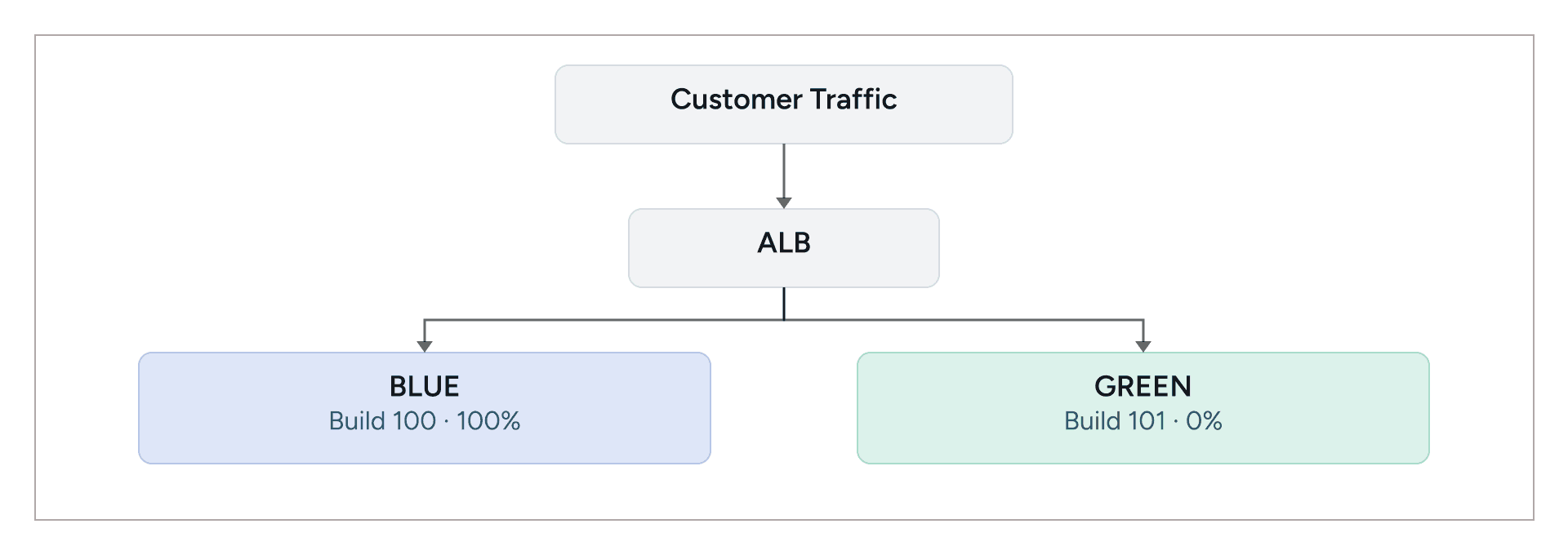
The principle is simple: deploy and validate Green before allowing it to receive production traffic. This separates deployment preparation from production traffic cutover.
3. What Happens During a Blue-Green Deployment
3.1 Build and Image Creation
The CI/CD pipeline creates an immutable image for the release. The frontend resources generated by that build are part of the same release artifact.
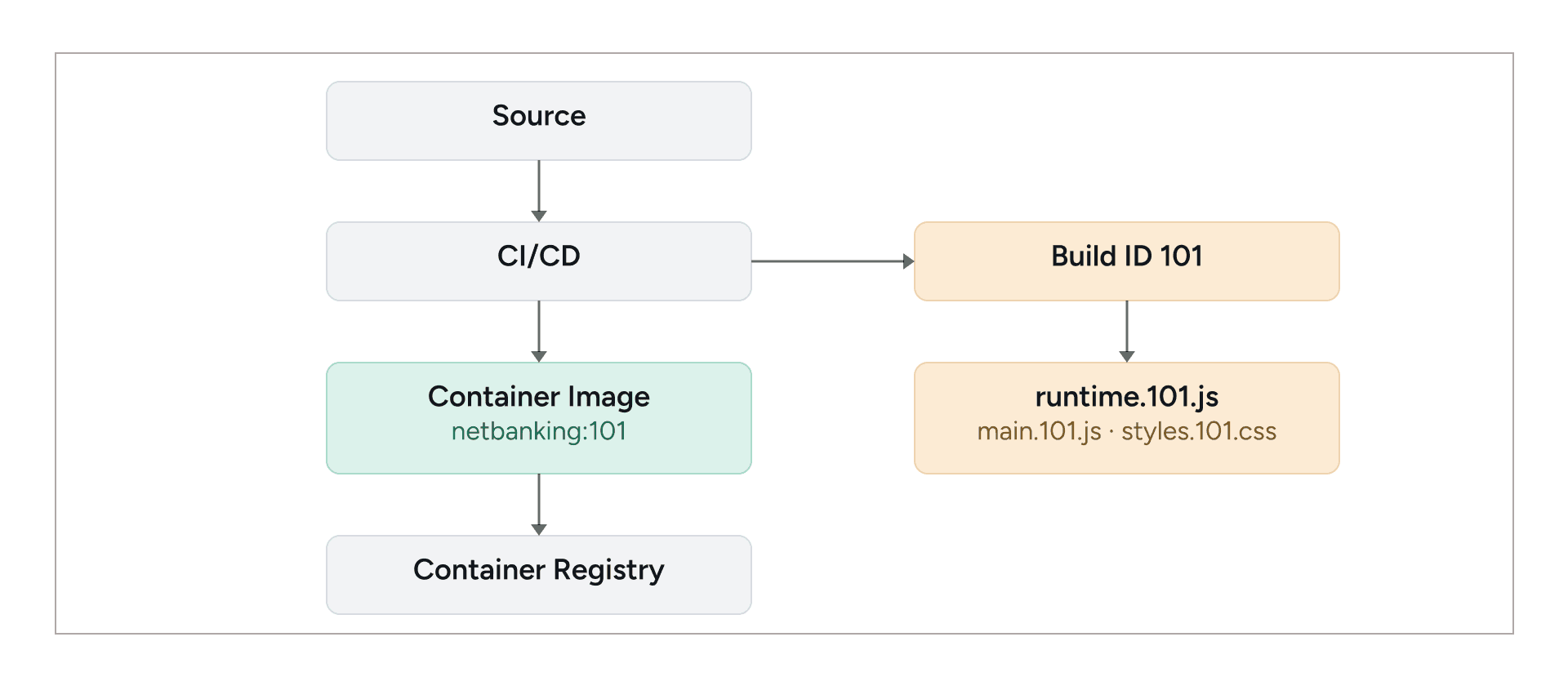
This preserves a clear relationship between the application version and the resources it serves.
3.2 Creating the Green Pods
The new release is deployed to Green without terminating the active Blue environment.
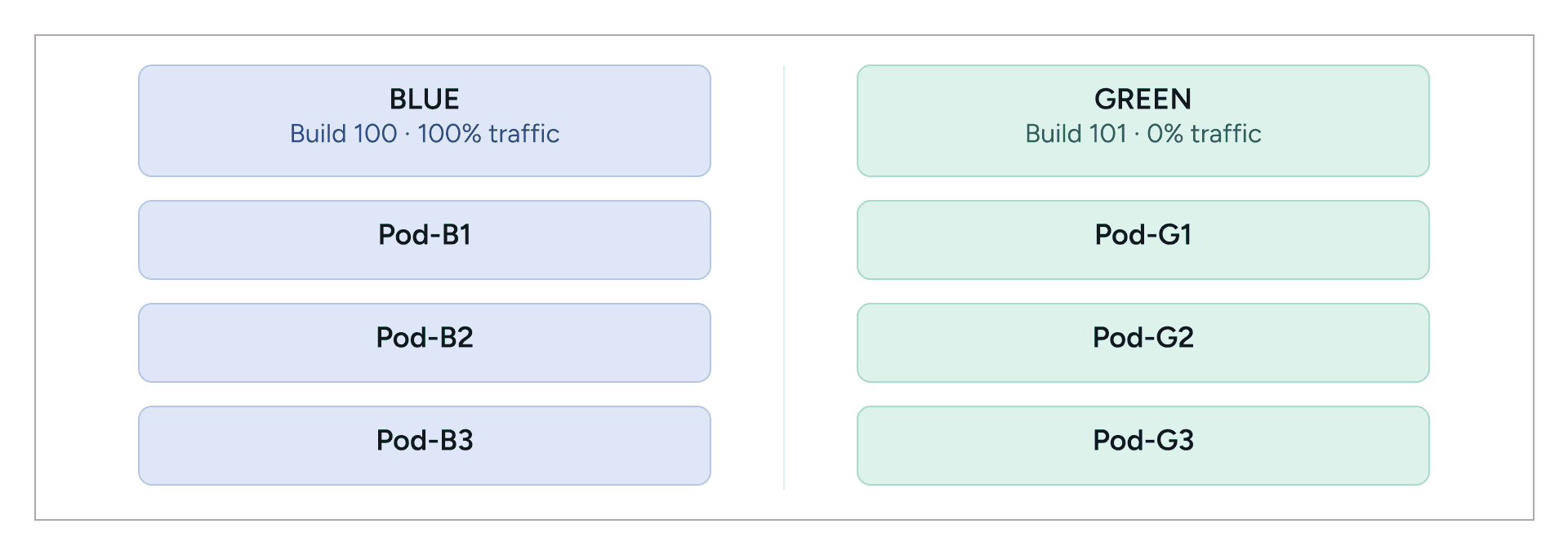
The Green pods go through image pull, container startup, application initialization, and readiness checks before they become eligible to receive traffic.
3.3 Pod Readiness
Readiness is a key mechanism in this architecture. Kubernetes distinguishes a running container from a container that is ready to accept traffic. A failed readiness probe causes the pod to be treated as not ready for normal service traffic. A startup probe can be used when an application needs more initialization time before liveness or readiness checks begin.
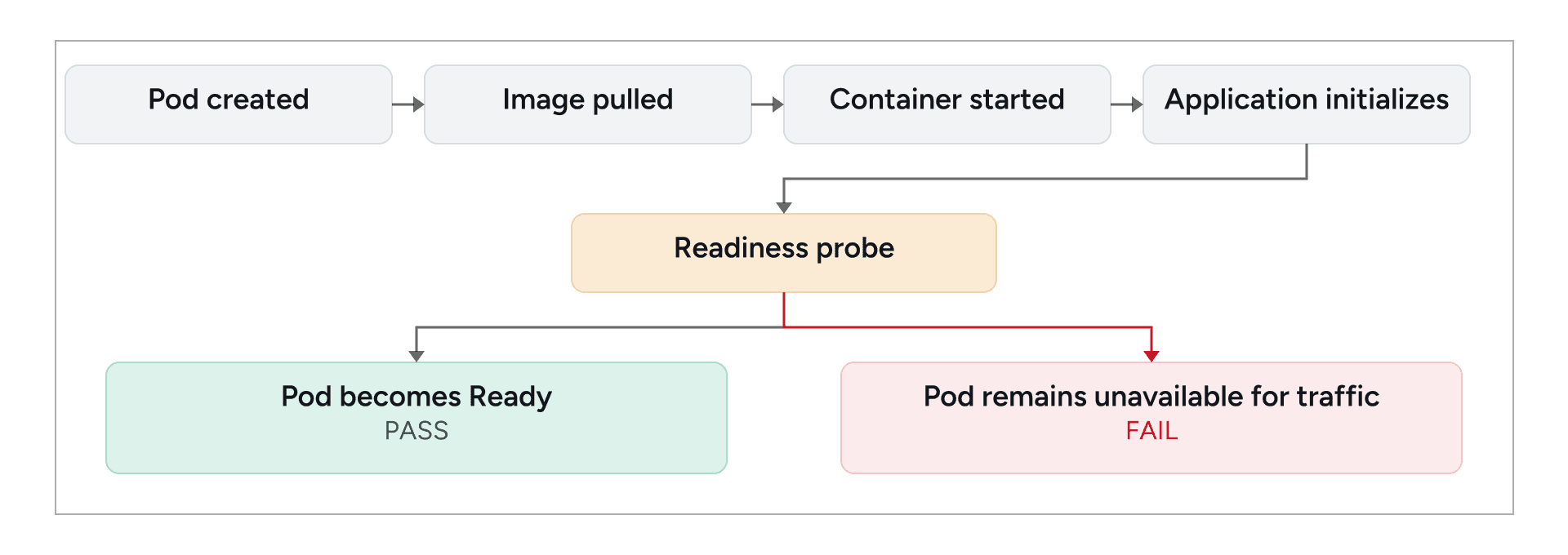
For a banking application, readiness should represent the minimum state in which the application can process production requests without creating service risk. Depending on the implementation, this can include application initialization, configuration loading, dependency availability, and other required startup conditions.
3.4 Green Validation
Once the Green pods are Ready, the new environment can be validated before customer traffic is moved.
- Confirm that the pods and application are healthy.
- Run API smoke tests against the new environment.
- Confirm that the required static resources are available.
- Check connectivity to critical dependencies.
- Test business-critical flows.
- Review application and infrastructure metrics.
This allows the team to validate Green while Blue continues serving production traffic.
4. How the ALB Traffic Switch Works
The Application Load Balancer (ALB) provides the boundary for switching production traffic between Blue and Green. An ALB listener evaluates routing rules and forwards traffic to target groups. Target groups contain registered targets and can have their own health checks.
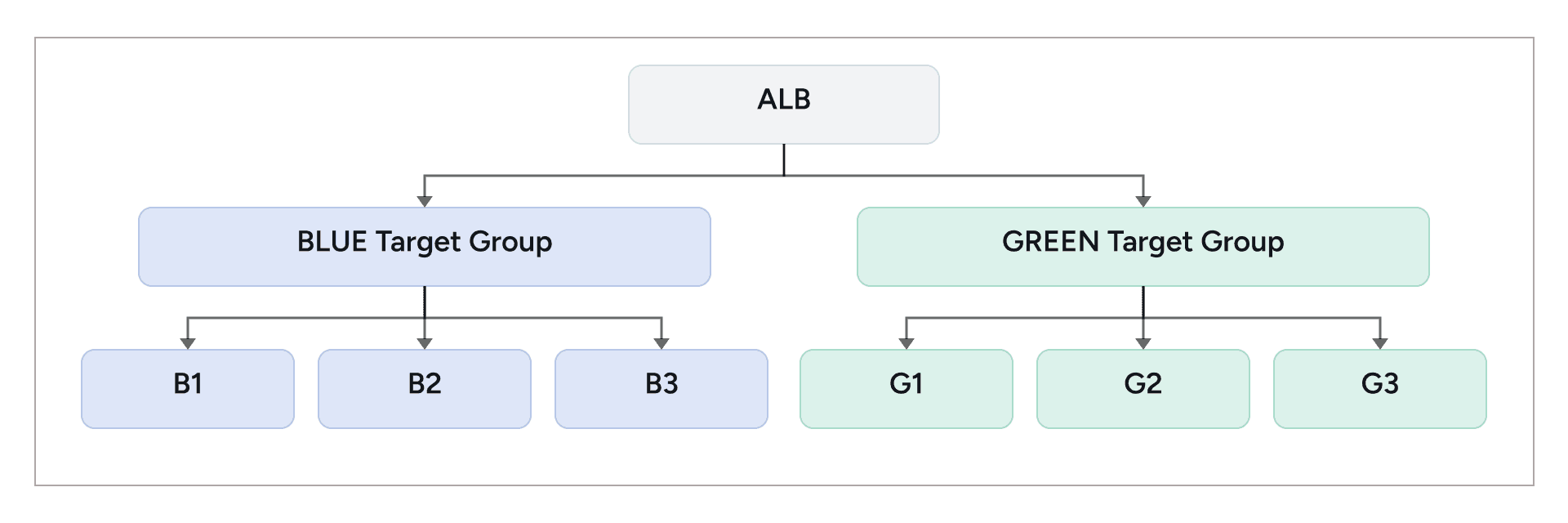
Before the cutover, Blue is the active target group and Green is prepared without receiving normal production traffic. Once Green has passed the deployment gates, the routing configuration changes so that production requests are directed to Green.
5. The Critical Difference: Deployment Time vs Customer-Impact Time
A key distinction in Blue-Green deployment is the difference between deployment time and customer-impact time. The new pods still need to pull the image, start the container, initialize the application, and pass readiness checks.
What changes is where that work occurs.
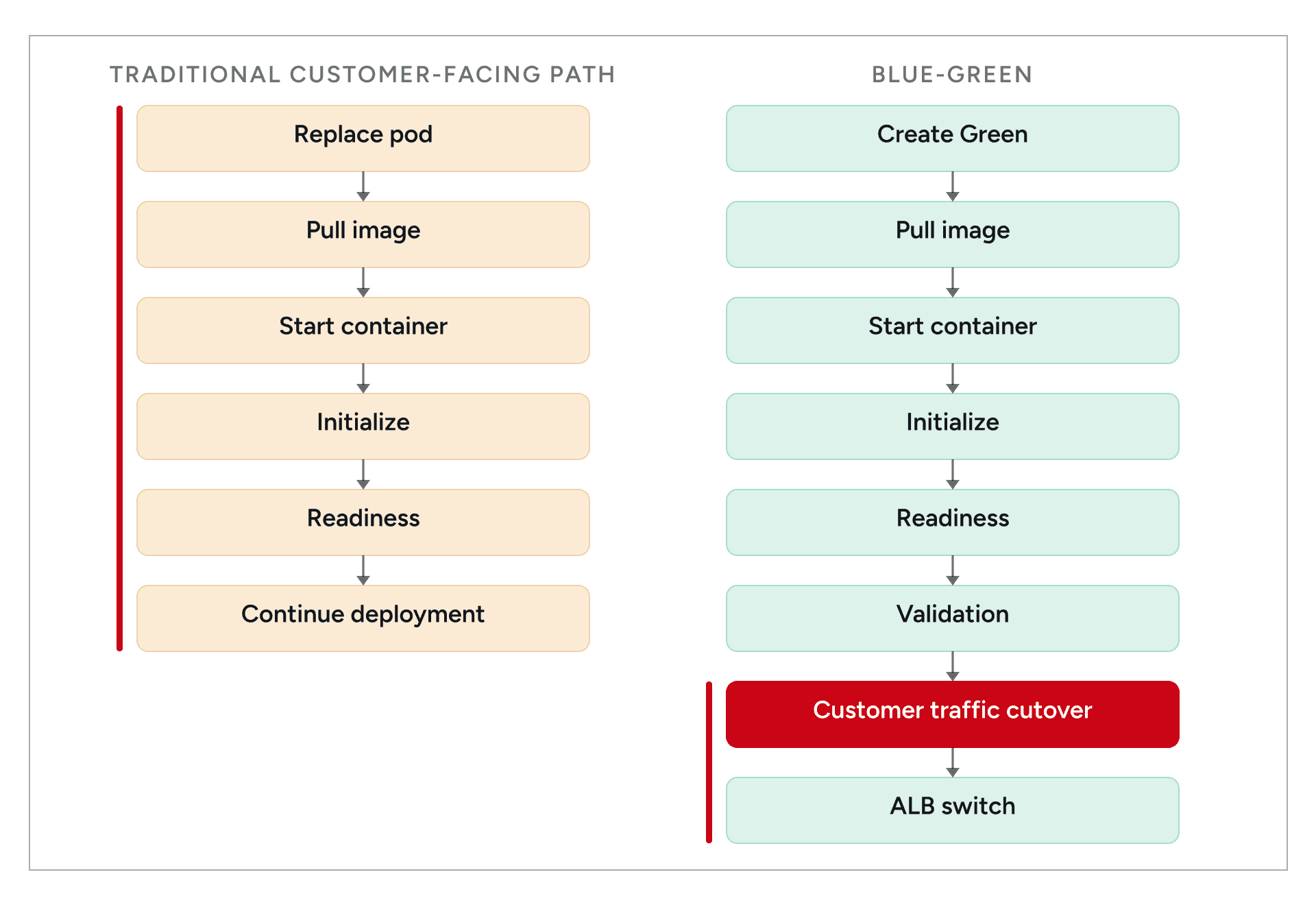
Blue continues serving customers while Green is being prepared. This removes the time-consuming preparation work from the customer-facing cutover path.
The customer-facing transition is limited to the routing window rather than the full duration required to create and warm the new pods.
The improvement should not be described as “the deployment became X% faster.” The deployment preparation time still exists, but it does not need to translate into customer downtime.
6. Rollback: Turning Recovery Into a Traffic Switch
Blue-Green changes the rollback mechanism.
Normal state:

BLUE  = Build 100
GREEN = Build 101
Traffic = 100% Green
If monitoring identifies a production problem after the cutover, Blue can remain available as the previous known-good version.
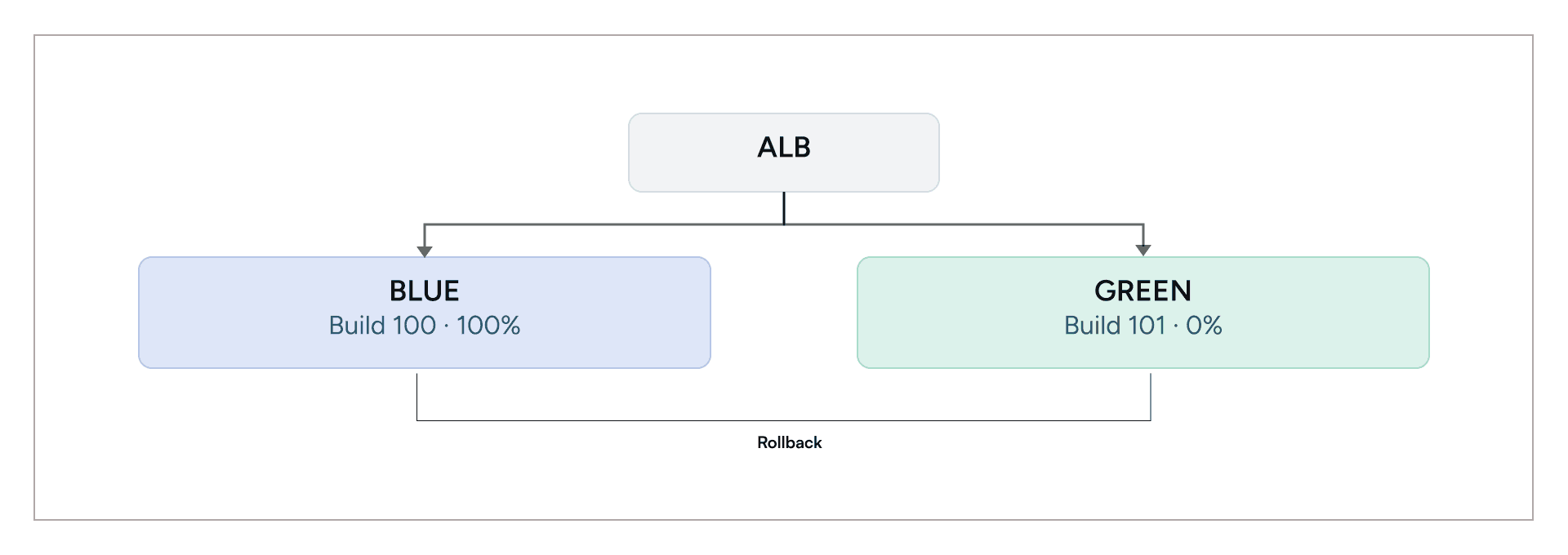
Instead of rebuilding and redeploying the previous image, the deployment can route traffic back to the running Blue environment.
This changes rollback from a deployment operation into a traffic-routing operation, which can reduce mean time to recovery (MTTR).
7. The Production Challenge After Blue-Green
7.1 The ALB Transition Window
Blue-Green solved the major version-coexistence problem, but production testing exposed a smaller race condition during the traffic switch.
In our environment, the observed ALB transition from Blue to Green was about 40–180 ms.
Before:
Blue  = 100%
Green =   0%

Transition:
Blue  = 100% -> 0%
Green =   0% -> 100%

After:
Blue  =   0%
Green = 100%
Under high request volume, requests can arrive during this short interval. A request that arrives during the transition can encounter the previous routing state.
7.2 Static Resource 404 During the Transition
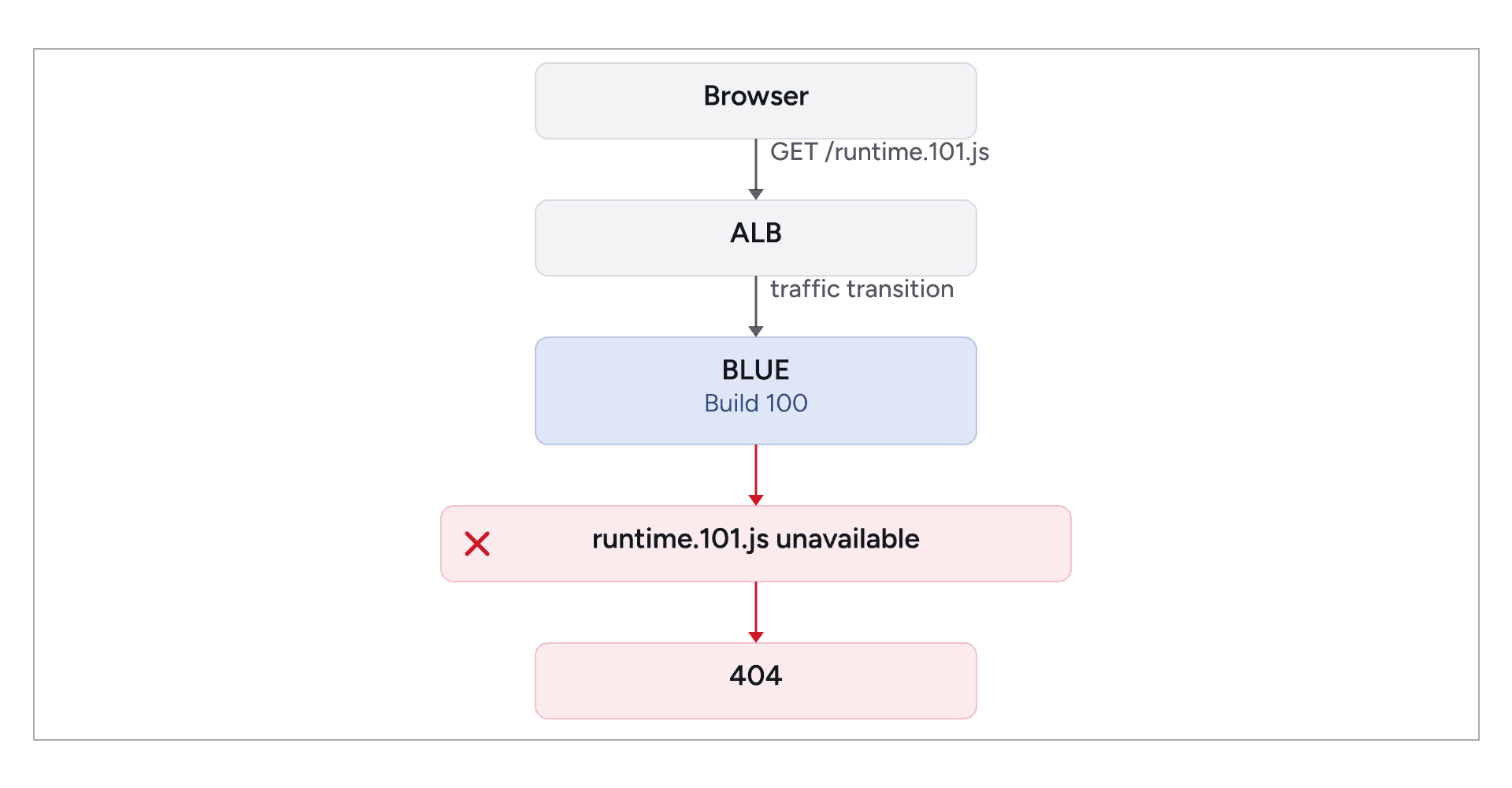
This was not a persistent application failure. It was a transient race condition caused by the interaction between build-specific resource names and traffic convergence.
8. NGINX Retry as the Last-Mile Resilience Layer
To address this transient condition, a targeted retry mechanism was introduced at NGINX for the affected static resources.
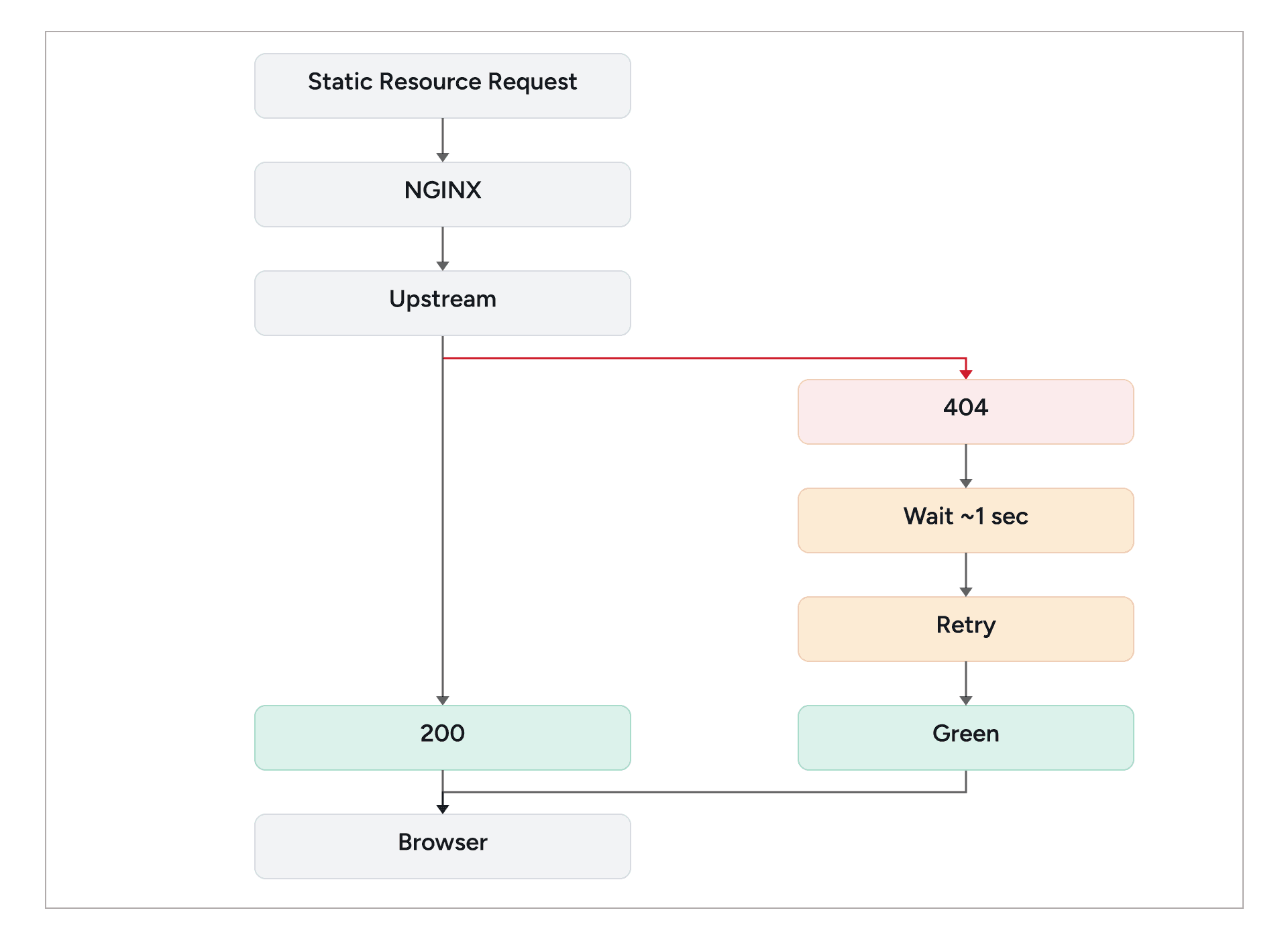
The one-second delay was longer than the observed ALB transition window. This gave the traffic transition time to complete before the retry.
This mechanism was scoped to static-resource requests. A generic retry policy should not be applied to state-changing banking operations such as fund transfers without idempotency and transaction-safety guarantees.
9. CDN and Resource Versioning
Build-specific resource names remain part of the design. Instead of overwriting a stable path such as /main.js, each build produces a unique resource path.
/main.100.js
/main.101.js
/main.102.js
This allows multiple versions of a resource to coexist in the CDN. The application shell should reference the resource set belonging to its build.
The CDN cache lifetime of about four minutes is treated as a separate concern from the ALB transition. Build-specific resources provide coexistence, while the NGINX retry addresses the short traffic-convergence race.
10. Zero-Downtime as an End-to-End Property
The implementation showed that zero-downtime (ZDT) is not a property of Kubernetes or the load balancer alone.
Client
|
CDN
|
ALB
|
NGINX
|
Kubernetes
|
Pod readiness
|
Application
|
Dependencies / data layer
A system can have healthy pods and still return customer-visible errors if resource versioning, caching, or routing transitions are not handled correctly.
Our final approach combines several mechanisms:
Blue-Green deployment
+
Pod readiness
+
Build-specific static resources
+
CDN caching strategy
+
ALB traffic cutover
+
NGINX static-resource retry
+
Fast rollback
=
Zero-Downtime Release Architecture
11. Business and Operational Impact
Before the move toward ZDT, deployments were scheduled during low-traffic periods such as night-time maintenance windows. This was a risk-management decision. If a deployment could cause service interruption, a period with fewer customers using the platform reduced the number of users exposed to that interruption.
Before:
Release Ready
|
v
Wait for Night
|
v
Maintenance Window
|
v
Deployment
Blue-Green changed the release model.
After:
Release Ready
|
v
Deploy Green
|
v
Validate
|
v
Switch Traffic
Because Blue remains available while Green is prepared, a new deployment does not require the application to be taken offline. Subject to change-management, monitoring, and business controls, teams can perform deployments during normal operating hours, including the morning, instead of restricting them to night-time maintenance windows to avoid deployment downtime.
This changes the operational model: application availability no longer dictates the deployment window.
12. Deployment Sequence
1. Developer merges release
|
2. CI/CD builds application
|
3. Build-specific static resources generated
|
4. Immutable container image created
|
5. Image pushed to registry
|
6. Green deployment created
|
7. Green pods start
|
8. Startup / initialization
|
9. Readiness probes pass
|
10. Green validation / smoke tests
|
11. Green target group confirmed healthy
|
12. ALB routing switched
|
13. Traffic moves Blue -> Green
|
14. Monitor application + business metrics
|
15. Keep Blue available for rollback
|
16. Decommission Blue after confidence window
13. Key Engineering Lessons
13.1 Blue-Green Requires Coordinated Deployment Controls
Blue-Green depends on the interaction between deployment orchestration, readiness, traffic management, resource versioning, CDN behavior, observability, and rollback. Two application environments alone do not address the dependencies across the release path.
13.2 Move Preparation Work Outside the Cutover Path
Image pulling, pod creation, startup, and readiness can take minutes. Blue-Green allows the previous version to continue serving traffic while the new environment completes this work.
13.3 Rollback Should Be Designed Up Front
Keeping the previous environment available allows the system to route traffic back to a known-good version without rebuilding and redeploying that version.
13.4 Short Transition Windows Can Expose Race Conditions
A short routing transition can still expose a race condition when request volume is high. Deployment design must account for requests that arrive while traffic moves between environments.
13.5 Static Resources Are Part of the Release Architecture
Frontend resources form part of the production deployment architecture. Their versioning, CDN lifetime, and relationship with the application shell must be considered as part of the release design.
14. Final Architecture
15. Conclusion
The move from rolling deployments to Blue-Green deployment addressed the version mismatch that could occur when build-specific frontend resources reached pods running an older build. Blue-Green separates release preparation from traffic cutover by allowing the new environment to complete startup, readiness checks, and validation while the existing environment continues serving customers.
The implementation showed that zero-downtime deployment depends on controls across the release path. Resource versioning, CDN caching, traffic switching, readiness checks, retry behavior, and rollback design must work together to protect customer requests during a release.
Keeping the previous environment available also allows recovery through a traffic switch instead of another deployment. This release model reduces the need to schedule deployments around maintenance windows while preserving a path back to the previous version.
Building Release Architectures for Production Reliability
Zero-downtime deployment depends on more than switching traffic between two environments. Pod readiness, static-resource versioning, caching, traffic routing, monitoring, and rollback must work together to protect customer-facing applications during a release. For teams building or modernizing applications with these production requirements, GeekyAnts provides custom software development services covering architecture, CI/CD, deployment, and post-launch support.
References
- Kubernetes: Liveness, Readiness, and Startup Probes
https://kubernetes.io/docs/concepts/workloads/pods/probes/ - AWS Elastic Load Balancing: Application Load Balancer
https://docs.aws.amazon.com/elasticloadbalancing/latest/application/introduction.html - AWS Elastic Load Balancing: Target Groups
https://docs.aws.amazon.com/elasticloadbalancing/latest/application/load-balancer-target-groups.html - AWS Elastic Load Balancing: Listener Rules
https://docs.aws.amazon.com/en_en/elasticloadbalancing/latest/application/listener-rules.html