

Key Takeaways
- This AI risk assessment framework scores each workflow from 1 to 4 on business impact, data sensitivity, autonomy, and regulatory exposure. Expected upside stays out of the score, which measures harm if the use case fails.
- The scores route a use case to a controlled pilot, a restricted scope, or a pause, which protects customer trust, limits avoidable cost, and sharpens launch decisions.
- A single 4 sends a use case to specialist review, and an open question about data permission or legal applicability pauses it, whatever the combined score shows.
- The AI Use Case Risk Scorecard, a downloadable AI risk assessment template, records scores, evidence, unknowns, safeguards, owner, and review date, and it supports accountable decision-making without serving as formal deployment approval.
Why Do Growing Companies Need an AI Risk Assessment Framework Before Funding or Launching a Use Case?
A product team has an AI feature ready for a launch date promised to a customer. The demo works and the sponsor wants to ship. Nobody has agreed on what happens if it sends a wrong refund, exposes an account detail, or gives bad guidance. An AI risk assessment framework settles that before money and credibility are on the line.
McKinsey’s August 2026 global survey of 1,719 respondents across 97 nations shows why that agreement matters. In it, 80% of respondents report that AI has improved their individual productivity, while 37% attribute at least some EBIT impact to AI use, about the same share as last year. The sample spans industries and company sizes, so the figures reflect a broad pattern.
Agent adoption and operating costs sharpen the gap between those figures. Among respondents from organizations with more than $1 billion in annual revenue, the share scaling AI agents in one or more functions rose from 27% to 40%, while smaller organizations stayed at 22%. About 20% of respondents say AI operating costs, including token costs, have constrained their AI use. As an AI agent gains permission to access more data and perform more actions, a mistake can affect more systems and customers.
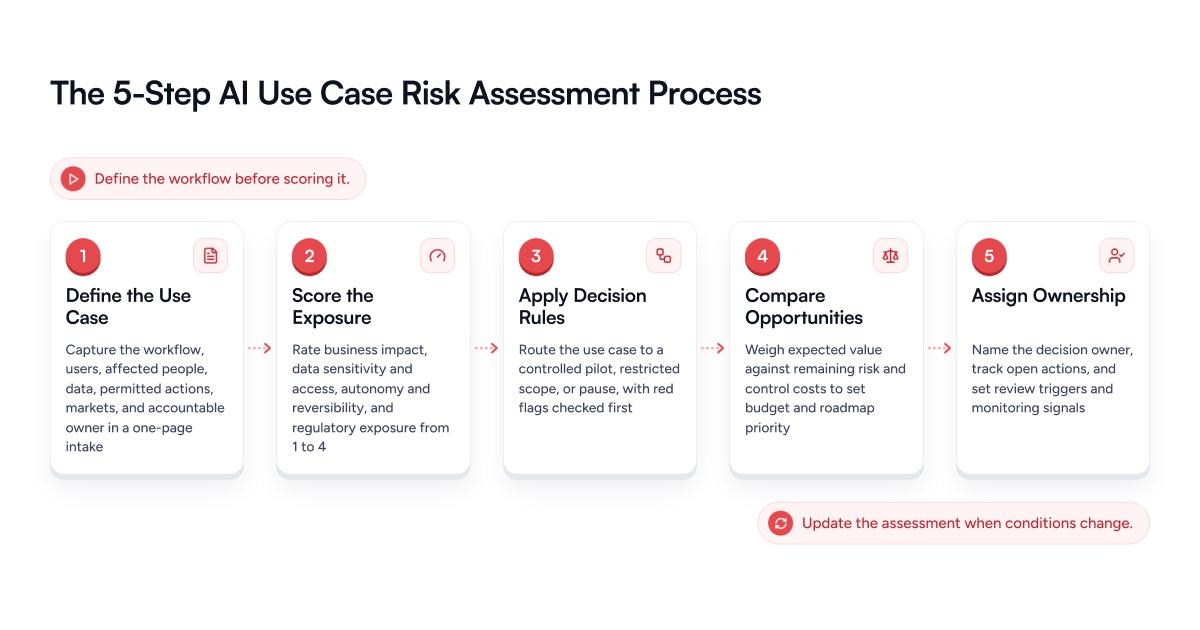
This guide serves businesses expanding AI across operations while managing limited specialist capacity, crowded roadmaps, and customer commitments. For them, a failed launch burns runway, a missed delivery date strains a relationship, and one wrong action in a customer account can end a contract. The next sections follow one order: define the use case, score its exposure, apply decision rules, compare opportunities, and assign ownership.
What Should an AI Use Case Risk Assessment Include Before Scoring?
An AI risk assessment framework is a method for finding how an AI system could cause harm, rating the exposure, and recording who decides whether the work proceeds. AI risk assessment forms part of AI governance, which establishes the policies, responsibilities, and controls for managing AI systems. The unit of assessment is a specific workflow: the model, the data it reaches, the people it affects, and the actions it can take. One model can draft internal notes in one workflow and edit customer records in another, and the two carry different exposure.
We recommend a one-page intake as the AI risk assessment checklist for each workflow, completed before anyone assigns a score. For planning purposes, teams can allocate 60–90 minutes to complete the intake, assign initial risk scores, and identify red flags for one defined workflow. Evidence gaps, legal questions, and specialist reviews require additional time. The intake has seven fields:
- Business objective: the result the workflow should produce.
- Users: the people who operate it.
- Affected people: customers, employees, or partners who feel the outcome.
- Data involved: what the workflow reads, stores, or sends.
- Actions permitted: what it may do and what stays out of scope.
- Deployment markets: where customers use it.
- Accountable owner: the person who accepts the remaining risk.
The intake names one measurable business outcome, such as shorter handling time or fewer manual reviews. That outcome feeds the funding decision and stays out of the risk score, which keeps a large benefit from offsetting a serious exposure.
A realistic failure scenario completes the record: what goes wrong, who bears the consequences, and which evidence is on hand.
Every field offers an “unknown / needs verification” entry. An unknown answer carries a visible flag into scoring, so missing information draws scrutiny in place of the lowest score.
How Do You Score AI Use Cases With an AI Risk Scoring Matrix?
The AI risk scoring matrix rates each workflow from 1 to 4 on four dimensions: business impact, data sensitivity and access, autonomy and reversibility, and regulatory exposure. Higher scores indicate greater exposure. The four scores remain visible, and their sum, from 4 to 16, supports comparison among use cases assigned the same decision route.
The engineering assessor records the scores, and the accountable business owner reviews the rationale. The scores describe potential exposure if the workflow fails; pilot tests provide evidence about failure frequency. The combined score supports comparison and does not determine whether a use case proceeds to a pilot, requires restrictions, or pauses.
GeekyAnts developed the scoring approach presented in this guide. Its scoring criteria do not constitute a NIST, ISO, or regulatory scoring scale. This guide does not provide legal advice.
Dimension | 1 | 2 | 3 | 4 |
|---|---|---|---|---|
Business impact | Minor inconvenience absorbed within normal work. | Limited cost or delay; a small group of customers notices. | Material financial loss or disruption; many customers or key accounts affected; visible reputational damage. | Severe or lasting loss; customer harm, contract loss, or operational stoppage. |
Data sensitivity and access | Public or low-sensitivity internal data; narrow access matched to the task. | Internal business data; access limited to one team. | Personal, customer, or confidential commercial data; access spans several teams or systems. | Health, financial account, or authentication data, or use or access broader than the stated purpose. |
Autonomy and reversibility | Suggests options; a person decides and acts. | Prepares actions; a person approves each one; stopping is immediate. | Acts without per-action approval in a limited scope; most actions reversible; a person can stop it. | Acts across a broad scope without approval; actions resist reversal; stopping is slow or impractical. |
Regulatory exposure | General internal use; no regulated activity; no decisions about individuals. | Customer-facing or personal-data use in one market with known rules. | Regulated sector, or output informs decisions about individuals; applicable rules identified. | Output shapes consequential decisions about individuals, or the workflow spans jurisdictions with differing rules. |
A workflow takes the highest anchor that any part of its description matches. Where evidence is missing, the scorer assigns the higher plausible anchor and flags the field until someone verifies it.
How Should You Score Business Impact if the AI Fails?
Business impact measures the damage a plausible failure could cause to customers, operations, contracts, and revenue. Start with the failure scenario recorded during intake. Identify the affected customer groups, the volume of transactions or records exposed, and the opportunity to correct an error before customers experience harm. Collect transaction volumes, service commitments, incident histories, and estimates of financial losses or recovery costs.
A common mistake is scoring an average working day rather than a credible failure affecting multiple customers. Move from 2 to 3 when an error could affect key accounts or produce material financial loss. A score of 4 applies when consequences include lasting customer harm, contract loss, or operational stoppage. Expected business benefits do not reduce the risk score.
How Should You Score Data Sensitivity and Access?
Examine the information the workflow reads, stores, or sends, including records retrieved through connected applications. Match those fields to the approved business purpose, vendor processing terms, retention rules, and access permissions. Collect a list of data fields, the vendor's data-use terms, and an export of system access settings.
A common mistake is scoring the information the feature needs while ignoring records its integration can retrieve. OWASP's mailbox-assistant example demonstrates the risk created when a summarization tool has permission to send messages. Customer or confidential information reaching multiple teams can raise exposure to 3. Sensitive financial or authentication information, or access exceeding the approved purpose, can justify a score of 4.
How Should You Score AI Autonomy and Reversibility?
Assess the actions the workflow can perform, including permissions that exceed its intended task. List connected tools and their authority to send messages, issue payments, delete records, or change account details. Examine whether people approve each action, the scope of permitted operations, the ability to reverse results, and the controls available to stop the workflow.
Collect the tool-permission list, approval records, action logs, and stop-control test results. A common mistake is counting human approval as a safeguard when reviewers cannot inspect supporting evidence or have insufficient time to challenge an action. A score of 3 reflects independent actions within a limited scope. A score of 4 applies when broad actions lack approval or resist reversal.
How Should You Score Regulatory Exposure?
Regulatory exposure depends on the intended use, affected people, sector, and deployment markets. Check whether the EU AI Act identifies the use as high risk, including specified recruitment and creditworthiness systems, and whether the GDPR governs the personal data involved. For US operations, examine sector rules such as the Equal Credit Opportunity Act and applicable state requirements for automated decisions.
The GeekyAnts guide to AI compliance in the United States explains the US regulatory landscape. Collect market records, decision descriptions, data categories, and documented legal assessments. A common mistake is treating a pilot as exempt from applicable obligations. Increase the score when the workflow affects regulated decisions or spans jurisdictions with differing requirements. Legal counsel determines which laws apply.
Where Do Accuracy, Bias, and Prompt Injection Fit in the Score?
Incorrect or biased outputs belong in the failure scenario, with business impact reflecting the potential harm. Model evaluation results help estimate failure frequency. Prompt injection can exploit the data and actions available to a workflow, so data access and autonomy determine the resulting exposure. Teams should collect representative test results, security test records, and evidence of failed controls. These findings inform safeguards and remaining-risk assessments without introducing a fifth scoring dimension.
Worked Example: How Does a Sales-Call Summarizer Score?
A hypothetical sales-call summarizer shows the method. Account managers review each summary before it is saved to the CRM.
Dimension | Score | Reason |
|---|---|---|
Business impact | 2 | A manager can correct a wrong summary before the next call. |
Data sensitivity and access | 4 | Calls hold customer names and contract terms, and the summaries reach sales and customer success. The initial score is 3, but unconfirmed vendor training use would exceed the stated purpose, so the higher plausible anchor, 4, applies with a flag until the vendor confirms. |
Autonomy and reversibility | 2 | A person approves each summary and can pause the tool. |
Regulatory exposure | 2 | The calls run in one market with familiar recording rules. |
Combined score | 10 | 2 + 4 + 2 + 2 = 10. |
Because the team cannot confirm whether the vendor uses transcripts beyond the approved purpose, the data-permission red flag remains open. Under this framework, the pilot pauses until the vendor confirms permitted use in writing.
A combined score can hide a serious concern, because three low scores pull one high score toward the middle. A 4 in any single dimension sends the workflow to specialist review. An open question about data permission or legal applicability is a red flag and pauses it, whatever the total shows.
What Does the AI Use Case Risk Scorecard Template Include?
The AI Use Case Risk Scorecard turns this method into an editable AI risk assessment template. It includes the scoring definitions, blank assessment fields, a completed example, evidence and uncertainty fields, escalation flags, safeguards, a decision owner, and a review date.
Teams complete one scorecard per workflow and compare assessments across opportunities. The accountable business owner reviews the assessment and decides whether the workflow can proceed.
I treat the four dimensions as one picture, because risk comes from how they combine. A workflow can show modest business impact and carry serious exposure once its data access and permissions are counted. Each score can look acceptable in isolation, yet the combination changes what a failure costs.
 Konakanchi Venkata Suresh BabuPrincipal Technical Consultant.
OWASP’s guidance on excessive agency describes a mailbox assistant built to summarize incoming email. The extension carries functions for sending messages, which the summary task has no need for. OWASP traces such exposure to excessive functionality, permissions, and autonomy. Buyers should assess what an assistant can do, beyond what it was built to do.
Need a repeatable way to score AI use cases and document each launch decision before committing resources?
Download the AI Use Case Risk Scorecard
How Do AI Risk Assessment Scores Determine Whether to Pilot, Restrict, or Pause a Use Case?
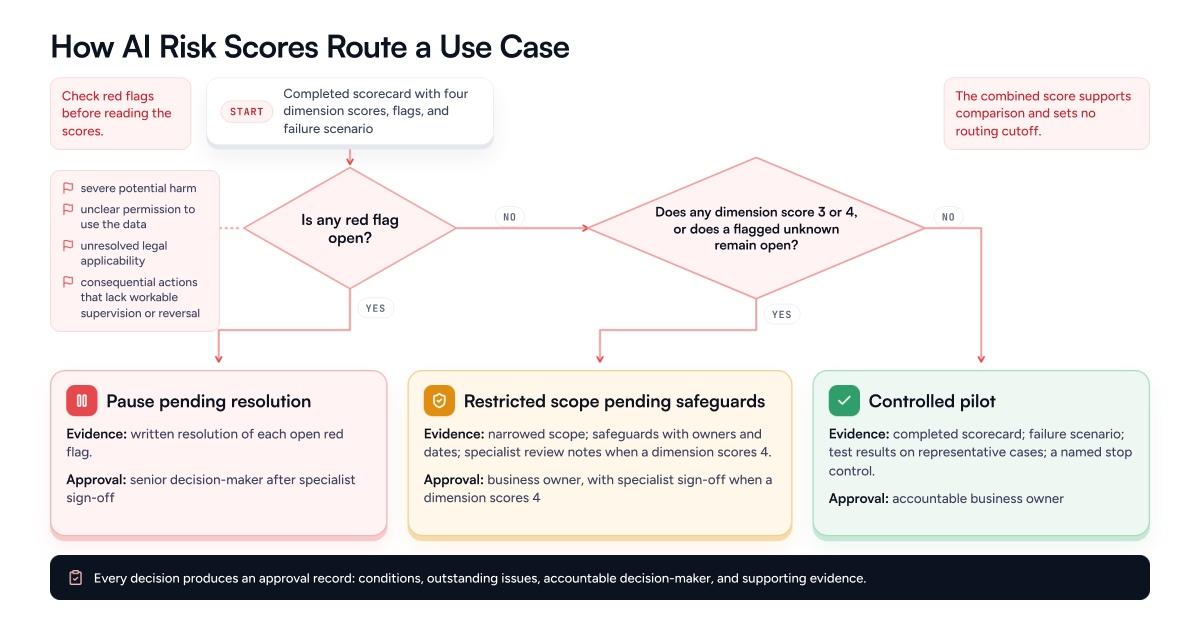
AI risk assessment scores route each use case to one of three outcomes: a controlled pilot, a restricted scope pending safeguards, or a pause pending resolution. Red flags come first, and the combined score sets no cutoff. These routing rules belong to this guide’s method.
Outcome | Evidence for approval | Approval |
|---|---|---|
Controlled pilot | Completed scorecard; failure scenario; test results on representative cases; a named stop control | Accountable business owner |
Restricted scope pending safeguards | Narrowed scope; safeguards with owners and dates; specialist review notes when a dimension scores 4 | Business owner; relevant specialist when a dimension scores 4 |
Pause pending resolution | Document every open red flag. Require written evidence of resolution before reconsidering the pilot. | Senior decision-maker after specialist sign-off |
Every decision produces an approval record: the conditions attached, the outstanding issues, the accountable decision-maker, and the evidence behind the call. The four-factor screen ranks exposure, and where a failure could cause severe harm, a scenario-level analysis of likelihood and impact has to follow.
When Can a Use Case Proceed to a Controlled Pilot?
A use case proceeds to a controlled pilot when every dimension scores 1 or 2, no field carries a flag, and no red flag is open. The pilot runs with a limited user group, a named stop control, and a review date. Under this rubric, workflows that use customer data score 3 or 4 for data sensitivity and access. They require restricted scope pending safeguards, with a pause for any open red flag. The four worked examples in this guide require restricted scope or a pause.
When Does a Use Case Need Safeguards or Specialist Review?
A use case moves to restricted scope when any dimension scores 3 or 4, or when a flagged unknown outside data permission and legal applicability remains open. Restricting scope means fewer users, read-only access, a lower cap, or approval on every action. Scores before safeguards describe inherent exposure, and the judgment after safeguards describes remaining risk, so the approver records both. Controls can lower the likelihood of a failure or the exposure it causes. Data sensitivity, legal obligations, and potential harm keep their scores until the facts change.
Which Red Flags Override the Overall Score?
Four red flags override the overall score and pause the launch until each is resolved: severe potential harm, unclear permission to use the data, unresolved legal applicability, and consequential actions that lack workable supervision or reversal. If a red flag cannot be resolved, such as when the company has no right to use the data, the pause becomes a decision to stop the use case. When a pilot ends, the owner rescores the use case using the pilot results before a wider release.
A low combined score can coexist with a data permission gap. If the team lacks proof that it may use the data for this purpose, the pilot narrows or stops, because no safeguard creates a right to use information. In my view, confirming permission is cheaper than rebuilding a pilot.
Konakanchi Venkata Suresh BabuPrincipal Technical Consultant.Before a pilot paused over data permission can be reconsidered, the team needs written confirmation of permitted use from the data owner or vendor, an export of the access configuration, and a test log from representative cases showing that the workflow stays within the approved data.
What Does an AI Use Case Risk Assessment Look Like for Common Growth-Stage Workflows?
The three workflows below are hypothetical, and design choices such as access and approval move the scores. A copilot that searches every account would score higher than the version shown.
Public-content drafting assistant | Customer-support copilot | Refund agent with manager approval | |
|---|---|---|---|
Assumptions | Drafts posts from public product pages; an editor publishes each; one market | The copilot drafts replies from the open ticket’s customer record and billing history. Its read-only access excludes card and bank account numbers. An agent sends each reply. The workflow operates in one market. | Proposes refunds up to a cap from order numbers and amounts, no card or bank account numbers; billing history included; a manager approves each payout; one market |
Business impact | 3: A false product claim could cause visible reputational damage. | 3: A reply exposes another customer’s billing history. | 3: repeated wrong refunds cause material loss |
Data sensitivity | 1: public information | 3: The copilot can access customer records and billing history, excluding card and bank account numbers. | 3: order data tied to customer accounts, no payment details |
Autonomy | 1: suggests text; a person publishes | 2: prepares replies; a person approves each | 2: proposes refunds; a person approves each payout |
Regulatory exposure | 2: public marketing claims, one market, known rules | 2: personal data, one market, known rules | 2: customer-facing refunds, one market, known rules |
Combined score | 7 | 10 | 10 |
Major failure | A post describes a feature the product lacks | Wrong-customer data appears in a sent reply | Approved refunds on fraudulent claims |
Safeguards | Editor review; claims checked against product documentation | Restrict retrieval to the open ticket’s customer, mask billing fields that the reply does not need, and retain access logs. | Per-request cap; order-history check; sample review |
Proposed decision | Restricted scope pending safeguards | Restricted scope pending safeguards | Restricted scope pending safeguards |
The refund agent is the only workflow in this table where the AI proposes a financial action. Three workflows in this guide total 10, and they land on two different routes, which is why the total never decides the route. One changed assumption alters the result. If the refund agent pays without manager approval, autonomy moves from 2 to 4, because paid refunds resist reversal and the rubric takes the highest matching anchor. The other scores hold, so the combined score rises from 10 to 12. A consequential action with no supervision or reversal opens a red flag, and the decision moves from restricted scope to pause pending resolution.
A completed scorecard for the refund agent with manager approval shows the record a team would keep.
Field | Entry |
|---|---|
Workflow and owner | Refund agent with manager approval; Head of Customer Support |
Scores | Impact 3, data 3, autonomy 2, regulatory 2; combined 10 |
Failure scenario | Approved refunds on fraudulent claims; tested on past refund cases |
Unknowns and flags | None open; no 4; no red flag |
Safeguards and owners | Refund cap (Finance); order-history check (Engineering); sample review (Support lead) |
Decision | Restricted scope pending safeguards; Head of Customer Support and relevant specialist must review the safeguards before pilot approval. |
Review date | Before pilot approval, then at the end of the first quarter after launch. |
How Should You Prioritize AI Use Cases Against Expected ROI, Remaining Risk, and Control Costs?
This AI use case prioritization framework places each workflow on a value-versus-remaining-risk matrix. The initial scores document exposure before safeguards. The business owner and relevant specialist then assess remaining risk using the implemented controls, test evidence, and unresolved issues. Expected value comes from the measurable business outcome recorded at intake. The axes stay separate, so a large upside changes no risk score and no approval requirement.
Lower remaining risk | Higher remaining risk | |
|---|---|---|
Higher value | Top priority | Narrow into a controlled pilot, or fund safeguards before scale |
Lower value | Fund when capacity allows | Defer |
An open red flag removes a workflow from the matrix until the owner resolves it, whatever its value.
Each candidate gets one comparison of expected benefit against implementation cost, operating cost, human review effort, safeguard cost, and time to measurable value.
A narrow pilot tests a valuable opportunity while limiting exposure: a small user group, a limited set of records, and a fixed review date. It answers whether the benefit appears at an acceptable cost.
Factor | Ticket-routing assistant | Contract-adjustment agent |
|---|---|---|
Expected benefit | Shorter first-response time, measurable from ticket logs | Larger savings, benefit uncertain |
Implementation and operating cost | Moderate | High |
Human review effort | Low; agents confirm each route | High; staff check each change |
Safeguard cost | Low | High; approval workflow, audit logging, legal review |
Time to measurable value | Short | Long |
Remaining risk | Lower | Higher |
The routing assistant earns the first budget because its benefit is measurable and its safeguards are cheap. The contract agent waits for a narrower scope, such as a single contract type, that lowers review effort and safeguard cost.
Each funded workflow ends with a prioritization record: business owner, benefit hypothesis, success metric, budget assumption, dependencies, and the evidence required for the next investment decision.
A business case for AI tends to list the benefit and leave out the cost of oversight, remediation, and delay. I ask leadership to put those costs beside the benefit before any budget is committed. If the case fails with those costs included, narrowing the scope is the first option to test, because a smaller use case needs a lighter review and fewer safeguards.
 Kunal KumarChief Revenue Officer
Gartner predicted in June 2025 that more than 40% of agentic AI projects will be canceled by the end of 2027 because of escalating costs, unclear business value, or inadequate risk controls, and it advises pursuing agentic AI where it delivers clear value or return on investment. A narrow scope with a measurable outcome addresses all three causes.
Who Owns AI Risk Decisions Under an AI Risk Assessment Framework, and When Should the Assessment Be Updated?
A lean operating model assigns four roles to every workflow, and each role answers one question.
Role | Question it answers |
|---|---|
Business owner | Does the business accept the remaining risk? |
Engineering assessor | Do the scores and tests reflect how the workflow behaves? |
Data owner | May the workflow use and reach this data? |
Specialist reviewer | Does a 4 or a red flag need legal or security judgment? |
In a smaller company, one person can hold several roles. The business owner role stays with one named individual who accepts the remaining risk, so responsibility stays explicit. The scorecard, an action register, and a review of each workflow replace a standing governance committee.
The action register, a lightweight AI risk register, tracks open work from each assessment. A hypothetical entry for the sales-call summarizer shows the fields.
Issue | Safeguard | Owner | Deadline | Evidence | Approval status |
|---|---|---|---|---|---|
Vendor use of transcripts for model training is unconfirmed | Obtain written terms that exclude training use | Sales operations lead | Before the pilot starts | Written vendor confirmation | Pending data owner |
Scheduled reviews follow the date recorded on each scorecard. As a planning guideline, teams should review controlled pilots weekly and at pilot completion, while restricted workflows require weekly reviews until safeguards are verified, followed by monthly reviews. Event-triggered reviews start when a workflow gains new data access or broader autonomy, changes purpose, enters a new market, suffers an incident, or undergoes a material supplier change.
Five business-facing signals show whether a workflow stays within its assessed exposure: incorrect actions, customer complaints, manual interventions, unexpected costs, and unresolved exceptions. A sustained rise in any of them triggers a review.
Why Choose GeekyAnts to Turn AI Risk Assessment Findings into a Production Plan?
GeekyAnts supports the work after the scorecard at three decision points.
Before approving AI investment: the AI Discovery Sprint, a three- to four-week engagement within our AI consulting practice, covers workflow mapping, data and system readiness, and use-case prioritization. It delivers a ranked use-case list, a view of where AI creates measurable value and which ideas should stop, a feasibility assessment of data maturity, technical readiness, and system constraints, an execution roadmap, and an investment case for leadership.
Before a pilot: the sprint closes with a defined pilot scope, expected outcomes with measurable success criteria, a roadmap for executing the pilot, and an investment case for approving the next phase. The pilot readiness discussion should also establish data access requirements, necessary safeguards, and the accountable owner before testing begins.
Before production:product engineering turns scorecard safeguards into working controls. Authentication, role-based authorization, and secrets management govern data access, while output evaluation, retrieval quality testing, and human review mechanisms address failure scenarios. Logging, error tracking, alerting, and cost visibility support the monitoring signals. Controlled releases, rollback, and an ownership handover prepare the team to run the workflow.
AI-Driven Insight Generation With a 99% Reduction in Manual Effort
GeekyAnts built an AI-driven insight pipeline for Pillar Engine on Snowflake, AWS Bedrock, and a custom agent, replacing manual, inconsistent summaries with automated insights that process 10,000 pages in two minutes at more than 85% accuracy. The client required the solution to meet its AWS compliance requirements while supporting scalable AI-driven insight generation. The published case study changed client names under an NDA.
GeekyAnts built an AI-driven insight pipeline for Pillar Engine on Snowflake, AWS Bedrock, and a custom agent, replacing manual, inconsistent summaries with automated insights that process 10,000 pages in two minutes at more than 85% accuracy. The published case study changed client names under an NDA.
Buyer fit: this path suits teams with a defined workflow, an accountable sponsor, and an upcoming investment or launch decision. The sprint informs that decision. Certification, legal compliance review, and security audit require separate work.
What Should Your Team Do After Completing the AI Risk Assessment?
Choose one real workflow with a defined owner and an upcoming decision, and complete the AI Use Case Risk Scorecard for it before applying the AI risk assessment framework across the roadmap. A finished scorecard leaves five outputs: documented exposure, unresolved questions, safeguards, a named owner, and a justified next step. Share the record with the people who approve and run the workflow, and settle each open question before launch. Repeat the process for the next workflow once the first yields a decision the team can explain.
Sources and Citations
- https://www.mckinsey.com/capabilities/quantumblack/our-insights/the-state-of-ai
- https://genai.owasp.org/llmrisk/llm062025-excessive-agency/
- https://www.gartner.com/en/newsroom/press-releases/2025-06-25-gartner-predicts-over-40-percent-of-agentic-ai-projects-will-be-canceled-by-end-of-2027
- https://eur-lex.europa.eu/eli/reg/2016/679/oj
- https://www.nist.gov/itl/ai-risk-management-framework
- https://www.iso.org/standard/77304.html
- https://blog.ansi.org/anab/iso-iec-42001-ai-management-systems/
- https://www.iso.org/standard/42001
- https://www.aicpa-cima.com/resources/article/2017-trust-services-criteria-with-revised-points-of-focus-2022