

Key Takeaways
- An AI artifact becomes a production application only when it has been taken through a structured implementation process that covers architecture, backend infrastructure, automated release workflows, CI/CD, security controls, and rollout planning. A strategy document does not replace any of these. The roadmap is the engineering plan that connects them.
- For enterprises, a structured implementation roadmap reduces deployment risk, satisfies governance and compliance requirements before build begins, ensures integration readiness across existing systems, and produces an application that scales without structural rebuilds.
- For growth-funded startups, the roadmap is the difference between an AI feature that reaches users on a defined timeline and one that consumes engineering resources without reaching production. A lean, well-sequenced implementation path is also the clearest signal to investors that the team can take an idea to a deployable product.
- The organizations that sustain value from AI applications are those that treat post-launch operations, including output quality monitoring, reliability management, and structured improvement cycles, as part of the implementation, not as activities that begin after it ends.
Why AI Artifacts Need an Implementation Roadmap to Reach Production
According to Stanford's 2025 AI Index Report, 78% of organizations had implemented AI in some form by 2024, and 92% of companies plan to increase their AI investment over the next three years. Yet only 1% of organizations have reached AI maturity. The gap is not a failure of ambition. It is a failure of execution.
Most organizations have something to show for their AI efforts: a working prototype, a proof of concept, an internal demo, an AI-generated feature, or a workflow built during a sprint. These outputs are called AI artifacts. An AI artifact is any AI-generated output, model, or workflow that has not been built for real-world deployment. It may perform well in a controlled environment, but it has not been tested against real users, real data volumes, or real system dependencies.
This guide is written for enterprise teams managing multiple AI pilots with no clear path to production, and for growth-funded startups that need to turn AI-powered prototypes into deployable, investor-ready products without burning engineering resources on preventable rework.
The most impressive AI demos I have seen were built by talented teams who genuinely understood the technology. But when those same teams were asked to take their work into a live environment, with real data, real users, and real system dependencies, most of them hit a wall within the first few weeks. Every single time, the issue was the same. No one had planned for production.
 Saurabh SahuChief Technology Officer (CTO)
We have reviewed hundreds of AI builds over the years, and the pattern is consistent. The demo works, the stakeholders are convinced, and then the team tries to move it into a real environment, and everything slows down. The model behaves differently, the integrations do not hold, and suddenly, a two-week deployment becomes a six-month rebuild. At that point, starting over is often cheaper than fixing it.
 Kunal KumarChief Revenue Officer
What both are missing is a roadmap that connects the artifact to a production application. One that accounts for application architecture, backend dependencies, infrastructure setup, CI/CD, deployment pipelines, security requirements, testing protocols, system observability, and defined ownership across teams. Approximately 70% of AI projects fail to deliver expected business value. In most cases, the model was not the problem. The implementation was never structured for production from the start. An AI implementation roadmap provides that structure, ensuring every decision from architecture to rollout is made in the context of what the business needs to go live, stay live, and grow.
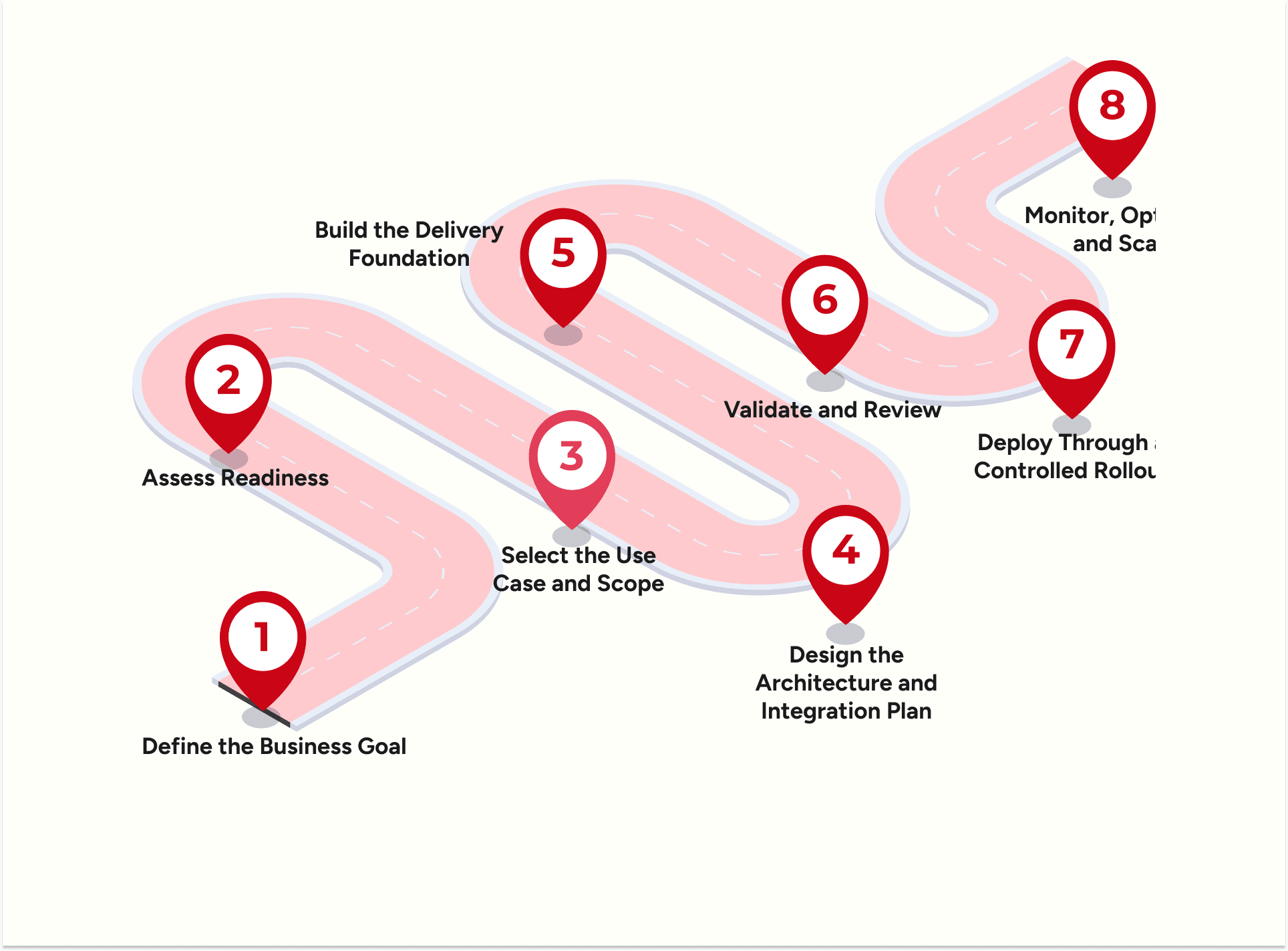
The 8-Stage Implementation Roadmap for Production-Ready Applications
An AI implementation roadmap defines every step required to move an AI artifact from its current state to a deployed, production-grade application. It covers the full journey from validating the business case through architecture and infrastructure decisions to controlled rollout and post-launch operations. Each stage builds on the one before it and carries both a decision and a deliverable. The journey begins with business intent and ends with a scalable, observable application.
Stage 1: Define the Business Goal Behind the AI Artifact
Every production investment begins with a business problem. This stage determines whether the artifact is solving a problem that justifies the cost, time, and engineering effort of production deployment.
Three things must be defined before this stage closes. What specific business problem does the artifact address? How will success be measured, in processing time, decision accuracy, or throughput, and what value does it deliver to the users or teams it serves? Are the stakeholders aligned across product, engineering, compliance, and business leadership? A deployment without that alignment will face friction at every subsequent stage.
For enterprises, this stage involves evaluating whether the artifact fits within the broader AI portfolio and whether it conflicts with existing governance requirements. For growth-funded startups, the question is more direct: does this feature support the product trajectory that investors have backed? Not every artifact deserves to be a product. This stage exists to make that determination before resources are committed.
Stage 2: Assess Readiness Across Data, Systems, Teams, and Risk
Readiness assessment is the gate that determines whether implementation begins on solid ground or on untested assumptions. Assumptions made here do not stay hidden. They become the production failures that cost significantly more to resolve mid-build than they would have before it began. Before any architecture decision is made, the organization must have an accurate account of where it stands across five dimensions: data, systems, security, team capability, and risk and compliance.
Data readiness
This examines whether the data required to run the artifact in production is available, governed, and accessible at the volume and frequency the application will demand. A model that performs well on a curated dataset behaves differently when exposed to live, incomplete, or inconsistent data.
Systems readiness
This reviews whether existing infrastructure, platforms, and third-party connections can support the integrations the application requires. An application that depends on systems not designed to carry additional load will expose that gap in production, not before it.
Security readiness
This evaluates whether the application introduces vulnerabilities that existing controls do not cover. Security gaps identified after deployment cost more to resolve than those addressed before the build begins, and in regulated industries, they can halt a launch entirely.
Team and ownership readiness
This identifies whether the organization has the internal capability to build and maintain the application, and who holds decision-making authority when issues arise. Undefined ownership creates accountability gaps that slow future decisions.
Risk and compliance readiness
This determines whether the application raises regulatory, data privacy, or ethical concerns that must be resolved before deployment. For enterprises in regulated industries, this dimension often sets the deployment timeline more than any other factor.
The output of this stage is a readiness scorecard covering all five dimensions. Each dimension is assessed against a defined threshold, gaps are documented with a resolution plan, and the stage produces a clear go or no-go decision. If gaps exist, the implementation does not proceed until they are closed.
Stage 3: Select the Right Use Case and Scope for Production
Clearing the readiness gate marks the end of ideation and the beginning of production planning. Not every artifact that passed the business goal review should move into build. This stage produces the answer: which use case gets productionized first, and at what scope.
The selection process is guided by four criteria:
Business impact evaluates how directly the artifact addresses a measurable business problem.
Technical feasibility assesses whether the artifact can be built within the constraints confirmed earlier.
Risk exposure examines whether compliance, security, and operational risks can be managed within the first release.
Time-to-value determines how long it will take for the deployed application to deliver a measurable return.
An artifact that scores well across all four is the right candidate for the first release. One that carries unresolved risk or requires foundational infrastructure work flagged earlier belongs in a later phase.
Scope discipline is equally important. The first release should be narrowed to the minimum functionality that delivers a defined, measurable outcome. Every feature added is an additional testing requirement and dependency to manage.
For enterprises, selection involves a formal review against the broader AI portfolio and governance requirements. For startups, the decision is driven by product roadmap alignment and investor expectations. In both cases, the question is not what is possible but what is ready.
The output is a documented use case selection with defined boundaries, a scoped feature set, and a written rationale for why this use case was prioritized. If the team cannot produce that documentation with confidence, the selection has not been made.
Stage 4: Design the Application Architecture and Integration Plan
Architectural design is where implementation either takes shape or begins to accumulate foundational problems that surface as production failures. The decisions made here define how the application is built, how it connects to existing systems, and whether it can perform under real operating conditions at the scale the business requires.
A production-ready AI application is built across five layers, each carrying its own set of decisions.
The application layer
This defines how users or systems interact with the product, including the interface, request and response structure, and the logic that determines what the application does with the AI output before it reaches the end user.
The backend layer
This governs business logic, data processing, and the rules that determine how the application behaves under different conditions.
The model layer
This determines how the AI component is accessed. Buying a proven platform delivers faster value when the use case is well-defined and the team does not have in-house AI engineering capability. Building is the right choice when the use case depends on proprietary data, requires full control over data storage, or when competitive differentiation depends on a custom capability.
The data layer
This defines how information moves between systems, how it is stored, and how it is retrieved. A unified data foundation at this layer is what separates AI applications that perform in production from those that degrade within weeks of launch.
The integration layer
This maps every external system the application depends on, including customer relationship management platforms, enterprise resource planning systems, and core operational tools. Governance structures, including approval workflows and audit trails, are established here before deployment begins.
Beyond the five layers, two decisions shape the overall architecture. Hosted versus self-managed infrastructure determines the balance between operational control and deployment speed. Feature type determines whether the AI component operates as a real-time response system, a batch processing function, or a background decision engine, each carrying different infrastructure and cost implications.
The output is an architecture document and integration plan that gives every subsequent team a shared understanding of what is being built and how every component connects.
Stage 5: Build the Delivery Foundation With Infrastructure, CI/CD, and Security Controls
This is the stage where planning ends and implementation begins. Everything documented in previously needs to be built into a delivery foundation that can support a production application. Most organizations can plan this stage. Far fewer have the engineering capability to execute it. That gap is where GeekyAnts operates.
Infrastructure setup
This establishes the environments the application will run across: a development environment where the application is built, a staging environment where it is tested under conditions that mirror production, and a production environment where it runs for real users. Each must be configured, monitored, and managed independently.
Release workflows and CI/CD (continuous integration and delivery)
These define how changes move from development to production in a controlled, repeatable manner. For AI applications, this means confirming that model behavior has not shifted, integration points are functioning, and performance benchmarks are met before any release proceeds.
Access controls
These determine who can interact with which parts of the application and at what level of permission. Every component, from the model layer to the administrative interface, must have defined access boundaries.
Secrets management
This governs how the application handles sensitive configuration values such as system credentials, secure connection details, and authorization tokens. These must never be stored in application code or shared configuration files.
Logging and observability
These establish the visibility the team needs to understand how the application is performing. Real-time monitoring dashboards that track accuracy, uptime, and system performance are built at this stage, before launch, not after it.
Security controls
These cover data handling procedures, audit trails, and a completed security review before the application moves to deployment. For enterprises in regulated industries, this review determines whether the application can launch at all. For startups, it prevents a security incident from disrupting both operations and investor confidence.
The output is a delivery foundation that has passed infrastructure load testing, has active monitoring in place, has completed a security review, and has release workflows that are documented and operational.
Stage 6: Validate With Testing, Guardrails, and Pre-Launch Reviews
An application that works in a staging environment is not the same as an application that is ready to launch. Validation is not a final formality before deployment. It is a launch discipline that determines whether the application can perform under real conditions, recover from failure, and meet the standards the business committed to. Organizations that treat this stage as a checklist consistently find that the issues they chose not to address before launch become the incidents they manage after it.
Functional testing
This confirms that every component behaves as designed across the full range of inputs and conditions it will encounter in production. The standard benchmark is that testing activity accounts for at least 30% of total implementation time.
Performance validation
This establishes whether the application can handle the load, speed, and data volume the production environment will place on it. An application that has not been tested at production scale carries unknown failure thresholds that only become visible when real users are affected.
Security checks
These confirm every security measure is functioning as intended under production conditions. For enterprises, this is a formal gate. For startups, it determines whether the application is safe to expose to real users and real data.
Guardrails
These define the boundaries within which the AI component is permitted to operate, whether through output filters for generative features or confidence thresholds for predictive models. They are the mechanism that makes the application trustworthy enough to operate without constant supervision.
Rollback readiness
This ensures the team has a tested and documented path to revert to the previous stable state if the application encounters a critical failure after launch.
The go/no-go review
This is the final gate before deployment. It assesses whether functional tests have passed, performance benchmarks have been met, the security review is complete, guardrails are confirmed, and the rollback process has been tested. If any criterion is unmet, the application does not proceed.
The output of this stage is a validated application with documented test results, a completed security review, active guardrails, and a tested rollback plan ready before the next stage begins.
Stage 7: Deploy Through a Controlled Rollout
A demo proves a concept. A pilot tests the feasibility in a limited environment. A controlled production rollout is a structured, monitored release to real users under defined conditions, with clear boundaries on who has access, what is being measured, and what triggers an escalation or rollback. Each carries a different level of exposure. A production rollout that fails without adequate controls fails in front of real users, with real consequences for the organization's reputation, revenue, and stakeholder confidence.
Phased release
This limits that exposure. The rollout begins with a defined subset of users or a single department. Only after stability, user adoption, and output quality are confirmed does it expand to the next group. Each expansion follows the same confirmation logic before proceeding.
Limited access
This ensures the application is only available to the users and systems it has been prepared to serve at each phase. For enterprises, this means a formal process of granting and tracking user permissions tied to each rollout phase. For startups, it means controlling which user segments receive access and under what conditions.
Feedback loops
These collect user feedback on output quality, monitor technical performance against established benchmarks, and track business outcome metrics against the success criteria defined in Stage 1. Feedback at this stage determines whether the rollout proceeds, pauses, or triggers an escalation.
Escalation protocols
These define what happens when the application encounters failure conditions not present during validation. Every rollout requires a documented path identifying who is notified at each threshold and what decisions they are authorized to make. Escalation ownership must be assigned before the first phase begins.
For enterprises, each rollout phase requires sign-off from engineering, product, and business leadership. For startups, the process is leaner, but the phased release logic, feedback collection, and escalation path all apply without exception.
The output of this stage is a production application that has been introduced to real users in a controlled sequence, has generated validated performance and feedback data from each rollout phase, and has demonstrated the stability required to support the next phase of expansion.
Stage 8: Monitor, Optimize, and Scale the Application After Launch
Deployment is not the final stage of implementation. It is the point at which implementation shifts from building to operating. Model accuracy degrades as real-world data patterns shift. System performance changes as usage volumes grow. Organizations that treat deployment as the endpoint find themselves rebuilding within twelve months.
Observability
This provides a continuous, structured view of how the application is performing across every layer, from output quality to system uptime to integration health. For enterprises, it connects technical signals to governance and risk reporting. For startups, it is the earliest indicator of whether the application is delivering the value investors were shown.
Reliability management
This ensures the application continues to meet the validated performance standards. This includes tracking uptime, response times, and error rates against defined thresholds. An application that powers customer-facing operations or influences financial decision-making cannot afford unplanned failures. At scale, reliability is a business continuity requirement, not a technical metric.
Cost visibility
This tracks what the application costs to run against the value it delivers. Without this tracking, an application delivering strong output quality may be consuming resources at a rate that does not justify the return. Cost visibility connects post-launch operations directly to the established ROI case.
Usage monitoring
This tracks how the application is being used against how it was designed to be used. Usage data is the most direct signal for identifying where improvement is needed and where expansion is possible.
Improvement loops
These address two distinct needs. The first is output degradation, which occurs when the data the application encounters in production diverges from the data it was originally built on. Detecting this early and updating the model against current data keeps the application accurate over time. The second is business feedback, capturing whether outputs are useful and what the business now needs the application to do.
Scaling decisions
These are driven by performance, cost, and usage data collected since launch. For enterprises, expansion follows a formal review against governance standards. For startups, it is the point at which a validated feature becomes a core product capability.
The output is an application performing within defined parameters, understood in terms of its cost and usage profile, and supported by a documented improvement and scaling plan tied to the business objectives established at the start of the roadmap.
Common AI Implementation Roadblocks That Delay Production Deployment
The gap between a promising AI pilot and a deployed production application is where most implementations fail. According to IDC research, 88% of AI proofs of concept never reach production deployment, and the share of organizations abandoning AI projects jumped from 17% in 2024 to 42% in 2025. These failures share a consistent set of causes.
Unclear ownership
This is the most pervasive blocker. When no single team holds defined accountability for the application's progress, decisions that should take hours take weeks. Engineering, product, business leadership, legal, and compliance each hold a piece of the picture, but none holds the authority to move the implementation forward independently. Establishing ownership before implementation begins is the condition that determines whether decisions get made at all.
Weak data readiness
This is consistently underestimated. Most organizations treat data preparation as a task to be handled during build rather than a prerequisite that must be resolved before build begins. Fragmented data across older systems, inconsistent formats, and insufficient historical depth cannot be corrected mid-build without high cost and schedule impact.
Integration complexity
This surfaces when AI outputs are connected to existing business systems without adequate planning. Older platforms were not designed to consume AI-generated outputs, and workflow dependencies, data format differences, and performance constraints only become visible when integration work begins. Organizations that treat integration as a late-stage activity consistently find it becomes the longest and most expensive phase of the entire implementation.
Security gaps
These are introduced when organizations move from pilot to build without establishing security controls, access boundaries, and compliance frameworks. The vulnerabilities created at this stage either halt the deployment during pre-launch review or surface as incidents after launch. For enterprises in regulated industries, an unresolved security gap is not a delay. It is a stop. For startups, it affects both user trust and investor confidence.
Poor deployment workflows
These reflect the absence of an engineering structure required to move changes from development to production in a controlled, repeatable manner. Without documented workflows, every issue requires the team to reconstruct the deployment context before they can begin diagnosing the problem.
Lack of observability
This means the team has no reliable view of what the application is doing in production. Without monitoring across output quality, system performance, and integration health, degradation accumulates without detection until users or business operations are visibly affected. By that point, the cost of resolution is substantially higher than it would have been had the issue been caught at the signal level rather than the symptom level.
How Does GeekyAnts Execute AI Implementation Roadmaps That Reach Production
The organizations that successfully move from AI artifact to deployed application treat implementation as an engineering problem, not a strategy exercise. Building a production-grade AI application requires backend engineering, infrastructure design, CI/CD, deployment pipelines, security controls, observability, and post-launch operations executed as a connected discipline.
GeekyAnts is the technical partner that executes across that entire discipline. The work begins with architecture and ends with a deployed, observable, and maintainable application.
For enterprises
The implementation challenge is integrating a new AI-powered application into an environment that carries years of architectural decisions, compliance requirements, and operational dependencies.
In one enterprise engagement, GeekyAnts built an end-to-end AI-driven pipeline that extracted performance data from a cloud-based data platform, transformed it into structured narrative outputs using a custom AI agent, and served those outputs to managers and dashboards with minimal latency. The result was a 99% reduction in manual effort, 85% or higher accuracy in responses, and the ability to process 10,000 pages in two minutes, within a compliant, secure cloud environment.
For growth-funded startups
The challenge is building infrastructure that performs reliably today and scales without a complete rebuild as the product grows. In one startup engagement, GeekyAnts executed a full cloud infrastructure migration and architectural redesign in one week with a single planned downtime window of one day. Monthly infrastructure costs dropped by 50%, from $1,650 to $845. Incident response time improved by 80% through structured deployment pipelines and endpoint monitoring.
These outcomes reflect the depth of engineering execution across backend architecture, infrastructure, deployment discipline, and observability that production-grade AI applications require. Organizations that choose GeekyAnts do so because that execution capability is precisely what the distance between an AI artifact and a deployed application demands.
Turning an AI idea into something that actually runs in production is a different challenge entirely from building the idea in the first place. You need people who have made those infrastructure decisions before, who know where the hidden costs show up, and who can tell you on day one what will break by month three. Most teams find that out the hard way.
Saurabh SahuChief Technology Officer (CTO)
Implementation Is Where AI Strategy Either Delivers or Disappears
The journey from AI artifact to deployed application is a sequence of disciplined engineering and business decisions, each one building on the last, each one reducing the risk that the application never reaches the users it was built to serve.
The eight stages in this roadmap provide that sequence. Each stage carries a decision and a deliverable. Together, they create the structure that allows organizations to reach production faster, with fewer points of unplanned failure, a clearer line between investment and return, and an architecture that supports growth rather than constraining it.
For enterprises, that means AI that integrates with existing operations, satisfies governance requirements, and scales without structural rebuilds. For growth-funded startups, it means a product that performs in production, justifies continued investment, and creates a foundation for the next phase of development.
The organizations that reach production are not the ones with the most sophisticated AI models. They are the ones who treated implementation as a discipline and executed it as one.