

Bringing Agents to Life in Google Cloud: A Developer’s Guide
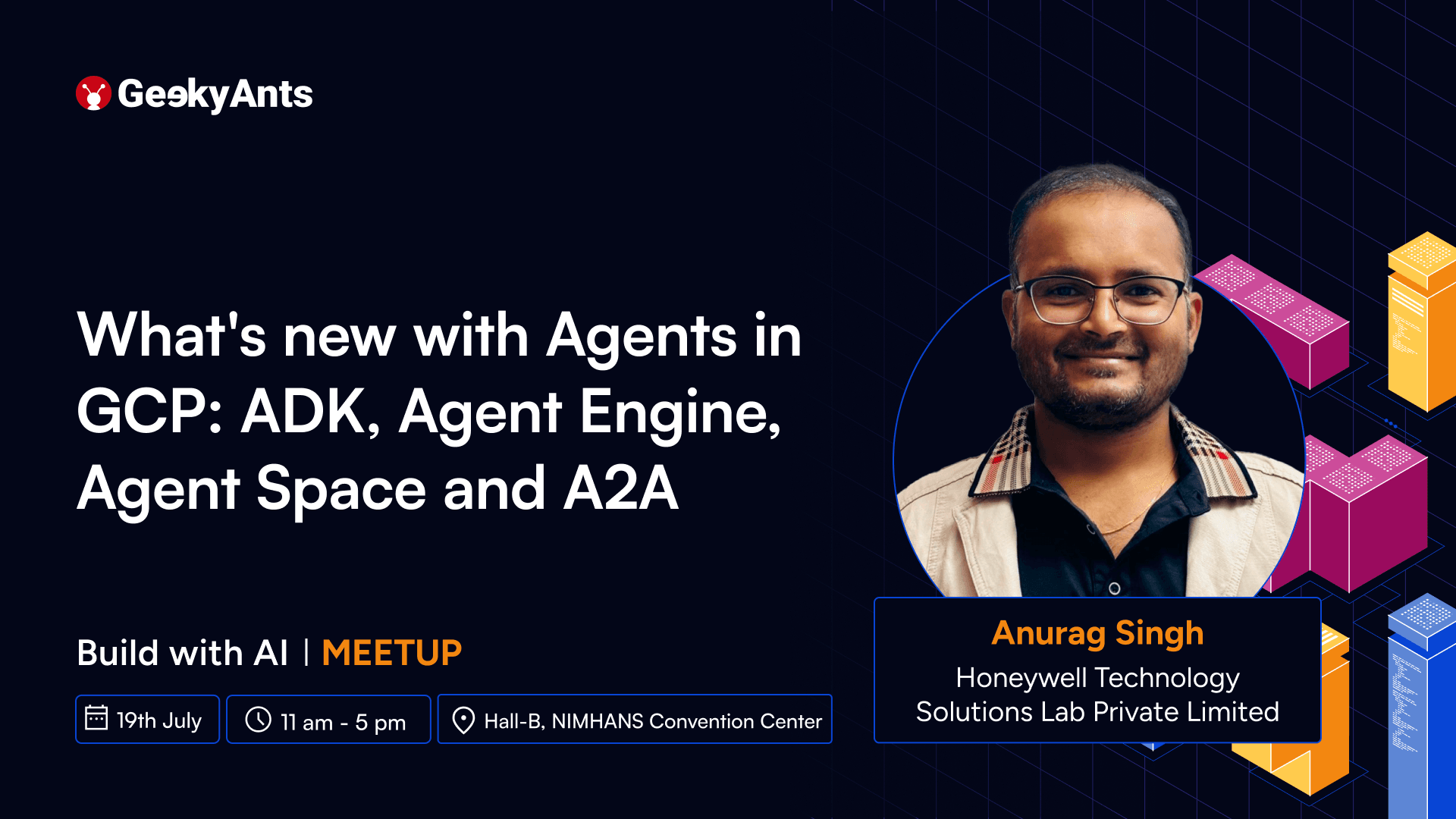
Editor’s Note: This blog is adapted from a talk by Anuragh Singh, delivered during the Build with AI meetup hosted by GeekyAnts at NIMHANS. In his session, Anuragh shared insights into the evolving architecture of LLM-based systems, focusing on how developers can move from one-off applications to production-ready autonomous agents. Drawing on his experience building with Google Cloud and the Agent Development Kit, he explored best practices for tool orchestration, modularity, and the infrastructure challenges of deploying real-world AI agents at scale.
From LLMs to Agent AI
Hi everyone, I am Anuragh Singh. I lead the GenAI portfolio at Honeywell Research and Development, and I have been in the industry for nearly eighteen years now. My journey started when data was not yet “big”—from early data work to cloud platforms, machine learning, and now generative AI.
This talk is focused on what is new in the world of agent development, specifically within the Google Cloud environment. I will not be going into deep technical code here, but I will walk through the major components and recent developments that can help you build AI agents, connect tools, and transition from prototype to production.
The Evolution Toward Autonomy
Generative AI began with chatbots—simple applications that generated text responses. Then came tool calling, where models could interact with functions. And now, we are entering the phase of autonomous agents—systems that not only respond, but also decide and act.
An agent is not just an interface. It is a construct that takes actions on your behalf. You trust it to make decisions, the same way you trust a legal or marketing agent to represent you. That autonomy is the critical leap. We are no longer asking models for answers—we are letting them execute workflows.
In regulated environments like BFSI, manufacturing, or aerospace, this trust has to be earned. Most teams, including mine, still enforce a human-in-the-loop. We maintain observability over every step, because we cannot afford unsupervised autonomy in high-stakes environments. But in retail, e-commerce, and marketing domains, there are many use cases where full autonomy is already viable.
Why This Is Good News for Developers
There was a time when data science dominated every AI conversation. Everyone wanted to be a data scientist. But with GenAI and agentic systems, the landscape is shifting back toward engineering. Most of what we do today—building, evaluating, deploying agents—depends more on software development principles than on data modelling.
You are not training models anymore. You are integrating them, orchestrating workflows, and packaging them into scalable systems. And this is where engineers come in. The architectural skills needed to take something from prototype to production are exactly what traditional developers are best equipped for.
The Production Gap in Low-Code Tools
There are many low-code and no-code tools that allow rapid prototyping of agent-based workflows. Tools like CrewAI or N8N are great for building proofs of concept and showing business value. But taking those solutions to production is a different story.
When it comes to deployment, security, observability, and performance at scale, most low-code tools fall short. That is where engineers are needed. The gap between prototype and production is still wide, and building robust, scalable agent systems requires code-first approaches, solid architecture, and cloud-native deployment patterns.
What Google Cloud Offers for Agent Development
If you are working in the Google Cloud ecosystem, there are four major components you should know about:
1. Agent Development Kit (ADK)
Google has open-sourced its Agent Development Kit through the Linux Foundation. It allows you to build agent systems in Python, define tools, and implement multi-agent communication. The SDK includes features like structured function calling and communication protocols to help you build agent workflows from the ground up.
This is a code-first, developer-friendly toolkit. If you want to customise logic, design advanced flows, and control how your agents behave—this is the place to start.
2. Vertex AI Agent Builder
Once your agents are built, you need to deploy them somewhere. Vertex AI is Google Cloud’s managed platform for deploying GenAI and agentic workloads. It handles scalability, security, and infrastructure concerns out of the box.
You can plug in different LLMs—OpenAI, Anthropic, DeepSeek, Mistral—depending on your use case. The Model Garden within Vertex AI gives you flexibility to choose the right model for the right job, whether you need speed, depth, or cost-efficiency.
3. Model Context Protocol (MCP)
MCP allows your agents to connect with external tools and services in a structured way. If your agent needs to fetch data from a financial system, a weather API, or an enterprise knowledge base, MCP enables that tool connection in a consistent, reliable manner.
This is the backbone of agent-to-tool interaction. It standardises how agents reach out to resources and gather information.
4. Agent-to-Agent Protocol (A2A)
This is a newer protocol that enables agents across different teams—or even different organisations—to interact. If one organisation has an agent for booking venues and another has an agent for catering, A2A allows those agents to negotiate and coordinate tasks.
While tool calls deal with systems, A2A deals with agent-level collaboration. It is how two intelligent agents can share context, hand off responsibilities, and work toward a shared outcome.
Managing Complexity with Discovery and Governance
In any large organisation, you will eventually face another challenge: agent sprawl. Multiple teams build similar agents, unaware of what others have already developed. That leads to duplication, inconsistency, and missed reuse opportunities.
To solve this, Google offers Agent Space—a registry that works like an app store for internal agents. It allows teams to publish, discover, and manage agent implementations across the organisation. Each agent is registered with a unique J-card, helping teams understand its purpose and avoid rebuilding the same logic again.
This level of discovery and version control is essential once your organisation starts scaling agent adoption. It brings structure to what would otherwise become chaos.
Where to Go Next
All of the components I described—Agent Development Kit, Vertex AI Agent Builder, MCP, A2A, and Agent Space are available today in the Google Cloud ecosystem. If you are building agents or planning to scale agentic systems in production, these tools give you everything you need.
I have written a detailed blog that walks through these capabilities step-by-step, including examples and implementation tips. You can find it on my Medium page.
If you are currently building with GenAI or planning to move toward autonomous agents, I hope this gives you a clear picture of what is possible and what it takes to get there in production.
