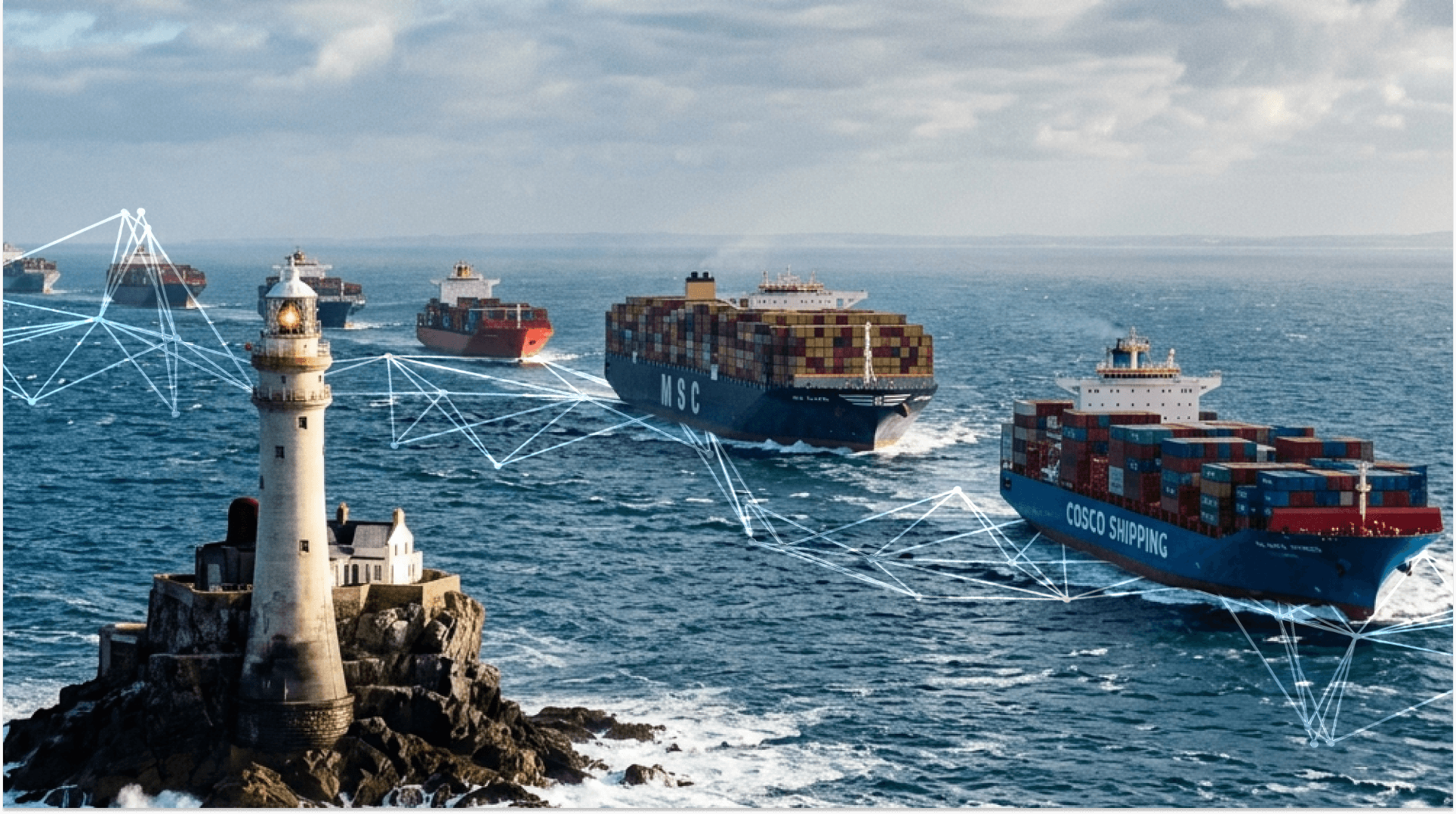

Modern manufacturing supply chains span continents. A typhoon in Southeast Asia, a port strike in Europe, or a sudden political conflict can send shockwaves through thousands of connected suppliers within hours. Most organizations respond only after a disruption has occurred, scrambling to reroute shipments and locate alternative suppliers.
Our internal engineering teams built an AI-powered predictive risk platform to change that—detecting threats before they become crises and recommending concrete responses.
What the Platform Does
A manufacturer uploads their supplier network, names, locations, and the materials each supplier provides. From that point, Promethean monitors external data and delivers:
- Risk detection across weather, geopolitical events, shipping disruptions, and news
- Opportunity identification for cost savings, time efficiencies, and market signals
- Mitigation plans — specific recommended actions for every detected risk or opportunity
- A single risk score from 0 to 100 per supplier and per manufacturer, updated as conditions change
- A live dashboard that reflects analysis in progress
The Three-Program Architecture
The platform breaks the analysis problem into three specialized programs that run concurrently to provide a 360-degree view of the supply chain
- Weather Program: Builds a day-by-day risk timeline for each supplier's location based on wind speed, rainfall, visibility, snow, and ice
- News Program: Searches news sources for articles tied to each supplier's name, location, and commodity, then uses AI to extract structured risks and opportunities from the text
- Shipping Program: Analyzes active transit routes, overlays weather data along those corridors, and flags likely delays
Once all three finish, their outputs combine into a single supplier risk score.
Scoring Risk: From Many Signals to One Number
Not all risks carry equal weight. In our system, geopolitical events and active conflicts carry the greatest weight, while shipping disruptions receive high multipliers due to their direct impact on logistics.
To prevent false calm, the system uses a non-linear scoring curve. Instead of a simple additive approach, the curve ensures that multiple moderate risks accumulating at once push the score upward significantly, reflecting the compounding nature of real-world supply chain stress.
Our AI-Powered Global Watchtower pulls from four external services:
Source | Purpose |
|---|---|
OpenWeatherMap | Current weather conditions |
WeatherAPI.com | 5 - 7 day forecasts |
NewsAPI | Breaking news and article search |
GDELT | Geopolitical event monitoring |
Mock Server | Shipping route and tracking data |
A caching layer ensures that if two programs request data for the same location within a 10-minute window, only one external call is made, keeping the system within free-tier API limits.
The Dashboard
The frontend presents analysis across five views:
- Main Dashboard — Agent status, recent risks, and the manufacturer-level risk score
- News Risk View — Risks sourced from articles, with source filtering
- Weather Risk View — Geographic exposure with day-by-day timelines
- Shipping Risk View — Route-level analysis with delay estimates
- Supplier Detail — Per-supplier risk breakdown with mitigation plans
Rather than making users wait while analysis runs, the dashboard streams progress updates in real time as each program completes its work.
What the Build Revealed
1. Specialization beats breadth. Splitting analysis into Weather, News, and Shipping programs, each with its own data sources and scoring logic, produced better results than a single broad query to the AI. Each can be tested and improved without affecting the others.
2. Non-linear scoring prevents false calm. A simple additive approach masked the danger of accumulating moderate risks. The curve corrects this by reflecting the real compounding nature of supply chain stress.
3. Provider flexibility from day one. Building the system to support multiple AI providers, Anthropic Claude, OpenAI, and a self-hosted option allowed the team to develop locally, prototype, and deploy without rewriting any core logic.
What Comes Next
Our team is currently exploring advanced features to further harden the platform, including:
- Market Trackers: Automated programs tracking commodity price fluctuations.
- Risk Propagation Mapping: A visual tool showing how a failure at a Tier-2 supplier ripples through the entire network.
- Predictive Sharpening: Using historical disruption data to improve the accuracy of future mitigation recommendations.