Carbon Footprint Tracker App For Greenr
Assisting environmentalists to raise awareness and give the power of preserving the planet to the people through a digital platform.
Project typeDesign and development
Tech stack


About the Client
In 2020, the founding members of the company understood that, with climate change being considered as one of the most grave environmental problems that mankind is currently facing, environmental considerations are an important factor in justifying urbanization decisions. Based in the UK, they set out to make people aware of the effects of their actions on the environment.
The Problem
The client was looking for the best Flutter developers and being acquainted with our portfolio, reached out to us through our website request form on July 23rd, 2020. The idea behind the project was simple, yet thought-provoking. They were looking for a way to leverage technology in order to calculate the carbon footprints of users and create awareness about climate change. The initial idea was to build a prototype, which they could showcase to their potential investors, get funding and then move on to develop the complete app.
With the initial discussions in place, the total engagement period was decided to last for 6 weeks over a Fixed Cost Model, divided between designing the app and developing parts of it to build a MVP, which later transitioned into complete development of a full-fledged working app at the time of official delivery, which was later changed to 8 weeks.
Development
With the stage set, the teams were geared up and ready to execute the project. Since the engagement involved both designing and developing the app, the entire process was divided into two phases. The first phase focused on designing the look and feel of the app, followed by the actual development and implementation phase.
Throughout the development phase, code reusability was a major consideration, which aligned perfectly with the client’s decision to use Flutter as the framework for app development. We also suggested pairing it with Node.js for the backend and MongoDB for the database to ensure maximum efficiency and scalability.
For deployment, the Google Cloud Build suite was chosen. The GCB App Engine was used for API server deployment, while the GCB Compute Engine was used for the database server deployment.
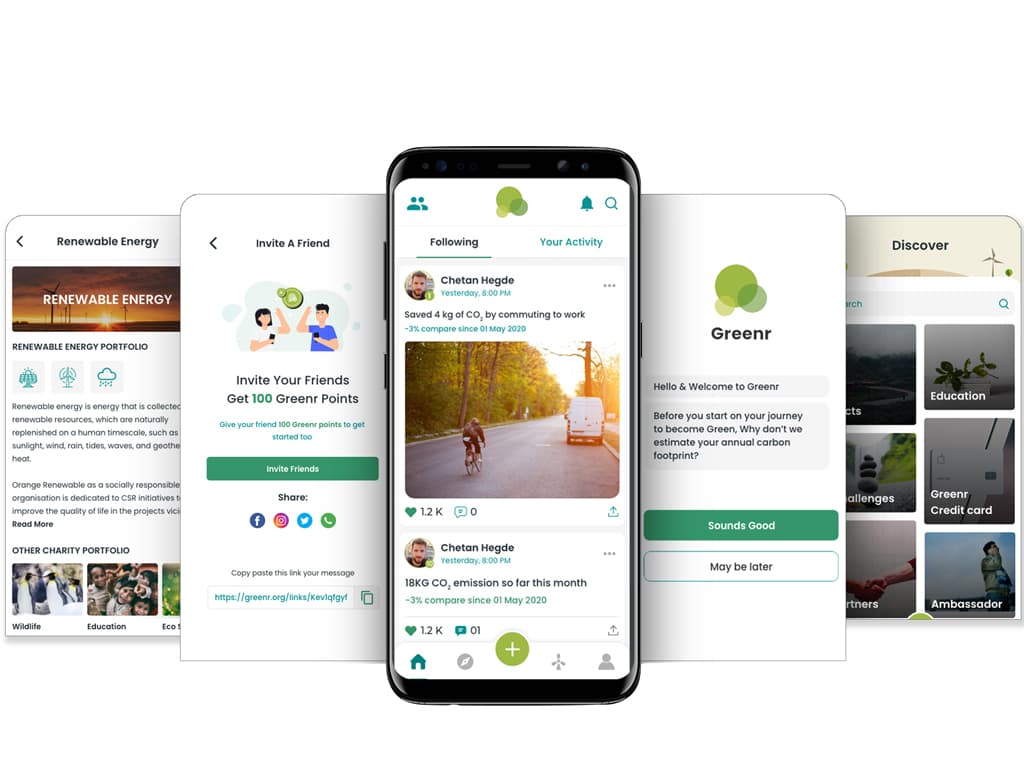
The app flow was designed to be simple and intuitive. On the first launch, users were greeted with a sign-up/login screen, followed by a social media feed once logged in. Using the “Create Content” button, users could post pictures and log their meals and travel activities. A sidebar menu provided access to features such as profile management, competitions, adding friends, wallet access, business partners, and more, along with a detailed profile view for user management.
The first task was to design screens for all the app’s features and create a seamless user journey that aligned with the app’s overall goals. The design team worked tirelessly to ensure the app experience was smooth, user-friendly, and easy to integrate into users’ daily routines.
Once the designs were finalized, the development team began implementing them to create the MVP as quickly as possible. Advanced Agile methodologies, including Continuous Design and Continuous Delivery, were employed throughout the process. The development team also adopted a test-driven development approach, creating testing strategies during the development phase itself. This technique was primarily used to validate the logic behind the CO2 calculator. For the core functionality, a nested logic structure was implemented where every component was carefully tested and optimized.
The use of test-driven development proved highly beneficial for the project. It not only improved the overall quality of the application but also accelerated the development process significantly, reducing the overall testing time by nearly half. The MVVM architecture helped separate the UI and business logic, making the codebase more readable, maintainable, and scalable. It also enabled parallel development of the UI and application logic while encouraging an event-driven coding approach.
Post-development, the product underwent another round of testing to identify and resolve any remaining issues. However, since most of the testing and bug fixing had already been completed during development, the final testing phase was much smoother and less time-consuming. User Acceptance Testing (UAT) remained a critical part of the process. The builds were shared with the client for testing and feedback, and any reported issues were promptly resolved and validated.
Overcoming Challenges
The project was quite a unique one and it came with its own unique challenges. During development, the client was continuously thinking about ways to evolve this project into the shape of the future, which led to quite a lot of changes in requirements expressly. These changes posed a challenge for the Client Experience team to accommodate in the existing engagement, which was solved by changing its nature to a Time & Effort based engagement. During development, accommodating these changes meant changing the complete logic behind the app, which seemed daunting at first but was handled by the team expertly. This change was majorly done to incorporate the Food Log feature addition, which would involve getting user's data on the kind of meals they eat and scorging through a large database to accurately calculate the CO2 emission.
In bird's eye view
- Tasks were managed using Excel and Slack + Skype was used primarily for communication.
- GitHub was used for versioning and source code management.
- The app is now live on Google Play Store and Apple App Store.
Final Impression
As it is with a project that's built from scratch, the look and feel of what the final product would always hang in the balance. In this particular case, the client was beyond ecstatic to see how their app turned out. The designs and the feel of the app were beyond what they imagined them to be. The MVP managed to get investors and the application was a success. They complimented the technical prowess of the developers with which they had developed the complete app and the satisfaction of delivering requirements on time was bestowed upon us. Another revolutionary idea found its outlet with our solutions.
Team On-Call
For creating the design for the app, the team consisted of an expert designer, overseen by a design lead to carry out tasks and activities efficiently. For development of the actual app, the team consisted of one Flutter dev and a QA engineer, overseen by a Tech Lead. The teams would be in touch with the client through every phase of the entire cycle to understand requirements and incorporate changes in the existing process.
Make green investments an easy, accessible and profitable everyday decision through a mobile app.
Provide exposure to and access towards selected green retailers who are advocates of the go-green agenda.
A social media platform for climate and sustainability enthusiasts.
An in app simple/advanced calculator to calculate emissions.
Incorporating bonus points, an initiative based on air miles that stores carbon offsets.





OUR APPROACH
- Amidst the severe environmental crisis that the world forces, we joined forces with Greenr in their attempt to raise awareness digitally. We engaged with the client over a period of eight weeks on a fixed cost model to develop a mobile app to support the go-green agenda.