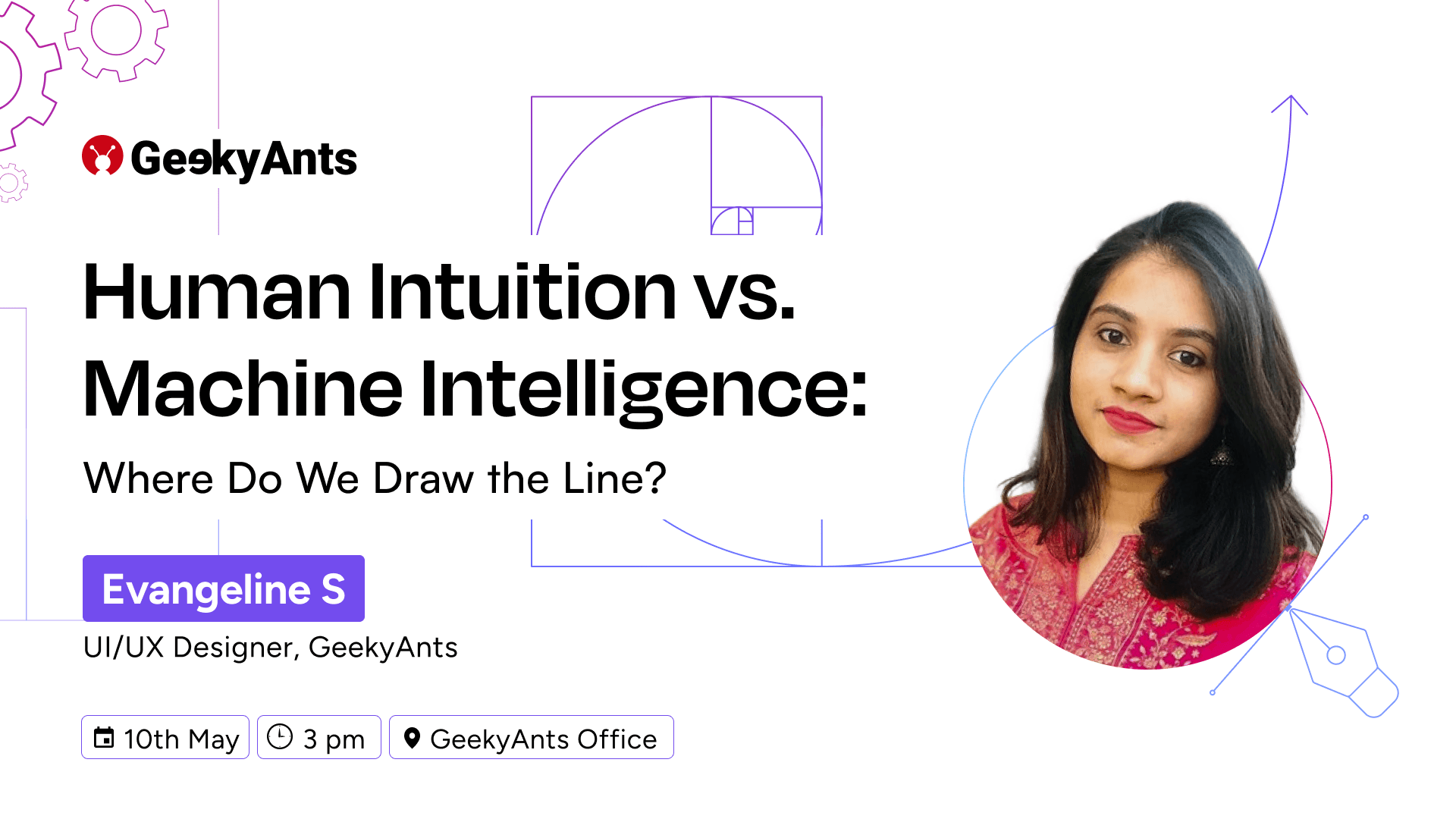

Editor’s Note: This blog is adapted from Evangeline S’s talk on the evolving relationship between human intuition and machine intelligence in design. It explores how designers can embrace AI as a collaborative tool while preserving empathy, creativity, and intent, offering insights into a balanced, forward-looking approach to modern UI/UX practices.
Hi, my name is Evangeline. I work as a UI designer at GeekyAnts. Outside of work, I enjoy planting, sketching, and painting. My design journey has not followed a straight path. I explored many fields before I became a designer. Once I chose design, I found no other profession as fulfilling.
Currently, I am exploring how artificial intelligence can influence design workflows. I aim to enhance efficiency and creativity. Design includes more than aesthetics. It involves understanding users, showing empathy, applying logic, and staying curious about user behavior.
Emerging Tension: Human Designers vs. AI
There is tension between designers and artificial intelligence. If artificial intelligence could design a full website in seconds, would I trust it? Many would say yes, and many would disagree. Those who support it point to its speed, pattern recognition, performance optimization, accessibility, and alignment with current trends. Artificial intelligence never rests. It operates continuously and keeps learning.
The Counterpoint: Empathy and Creativity
Artificial intelligence supports fast prototyping, especially for MVPs and brainstorming. However, those who oppose it often raise concerns about empathy, creativity, and experience. They question how artificial intelligence handles flow, accessibility, and varied user behavior. Different users interact differently. Artificial intelligence might fix bugs through prompts, but human creativity allows deeper exploration.
When emotional depth, cultural understanding, ethical judgment, and long-term vision matter, humans must take the lead. Artificial intelligence depends on data that humans provide. I see this as a collaborative opportunity. Artificial intelligence and humans should work together. Design is rooted in empathy, creativity, and experience. Artificial intelligence tools can assist but not replace these human elements.
Tool or Threat?
This raises a question: Do we treat artificial intelligence as a tool or a competitor? I treat it as a partner. I prompt them to enhance my work. I do not treat it as a threat.
Should designers fear artificial intelligence or embrace it? I have heard designers express concern. They feel artificial intelligence is advancing faster than they can adapt. I believe we should embrace artificial intelligence and use it wisely.
AI in Daily Workflows
Many of us use artificial intelligence in daily tasks. For instance, ChatGPT often stays open in a browser tab. It helps with checking ideas. Artificial intelligence makes us faster and more efficient. Whether it makes us more creative depends on the prompt. We still refine outputs, improve them, and apply our creativity.
Do I feel threatened by artificial intelligence? At times, yes. But I believe in maintaining a human-centred approach. I enhance creativity and treat artificial intelligence as a collaborator.
Stages Where AI Adds Value
Instead of competing, I believe in using artificial intelligence at various stages of the design process:
- Research: Artificial intelligence summarizes trends. Designers must ask the right questions.
- Ideation: Artificial intelligence drafts visuals. Designers curate and refine.
- UX Writing: Artificial intelligence drafts options. Designers align them with an emotional tone.
- Accessibility: Artificial intelligence flags issues. Designers fix them with empathy.
Tools Leading the Way
Recent updates like Figma’s “Make” show what artificial intelligence can do. With a prompt, it can generate code and design interfaces. Framer already builds websites in seconds. Artificial intelligence creates images, illustrations, and animations as well.
Figma Make, currently in beta, allows design and code generation from a prompt. It reduces the need to start from scratch.
Where Do We Draw the Line?
I believe designers hold a superpower—creativity. As one colleague said, our approach to design depends on our environment and the culture we work in. Artificial intelligence has broad capabilities, but humans provide intention. With the right prompts and clear goals, we shape the results.
The real value does not lie in artificial intelligence alone. It lies in how we use it. Artificial intelligence should amplify our ideas, not replace them. Machine intelligence is powerful. Human creativity provides depth.
The future of design will involve artificial intelligence. But human stories and creativity will continue to lead. While the boundary is not fixed, it remains flexible. It depends on our choices and our approach.