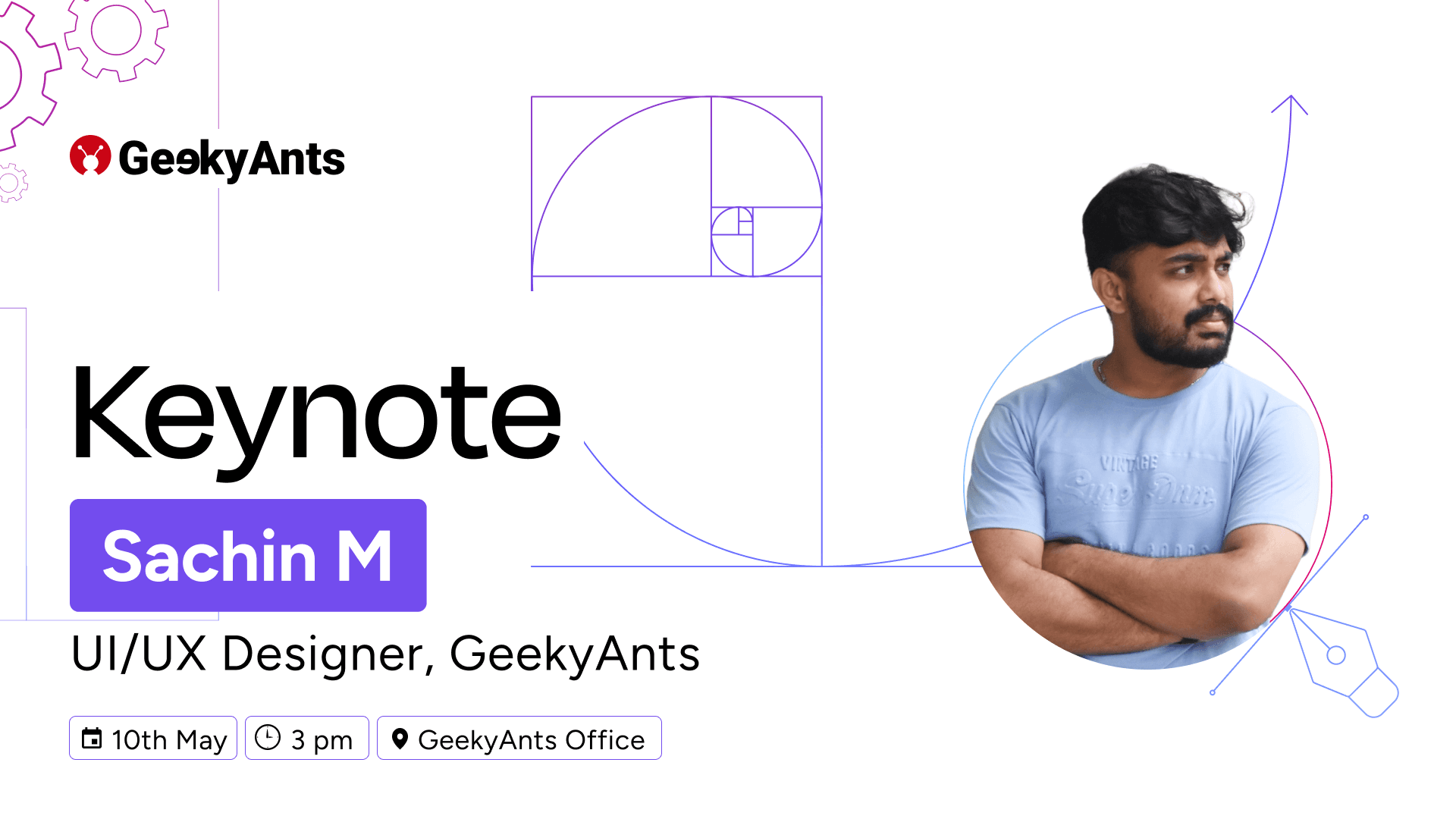

Editor’s Note- This blog is adapted from Sachin’s keynote on AI and human collaboration in design. It presents a grounded perspective on how designers can use artificial intelligence as a creative ally without sacrificing empathy, intent, or innovation—highlighting real-world
Hi, I am Sachin. I work as a UI/UX designer at GeekyAnts. Today, I will speak about artificial intelligence. I will explain how artificial intelligence and humans can form an innovative partnership. I will also explain why artificial intelligence will not replace us.
Let me begin by asking a question. How many people believe that artificial intelligence will take away our jobs? Many people hold this belief. However, the answer is different. Artificial intelligence will not replace us. Artificial intelligence and creativity stand apart. These are not interchangeable. Still, artificial intelligence will change the way we design. It has already begun to do so. I believe this change will not remain limited to design alone. It will influence many fields. However, in design, the impact will be more direct and visible as we move forward.
The Spotify Storyline Case
Let me share a story. In late 2022, Spotify launched a feature called "Storyline." This feature received low engagement, even though initial marketing created interest. Storyline was designed to connect users with artists. It allowed users to see how artists created music and to learn about their stories. However, the feature failed to meet expectations.
To improve this feature, the team formed a small design group. They had six weeks before release. The team decided to experiment with an artificial intelligence design tool. This decision carried risk. Feeding internal data and brand guidelines to an artificial intelligence model is not a simple task. Artificial intelligence models use such data to train themselves.
Still, the team moved forward. They gave the tool prompts that included brand rules and objectives. The tool generated many ideas. Designers felt excited in the beginning. However, they soon discovered problems. Many outputs from artificial intelligence were not technically feasible. Some solutions ignored brand rules. The tool created results that did not align with the requirements.
At this point, the team had already used one and a half weeks. Only four weeks remained. The question arose—should they discard artificial intelligence and return to a traditional design process?
The Human-AI Solution
The team chose a different path. They created a partnership between humans and artificial intelligence. Artificial intelligence acted as a springboard. The team extracted useful elements and added human understanding. They improved technical accuracy and introduced empathy into the designs. A designer named Jordan discovered an opportunity for waveform visualization. He saw potential in artificial intelligence as a design partner.
This approach led to positive outcomes. Engagement increased by 87 percent. Time spent with content grew by 34 percent. Artists reported higher satisfaction. They felt more motivated after receiving positive feedback from users. The team later won a UX design award for this project.
Why Artificial Intelligence Cannot Replace Human Designers?
Many people use artificial intelligence in their work. I use it as well. Artificial intelligence provides support, but I do not believe it can replace human designers. Designers possess empathy. We understand what users need. We consider the business impact of each decision. Artificial intelligence cannot make those judgments.
Design is not only visual. It involves solving problems. I find joy in reducing complex flows into simpler ones. Artificial intelligence might suggest random deletions, but it cannot understand the effect of those changes on business goals or user experience.
Innovation also means breaking rules. Artificial intelligence follows predefined patterns. I often go beyond those patterns to create better results. Artificial intelligence cannot offer that kind of freedom or insight.
Where Artificial Intelligence Can Help?
Despite these limits, artificial intelligence has value. We can use it as:
- An idea generator: Artificial intelligence can offer multiple directions to begin.
- Technical support: It can provide suggestions when comparing design elements.
- An accelerator: When deadlines are tight, it can help create quick sketches or draft storyboards.
These tools do not replace designers. They support us.
Closing Thoughts
The most creative and effective intelligence does not come from humans alone or machines alone. It emerges when both work together.