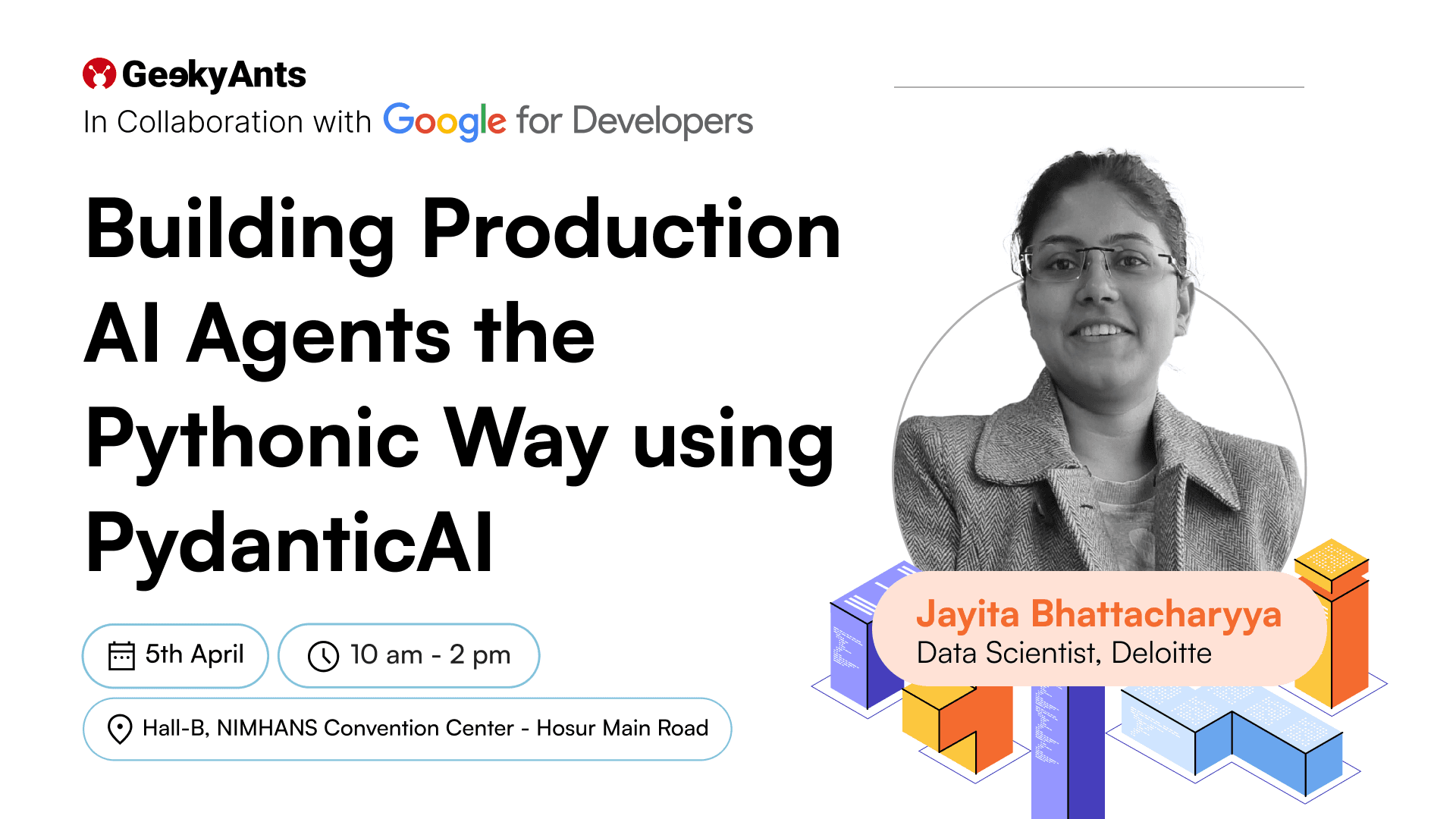

Editor’s Note: This blog is adapted from Jayita Bhattacharyya's talk on building production-grade AI agents using Pydantic AI. She covered type safety, structured outputs, and Python-native tooling for scalable deployment.
Hi, I am Jayita. I have built several AI agents—most of which never progressed beyond proof of concept. The reason? Most tools are not built for production. They lack structure, consistency, and type safety—critical requirements for scalable systems.
Pydantic AI addresses this gap. Built on the widely used Pydantic library, it offers a structured, type-safe framework for developing reliable, production-ready agents.
What Are AI Agents—Really?
We often throw around the term “AI agent,” but let’s define it clearly. An AI agent is a self-operating software entity that can make decisions, perform tasks, and adapt to user input, all without constant human intervention. Whether it’s generating a travel itinerary or managing support tickets, an AI agent needs to fetch relevant data, reason about context, and respond with clarity and consistency. To do that well, it needs more than an LLM—it needs structure.
Why Pydantic AI?
Pydantic AI brings engineering rigour to agent design. It's model-agnostic, allowing developers to work with platforms like OpenAI, Claude, Cohere, and more. But more importantly, it focuses on strong type enforcement, structured outputs, and dependency injection—all foundational to building production-grade software.
If you have ever struggled to get LLMs to return valid JSON or consistently formatted outputs, you'll appreciate what Pydantic AI offers. You define your expected schema once, and the agent sticks to it. You can also plug in tools like external APIs and custom functions via dependency injection. Additionally, it provides streaming output support, built-in retry logic, and observability through LogFire, which gives you everything needed for stable, deployable agents.
Let’s Build Something: A Customer Support Agent
In my demo, I built a simple customer support agent using GPT-4 and Pydantic AI. Initially, it handled general queries like “How do I track my order?” with intelligent fallback responses. As I introduced structured data and defined Pydantic models for ticket details, sentiment, and escalation status, the agent responded with well-formed, context-aware JSON outputs.
I then extended the agent with dummy data for customer and order records. Using dependency injection, the agent began responding with actual user-specific details, referencing names, items purchased, and shipping statuses. Streaming enabled fluid real-time responses, while retry logic ensured the agent could recover from missing context or data mismatches.
The entire interaction felt less like testing a chatbot and more like interacting with a production-grade application.
Error Handling, Reflection, and Self-Correction
What sets Pydantic AI apart is its support for reflective, self-correcting agents. In real-world applications, failures are inevitable, data may be missing, or the agent may misinterpret context. With built-in fallback mechanisms and retry logic, agents can adapt in real time, recover from errors, and improve response quality autonomously. This level of resilience is critical when transitioning from development to production.
Observability with LogFire
One of the biggest gaps in many agent frameworks is visibility. When something breaks, you need to know why. Pydantic AI integrates with LogFire, an observability tool that lets you track every API call, token stream, and system variable in real time.
During the demo, I was able to trace each user interaction—from input prompt to model output—with full transparency. This level of insight makes debugging faster, iteration smoother, and production incidents easier to resolve.
Final Thoughts: Production AI Is Pythonic
Shipping production-grade agents demands more than prompt engineering—it requires a foundation of structure, reliability, and developer-aligned tooling. Pydantic AI delivers on all fronts.
With strong type enforcement, consistent schema generation, real-time streaming, and integrated observability, it encapsulates the core principles of robust Python development, purpose-built for scalable AI agents.
For teams moving beyond prototypes, Pydantic AI offers a mature, open-source solution rooted in proven engineering standards. It’s not about generating output—it is about delivering results.