
Jul 20, 2022
Top 5 Use Cases Of Blockchain Beyond Cryptocurrency
Blockchain has been instrumental in catapulting cryptocurrency to the next level. Let's take a look at what else can be achieved using it.
Author
 Charmy DafdaTechnical Content Writer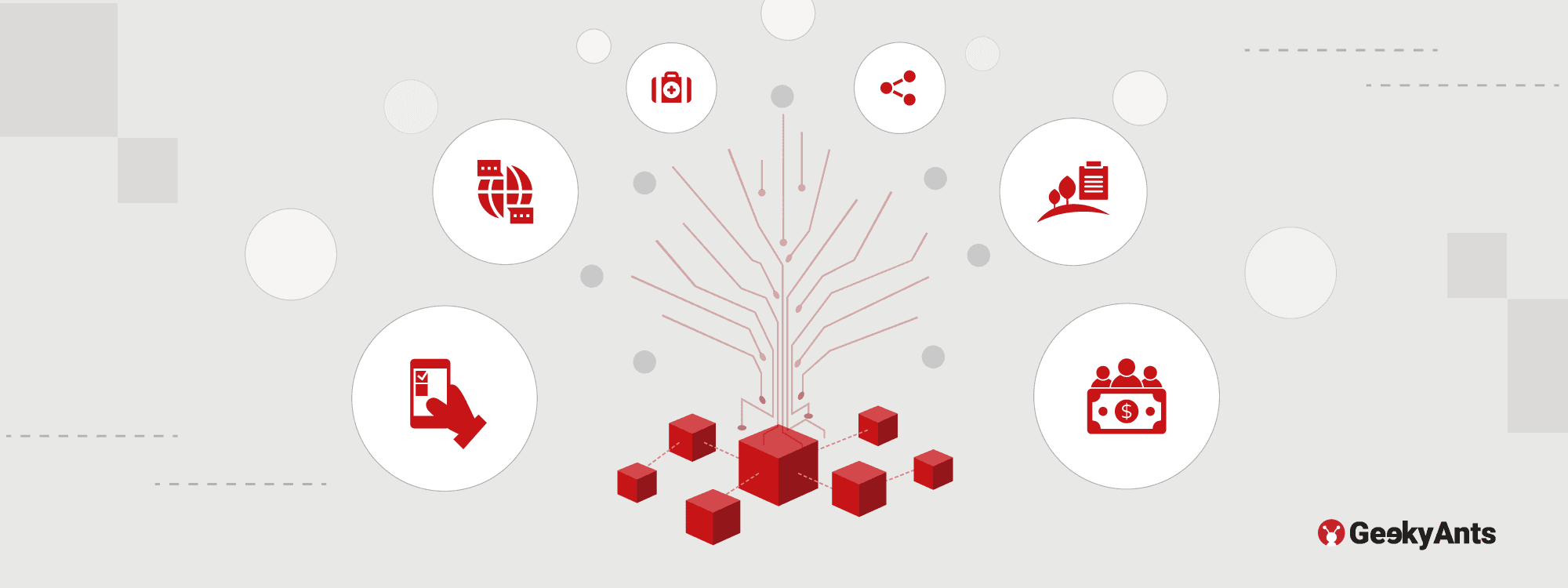
As we know, blockchain is a digital public ledger that stores data securely, making it almost impossible to hack or alter without authorization. Since its inception in 1992-93, it has evolved dramatically and made its mark in promoting cryptocurrency. Even the ones who are critical of this change cannot deny the potential of using blockchain for other use cases. In this article, we will discuss how this revolutionary technology is changing the business processes beyond cryptocurrency.
Top 5 Use Cases Of Blockchain Beyond Cryptocurrency
1. Blockchain in Supply Chain Management
Given the general uncertainty of the markets, complex patterns of consumer demands, and the unreliability of the data, managing supply chains is not easy. These systems also need to be robust to allow for better traceability of disruptions. Moving from the traditional methods of storing data on spreadsheets and going through endless email threads to incorporating blockchain technology here can make all the difference.
Blockchain can help monitor every stage of processes in supply chains, from raw materials inventory to the end product delivery stages. For example, Walmart has successfully used blockchain to track products in supply chains from origin to final delivery in the food industry.
2. Blockchain in Land Registry
Creating land deeds records is a complex task that might be spread over a span of many years. It involves multitudes of steps that require proper data storage at every stage. Loss of data at any stage can complicate the process and matters further. Also, any discrepancies in this data can have serious consequences and changes in property ownership.
Introducing blockchain technology to store this information decentralized will ensure higher data security and transparency. The likelihood of human errors is also reduced. For example, Tech Mahindra introduced blockchain for the Abu Dhabi land registry. It helped them eliminate friction in document sharing and provided a safe, secure, and transparent environment for all the parties involved.
3. Blockchain in KYC
Know Your Customer or KYC processes are at the heart of financial services compliance and anti-money laundering efforts. Despite the budgets allocated and efforts to improve these processes, KYC operations are still inefficient. Introducing blockchain technology here can make the data involved unhackable, increases the accuracy of the information, and provide real-time user data updates.
It helps with all operations, including verifying customer identity, streamlining KYC on-boarding process, and throughout the entire customer lifecycle. Reducing the data processing costs by reducing response time and eliminating manual work are also some of the added advantages of blockchain in KYC.
4. Blockchain In E-Voting
Elections are pivotal processes for any democracy or institution. The accuracy and security of the data cannot be compromised at any cost. Over the years, with advancements in technology, elections and voting have been automated to a great extent. But sharing this sensitive information online does not come without cyber security risks. Blockchain technology can help make this process more robust in terms of data security and accessibility.
With blockchain, the possibility of creating a fake voter ID can be narrowed down to nil as it tallies each voter ID efficiently, and each ballot is attributed to one ID. Also, the cost of setup is reduced as only the internet connection cost is required at each voting platform. Accurate results, speed in the vote count, and fraud prevention can be achieved without unnecessary human intervention.
5. Blockchain In Unified Communications
Unified communications have time and again proved their effectiveness in handling organizational communication in every industry. They have especially transformed the information exchange process for the hospitality industry. But despite its advantages, it still can be cumbersome to manage and track as the communication is asynchronous.
Blockchain helps eliminate the need for a centralized clearing house. Communication is also made more authorized and secure than before. The problems of transparency, time stamping, and traceability can be solved even when using chatbots.
6. Blockchain In Healthcare
Blockchain is considerably new in the healthcare industry, but it is starting to show its benefits right from the beginning. It has provided an unprecedented level of data integrity which is the primary requirement for medical records. Patients are allowed control over their data to increase trust in the system. The abundant data generated from linked medical equipment can also be transferred and saved securely.
How GeekyAnts uses Blockchain Technology to seize the future?
As an industry leader in developing hi-tech digital solutions that harbor advanced features, GeekyAnts- Blockchain Development Company has always believed in adapting to new technologies. Our expert team of blockchain developers is building new solutions for clients and also performing their own experiments. One of the latest solutions that we are working on is a blockchain-based gaming solution for Soccer Manager. The solution is still in its beta stage, and our client is extremely satisfied with the results.
Conclusion
We conclude by acknowledging blockchain’s evolution in the past years. What started just as a cryptocurrency application has now evidently taken over almost all other applications in the IT space. And yet, there still remains a lot to be explored. As business leaders in innovation, we will be investing in enlightening the community about and building solutions using this breakthrough technology to enhance people’s lives and empower them to build new things in the coming years.
Subscribe to Our Newsletter
Subscribe to RSS
Press & Media Hub RSS FeedRELATED ARTICLES
More from the engineering frontline.
Aug 31, 2026
Aug 31, 2026
Aug 27, 2026
Aug 27, 2026
Aug 25, 2026
Aug 21, 2026
Aug 21, 2026