


Drug discovery is not slow because we lack data—it’s slow because we have struggled to use it meaningfully. Traditional pipelines take 10–15 years and over $2 billion to bring a single drug to market, yet 90% of candidates fail in clinical trials. AI is changing that equation. By accelerating molecule screening, improving target prediction, and reducing trial-stage failures, it empowers pharmaceutical teams to make faster, smarter, and more cost-effective decisions.
Globally, over $10 billion has already been invested into AI drug discovery technologies, and by 2028, AI is projected to enable the approval of 50+ new drugs per year. Supporting this shift is cloud infrastructure, enabling scalable compute, secure data pipelines, and real-time collaboration.
This guide is tailored for biotech startups, pharma enterprises, and technology leaders aiming to build scalable, compliant AI drug discovery platforms. We’ll unpack AI’s role, regulatory mandates, implementation strategies, industry challenges, and how to launch production-grade solutions.
Key Highlights
- Generative AI is transforming drug discovery by designing new compounds, optimizing properties, and cutting timelines from years to weeks.
- Compliance must be embedded from day one—covering FDA, HIPAA, and GxP—to ensure trust, approval, and scalability.
- AI success depends on system-wide planning with unified data, explainable models, and continuous validation—not strong model performance alone.
Why AI & Cloud Are Game-Changers in Drug Discovery
In 2003, mapping the human genome took 13 years and billions of dollars. Today, AI models can analyze genetic sequences in hours—and that's only the beginning. Traditional drug discovery remains a slow, costly process rooted in trial-and-error. AI flips that model, predicting compound behavior, identifying potential drug targets, and accelerating molecule screening with unprecedented precision.
Notably, AI-discovered molecules have shown 80–90% success rates in Phase I clinical trials, significantly higher than the historical industry average of 40–65%. This advancement is reshaping the landscape of pharmaceutical research.
The global AI in drug discovery market was valued at $1.5 billion in 2023 and is projected to expand at a CAGR of 29.7% from 2024 to 2030, reflecting the growing adoption of AI technologies in the pharmaceutical sector.
But this power needs a strong backbone. That’s where the cloud steps in—offering scalable compute, massive data storage, and seamless collaboration across global research teams. Together, AI and cloud are not just improving drug discovery—they’re completely rebuilding it for speed, scale, and accuracy.
Understanding the U.S. Landscape: Regulations & Compliance
Key compliance areas:
FDA
Requires AI models to provide explainable, reproducible outputs. Validation standards cover input traceability, output justification, and clear audit logs, especially for models used in clinical contexts.
HIPAA
Mandates encryption, role-based access, and secure cloud storage for any health-related or genomic data. Compliance failures here can halt progress entirely.
GxP
Applies to quality assurance across the pharma lifecycle. For AI systems, this includes version control, audit trails, and consistent procedural documentation throughout development and deployment.
Cloud Architecture
Must support region-specific data storage, secured APIs, and detailed access logs. Non-compliant infrastructure can void otherwise effective AI solutions.
Ethical Guardrails
Black-box models pose risks in generating unsafe compounds. Human oversight and built-in safety layers are critical to meet ethical and regulatory expectations.
Building for compliance ensures not only approval but lasting credibility, market access, and user trust.
Role of Generative AI in Drug Discovery
In early trials, researchers used a generative AI model to design a potential lung cancer treatment—what once took four years was reduced to just 30 days. No molecule was hand-drawn. The AI understood the chemical rules, designed novel compounds, and filtered viable candidates—all before a single lab test began. That speed is not a shortcut—it’s a shift in how drug discovery fundamentally works.
Here’s how Generative AI is transforming the process:
1. Design Novel Molecules from First Principles
Generative models don’t rely on pre-existing compound libraries. They learn chemical structure-function relationships and generate new molecules tailored to specific targets, expanding the discovery space beyond what’s been previously explored.
2. Accelerates Early-Stage Screening
By simulating thousands of compound-target interactions in silico, AI identifies viable candidates in weeks, not years. This eliminates weak leads early, conserving time, cost, and lab resources.
3. Optimizes for Efficacy and Safety
Modern generative pipelines include predictive layers that assess binding affinity, toxicity, and metabolic stability. This improves clinical readiness and minimizes failure in Phase I trials.
4. Supports Multi-Target Drug Design
AI models can be trained to optimize molecules for multiple therapeutic endpoints, addressing complex diseases like cancer or autoimmune disorders that require broader intervention strategies.
5. Enables Drug Repurposing at Scale
Generative AI can analyze existing compounds and predict new indications, breathing life into shelved molecules and accelerating time-to-market through already approved pharmacological profiles.
When guided by validated data, regulatory oversight, and ethical guardrails, Generative AI moves beyond automation—it becomes a force multiplier in the race to develop next-gen therapeutics.
How to Develop AI Solutions for Drug Discovery in the U.S Market.
Most AI drug discovery platforms don’t fail due to poor model performance. They fail quietly when ambitious ideas aren’t grounded in system-level planning. Fragmented data, unclear scientific intent, and missed regulatory alignment are the usual suspects. We've seen it firsthand—working with healthcare and pharma teams across the U.S.—and we’ve built this roadmap to help you avoid those pitfalls.
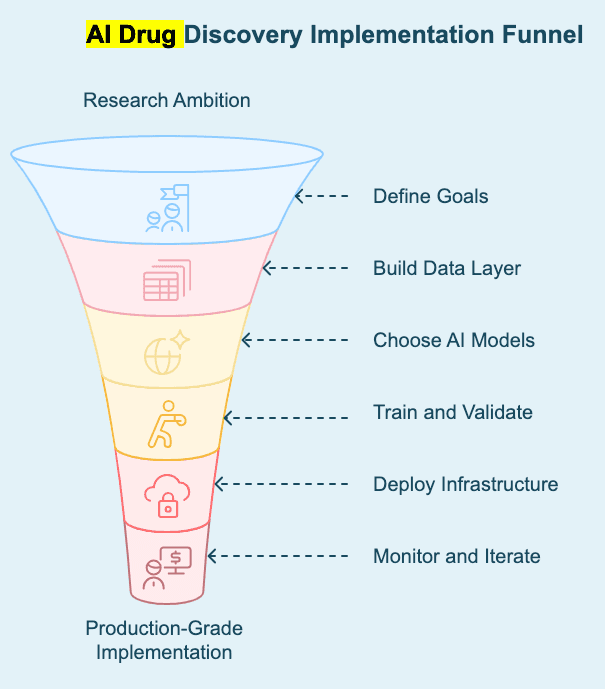
1. Define the Scientific Mission, Not Just the Model
Before writing a single line of code or building your first model, pause. What exactly are you trying to solve?
When Insilico Medicine set out to find a treatment for fibrosis, they didn’t aim for a general-purpose model. They built an AI system around a single question: how do we design a molecule for a specific biological target? Eighteen months later, they were in Phase I trials. That kind of acceleration happens when your AI is tethered to a clear therapeutic goal, not a vague idea of disruption.
Start here. Be specific. Are you trying to:
- Accelerate hit identification?
- Improve success rates in preclinical testing?
- Unlock therapeutic pathways for rare or neglected diseases?
Precision at this stage defines everything that follows.
2. Build a Unified and Clean Data Layer
AI’s performance is tied directly to the quality of the data it’s fed. But in drug discovery, datasets often live in disconnected silos—spread across departments, vendors, and formats.
To build a high-performance data layer:
- Aggregate and standardize molecular libraries, assay results, genomic sequences, and clinical trial data.
- Use tools like LIMS (Laboratory Information Management Systems) to ensure structured lab data collection.
- Apply NLP techniques to extract hidden insights from unstructured literature and public databases.
- Establish data governance early—naming conventions, access protocols, and version control are not afterthoughts.
When Novartis invested in harmonizing its datasets, it consumed nearly 40% of their AI team’s time—but that foundation paid off in reproducibility and predictive accuracy.
3. Choose the Right AI Models for Each Objective
Not all models are created equal. Choosing the right one depends on what you're solving for:
- Deep learning: Ideal for predicting toxicity, pharmacokinetics, and bioavailability.
- Generative models (e.g., VAEs, GANs): Best for designing novel compounds from scratch.
- Reinforcement learning: Helps optimize efficacy using simulated environments.
Atomwise used convolutional neural networks trained on protein-ligand interactions to drive compound selection in structure-based drug design. It wasn’t about the trendiest architecture—it was about choosing the right one for the mission.
Bonus Insight: If your AI is guiding clinical decisions, explainability must be baked into the architecture. Regulators—and your research team—need to understand why the model made a recommendation.
4. Validate, Benchmark, and Document Everything
Training a model is one milestone. Proving that it generalizes is another.
What matters to regulators and research teams alike is this:
- Has the model been validated on both legacy and novel compound datasets?
- Are predictions backed by experimental evidence (e.g., in vitro assays)?
- Can every model decision be traced back to the dataset, algorithm, and parameters?
At Exscientia, AI-designed oncology candidates weren’t moved forward until validated through wet-lab synthesis. Documentation wasn’t a formality—it was a success factor.
5. Deploy on Infrastructure That’s Built for Compliance
A robust AI model can still fail if the deployment infrastructure isn't compliant. The stakes are high when handling clinical or genomic data.
Here’s what best-in-class deployment looks like:
- Cloud-native architecture for elasticity and collaboration
- Compliance with HIPAA, GxP, and FDA 21 CFR Part 11
- Built-in security: data encryption, access control, audit trails, and versioning
Recursion Pharmaceuticals scales millions of biological experiments daily using this approach—not because it’s fast, but because it’s secure, traceable, and built for scientific integrity.
6. Monitor, Retrain, and Evolve
AI models degrade over time as data shifts. If you’re not actively monitoring for drift and retraining periodically, performance will suffer.
Think of your system as a living model, not a one-time build:
- Implement continuous monitoring pipelines
- Schedule retraining cycles with every new data batch
- Incorporate domain feedback loops to sharpen predictions
Just like DeepMind iteratively refined AlphaFold, your platform should evolve as your data—and scientific knowledge expands.
This is not a checklist. It’s a system blueprint. One that transforms AI from a promising experiment into a compliant, scalable, and clinically relevant platform.
Must-Have Features of AI-Powered Drug Discovery Software
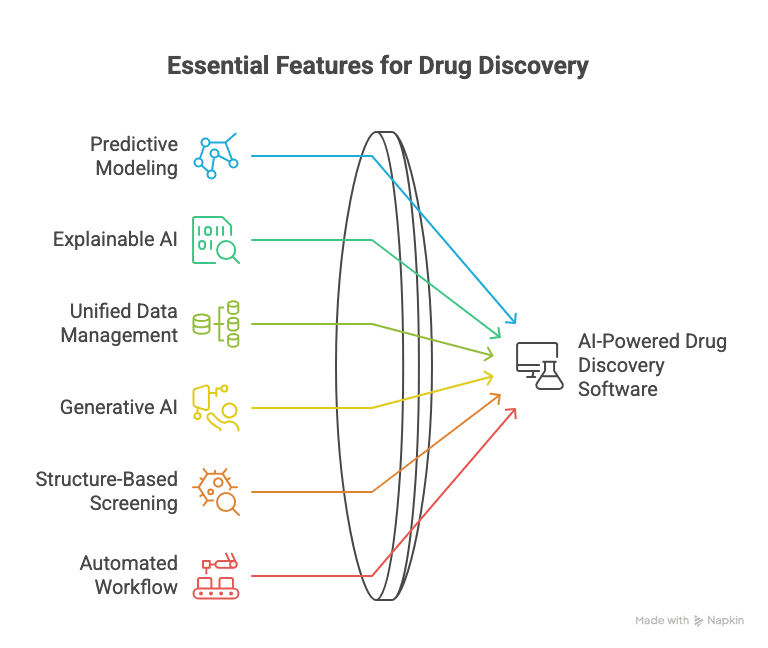
Every great molecule starts with the right infrastructure. Based on our direct experience building AI drug discovery platforms, these are the features that make a difference, not on paper, but in production. We have ranked them by what drives results when speed, compliance, and accuracy are non-negotiable.
1. Predictive Modeling (ADMET + Efficacy)
Predictive modeling is not a feature—it’s the engine. Whether assessing toxicity or simulating blood-brain barrier penetration, early ADMET insights reduce failures before they start. We have seen projects cut preclinical rejection rates by 40% using well-tuned models trained on structured, diverse datasets.
2. Explainable AI (XAI)
In regulated drug discovery, predictions without reasoning are liabilities. XAI makes AI decisions traceable and auditable—mapping inputs to outcomes with clarity. When your model is under FDA scrutiny, explainability isn't an enhancement. It’s your compliance strategy.
3. Unified Data Management (with LIMS & EHR Integration)
We have built platforms where 50% of delays came from fragmented, unstructured data. Integrating LIMS, assay data, and clinical trial reports into a single governed layer transforms model performance. Clean data isn't “nice to have.” It’s the foundation that makes every insight reliable.
4. Generative AI for Molecule Design
Used well, generative models like VAEs or diffusion networks don’t accelerate ideation—they create novel molecules with optimized properties never seen before. In a recent oncology case, this capability reduced hit-to-lead time from 12 months to under 30 days.
5. Structure-Based Virtual Screening
This is where scale meets strategy. Docking simulations, binding affinity scoring, and ligand–receptor visualization allow your team to screen millions of compounds digitally before committing a single synthesis. The result: smarter bets on fewer compounds.
6. Automated Workflow Orchestration
Manual handoffs shouldn’t slow down scientific teams. From compound ingestion to training logs, automation ensures reproducibility, timeline adherence, and version control. It’s not automation for the sake of it—it’s for delivering faster insights with less human overhead.
7. Chemoinformatics & Bioinformatics Engines
Whether you are clustering libraries or mining protein–gene interactions, chemoinformatics and bioinformatics unlock context from complexity. We’ve deployed layered tools that help data scientists find unexpected leads by cross-referencing chemical similarity with genetic expression patterns.
8. Cloud-Native, Secure, and Compliant Infrastructure
Elastic compute for simulations? Yes. But also: full HIPAA alignment, GxP readiness, and built-in FDA 21 CFR Part 11 logging. Cloud platforms we’ve deployed also include multi-tenant security, encrypted audit trails, and regional compliance overlays—so global teams can collaborate without risk.
9. Real-Time Collaborative Interfaces
In modern R&D, AI is a team sport. Your platform must enable biologists, chemists, and engineers to comment, iterate, and analyze in one place. Shared workspaces, annotation tools, and permissions-based views reduce misalignment—and increase collective velocity.
10. Continuous Learning Loops
No model should be static. Integrating pipelines that retrain with new assay data, literature insights, or clinical trial feedback keeps your platform relevant and sharp. In one engagement, we deployed a retraining trigger system that improved prediction accuracy by 18% over six months.
11. High-Throughput Screening (HTS) Integration
Automating HTS workflows accelerates discovery without compromising precision. By linking HTS with compound scoring engines, teams can immediately identify and prioritize active hits, cutting screening cycles by weeks.
12. External Database Connectivity (PubChem, DrugBank, ChEMBL)
The smartest insights come from layered data. Connecting to trusted third-party databases prevents duplication, flags known red flags, and enriches models with context. A recent deployment showed a 22% gain in model relevance after external data was added.
These capabilities don’t live on paper—they’re what power real breakthroughs in labs and trials.
Challenges of Implementing AI in Drug Discovery
AI in drug discovery is not plug-and-play. From technical roadblocks to regulatory hurdles, here are the most critical challenges—and how top companies are solving them.
1. Fragmented and Inconsistent Data
Challenge: AI models depend on clean, high-volume datasets spanning genomics, clinical trials, assays, and real-world evidence. However, these are often siloed, inconsistent, or poorly labeled—leading to unreliable outputs and longer training cycles.
Solution: Novartis tackled this by creating unified data lakes and enforcing standardized ontologies across departments. Structuring datasets with LIMS integration and automating data labeling has helped improve training efficiency and model reliability across the pipeline.
2. Low Model Interpretability
Challenge: Many AI models—especially deep neural networks—lack transparency. Without insight into how a model makes predictions, regulatory bodies hesitate to approve, and scientists find it difficult to trust or validate outcomes.
Solution: Companies like Exscientia and BenevolentAI use explainability frameworks such as SHAP and attention maps to visualize how inputs influence outputs. At GeekyAnts, we integrate interpretability modules during development to ensure auditability and traceability are built in from the start.
3. Regulatory Complexity
Challenge: HIPAA, GxP, and FDA regulations demand full traceability, encrypted data pipelines, and auditable versioning—standards that are difficult to retrofit once a system is built.
Solution: Recursion Pharmaceuticals designed its platform from the ground up for compliance, incorporating HIPAA-grade encryption, audit trails, and FDA 21 CFR Part 11 readiness. Similarly, our team at GeekyAnts architects platforms with regulatory frameworks embedded by design, not added as afterthoughts.
4. Limited Generalization in Generative Models
Challenge: Generative AI trained on narrow or biased chemical spaces often fails to produce viable compounds when exploring new targets or therapeutic areas.
Solution: Insilico Medicine enhanced generalizability by expanding their training datasets and validating AI-generated compounds through lab synthesis and biological testing. Periodic retraining using new assay data helps maintain relevance and effectiveness.
5. Workflow Misalignment
Challenge: AI tools that don't integrate with lab workflows—such as ELN, LIMS, or manual experimental pipelines—often sit unused, creating operational silos.
Solution: Relay Therapeutics developed modular AI systems that align with existing research processes. Embedding the platform within day-to-day lab operations ensured broader adoption and functional alignment.
6. Infrastructure and Cost Barriers
Challenge: Training and deploying AI models at scale requires significant compute power—posing budget challenges for early-stage biotech firms.
Solution: Atomwise adopted hybrid cloud strategies, using model optimization techniques to reduce computational demands. For scalable yet cost-efficient deployment, cloud-native solutions with containerized environments offer elasticity without overcommitting resources.
7. IP Ambiguity for AI-Generated Compounds
Challenge: Intellectual property rights for AI-designed molecules are still evolving. Without clear logs or traceability, ownership disputes may arise.
Solution: BenevolentAI addresses this by maintaining detailed generation records and version-controlled logs, enabling defensible IP claims. Incorporating such frameworks into AI pipelines safeguards long-term commercialization efforts.
How GeekyAnts Can Help You Build AI-Powered Drug Discovery Software
Why GeekyAnts?
At GeekyAnts, we bring over six years of focused experience in healthcare software engineering—with a strong foundation in AI-powered systems, medical-grade compliance, and data-driven architecture. From building pharmacy intelligence platforms to AI-driven symptom triage tools, our track record shows we don’t experiment—we execute. For teams navigating the complex intersection of biotech, data science, and regulation, we provide more than code—we provide clarity, speed, and scalability.
Our Track Record in Healthcare AI
We have delivered production-grade platforms across clinical, diagnostic, and operational domains:
- Symptom Triage Assistant – AI-powered tool trained on real-world datasets to streamline patient intake for a major healthcare chain.
- Pharmacy Automation Suite – Built to support predictive inventory, compliance workflows, and medication traceability at scale.
- Care Coordination Platform – Delivered in just 13 weeks using React and ExpressJS, enabling real-time task management for clinical teams.
Each solution was built cloud-native, HIPAA-compliant, and architected to scale with evolving research needs.
Built for Compliance. Engineered to Scale.
Our systems are designed with regulatory foresight from day one, supporting FDA 21 CFR Part 11, HIPAA, and GxP alignment. We integrate effortlessly with EHRs, LIMS, and external drug databases like PubChem or DrugBank—so your AI solution doesn’t just fit into the ecosystem, it enhances it.
AI Infrastructure That Grows With You
Whether it’s model retraining, data pipeline scaling, or integration with bioinformatics tools, our microservices-based architecture and DevOps culture ensure your platform stays fast, stable, and future-ready.
Let’s talk about building your production-grade AI solution for drug discovery—built with speed, science, and compliance in mind.
Driving Innovation and Efficiency: How AI Transforms Drug Discovery for Established Businesses
For established pharmaceutical companies, AI is more than a frontier—it’s an accelerator embedded across the entire drug discovery value chain. What once took years of trial-and-error now compresses into weeks of targeted experimentation, powered by machine learning and data-driven simulation.
Take BenevolentAI’s work on ALS: by using AI to mine patient data and scientific literature, the team identified overlooked cellular pathways and repurposed known drugs to tackle a condition with limited treatment options—saving both time and capital. Similarly, during the COVID-19 outbreak, AI engines screened thousands of approved compounds in days, dramatically expediting the identification of viable candidates.
Across the board, AI is driving real ROI:
- Faster Insights: AI enables predictive modeling of ADMET properties and simulates thousands of compound-target interactions before a molecule reaches the wet lab.
- Efficiency at Scale: Automating SAR analysis, protein modeling, and screening processes minimizes time-intensive tasks in early-stage R&D.
- Smarter Trials: AI helps design adaptive clinical trials, forecasting patient responses and improving enrollment strategies.
- Reduced Cost and Risk: McKinsey reports AI can cut R&D costs by 25% and reduce time-to-market by 30–50%.
For legacy pharma teams, this isn’t about replacing scientists—it’s about augmenting decision-making, accelerating discoveries, and turning pipelines into platforms. AI doesn’t just improve drug discovery. It transforms it into a repeatable, scalable, data-first engine of innovation.
How AI Is Reshaping the Future of Drug Discovery
The future of drug discovery isn’t a distant vision—it’s taking shape today in labs powered by algorithms instead of trial-and-error. AI is reshaping the process into a faster, more integrated, and predictive science.
Precision Target Identification
Rather than starting with a hypothesis, AI platforms now analyze vast molecular datasets, proteomic structures, and gene expression profiles to reveal novel drug targets. This data-first approach accelerates early-stage discovery. For instance, Verge Genomics used AI to identify ALS drug candidates by analyzing RNA and protein networks, skipping conventional screening entirely.
Accelerated Drug Design & Lead Optimization
Deep generative models like GENTRL and AlphaFold enable chemists to design molecules atom-by-atom, predicting binding affinity and off-target effects before synthesis. This dramatically shortens the design cycle—from years to weeks. Insilico Medicine used such models to bring a fibrosis drug to clinical trials in under 18 months, versus the traditional 5–6 years.
Drug Repurposing Made Efficient
AI is increasingly being used to match existing molecules to new indications by simulating biological pathways at scale. During COVID-19, BenevolentAI identified baricitinib—a rheumatoid arthritis drug—as a treatment candidate within days. This kind of real-time inference wasn’t possible with legacy R&D models.
Personalized Drug Discovery
AI models can now integrate genomic, epigenomic, and EHR data to suggest personalized therapies. In oncology, Tempus leverages multimodal data to tailor treatment plans for individual patients, adjusting based on tumor genetics and response histories—pushing precision medicine from concept to clinical reality.
Scientific Discovery at Scale
AI isn’t only designing drugs—it’s driving new biological understanding. For example, DeepMind’s AlphaFold predicted over 200 million protein structures, now publicly available to researchers. This unprecedented data access is accelerating basic science and reshaping how we explore disease mechanisms.
What’s Next? AI won’t replace scientists, but those using AI will replace those who don’t. The coming years will be defined by collaborative ecosystems where AI augments human insight, regulatory standards evolve for algorithmic pipelines, and drug discovery becomes faster, cheaper, and far more intelligent.
FAQs About AI in Drug Discovery
1. What machine learning models are used in AI-driven drug discovery?
The choice of model depends on the specific task. Deep learning models are commonly used to predict biological activity and toxicity. Generative models like GANs or VAEs help design new molecular structures. When optimization is needed—for instance, improving a compound’s binding affinity—reinforcement learning is applied. Simpler models like Random Forests or SVMs are still valuable for classification tasks like compound filtering or target prioritization.
2. How do you validate the accuracy of AI predictions in drug discovery?
Validation starts by comparing AI predictions against known outcomes using curated datasets. Cross-validation ensures the model generalizes well. Top predictions are often tested in the lab (in vitro or in silico). For regulatory readiness, results must be documented and traceable, with performance metrics clearly defined.
3. How are pharmaceutical companies using AI for drug discovery?
You’ll find AI embedded across multiple phases—hit discovery, lead optimization, and even clinical trial simulation. For example, AI platforms help predict how a molecule behaves inside the body before it reaches human trials. During the COVID-19 pandemic, Pfizer used AI to shortlist potential antiviral candidates in record time, dramatically reducing the early-stage R&D cycle.
4. How will generative AI disrupt data science in drug discovery?
Generative AI flips the workflow—it doesn’t just analyze data; it designs new possibilities. These models can propose entirely new molecules that meet specific safety, efficacy, or structural requirements, expanding the chemical space faster than traditional methods ever could.
5. What is the typical cost of developing AI drug discovery software?
While costs vary, a typical project ranges from $150,000 to $500,000. Factors influencing this include:
- Volume and quality of available data
- Need for custom model development
- Cloud infrastructure and storage
- Security and compliance architecture
6. How long does it take to develop AI drug discovery software?
On average, development takes 4 to 8 months. Projects that require deep integration with clinical systems or advanced model training may take longer. The timeline is shaped by data complexity, regulatory compliance needs, and the platform’s overall scope.
7. Can the AI drug discovery software integrate with our existing systems?
Yes, integration is typically built into the architecture. The software can connect with systems like LIMS, EHRs, internal databases, and cloud platforms through APIs. Proper integration ensures smooth data flow, version control, and cross-functional usability across research and clinical teams.
8. What are the ethical considerations in using AI for drug discovery?
Ethical concerns center on data bias, decision transparency, and accountability. For instance, biased training data can lead to unsafe predictions. There’s also the question of IP ownership—who owns a molecule designed by an algorithm? Addressing these issues requires clear governance, explainability, and human oversight in every AI-driven decision.
