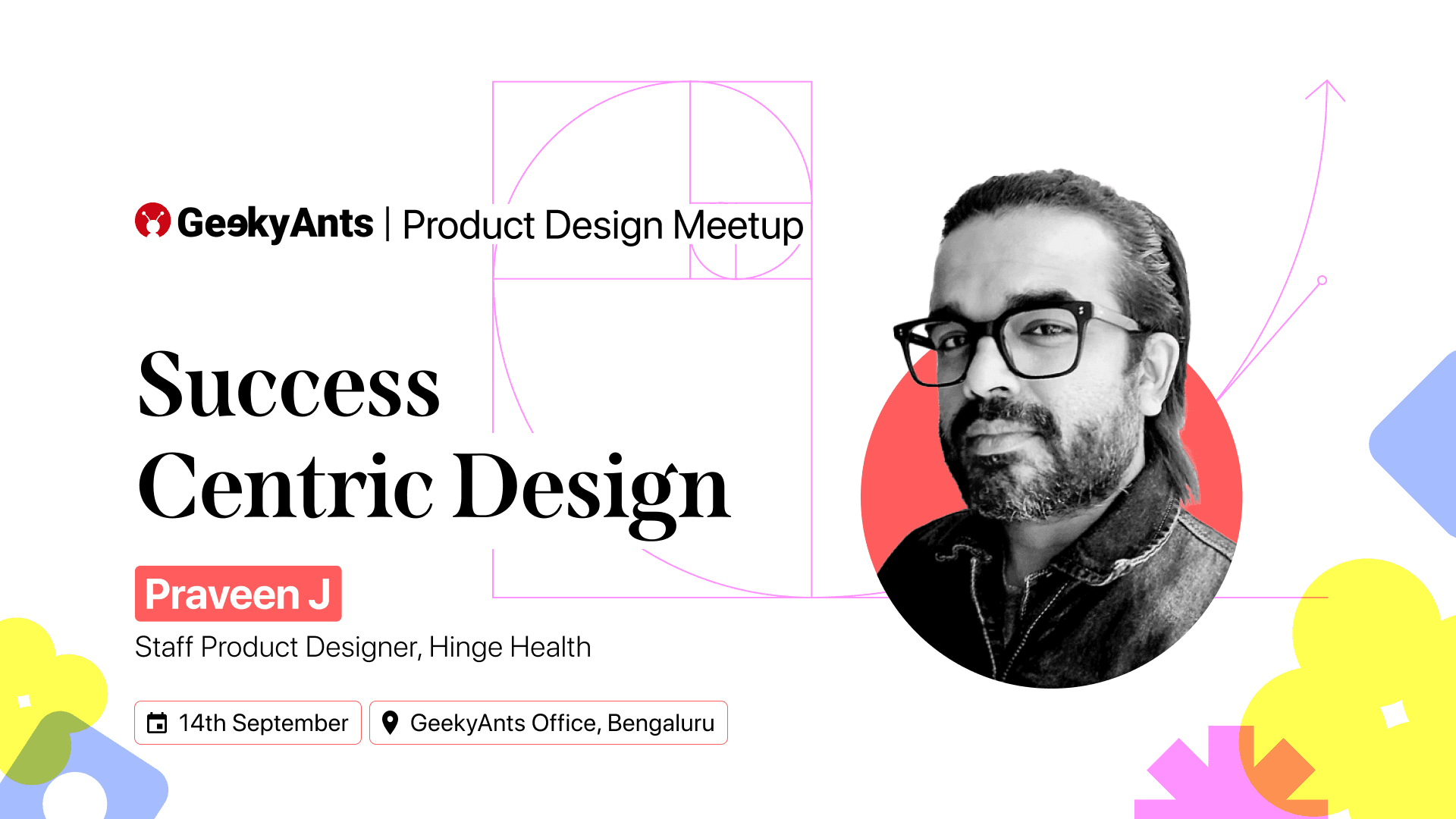

Editor’s note: Below is an edited transcript of Praveen J’s keynote speech at the GeekyAnts Design Meetup 2024. Praveen is a Staff Product Designer at Hinge Health, and this speech has been adapted to include more detailed insights shared on stage. Learn more about how success-centric design can shape the future of your products.
Good evening everyone! I hope my voice is coming through loud and clear. Great. I raised my hand when you mentioned the BookMyShow manager’s story, but not for the reason you might think—I’ll get to that in the upcoming slides. For now, let’s dive into something close to my heart: Success-Centric Design.
Sometimes, I find myself forgetting who I am. It might sound strange, but I created a few slides to remind myself—and I’m going to share them with you. I come from a family that’s deeply rooted in fine arts. We sculpt, we paint—art has always been a huge part of who I am. It’s something my father passed down, and my brother now carries the tradition in our hometown in Kerala. On my mother’s side, I also have a performing arts background. I’m a mimicry artist, and I spent two years researching art and archaeology at the Indian Institute of Science before I fully embraced the world of design. With a background in computer engineering, I like to call myself a versatilist—a product designer, thinker, and facilitator.
Design Isn’t Just a Profession—It’s an Extension of Who We Are
In 2022, I had the pleasure of conducting a Design Thinking Workshop at BookMyShow. That’s right—BookMyShow! Design is something I’ve always been passionate about, but beyond the work itself, I’ve spent years as part of various design communities, including the Russian Design Foundation. These communities keep me grounded in the practice of design and its broader purpose. However, many of you might know how challenging it can be to institutionalize design within organizations. Sometimes, you have to go beyond your daily design work to advocate for design itself—through talks, panels, and articles. It’s not just about designing—it’s about teaching others to see the value of design. This is what raises the bar for design maturity within our companies.
Advocating for Design is Part of the Design Journey
I’ve been fortunate to work with some amazing organizations. My journey started at the National Institute of Advanced Studies, and from there, I transitioned into product design at Cloud9. I had the opportunity to help redesign over 40 e-commerce search platforms during my time at Unbxd, and later worked at Noodle.ai, developing solutions for supply chain and logistics. I’ve worked at Urban Health, a mental health startup, and now, I’m at Hinge Health, where I continue my journey as a product designer.
Each Project Teaches Something New—and Expands Your Design Perspective
Let me ask you this: whom do you design for? I know many of you are designers—90% of you raised your hands when I asked earlier. But who do you design for? Most people say the users. Some of you might be thinking you design for the business, for the CEO. The truth is, you design for both the user and the business. Success-centric design means finding the balance—creating something that delights users while serving business needs. Your design has to work for people, but it also has to work for the business behind it.
Design Is the Intersection Where User Needs and Business Goals Meet
Have you ever heard of the Columbia Obstruction Device experiment? It’s a fascinating psychological test from the 1940s that helps us understand motivation. In the experiment, a mouse has to cross an electric floor to reach a piece of cheese. The bigger the cheese, the more willing the mouse is to endure the electric shock. In product design, your users are like that mouse. The product is the obstacle they have to navigate, and the cheese is the reward they get from using your product. The key is simple: if the reward is valuable enough, users will endure the “shocks” of cost, learning curves, and complexities to use your product.
Motivation Drives Action—and Great Design Motivates Users
Let’s take a real example from my work at Urban Health, where we were working to transform an app from a mindfulness platform, similar to Headspace or Calm, into a clinically-backed mental health solution. We knew we had to prioritize key goals—improving user engagement in the first 14 days, shifting the app’s look from mindfulness to clinical mental health, and enabling users to track their mental health scores. This wasn’t just about making the app look better. It was about redefining the brand’s purpose and creating an experience that truly met users' needs.
Design Isn’t Just Cosmetic—It’s About Crafting Experiences With Meaning
When it comes to user research, we didn’t have to start from scratch. We built on the wealth of knowledge we already had—over 30 user interviews, app reviews, analytics, and UX audits. You don’t always need to reinvent the wheel—sometimes, the answers are already in front of you. We also learned from previous experiments. For example, we’d already introduced gamification elements that increased engagement. This led us to form our hypothesis: making the app experience more dynamic and reducing content overload would improve user engagement.
Sometimes, the Key to Innovation Is Building on What You Already Know
But there’s more to success than just building a great product—you need a strong brand identity. I’ve worked at multiple startups, and one mistake many of them make is focusing too much on the product while ignoring the brand. The product is essential, of course, but a strong brand is what connects emotionally with users. At Urban Health, we defined our brand using the Caregiver archetype. This guided everything from our tone of voice to our color palette. We moved from blue—a color widely used by competitors—to green, which helped us stand out.
Your Brand Is Your Product’s Personality—Don’t Overlook It
Success-centric design is about experimentation and learning. At Urban Health, we operated at a fast pace, releasing weekly updates. In environments like this, you have to be comfortable with failing fast and learning faster. Our first redesign was a mixed success. While the Recents & Favorites icons increased engagement, other elements underperformed. But we didn’t stop there. We kept iterating, and by our second experiment, we saw improvements in 14-day engagement and session completion rates.
Every Design Experiment Brings Valuable Insights Even the Failures
Another key principle of success-centric design is bias for action. In fast-moving environments, you often won’t be fully satisfied with every live design. But taking quick action and making trade-offs is essential. In such cases, it’s okay to fail—every failure teaches you something new. When we completed our second experiment at Urban Health, we saw a rise in user retention, higher engagement, and improved mental health effectiveness scores. We even achieved FDA-level effectiveness rates of over 80%, which is a crucial milestone for digital therapeutics. This success wasn’t just about one big idea—it was about acting on what we learned, iterating quickly, and staying open to failure.
Action Beats Perfection—Progress Comes From Making Decisions, Even When It’s Hard
In conclusion, success-centric design is about balancing user needs with business goals, but it’s also about prioritizing goals, experimenting, and learning along the way. Defining your brand early in the process is key, and no design project is complete without a solid understanding of the users you’re serving. So remember, action drives success—and even failure brings valuable lessons.
Thank you all for listening. You’ve been a thoughtful and attentive crowd—it’s been a pleasure speaking with you tonight!
Watch the full video here. ⬇️