
Learn how AI-Augmented Clinician uses RAG, FastAPI, and ChromaDB to deliver fast, evidence-backed decisions and empower doctors in real-time clinical workflows.
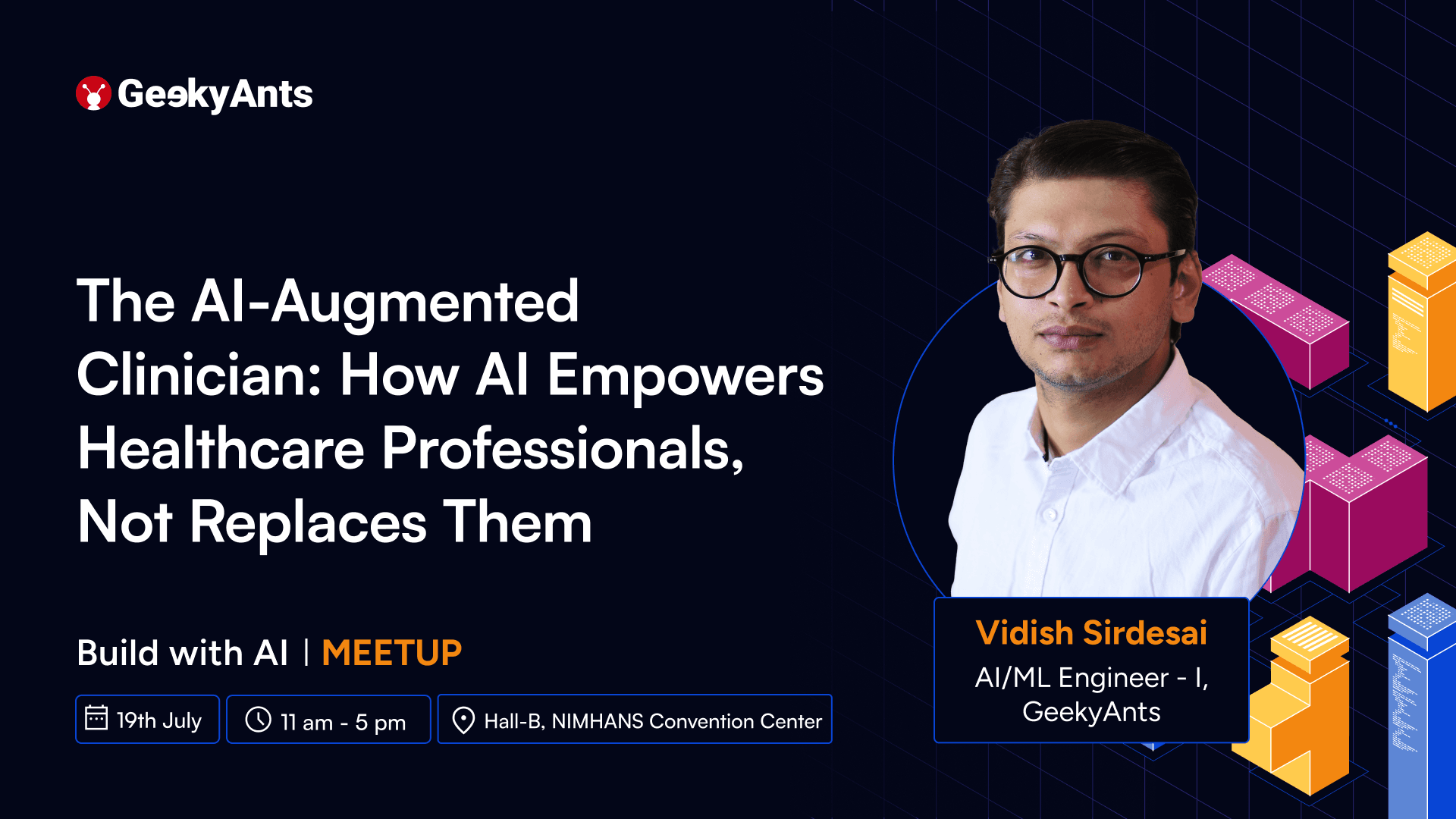
Editor’s Note: This blog is adapted from a talk by Vidish Sirdesai, AI/ML Engineer at GeekyAnts, delivered during the Build with AI meetup hosted by GeekyAnts at NIMHANS. In his session, Vidish explored how artificial intelligence can integrate into clinical workflows, improving access to information and supporting timely decision-making. His demonstration featured an application designed to assist healthcare professionals by combining speed, transparency, and reliability.
The Vision Behind AI-Augmented Clinician
Hi, my name is Vidish Sirdesai, and I work as an AI/ML Engineer at GeekyAnts. Artificial intelligence has become one of the most influential forces in modern technology, transforming industries at an extraordinary pace. Its role in healthcare is particularly significant because clinical decisions rely on both accuracy and trust.
Healthcare professionals deal with vast volumes of information every day. Patient records, treatment guidelines, and drug interaction data all need to be considered before taking action. Collecting this information can be time-consuming, and in critical scenarios, delays can impact outcomes. This challenge inspired me to develop a solution that simplifies access to essential knowledge while keeping the decision-making process in the hands of professionals.
The application I introduced, AI-Augmented Clinician, is designed to meet this need. It retrieves data from verified sources and presents it in a clear, transparent format. The system ensures that every recommendation is accompanied by supporting evidence, enabling clinicians to act quickly without sacrificing reliability.
Inspiration for the Project
The idea developed from two primary sources. The first was an article in Kellogg Insight titled Will AI Eventually Replace Doctors?, which examined how automation intersects with clinical practice. The second was a video published by IBM Technology discussing techniques for addressing performance gaps in AI models. Both resources emphasised the importance of systems that increase efficiency while preserving the trust that defines healthcare interactions.
Demonstrating the Solution
The interface of the application is structured for clarity and ease of use. It begins with a conversational chat window where professionals can submit queries in natural language. This design creates an intuitive experience that allows users to focus on the question rather than the tool.
Adjacent to the chat window, the application displays the sources behind each response. Whether the information is drawn from patient records, treatment guidelines, or drug interaction references, it appears alongside the generated text for immediate verification. This transparency is critical for maintaining confidence in the system.
The knowledge base is organised into three primary categories. Patient records provide individual medical histories for quick reference. Treatment guides outline condition-specific recommendations. Drug interaction data highlights possible conflicts between medications. Bringing these elements together in a single view eliminates the need for navigating multiple systems and searching through large documents manually.
The Architecture Behind the System
The system combines a simple, functional interface with a backend designed for speed and accuracy. The frontend uses standard web technologies to deliver a smooth experience. The backend, built with FastAPI, manages requests, coordinates retrieval, and returns structured responses to the user interface.
At the centre is a Retrieval-Augmented Generation and Cache-Augmented Generation pipeline. When a query is entered, the system retrieves relevant context from a knowledge base instead of generating answers without reference. This data is stored as embeddings in ChromaDB, a vector database optimised for fast similarity search.
The retrieved information is then processed by a language model to create a response grounded in verified content. For this project, the model selected was Mistral, hosted locally to ensure performance and security. A caching layer improves responsiveness for repeated or similar queries, making the system efficient during high-frequency use.
Real-Time Performance and Workflow
When a user submits a question, the process begins instantly. The system retrieves the most relevant data, sends it along with the query to the language model, and returns a synthesised response. This response appears with its supporting evidence so that the user can confirm accuracy without leaving the interface.
The workflow is designed to reduce time spent on information gathering while maintaining the integrity of clinical decision-making. It provides actionable insights within seconds, allowing healthcare professionals to prioritise patient care over administrative effort.
Final Thoughts
AI-Augmented Clinician demonstrates how artificial intelligence can serve as a practical tool in healthcare environments. By combining advanced retrieval techniques with contextual language processing, it delivers accurate answers with complete transparency. This approach addresses the challenge of information overload and creates a system that improves efficiency without compromising trust.
As technology continues to evolve, solutions that prioritise clarity, speed, and reliability will define the future of clinical support. Tools like AI-Augmented Clinician show how intelligent systems can strengthen workflows and help professionals focus on what matters most—delivering quality care.