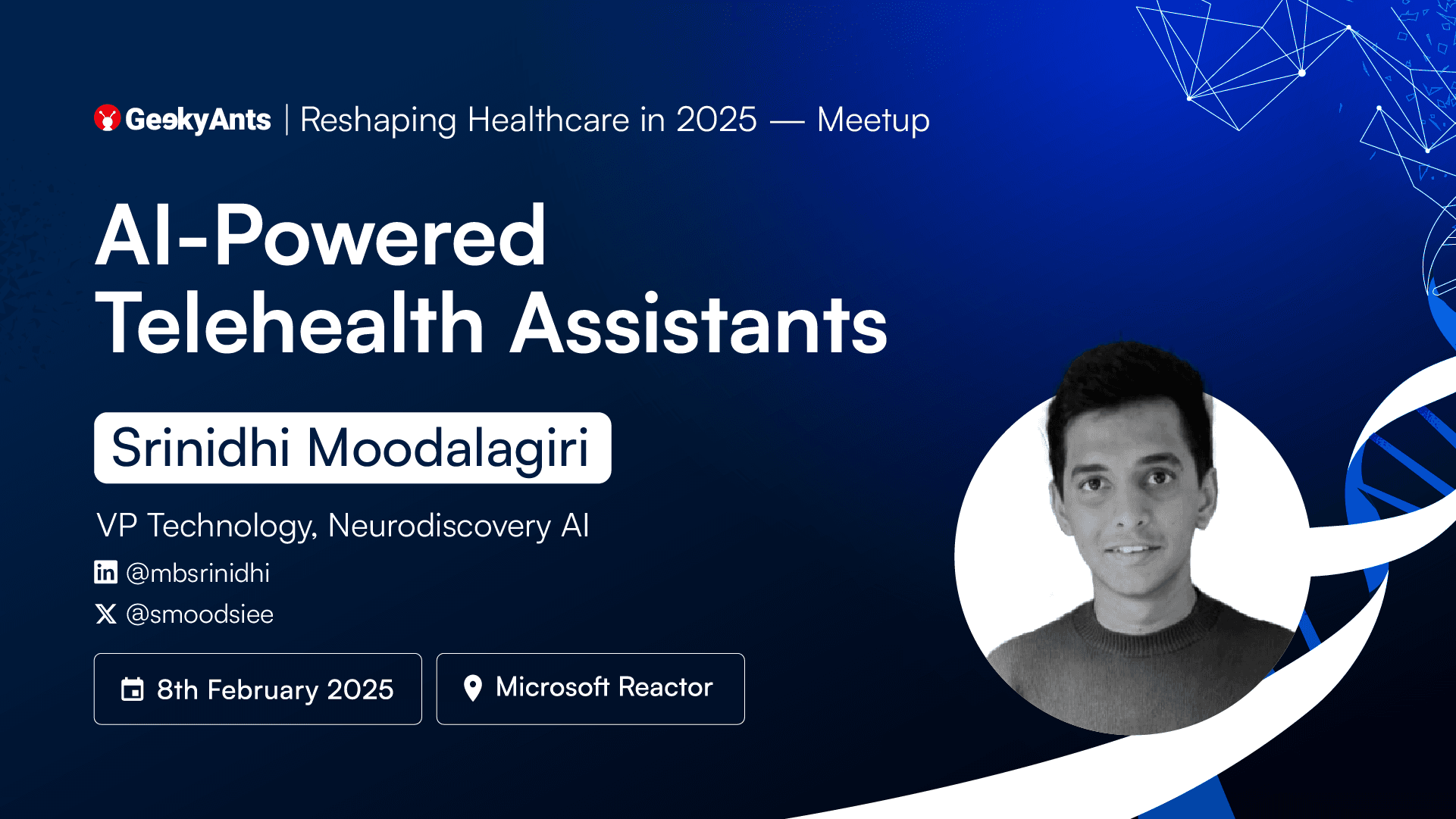

Editor’s Note: This blog is an adapted transcript of Srinidhi’s talk at the GeekyAnts Healthcare AI Meetup. Srinidhi, the Vice President of Technology at NeuroDiscovery, discussed the challenges and opportunities in working with U.S. healthcare data, particularly in the field of neurology. While refined for clarity and brevity, this transcript captures the depth and essence of the session.
The Challenges of Healthcare Data in Neurology
Healthcare is one of the most complex industries when it comes to data management. At NeuroDiscovery, we are tackling some of the biggest challenges in neurology by building the world’s largest longitudinal dataset in this field. However, working with U.S. healthcare data comes with significant hurdles, particularly around gathering, standardizing, and ensuring compliance with regulations like HIPAA.
The primary challenge in healthcare AI is making the data pipeline HIPAA-compliant. Ensuring that all patient data remains private and de-identified while still being useful for research and clinical applications is a major technical undertaking. At NeuroDiscovery, we partner directly with neurology practices to source structured and unstructured data, carefully de-identifying patient information before it is processed. This is a critical step that enables us to use the data without compromising privacy.
Multimodal Data: The Key to Insights in Neurology
One of the fundamental aspects of healthcare data is its multimodal nature. Unlike structured datasets commonly found in finance or academia, healthcare data includes a wide range of formats:
- Structured Data: Electronic Health Records (EHRs), patient demographics, and lab results.
- Unstructured Data: Clinical notes written by doctors, often contain crucial but non-standardized information.
- Imaging Data: MRI and CT scans, which require complex processing techniques.
- Omics Data: Genomic and proteomic data, are becoming increasingly important in understanding neurological conditions.
At NeuroDiscovery, we are focusing on six key neurological disorders: multiple sclerosis, Parkinson’s, Alzheimer’s, frontotemporal dementia, migraine, and, in the future, autism. While autism research remains a goal, our current dataset does not yet include paediatric patients. The ultimate aim is to leverage this multimodal data to discover patterns that can improve patient care and help develop predictive models for disease progression.
Standardizing Healthcare Data for Better Outcomes
One of the biggest problems in healthcare technology is the lack of standardization across EHR systems. Different hospitals and clinics use varying formats to store patient data, ranging from a few hundred tables to over 8,000 tables with no standardized data dictionary. This lack of consistency makes data extraction and analysis extremely challenging.
At NeuroDiscovery, we have developed a proprietary data modelling system that allows us to extract relevant information from raw EHR tables. Our approach includes:
- De-identification: Removing Personal Health Information (PHI) using Optical Character Recognition (OCR) for text-based notes and advanced image processing for pixel-based data.
- Data Pipeline Automation: Standardizing data extraction across multiple EHR formats using custom-built tools.
- Frequent Data Refreshes: Pulling fresh data every 15 days to ensure that our insights remain up to date.
By creating a unified and structured dataset, we are enabling researchers and clinicians to extract meaningful insights from previously siloed data sources.
AI-Powered Clinical Trial Matching and Patient Insights
One of the most exciting applications of our work is in clinical trial matching. The process of recruiting patients for clinical trials is highly inefficient—pharmaceutical companies can spend years trying to find the right participants. With AI-driven data extraction and analysis, we can reduce patient recruitment time from years to just a few days.
Our AI-powered solutions analyze both structured and unstructured data to match patients with clinical trials based on specific inclusion and exclusion criteria. Using Elasticsearch-based search and text-to-DSL conversion, our platform can scan millions of patient records in seconds. This has the potential to revolutionize clinical research by dramatically increasing the efficiency of trial recruitment.
Building an AI Co-Pilot for Clinical Practitioners
Another major focus at NeuroDiscovery is developing an AI-powered data interrogation tool—a retrieval-augmented generation (RAG) system that allows healthcare providers to interact with patient data using a chat-based interface. Instead of manually searching through EHR software, clinicians can ask specific questions and receive instant, accurate responses based on historical patient data.
Additionally, we are integrating AI-driven medical imaging analysis into this system. For example, measuring cerebrospinal fluid volume in brain MRI scans currently takes 45 minutes to an hour using traditional methods. Our AI model can complete this task in under 15 seconds, significantly improving efficiency for neurologists and radiologists.
The Future of AI in Neurology and Beyond
The opportunities presented by AI in neurology are vast. Some of the key advancements we are working on include:
- Cohort Builder: A tool that allows researchers to filter patient datasets using natural language inputs, powered by Elasticsearch indexing.
- Voice-Based Clinical Documentation: A mobile app that enables doctors to dictate clinical notes, which are then automatically structured and integrated into EHRs.
- MIPS Reporting and Analytics: Enhancing Medicare and Medicaid compliance by providing automated performance tracking for healthcare providers.
With these tools, we are not only improving operational efficiency but also making healthcare more data-driven and patient-centric.
Final Thoughts
AI is unlocking new frontiers in neurology by making data more accessible, actionable, and standardized. At NeuroDiscovery, our mission is to build a neurology-focused AI ecosystem that empowers clinicians, researchers, and pharmaceutical companies. By addressing the fundamental challenges of data compliance, standardization, and processing, we are paving the way for more efficient clinical trials, better patient care, and groundbreaking discoveries in neurological health.
For those interested in working at the intersection of AI and healthcare, this is an exciting time. If you would like to collaborate, contribute, or learn more about our work, feel free to connect with us. Thank you for reading!