

Key Takeaways
- SOC 2 auditors require documented access records, change history, and approval trails, not just functional testing.
- AI-generated prototypes skip governance, leaving gaps in access management, code ownership, and data boundaries that are costly to fix at production.
- Production hardening spans permissions, cloud controls, activity logging, and third-party code review — it cannot be deferred to the final step before launch.
- Without SOC 2 readiness documentation, products fail enterprise security reviews before buyers ever evaluate their capabilities.
AI-assisted development has moved from experiment to standard practice across the software industry. Stack Overflow reports that 84% of respondents either use or plan to use AI tools in development, and 51% of professional developers rely on them as part of their standard workflow. McKinsey reports that 88% of organizations have adopted AI in at least one business function, yet nearly two-thirds have not scaled it across the enterprise.
The result is a surge in AI-generated prototypes. Teams that needed weeks to validate an idea can complete the same process in hours, and the business value of that speed is real. Stakeholders see working software faster, investment decisions get made sooner, and product timelines compress in ways that were not possible before.
But speed without structure creates a specific category of risk that most engineering and platform leaders discover after significant investment has been made. A prototype that functions in a demo environment is not the same as a product that can survive a SOC 2 audit, clear enterprise procurement security reviews, perform under production load, and meet the data handling standards that large buyers require before signing a contract.
Whether you are a Head of Digital Transformation managing AI adoption across the enterprise, a Head of Platform Engineering responsible for the infrastructure controls that production demands, or a VP of Digital Platforms accountable for the compliance posture that enterprise deals depend on, this guide identifies every gap that must be resolved before your AI-generated prototype reaches production.
Why Do AI-Generated Prototypes Fail SOC 2 Audits Before They Reach Production?
AI-generated prototypes are built to prove that an idea works, not to meet the control requirements that a SOC 2 auditor will evaluate. That distinction is the root cause of every compliance failure that engineering and platform leaders encounter when they attempt to move an AI-generated product into a production environment.
The first problem is that speed takes priority over governance during the prototype phase. AI tools generate functional code at a pace that encourages teams to defer decisions about access management, data boundaries, and control documentation. Those deferrals compound over time and become structural problems that cannot be resolved with a policy document or a late-stage audit preparation sprint.
The second problem is that AI-generated code often contains fixed logic that was written for a specific demo condition. User permissions get set once and never reviewed. Configuration values get written directly into the codebase rather than managed through a controlled process. Data flows that were acceptable in a test environment remain unchanged when real customer data enters the system.
The third problem is that AI-generated prototypes produce no audit trail by default. SOC 2 auditors do not accept a functional product as evidence of compliance. They require documented proof that controls operated consistently over a defined period, and a prototype built for speed will not have the activity records, access reviews, change histories, or approval documentation that an audit requires.
Enterprise buyers who issue vendor security questionnaires will identify these gaps before your product ever reaches a formal SOC 2 review, and a stalled enterprise deal is rarely recovered once a security team flags insufficient controls.
How Do the SOC 2 Trust Service Criteria Apply to AI-Generated Prototypes?
SOC 2 compliance is structured around five Trust Service Criteria, and for engineering teams moving AI-generated prototypes toward production, each criterion translates into a specific set of controls that must be built, tested, and documented before an audit begins.
1. Security
Security requires documented access controls, admin approvals, and permission structures that operated consistently throughout the audit period. RBAC, MFA, and access review logs are commonly used to prove enforcement.
2. Availability
Availability applies when products include uptime commitments and requires monitored system performance with tested recovery procedures. Uptime reports, backups, and incident response records are used as evidence.
3. Processing Integrity
Processing Integrity requires validation and reconciliation controls that prove system outputs remained complete and accurate over time. For AI-generated products, this includes output validation logs and error reporting records.
4. Confidentiality
Confidentiality requires engineering teams to classify data based on sensitivity levels defined in customer agreements and build access restrictions and disposal procedures that reflect those classifications.
5. Privacy
Privacy requires engineering teams to document data collection and storage practices, build a process for responding to deletion requests, and ensure that vendor agreements reflect the privacy obligations that apply across every jurisdiction where the product operates.
From Prototype to Production: Where Do AI-Generated Prototypes Break SOC 2 Requirements?
Every AI-generated prototype carries a set of behaviors that are acceptable in a development environment but create direct compliance failures in production. The table below maps the most common gaps across eight critical areas, showing what a prototype delivers by default, what production requires, and what the SOC 2 consequence is when the gap is not addressed before launch.
Area | Prototype Behavior | Production Requirement | SOC 2 Risk |
|---|---|---|---|
User Access | No access controls or single shared login | Role-based access with documented permission levels and access review records | Security violation |
Logging | Minimal error logs for debugging purposes | Complete activity records covering access, changes, deployments, and incidents | Compliance failure |
Secrets Management | Credentials written directly into the codebase | Centralized secrets storage with rotation policies and environment isolation | Security violation |
Data Handling | No data classification or boundary controls | Defined data categories with encryption, retention policies, and deletion procedures | Privacy and confidentiality failure |
Dependencies | Unreviewed third-party packages included by AI | Reviewed, approved, and documented third-party code with license verification | Processing integrity risk |
Model Behavior | No output validation or accuracy checks | Documented validation procedures for AI-generated outputs with error detection | Processing integrity failure |
Infrastructure | Default cloud settings with no environment separation | Hardened cloud configuration with network controls and environment boundaries | Security and availability violation |
AI Governance | No documentation of AI tool usage in development | Documented AI usage policies, human review records, and vendor assessments | Compliance and audit failure |
The Critical SOC 2 Gaps in AI-Generated Prototypes That Engineering Leaders Must Resolve Before Production
In one engagement, a client came to us with an AI-generated prototype they described as 95% complete. The product performed its intended workflows. When we reviewed the codebase, the authentication flow ran every request through a single external provider with no redundancy. The credentials for that provider were written into the codebase with a fallback value that made the environment configuration irrelevant. Every request ran under a single database account that enforced no access boundaries between users. They are the standard condition of an AI-generated prototype that was built without the architectural foundation that SOC 2 controls require to function as intended. The client believed they had a product that was close to production. What they had was a prototype with every critical gap that this section describes, and the work required to close those gaps was not an extension of the build. It was a rebuild.
Moving an AI-generated prototype toward production requires a structured engineering review of every control gap the prototype carries by design, and the eight areas below represent the most common and consequential gaps found in AI-generated codebases, each carrying a direct consequence for audit readiness, enterprise procurement, and customer trust.
1. Identity and Access Control Gaps
AI-generated prototypes implement login flows that function in a demo environment but fall short of the access governance standards that enterprise buyers and SOC 2 auditors require. A functional login screen is not the same as a documented permission structure, and the difference between the two is what determines whether a product passes or fails a security review.
Auditors require a permission matrix that defines what each user type can access, records of access reviews conducted at defined intervals, approval documentation for admin-level privileges, records that show when user access was removed following a role change or departure, and evidence that verified login and identity confirmation methods were enforced across all accounts. Shared login credentials and permission checks that are applied at the interface level rather than enforced within the system itself are two of the most common findings in AI-generated codebases, and both represent security violations under SOC 2 review.
2. Logging and Audit Evidence Gaps
SOC 2 readiness depends on evidence as much as it depends on controls, and the logs that development teams generate for troubleshooting purposes do not meet the standard that auditors require. Audit-grade logs must cover user login events, admin activity, data access, system changes, deployments, and incident response actions, and they must be retained for a defined period and protected against modification.
Before launch, engineering teams should capture every action that touches user data or system configuration, store those records in a location that is protected against alteration, and define a retention period that aligns with the audit observation window. The distinction between a log that helps a developer identify a problem and a log that satisfies an auditor is documentation scope, intent, and protection against tampering.
3. Secrets Management Gaps
AI-generated code produces credential patterns that are acceptable in a development environment but become security violations when they reach production. Credentials written into the codebase, unmanaged configuration values, shared login details, and access tokens stored in local files are patterns that AI tools generate without identifying them as risks, and those patterns persist into production when no review process is in place to catch them.
Before production, every credential must move to a centralized system designed for secure credential storage, credentials must be separated by environment, the build and release process must include a check that stops a release when a credential appears in the codebase, rotation schedules must be defined and documented, and system-level access accounts must carry only the permissions required for their specific function.
4. Data Handling and Privacy Risks
AI-generated prototypes do not establish boundaries between test data, customer data, activity records, usage analytics, and data passed to third-party services, and that absence creates exposure across every privacy criterion in a SOC 2 audit. It also raises concerns that enterprise procurement teams surface before contracts are signed.
The questions that procurement teams ask include where data is stored, who can access it, whether it is protected during storage and transfer, whether customer data is passed into AI workflows, and whether it can be removed on request. Closing these gaps requires a data classification policy, defined retention and deletion procedures, separation between customer data environments, and a process for responding to deletion requests that is documented and testable. Compliance with privacy requirements is not only an audit obligation but a customer trust requirement, and products that cannot answer these questions at the procurement stage lose deals before they reach a formal review.
5. Dependency and Generated Code Gaps
AI-generated code introduces third-party packages, libraries, and code patterns that no member of the engineering team reviewed or approved before they entered the codebase. Those packages may carry known security vulnerabilities, outdated versions, or license terms that create legal exposure, and the risk is not in using AI-generated code but in deploying it without a review process.
The governance requirement is to treat AI-generated code with the same review discipline applied to any external contribution. That means running a security scan against all third-party packages, locking package versions to prevent uncontrolled updates, reviewing the license terms of every included library, conducting a security-focused code review on generated modules, documenting what was generated and under what conditions, and assigning a named engineer as the owner of every module that reaches production.
6. Model Behavior and Processing Integrity
AI models produce outputs that cannot be verified the same way a calculated result can be, and a model can generate a response that appears correct but contains inaccurate information. Without a validation layer in place, that inaccuracy can move through the system without detection and affect downstream processes or decisions.
Production-ready AI-generated products require documented validation procedures for model outputs, error detection processes that flag results not meeting the accuracy and completeness standards defined for that workflow, and reconciliation controls that confirm data integrity across the full processing workflow.
7. DevOps and Infrastructure Gaps
Prototypes deployed without a production readiness review carry cloud configuration settings that create security and availability exposure at scale. Cloud storage accessible to anyone outside the organization, permission settings that grant broader access than any role requires, no separation between development and production environments, no backup policy, no tested recovery procedure, and no infrastructure review process are gaps that platform and cloud infrastructure leaders must resolve before a product accepts real customer data.
Infrastructure configuration must be managed through a reviewed and documented process, every environment must have defined access boundaries and monitoring, and recovery procedures must be tested before they are needed. These requirements apply regardless of whether the infrastructure runs on Amazon Web Services, Microsoft Azure, or Google Cloud Platform.
8. AI Governance Gaps
IBM reports that 63% of organizations operate without formal AI governance policies, and that gap creates measurable breach-cost risk when AI tools are used in development without documented controls. For AI-generated products, governance covers both how AI tools were used during development and how AI functions within the product itself.
A production-ready governance posture requires a defined list of approved AI tools, a policy that covers how data is handled when it enters an AI workflow, a requirement for human review of AI-generated code before it reaches production, documentation of AI tool usage across the development process, a vendor assessment for every AI tool that touches product data, visibility into how data moves through every AI component in the product, and a process for identifying AI tool usage that falls outside the approved list before it creates an undocumented exposure.
What Traditional SOC 2 Guides Miss About AI-Generated Prototypes: The Risks Auditors Are Now Examining
Standard SOC 2 guidance was written for traditional software systems, and the risks that AI components introduce require a separate category of controls that most compliance frameworks have not addressed until recently. The gaps below represent the areas where AI-generated prototypes carry exposure that falls outside conventional audit preparation.
Prompt Injection Attacks
When users can interact with an AI component through inputs, those inputs can be structured to override the instructions that govern the system's behavior. Without defined input boundaries and output validation controls, this exposure creates a direct gap in the risk assessment documentation that auditors require.
Model Drift and Degraded Performance
An AI model's outputs can diverge from the standards the system was built to meet, and that divergence creates compliance exposure when no change management process covers AI model behavior. Auditors require the same approval records, validation evidence, and rollback procedures for AI-driven changes that they require for any other system update.
Unintended Autonomous Actions
When an AI component takes an action without a documented human request or approval, auditors treat that as an accountability gap. SOC 2 requires that actions affecting protected data or system configuration be traceable to an accountable individual, and autonomous AI actions that fall outside that requirement represent a direct control failure.
Data Leakage from Training Sets
When customer data enters an AI workflow, there is a risk that it surfaces in model outputs in ways that expose information to unauthorized parties. Auditors require documentation of data handling at every stage of the AI processing workflow, including how data is protected during input, processing, and output generation.
Third-Party AI Provider Risks
When customer data is passed to an external AI service, auditors require a documented assessment of how that provider handles and protects that data, evidence that the provider's data handling terms have been reviewed and accepted, and confirmation that customer data is not used by the provider outside the scope of the agreement.
Bias and Unfair Outcomes
When an AI system produces outputs that reflect systematic inaccuracies, auditors require documentation that the organization identified the risk, assessed its scope, and put controls in place to monitor and address it. Without that documentation, auditors may conclude that the control did not operate as intended regardless of how the system performed in practice.
The Business Cost of Ignoring SOC 2 Gaps in AI-Generated Prototypes Until It Is Too Late
The decision to defer compliance work until after launch rarely presents itself as a decision. It accumulates through smaller choices to prioritize features over controls, speed over documentation, and demos over production readiness. The financial and operational consequences of those choices are specific and measurable.
Delayed Enterprise Deals
Enterprise procurement teams issue vendor security questionnaires as a standard buying step, and a product that cannot respond with documented evidence does not move forward. Review processes following an incomplete submission can take months, giving competitors who invested in compliance the time to close deals that were within reach.
Re-Architecture Costs
Compliance gaps identified in production require engineering work, not policy updates. Permission structures, data classification, and activity records all need rebuilding — work that competes with product development on the same resources and costs substantially more under pressure than building correctly from the start.
Security Incidents
Products with unresolved control gaps carry real breach exposure. IBM's 2024 Cost of a Data Breach Report puts the average at $4.45 million, and that figure excludes contract losses, customer trust damage, and compliance investigations. For AI-generated products, gaps in access management, credential handling, and data boundaries represent the highest-risk categories.
How to Fix SOC 2 Gaps in AI-Generated Prototypes Before They Reach Production: A Four-Phase Roadmap
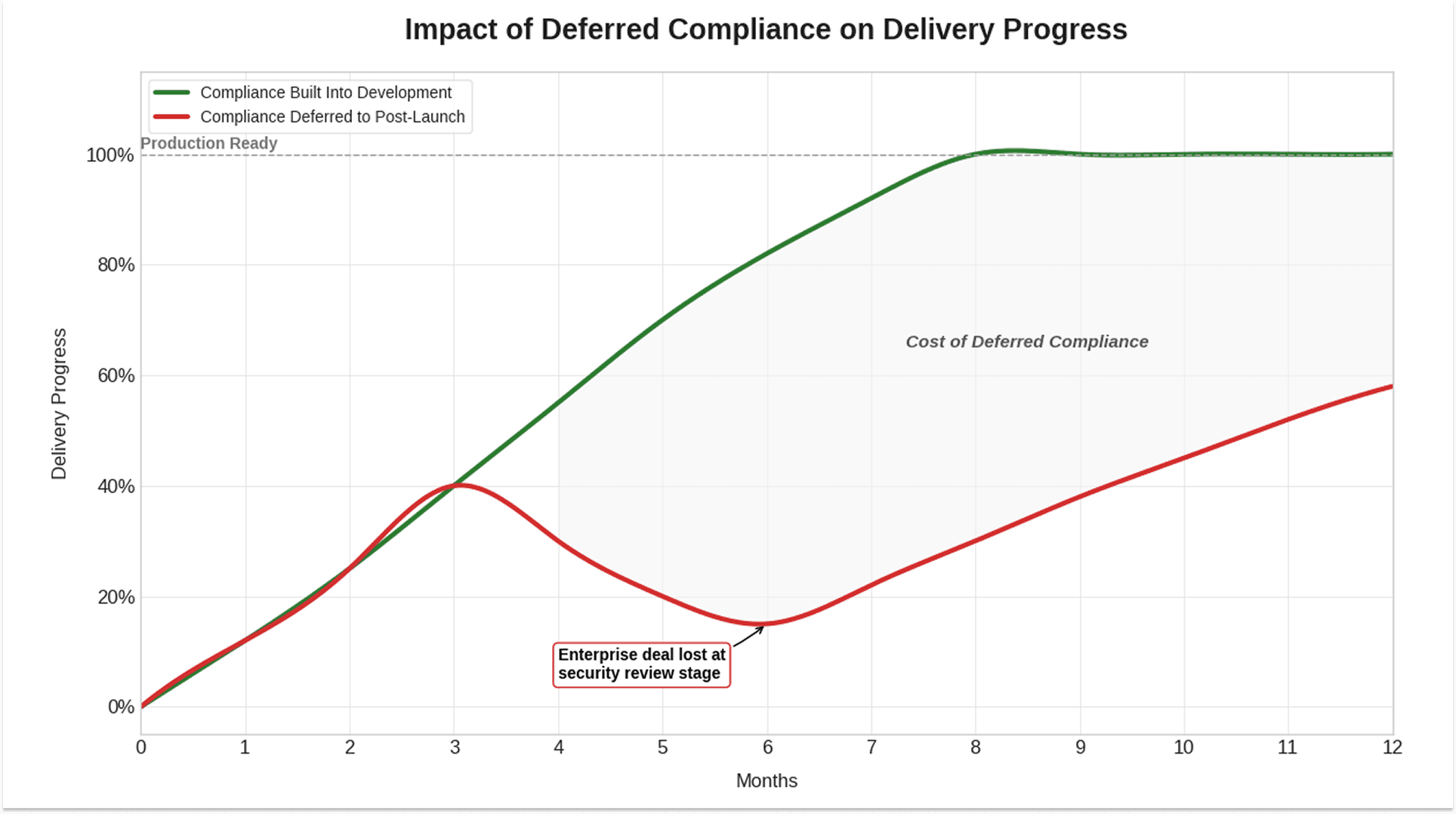
Closing SOC 2 gaps in an AI-generated prototype is not a single engineering task. It is a sequence of decisions that must be made in the right order, with each phase resolving the gaps that the next phase depends on to function as intended.
Phase 1: Architecture Hardening
The product's underlying structure must be reviewed and documented before any compliance control can be applied. Service boundaries must be defined, ownership must be assigned, and the data flow between components must be documented in a way that an auditor can follow.
Output: Documented architecture, data flow map, service boundaries, ownership model
Phase 2: Security Implementation
With a documented architecture in place, permission structures must be built to reflect defined user roles, identity verification must be enforced across all accounts, and data must be protected at the storage and transfer level. Every control implemented must be documented with the date it was applied, the individual responsible, and the scope it covers.
Output: Permission structure documentation, identity verification records, data protection controls, control evidence log
Phase 3: Observability and Logging
Logs must cover user access, administrative actions, data access, system changes, deployments, and incident response activity, and must be stored in a protected location. System performance must be monitored against defined availability targets.
Output: Audit-grade activity logs, availability monitoring records, anomaly detection process, incident response documentation
Phase 4: DevOps and Compliance Controls
Every change to the production environment must move through a documented approval process. Environment boundaries between development and production must be enforced, backup procedures must be tested and recorded, and a recovery plan must be documented and validated before the product accepts customer data.
Output: Change approval records, environment boundary documentation, tested backup procedures, validated recovery plan
Why Engineering Leaders Trust GeekyAnts to Move AI-Generated Prototypes to Production
As a consultancy working across engineering and compliance, we see the same pattern repeat. Products that pass every functional evaluation fail at the security review stage.
In one engagement, a team came to us after losing two enterprise deals in late-stage procurement. The product met every requirement. What it could not produce was an access review record, a credential management policy, or a documented data handling process. The deals did not fail on capability. They failed on the evidence.
This is where most teams misread the problem. They treat it as an engineering gap when it is a governance gap. By the time it shows up in a security review, the cost is lost revenue and delayed growth.
The teams that scale without this friction are not the ones that fix compliance faster. They are the ones who design it before the first audit request arrives.
Every gap covered in this guide represents a specific control failure that surfaces during SOC 2 audits, enterprise procurement reviews, and security assessments of products built with AI assistance. GeekyAnts works with engineering and platform leaders to identify and resolve those gaps before they become audit findings or procurement blockers.
A Security and Compliance Assessment is where that work begins. It surfaces access control weaknesses, cloud configuration gaps, and compliance exposure across the product before an auditor or procurement team identifies them. The output is a prioritized list of specific gaps with the engineering work required to close each one, giving technology and platform leaders a clear and actionable picture of what stands between their product and a production-ready compliance posture.
For teams ready to act on those findings, the Prototype to Production service addresses the full range of control gaps that AI-generated products carry into a production environment. Access permission structures that were never built for multiple user types get rebuilt with defined roles and documented review processes. Activity records that were designed for troubleshooting get replaced with audit-grade logs that meet the evidence requirements of a SOC 2 review. Stored credentials that were written into the codebase get moved to a controlled and documented system. Third-party code that entered the product without review gets assessed, documented, and assigned ownership. Cloud environments that were configured for a demo get hardened to meet the infrastructure standards that production requires.
For products where the underlying structure creates barriers to compliance, the Code Quality Engineering service addresses the architectural and code-level changes required to support a scalable and auditable production environment.
Stop losing enterprise deals at the security review stage. See how we take your prototype to production.
Conclusion
AI-generated prototypes have changed the pace at which software ideas reach a working state, but the distance between a working prototype and a product that can survive a SOC 2 audit, pass enterprise procurement, and hold customer trust has never been greater. The gaps covered in this guide are the standard condition of every AI-generated prototype that has not been through a structured production readiness process. Closing them requires planned engineering work across access controls, activity records, data handling, infrastructure, and governance, and that work is what separates a product that wins enterprise deals from one that stalls at the security review stage.
Sources & Citations
- https://survey.stackoverflow.co/2025/ai
- https://www.mckinsey.com/capabilities/quantumblack/our-insights/the-state-of-ai
- https://www.ibm.com/think/insights/whats-new-2024-cost-of-a-data-breach-report
AI-generated prototypes have compressed the time it takes to get a product in front of an enterprise buyer, but they have also compressed the time it takes for that buyer to walk away. The first question a procurement team asks is about compliance, and if that answer is not backed by documentation, the conversation ends before it begins.
 Kunal KumarChief Revenue Officer
The pattern across enterprise sales cycles is clear. Teams move through evaluation, align on the problem, and lose the deal at the security review stage because the product cannot demonstrate compliance.
By that point, the cost is not technical. It is commercial. Late-stage deal loss, extended sales cycles, and stalled pipeline.
Enterprise buyers are not lowering their standards as AI adoption grows. They are tightening them. The products that close are not just functional. They are audit-ready. And that readiness is decided during product design, not at the end of the sales cycle.
When I audit AI-generated codebases, the gap I find is not that a specific control was forgotten. The product was built before the team decided what the product needed to be, and AI tools cannot make that decision on the team's behalf. What looks like a working access control system is often a single database account doing everything behind a login screen that enforces nothing, and that is the kind of structural gap that surfaces at the worst possible moment, which is the security review stage of an enterprise deal.
 Konakanchi Venkata Suresh BabuPrincipal Technical Consultant.
Every engagement we take on that involves an AI-generated prototype starts with the same conversation. The team has built something functional, the stakeholders are excited, and the pressure to launch is high. What is absent is the layer of engineering work that turns a working product into a trustworthy one, and that layer is what determines whether the product survives its first enterprise deal or its first audit.
 Kumar PratikFounder & CEO