
Jan 10, 2023
New Tech Stacks Added To Our Profile In 2022, And Plans For 2023
Here's a look at the new technologies GeekyAnts added to its front-end and back-end stacks in 2022 and plans to add in 2023.
Author

Book a call
Table of Contents
In terms of technological advancements, 2022 was an incredible year. Whether it was Flutter 3.0, React's latest architecture, the design system revolution, or the full-stack revolution, each tech update has contributed enormously to a fruitful 2022.
We have also made significant improvements in the full-stack domain this year and added several new tech stacks. Here's a look at what we added to our technological arsenal in 2022 and our plans for 2023.
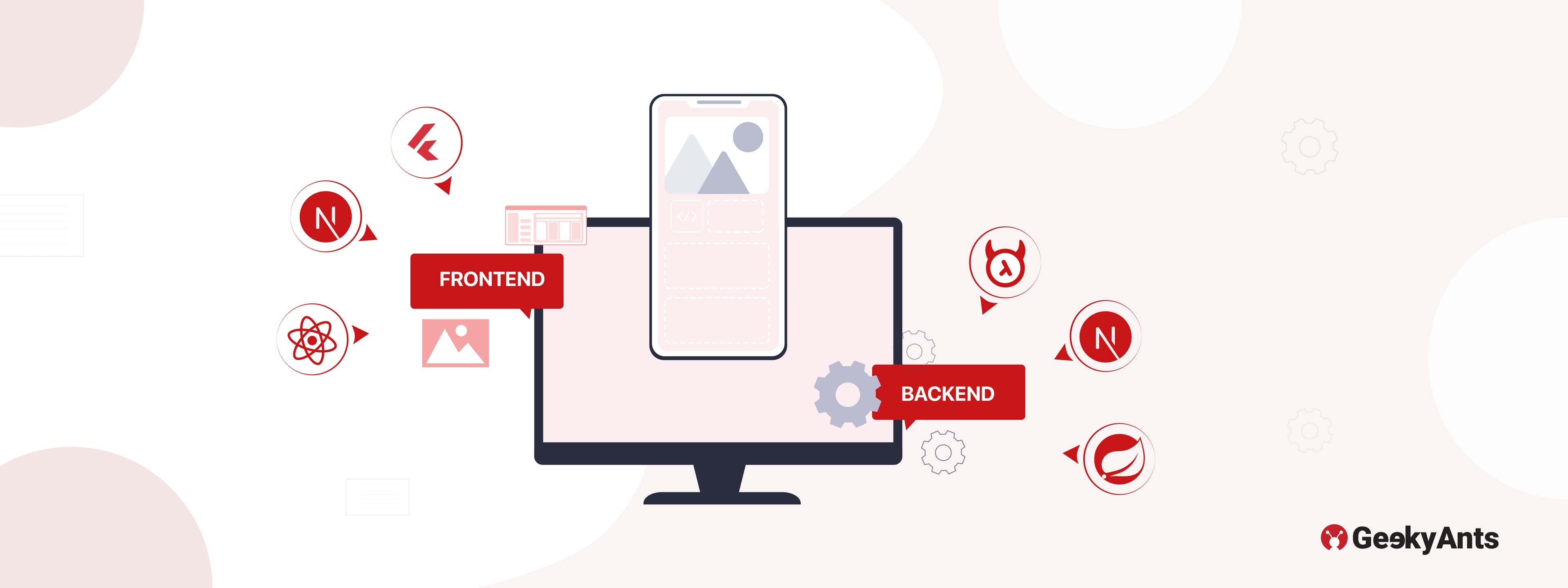
Front-End
Front-end development has been a significant focus at GeekyAnts. We create front-end solutions for a wide range of clients worldwide.
Here’s a look at all the tech stacks we added to our front-end weaponry in 2022.
Next.js
- Next.js has always been GeekyAnyts’ preferred choice for building online applications.
- We used Next.js to enable server-side rendering of our applications, which increases performance and makes them more SEO-friendly.
- We emphasized features like automatic code splitting and optimization, which help improve the performance and scalability of applications. Furthermore, Next.js's active developer community and ability to support modern JavaScript technologies like TypeScript, JSX, and CSS-in-JS made it a must-have tech stack for us.
React Native
- React Native has been our primary choice for mobile application development.
- React Native enables the creation of native apps for both iOS and Android using the same codebase, saving both time and effort.
- The applications we build using React Native operate similarly to native Swift or Java programs. It also allows the reusing of extensive code between our iOS and Android apps. Furthermore, the React Native developer community being vast and active, makes it simple to obtain assistance and resources if needed.
Flutter
- We've also had success building mobile apps with Flutter.
- Flutter has performed admirably on the projects we've completed, and we consider it a top choice for mobile development.
- The future looks bright with the introduction of Flutter 3.0 and its excellent 120 fps support.
In addition to these technologies, we have also worked with native iOS development using Swift. We gained a good understanding of the native side of iOS development and successfully completed many projects using this technology.
Overall, we had positive experiences with Next.js, React Native, Flutter, and Swift.
In 2023, the goal will be to continue using these technologies as our top web and mobile application development choices.
Note: The additions made in 2022 in the front-end domain have inspired us to build a free, open-source framework called gluestack. Do check it out: SIGN-UP FOR EARLY ACCESS.
Back-End
In 2022, we experimented with various backend technologies to power our applications. It was fun to venture into uncharted territories by experimenting with new frameworks.
Take a look at some of them below.
Hasura
- Hasura is a powerful tool for building real-time GraphQL APIs. Hasura allows users to set up and manage a GraphQL server quickly. Its real-time capabilities make it an excellent choice for applications that require real-time updates and synchronization.
- GraphQL is a flexible query language that allows clients to request the exact data they need, making it an excellent choice for modern, data-driven applications. It has a robust ecosystem of tools and libraries, making it easy to integrate with various front-end frameworks.
Nest.js
- In addition to Hasura and GraphQL, we used Nest.js as a backend framework.
- Nest.js is built on top of the popular Node.js runtime and uses the modular architecture of Angular to provide a scalable and maintainable backend solution.
- It includes features like dependency injection and modular architecture, which makes it an excellent choice for building enterprise-grade applications.
Java SpringBoot
- We also used Java SpringBoot for backend development. SpringBoot is a popular Java framework used for building web applications and microservices.
- It provides several features and tools for building robust and scalable applications. It also has a strong community of developers and a wealth of resources and documentation.
Overall, these backend technologies have allowed us to build robust and scalable applications, and we will continue to use them in the future.
The Road Ahead
With a lot in the offing for 2023, GeekyAnts will be coming up with a multitude of digitized solutions. 2022 helped us evolve into a more holistic team, and the learnings will continue to guide us in our journey to empower the world digitally.
We will strive to continue producing bigger and better solutions in 2023.
gluestack.io is our first step in that direction. It is a full-stack open-source framework that simplifies web and mobile application development. The framework is built on a modular architecture and supports custom plugins, giving developers a great working environment.
Stay tuned for more exciting announcements.
Subscribe to Our Newsletter
Subscribe to RSS
Press & Media Hub RSS FeedRelated Articles.
More from the engineering frontline.
Dive deep into our research and insights on design, development, and the impact of various trends to businesses.
Jul 10, 2026
How We Built the Missing Bridge from Code to Figma
Jun 27, 2026
Building a Resilient Hybrid-Cloud Network with WireGuard HA, Route-Based Failover, and Deep Observability
Jun 19, 2026
We Built a 114-Second AWS-to-Azure Failover. Here’s What We Learned
Jun 12, 2026
Cloud-Native and Cloud-Agnostic Are Not Ideologies; They Are Business-Stage Decisions
Jun 8, 2026
Geeklego: The Open-Source Design System Built to Work With AI
May 18, 2026