










Crypto Summer Signals a New Era for Digital Asset IPOs
The cryptocurrency market is entering a phase being dubbed "crypto summer," marked by a surge in optimism after years of volatility and regulatory uncertainty. Driven by increasing institutional interest, favourable regulations, and broader mainstream adoption, investor sentiment is shifting toward stability. A key indicator of this shift is the rise in Initial Public Offerings (IPOs) from crypto-focused companies, signalling the market’s maturity.
Leading firms like Bullish and Miami International are preparing to go public, a significant step for an industry that was once wary of entering traditional financial markets. These IPOs are viewed as a critical test for the crypto sector, as their success could establish digital assets as mainstream financial instruments. The potential success of these offerings is attracting institutional investors, which further boosts confidence in the market’s future.
An important catalyst behind this trend is the evolving regulatory landscape. Governments worldwide, particularly in the U.S. and Europe, are introducing clearer regulations, reducing uncertainty and making it safer for investors. This regulatory clarity is key to maintaining market stability and fostering long-term growth for digital assets.
Despite the optimism, challenges remain. Cryptocurrencies are still known for their volatility, and regulatory risks linger. However, the growing interest in crypto IPOs and the positive regulatory developments indicate a new phase for the digital asset market. As this "crypto summer" unfolds, the sector is poised for greater integration into the global financial system, with the potential for innovation and new opportunities on the horizon.
Crypto’s Institutional Turn: Banking Licenses, Stablecoin Laws, and DeFi in Practice
Five years ago, crypto threatened banks. Today, banks are increasingly adopting a crypto-centric approach, often with distinct branding. This evolution is evident in the institutional adoption of stablecoins, the development of global regulatory frameworks, and the strategic repositioning of crypto companies toward traditional banking models.
The role of crypto is no longer defined by disruption but by integration. It is embedded within the machinery of finance, influencing the circulation of capital, the management of digital value, and the long-term structure of financial systems across markets.
The Mainstreaming of Stablecoins
Stablecoins have emerged as the critical bridge between traditional finance and digital assets. Unlike volatile cryptocurrencies such as Bitcoin or Ethereum, stablecoins are digital tokens pegged to stable assets, typically the US dollar. This stability makes them suitable for everyday transactions, cross-border payments, and as a store of value in volatile economies. Globally, stablecoin trading volume reached US$27.6 trillion in 2024, according to a report by cryptocurrency exchange operator CEX.io, surpassing the combined volume of Visa and Mastercard transactions (about US$25.63 trillion) over the same period. This staggering figure underscores the rapid adoption of stablecoins as a payment mechanism and their growing importance in the global financial ecosystem.
Circle's Strategic Evolution: From Crypto to Banking
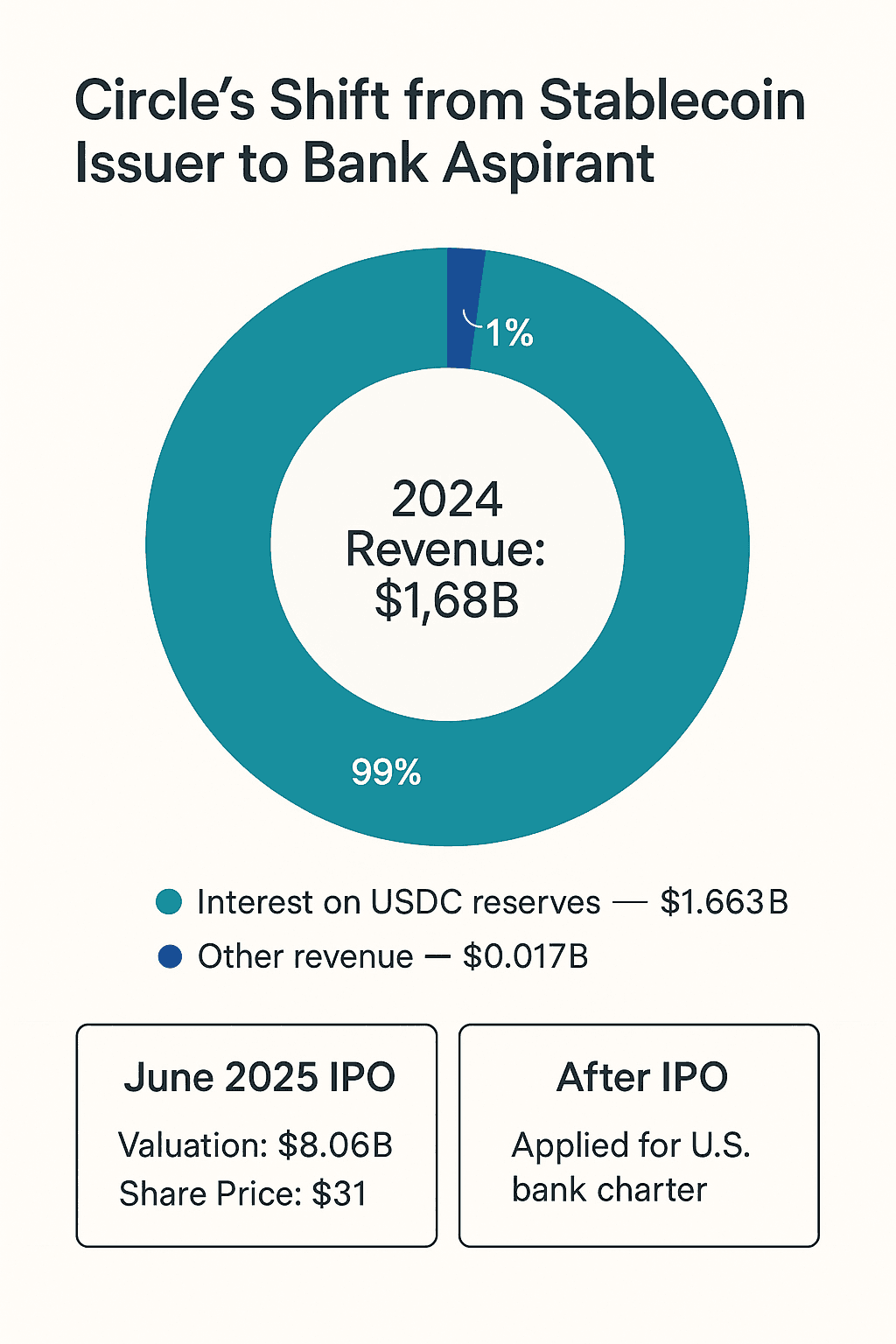
The most significant development in the stablecoin landscape has been Circle's transformation into a publicly traded company with banking ambitions. Circle, the stablecoin giant, is valued at $8.06 billion after increasing the size of its IPO deal for the second time. The company’s June 2025 IPO, which priced shares at $31, marked a watershed moment for the crypto industry.
Circle’s business model highlights the financial potential of stablecoins. In 2024, the company generated $1.68 billion in total revenue, with 99 percent of that coming from interest on the reserve assets backing USD Coin (USDC), its dollar-pegged stablecoin. This structure offers a stable and transparent income stream that mirrors the yield-based models familiar to traditional financial institutions and is straightforward to evaluate.
The company's strategic evolution extends beyond its public listing. Circle Internet Group, which debuted on the New York Stock Exchange earlier this month, has applied for a bank charter. This move represents a significant shift in how cryptocurrency companies perceive their role in the financial ecosystem. Rather than operating on the periphery, Circle seeks to become a fully regulated banking institution, subject to the same oversight and capital requirements as traditional banks.
Regulatory Frameworks: Hong Kong's Pioneering Approach
Hong Kong has emerged as a global leader in stablecoin regulation, establishing a comprehensive framework that balances innovation with consumer protection. On 21 May 2025, the Legislative Council of Hong Kong passed the Stablecoins Bill, establishing a new licensing regime for fiat-referenced stablecoin (FRS) issuers and strengthening Hong Kong's position as a leading international financial centre for virtual assets.
The Hong Kong framework establishes several key principles for stablecoin operations. Stablecoins must always be fully backed by reserve assets equal to or greater than their par value, with regular reconciliation to verify full backing. Issuers must apply prudent calculation methods, maintain over-collateralisation to cover market risks and ensure custodial security.
This regulatory approach addresses one of the fundamental challenges in the stablecoin market: trust. By requiring full backing and regular audits, the Hong Kong framework provides the transparency and security that institutional investors and consumers demand.
China's Strategic Response: The Yuan Stablecoin Initiative
China's approach to stablecoins reflects broader geopolitical considerations about currency dominance and financial sovereignty. In their proposal to China's central bank, JD.com and Alibaba-affiliate Ant Group have outlined a plan to launch stablecoins pegged to the offshore yuan in Hong Kong. This initiative represents China's strategic response to the dollar-dominated stablecoin ecosystem.
The timing of this initiative is significant. As Hong Kong's Stablecoins Ordinance takes effect in August 2025, market participants will monitor closely how the yuan stablecoin Hong Kong initiatives develop in this new regulatory environment. Hong Kong's role as a testing ground for China's digital currency ambitions could provide valuable insights into the future of state-backed digital currencies.
European Integration: MiCA and Coinbase's Compliance
Europe has taken a different but equally significant approach to crypto regulation through the Markets in Crypto-Assets (MiCA) regulation. Coinbase's receipt of a MiCA license represents a major milestone in the regulatory integration of crypto exchanges into the European financial system. This development signals that major crypto platforms are willing to adapt their operations to comply with comprehensive regulatory frameworks, marking a shift from the industry's earlier resistance to regulatory oversight.
The MiCA framework establishes uniform rules across the European Union for crypto asset issuers and service providers, addressing concerns about market manipulation, money laundering, and consumer protection. For stablecoin issuers, MiCA requires similar backing and transparency requirements to those established in Hong Kong, creating a global trend toward standardised regulatory approaches.
Understanding DeFi: The Infrastructure Revolution
Decentralised Finance (DeFi) represents the technological foundation that enables many stablecoin applications. Unlike traditional finance, which relies on centralised institutions such as banks and clearinghouses, DeFi operates through smart contracts on blockchain networks. These self-executing contracts automatically enforce the terms of agreements without requiring intermediaries.
DeFi exists because it addresses several fundamental limitations of traditional finance. It provides 24/7 availability, eliminates geographic barriers, reduces settlement times from days to minutes, and enables programmable money that can automatically execute complex financial operations. For stablecoins, DeFi infrastructure enables instant cross-border transfers, automated lending and borrowing, and complex financial instruments that would be impossible or prohibitively expensive in traditional systems.
Real-World FinTech Applications
The practical applications of stablecoins in financial technology extend far beyond speculative trading. In remittances, stablecoins offer a solution to the high fees and slow settlement times of traditional money transfer services. Workers can send money across borders instantly at a fraction of the cost of traditional wire transfers or money transfer operators.
Smart contracts enable automated lending platforms where borrowers can access credit without traditional credit checks or lengthy approval processes. These platforms use over-collateralization and algorithmic risk assessment to provide loans that are automatically liquidated if collateral values fall below specified thresholds. This approach has enabled billions of dollars in lending activity without the overhead of traditional banking infrastructure.
In trade finance, stablecoins enable instant settlement of international transactions, reducing the need for letters of credit and complex correspondent banking relationships. Companies can pay suppliers instantly upon delivery confirmation, improving cash flow and reducing counterparty risk.
The Spectrum of Digital Money
The digital currency landscape encompasses three distinct categories, each serving different purposes and operated by different entities. Cryptocurrencies like Bitcoin and Ethereum are decentralised digital assets whose values fluctuate based on market demand and speculation. Their primary use cases include investment, speculation, and as a hedge against traditional financial systems.
Stablecoins occupy the middle ground, combining the technological advantages of cryptocurrencies with the stability of traditional currencies. They enable the benefits of digital money while maintaining predictable value, making them suitable for payments, remittances, and as a unit of account in digital transactions.
Central Bank Digital Currencies (CBDCs) represent government-issued digital versions of national currencies. Unlike stablecoins, which are issued by private companies, CBDCs are direct liabilities of central banks. They offer governments greater control over monetary policy and financial surveillance while providing the efficiency benefits of digital currencies.
Challenges and the Path Forward
Despite rapid progress, the stablecoin ecosystem faces significant challenges. Regulatory uncertainty remains a concern in many jurisdictions, with different countries adopting varying approaches to oversight. The lack of global coordination could lead to regulatory arbitrage, where issuers shop for the most favourable regulatory environments.
Trust remains a fundamental challenge. While regulatory frameworks like those in Hong Kong and Europe address some concerns, the collapse of previous stablecoin projects has highlighted the importance of proper backing and transparency. The industry must continue building robust audit and disclosure mechanisms to maintain public confidence.
Adoption barriers persist, particularly in developing countries where access to digital infrastructure and financial literacy remain limited. The promise of stablecoins to provide financial inclusion can only be realised if these fundamental challenges are addressed.
The recent trend of crypto companies applying for banking charters reflects the industry's recognition that legitimacy requires embracing traditional regulatory frameworks. This evolution suggests that the future of digital finance will not replace traditional banking but rather will integrate with it, creating a hybrid system that combines the efficiency of digital technologies with the stability and oversight of traditional financial regulation.
As stablecoins become part of regulated finance, they are emerging as essential tools in the next phase of global money. The rules being created now will shape how stablecoins are used, trusted, and scaled in the future.
Stablecoins in 2025
Market Size
- Total Market Cap: $260 Billion
- Tether (USDT): $160 Billion
- USD Coin (USDC): $66 Billion
- Together, USDT + USDC ≈ 90% of the market
Types of Stablecoins
(Visualised as a pie chart or percentage breakdown)
- 94% Fiat-backed (≈ $237B)
- 5% Algorithmic (≈ $11B)
- 1% Crypto-backed (≈ $4B)
Global Impact
Transactions in July 2025: $1.5 Trillion
- Transfers in 2024: $28 Trillion (exceeding Visa & Mastercard)
- Projected Market Size by 2030: $3.7 Trillion
Wrangling a Thousand Billers: Building a Comprehensive Bill Settlement Platform
Most fintech projects involve building sleek interfaces around straightforward transactions. Geekyants faced something entirely different when a major Indian private bank commissioned a bill payment platform: create a mobile application capable of handling over 1,000 diverse service providers while delivering the reliability that financial services demand.
The technical specifications revealed challenges that extended far beyond typical payment processing. Users needed to pay electricity bills, recharge prepaid mobiles, clear credit card balances, make donations, and handle DTH subscriptions—each category following different operational rules yet requiring consistent user experiences. Meanwhile, the entire system depended on BillDesk's APIs, introducing external dependencies that could affect thousands of concurrent transactions.
Architecture Decisions Under Constraint
React Native provided the foundation for simultaneous iOS and Android deployment, but framework selection represented just the beginning. The development team needed to architect data structures accommodating India's chaotic billing landscape, from fixed utility charges to variable donation amounts, without compromising interface clarity.
Redux implementation became critical for managing state across complex payment journeys. The application required persistent transaction histories, real-time balance updates, and user preference storage while preventing data inconsistencies that plague financial applications. State management complexity multiplied when considering SmartPay automation, which needed to coordinate scheduled payments across multiple service categories simultaneously.
The bills module was designed as an independent component within the bank's broader mobile banking ecosystem. This architectural choice enabled specialised tuning for high-frequency bill payment patterns while allowing the module to evolve independently of other banking features. Modularity also facilitated parallel development streams and isolated testing of specific payment workflows.
User Experience Complexity
Interface design confronted the challenge of serving the bank's diverse customer base without assuming technical familiarity. The team implemented progressive disclosure patterns that revealed advanced functionality only when users demonstrated readiness, ensuring accessibility without sacrificing efficiency for experienced customers.
Separate user journeys for prepaid recharges and credit card payments recognise that these transactions follow distinct mental models. Rather than forcing artificial consistency, each flow received optimisation for its specific requirements while maintaining visual coherence across the application. Standard biller categories shared a unified search and payment experience that allowed users to locate service providers while simultaneously saving information for future transactions.
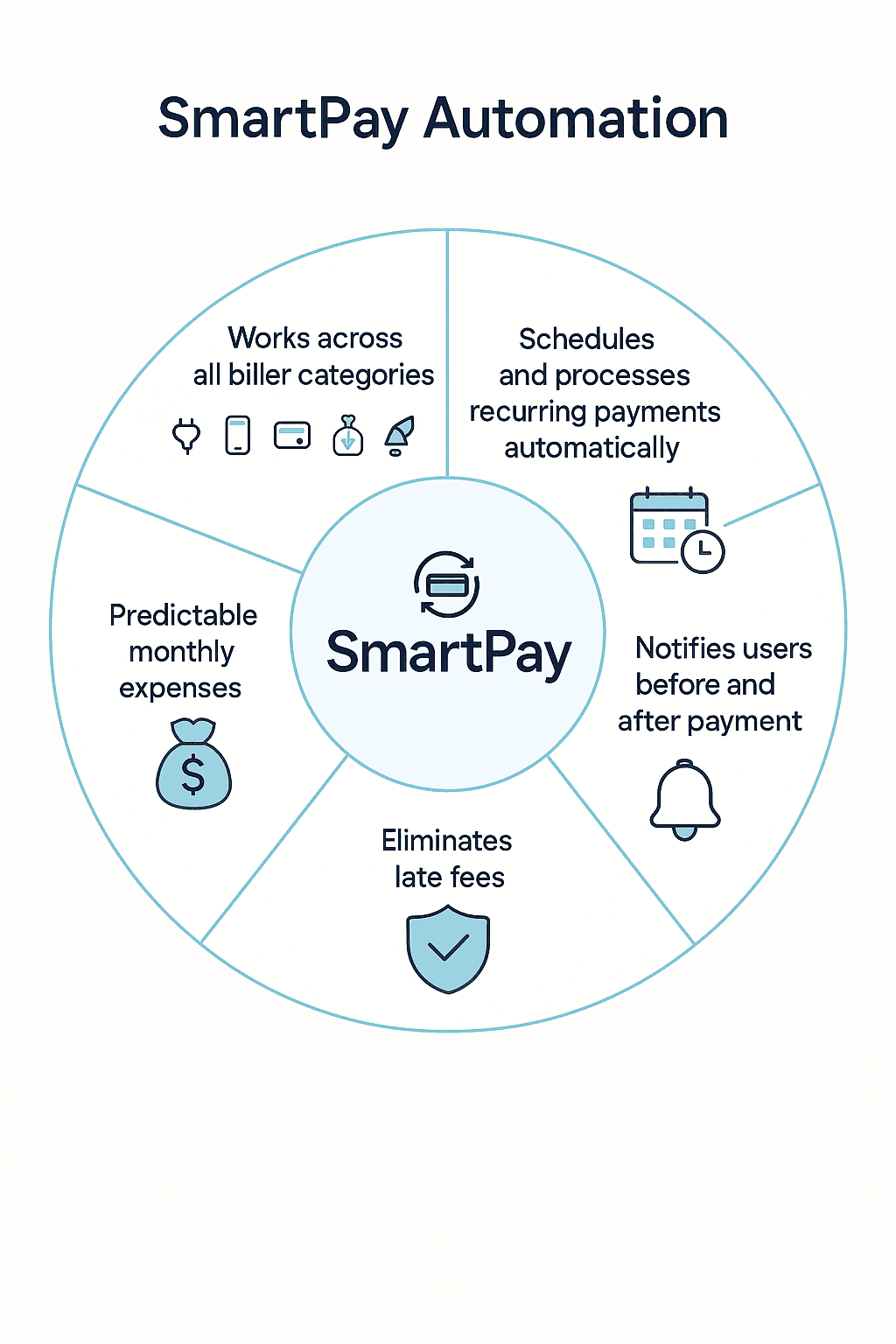
SmartPay automation required particularly sophisticated interface thinking. Users needed a transparent understanding of automated payment implications without configuration complexity that might discourage adoption. The feature handles recurring payments across all supported biller categories, eliminating deadline anxiety while providing users with predictable monthly financial obligations.
Integration Challenges
Working with BillDesk's external APIs introduced dependencies beyond Geekyants' direct control. The development team implemented comprehensive error handling to ensure graceful degradation when external services experienced problems. Caching strategies reduced API dependency while maintaining data freshness for time-sensitive billing information.
Performance became crucial as user adoption increased. The application needed responsive performance across different device capabilities and network conditions while handling concurrent usage spikes during peak billing periods. Load balancing, efficient data structures, and refined rendering processes required continuous attention.
Real-time payment processing demanded careful coordination between multiple systems. Account balance verification, transaction execution, interface updates, and cross-platform data synchronisation needed seamless orchestration without creating opportunities for inconsistent states or failed transactions.
Design Precision Requirements
The client's specifications demanded pixel-perfect implementation of detailed Figma mockups across multiple screen sizes and device types. This requirement transcended aesthetic preferences—visual consistency reinforces user trust in financial applications. The development team established rigorous design review processes, ensuring that implemented interfaces matched approved specifications across different device configurations.
Google Services and Adobe Services integration provided analytics capabilities and user experience enhancement tools. These integrations enabled monitoring of real-world usage patterns, identifying friction points that internal testing could not reveal. Heat mapping and user activity analytics informed interface refinements that improved transaction completion rates.
Platform Performance
The completed platform consolidated previously fragmented payment experiences into a coherent ecosystem. Users gained single-application access to over 1,000 service providers while benefiting from saved payment information and automated scheduling options. Transaction volumes exceeded projections, validating market demand for comprehensive bill payment consolidation.
SmartPay adoption demonstrated user appetite for financial automation when implemented thoughtfully. The feature eliminated late payment fees while providing predictable monthly expense management. However, analytics revealed variation in automation adoption across different biller categories, suggesting distinct psychological relationships with various payment types.
The modular architecture proved valuable during scaling phases. Performance enhancements could target the bills component without affecting other banking application elements. Database schemas evolved to handle increasing transaction volumes while maintaining query responsiveness across growing user bases.
Technical Lessons
The project demonstrated how complex financial integrations can be simplified through intuitive user interfaces, maintaining functionality while enhancing user experience. However, external API dependencies emphasised the importance of defensive programming and thorough error handling in ensuring the platform’s reliability under varying conditions. User adoption insights revealed that automation features gained traction at different rates across service categories, while interface analytics helped identify navigation bottlenecks that had been overlooked during internal testing.
This feedback drove continuous improvements based on real user behaviour, rather than theoretical assumptions. The platform’s success also laid the groundwork for future financial management tools, such as expense categorisation, budgeting features, and predictive cash flow analysis. The existing infrastructure and design patterns provide natural extension points for these new capabilities.
GeekyAnts’ expertise in mobile app development, financial systems integration, and performance optimisation ensured that the platform met the high standards required for financial services. The resulting solution serves millions of users, transforming routine financial tasks into seamless digital experiences while maintaining the reliability needed in the financial sector.
Finance Just Got Its iPhone Moment with Claude
The introduction of Claude into financial services feels less like the arrival of a new tool and more like the unveiling of a new operating layer for the industry. It did not wait for pilots or staggered onboarding. It entered trading floors and research desks already functioning at analyst scale, quietly rewiring how institutions absorb information and make decisions.
Bridgewater uses it to mirror junior analyst workflows with precision. Commonwealth Bank processes millions of transactions through it to surface real-time fraud signals. Norway’s NBIM folds it into asset reviews, freeing more than 200,000 analyst hours in a single reporting cycle. These are not early experiments; they are operational shifts happening inside some of the world’s largest financial organisations. Claude is no longer an addition to the system. It has begun to shape the system itself.
The Model That Speaks Finance Fluently
A senior analyst’s day still often begins with an unglamorous routine: raw data in one tab, market feeds in another, an endless spreadsheet for sanity and structure. Exposure reports are pieced together line by line, risk summaries double-checked against multiple sources, and hours are spent moving between tools rather than interpreting outcomes.
Claude altered this rhythm overnight. Integrated directly with FactSet, PitchBook, Morningstar, and internal data lakes, it understands market sentiment, parses exposure shifts, and explains its reasoning with sources attached. A query for a comparative analysis of Nordic energy portfolios with Q3 earnings context now returns a structured brief ready for a board deck. The process that once consumed hours of manual work is compressed into a single, verifiable output.
Intelligence Takes the Stage
For years, financial software design focused on interfaces—dashboards refined for speed, colourful visualisations meant to feel intelligent. True decision-making still lived in human hands, orchestrated between windows and worksheets. Claude shifts the emphasis from navigation to outcomes. The interaction is no longer about where to click or how to visualise a dataset. The only thing a user supplies is intent, and the platform delivers an answer that can withstand scrutiny.
Pratik Kumar, CEO of GeekyAnts, describes the shift simply:
"When the first output is clear, defensible, and decision-ready, the interface becomes invisible. That is when you know you are no longer designing tools—you are enabling outcomes.
The measure of value is no longer how well someone learns a platform but how much faster and more confidently they reach a decision.
The Analyst Desk, Rebuilt at Every Layer
Claude brings computational scale to the work of analysis, and it does so in layers. Its latest models outperform competitors on Vals AI’s Finance Agent benchmark, excelling in structured analysis, Excel logic, and financial modelling. At FundamentalLabs, Claude Opus 4 completed five out of seven Financial Modelling World Cup challenges—complex spreadsheet problems that would test even seasoned analysts—with 83% accuracy. The ecosystem around it is equally formidable. Claude draws directly from S&P Capital IQ, FactSet, Snowflake, PitchBook, and Palantir. It synthesises market moves rather than summarising headlines, giving institutions an information layer that is always current, always connected to the source.
Even on risk and compliance, traditionally the slowest and most audit-heavy corner of finance, Claude reshapes the timeline. AIG reduced its business review cycle fivefold and lifted data accuracy from 75 to over 90 percent using Claude Code for Monte Carlo simulations and underwriting analysis. These gains are not about speed alone; they represent structural improvements in precision and oversight.
Claude as Infrastructure
For decision-makers, Claude signals a future in which financial intelligence does not sit in dashboards or assistants but runs through the core of every process. It acts as a reasoning engine, embedded across data warehouses, call transcripts, and pitch memos, raising the baseline of judgment within the institution.
Its arrival is not incremental innovation. It redefines the foundations on which decisions are made, shifting the conversation from productivity tools to cognitive infrastructure. Institutions that integrate it now are not simply gaining efficiency. They are laying down new architecture for how insights are generated, verified, and turned into action at scale.
Claude’s launch is a turning point. It changes not just what analysts can do, but how entire organisations think, decide, and operate. In an industry where milliseconds matter and clarity is currency, that change will redraw competitive lines for years to come.
The New UX Layer of Money, ID, and Access
The convergence of payments, identity, and access control is reshaping how people interact with financial systems, government services, and digital commerce. Digital wallets, once little more than containers for payment cards, have evolved into intelligent platforms. They now serve as the primary interface through which individuals participate in the digital economy.
This transformation is more than a technical upgrade. It marks a shift in how society defines the relationship between identity, value, and access. As digital wallets take on roles once reserved for banks, documents, and even hardware, they are becoming the new front door to both public and private digital systems.
The Government as Wallet Provider
The United Kingdom's announcement of the GOV.UK Wallet, scheduled for launch in Summer 2025, marks a pivotal moment in the evolution of digital identity infrastructure. The UK government has announced a digital identity wallet application, GOV.UK Wallet, designed to allow citizens to store government-issued identification documents on their smartphones. This initiative extends beyond the simple digitisation of physical documents to create a comprehensive platform for citizen-government interaction.
Government-issued digital credentials are built on an architecture that departs from traditional centralised identity systems. Mobile driver's licenses (mDLs) and other digital ID documents will carry the same legal status as their physical counterparts. This equivalence between digital and physical credentials establishes a new foundation for identity verification that transcends the limitations of paper-based systems.
The implications extend far beyond convenience. Government-backed digital wallets create a direct channel between citizens and state services, eliminating intermediaries and reducing friction in essential transactions. Instant identity verification, benefit access, and interaction with government services through a unified interface redefine civic engagement for the digital economy.
Cross-Border Payments as the New Operating System
India’s Unified Payments Interface (UPI) is expanding globally, illustrating how payment systems are evolving into universal protocols for economic interaction. In 2024, UPI payments launched in France, with the Eiffel Tower becoming the first iconic landmark to accept them.
The technical architecture of UPI, built on open standards and interoperability, provides a template for how digital wallets can transcend national boundaries. In January 2025, the RBI relaxed forex regulations to support cross-border trade and expand the Rupee’s international use. These regulatory changes reflect a recognition that payment systems are becoming the foundational infrastructure for international economic cooperation.
Rise in cross-border wallet functionality signals a shift from traditional correspondent banking toward direct, peer-to-peer international transactions. This evolution reduces settlement times, lowers costs, and increases transparency in international commerce. More significantly, it establishes payment wallets as the primary interface for global economic participation, positioning them as essential infrastructure for the interconnected world economy.
QR Codes and the New Visual Language of Commerce
The ubiquity of QR codes in digital payment systems has created a new visual language for commerce that transcends linguistic and cultural barriers. This standardisation represents more than technological convenience. It establishes a universal protocol for initiating financial transactions that operate independently of traditional banking infrastructure.
A QR-first approach to payment interfaces reflects a broader shift toward visual, intuitive user experiences that reduce cognitive load in financial transactions. This design philosophy prioritises accessibility and speed, enabling users to complete complex transactions through simple camera-based interactions. Its implications extend beyond payments to encompass identity verification, access control, and service provisioning.
QR-based interaction models show how digital wallets have become the default interface for linking physical and digital environments. Merchants, service providers, and institutions increasingly design customer touchpoints around wallet-based interactions, creating an ecosystem where the digital wallet functions as the universal key to commercial participation.
Biometric Security and the Personalisation of Access
The integration of biometric authentication into digital wallets represents a fundamental shift in how security is conceptualised and implemented. Rather than relying on external tokens or credentials, biometric systems embed security directly into the user's physical identity, creating an unbreakable link between individual and access rights.
Advanced biometric implementations combine multiple authentication factors, such as fingerprint, facial recognition, and behavioural biometrics, to create security profiles that are virtually impossible to replicate. This multi-modal approach not only enhances security but also improves user experience by reducing reliance on passwords and external authentication devices.
The implications extend beyond security to encompass privacy and autonomy. Biometric authentication enables users to maintain control over their identity verification while reducing dependence on centralised authorities. This shift toward user-controlled identity management represents a fundamental reimagining of how individuals interact with digital systems.
NFC and the Invisible Interface
Near Field Communication (NFC) technology embedded in digital wallets creates an invisible layer of connectivity that enables seamless interactions between users and their environment. This technology eliminates the need for visible interfaces, allowing users to authenticate, pay, and access services through simple proximity-based interactions.
The proliferation of NFC-enabled wallets transforms physical spaces into interactive environments where users can engage with services, access information, and complete transactions without explicit interface navigation. This ambient computing approach represents a significant evolution in user experience design, moving beyond screen-based interactions toward contextual, environmentally integrated systems.
Integrating NFC capabilities into digital wallets creates new possibilities for personalised experiences in physical spaces. Retail environments, transportation systems, and public facilities can adapt their offerings based on user preferences and historical behaviour, creating personalised experiences that blur the boundary between digital and physical interaction.
Artificial Intelligence and Predictive Financial Services
The incorporation of artificial intelligence into digital wallets enables predictive financial services that anticipate user needs and optimise transaction experiences. Machine learning algorithms analyse spending patterns, location data, and behavioural indicators to provide personalised recommendations and automated financial management.
AI-powered wallets can automatically categorise expenses, identify fraudulent transactions, and suggest optimal payment methods based on merchant partnerships and reward programs. This intelligent automation reduces cognitive load while maximising financial efficiency, transforming the wallet from a passive storage system into an active financial advisor.
Predictive capabilities of AI-enabled wallets extend beyond individual optimisation to encompass broader economic insights. Aggregated spending patterns and behavioural data provide valuable intelligence for merchants, financial institutions, and policymakers, creating new opportunities for economic analysis and intervention.
The Identity-Commerce Nexus
The convergence of identity verification and commerce within digital wallets opens new avenues for secure, tailored experiences. When a user’s identity is verified at the point of interaction, businesses can deliver offerings with greater precision while reducing fraud and streamlining authentication.
By linking identity data with transactional history, platforms can generate rich user profiles that support dynamic pricing, predictive offers, and context-aware recommendations. This level of integration enhances trust, improves targeting, and reshapes how value is exchanged in digital marketplaces.
This convergence also enables new forms of commercial trust and reputation management. Users can build verifiable transaction histories and reputation scores that facilitate peer-to-peer commerce and reduce the need for traditional intermediaries.
Conclusion: The Wallet as Universal Interface
Digital wallets have evolved from simple payment tools into comprehensive platforms for identity, access, and commerce. They are becoming the primary interface through which users interact with both financial services and digital systems. As these platforms continue to develop, their ability to balance functionality, simplicity, security, and innovation will be key to their success.
Looking ahead, digital wallets will increasingly serve as the foundation for economic participation, reshaping how individuals access services, verify identity, and engage with the digital economy. As technology advances and user expectations evolve, these wallets will redefine the way people connect with the digital world, opening new opportunities for innovation and seamless experiences.