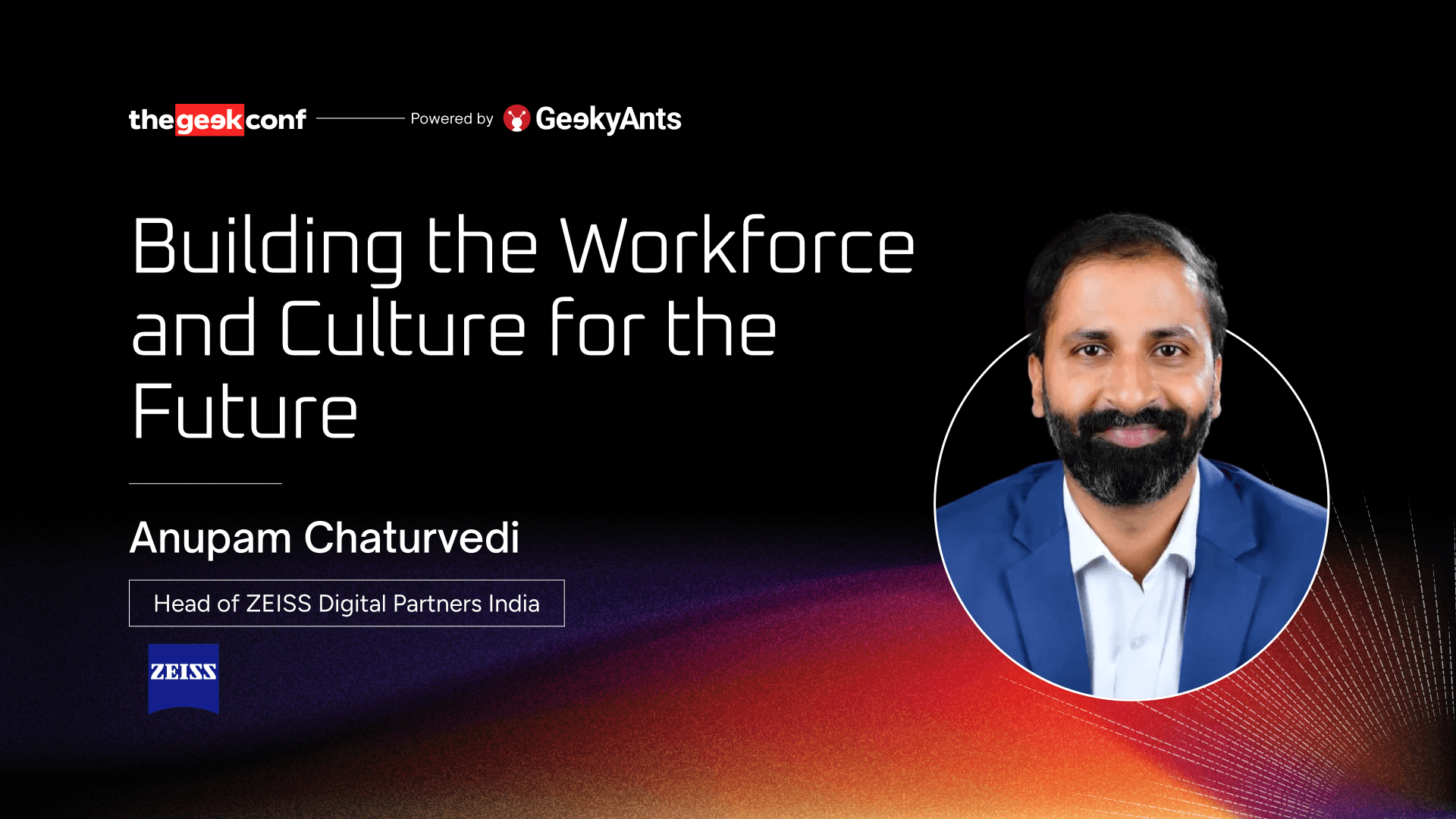

Editor’s Note: This blog is adapted from a talk by Anupam Chaturvedi, Head of Zeiss Digital Partners, at thegeekconf 2025. Leading the digital organization within the Zeiss Group, Anupam explores the critical shift from predictive analytics to the generative AI era. His session focuses on the dual challenge of addressing job displacement fears while building a talent-rich, future-ready culture that treats AI as a long-term journey rather than a short-term sprint.
Hi, I am Anupam Chaturvedi, and like many of you, I am navigating this massive transition into the generative AI era. At Zeiss, we are moving beyond simple predictive models to explore how these technologies fundamentally change the way we work. We all read the headlines about AI replacing humans, and the World Economic Forum recently noted that 85 million jobs might be replaced. However, as an organization in the middle of this shift, I see the other side of the coin. We are desperately looking for talent that can build these solutions and a culture that can sustain them.
Change is always difficult. Every industrial revolution has affected human beings in stark ways, and this fourth revolution is no different. Everyone has a fear of missing out, yet everyone is still figuring out how to deliver the results we want. I believe the answer lies in how we bridge the talent gap, prepare our infrastructure, and maintain the consistency required for the long haul.
The Reality of the Talent Gap
The talent gap is not a myth. It is a very real challenge that organization leaders face every day. While millions of roles may be displaced, the World Economic Forum also estimates that 97 million new roles will emerge, specifically aligned with data and AI. This gap is no longer limited to software engineering; we are seeing a skill deficit across all functions: marketing, sales, operations, and finance.
We need people who possess both advanced data skills and creative thinking. Data has always been there, but it used to be a small cohort of people in IT or digital engineering who handled it for everyone else. Now, generative AI means every function wants to use it. This shift makes AI literacy the crux of every job in the modern organization.
Upskilling Over Hiring
Over the past two years, I have learned that upskilling internally can beat hiring alone. You cannot simply go out and hire hundreds of AI engineers from scratch to make your organization ready. Instead, we focus on curated learning paths and project-based experiential learning. In my organization, we have created "citizen AI practitioners" across different functions.
These practitioners serve as mentors and evangelists within their own departments. They help their peers learn, support the rollout of new tools, and eventually become specialists themselves. By working in cross-functional cohorts that include people from finance, product management, and digital IT, we create a multiplier effect. These high-performing teams learn faster together and deliver measurable outcomes that we can actually track, such as a finance professional building their own AI assistant.
The Four Pillars of Organizational Readiness
Building a workforce is about more than just technology. It requires a solid foundation in culture, infrastructure, and governance. The first pillar is cultural readiness, specifically psychological safety. When a finance professional hears about AI automation, their first thought is often "will I lose my job?" We must work to provide them with approved tools and skills, so they see AI as an enabler rather than a threat.
Infrastructure is the second pillar. Successful AI implementation is impossible without a robust data foundation or a semantic layer. Many organizations attempt to deploy AI agents while still struggling with their data foundations. However, these agents are only as effective as the data supporting them. We must invest in data landing zones and governance to ensure our results are accurate and measurable. This foundation reduces frustration for both the management and the developers.
The third and fourth pillars are change management and governance. Change must be planned and communicated clearly from the top to prevent panic. We use playbooks and prompt-engineering templates to make the transition easier for everyone. Simultaneously, we invest heavily in responsible AI frameworks. In highly regulated sectors—such as medical technology—we dedicate months to security roadshows to ensure every stakeholder trusts the tools. This removes the skepticism that often slows down investment.
The Leadership Operating Model
Leadership serves as the bridge for this entire transformation. I believe the single biggest way to impact an organization is to focus on leadership development. Leaders must champion AI by modeling the right behaviors and ensuring every project aligns with business goals. This starts with a long-term strategy, typically a 12 to 24-month plan, rather than a short sprint.
We establish a clear operating model to avoid confusion. At Zeiss, we use a digital council that sits with stakeholders to understand their needs. This council is supported by a Center of Excellence (COE) team that provides the platforms and tools, while communities of practice help people learn. This three-layer structure ensures that everyone knows where to go for help and who is responsible for which part of the AI journey.
Finally, we must embed AI into the leadership workflow itself. When the management team embraces these tools for decision-making, it gives the rest of the organization the confidence to follow. It is not just about being motivated. Motivation fades, especially when you are stuck in Bengaluru traffic, but consistency is what delivers results. We have to be persistent in our direction to build a workforce that can truly thrive in this emerging era.