Cloud Migration & Modernization
We analyse your existing infrastructure landscape, application dependencies, and migration readiness so you gain absolute clarity on what to move, what to modernize, what to retire, and the most strategic sequence to execute it all without disrupting the business.
Transition to the Cloud With Precision, Speed, and Zero Regret











Most engineering teams don't fully appreciate the complexity of their existing infrastructure until a migration is already underway and surprises start surfacing. Our Cloud Migration Assessment maps every dependency, compatibility risk, and modernization opportunity before a single workload moves.
Your migration sequence becomes deliberate and de-risked, cutover events stop feeling like emergencies, and the destination architecture actually delivers the outcomes the business expected. You walk away with a detailed, prioritised execution roadmap your team can begin acting on immediately.
Client Results and Success

Production-Ready Kubernetes Architecture
The platform was designed to support scalable production deployments with minimal resource consumption, enabling faster environment provisioning and operational stability.
- environments K8s setup
- 3
- environments K8s setup
- 95%
- savings over managed Kubernetes alternatives
- 35%

40% Faster Onboarding Completion
The redesigned system achieved a 40% reduction in onboarding completion time, directly improving platform adoption and reducing operational bottlenecks.
- Improvement in the doctor's efficiency for treatment planning
- 35%
- Reduction in onboarding completion time
- 40%
Production-Grade AI Infrastructure
The system supports scalable AI inference and automated inspection workflows, reducing manual intervention and enabling consistent performance under growing usage.
Read case study3× Faster Feature Iteration
The platform achieved 3x faster AI feature iteration cycles, significantly reducing time-to-release for new recommendation
- Reduction in meal decision time
- 40%
- Increase in daily active usage during pilot
- 2x
50% Fewer Manual Validation Cycles
The system achieved a 50% reduction in manual validation cycles, improving throughput and accelerating delivery timelines.
- Reduction in manual validation cycles
- 50%
- Faster internal testing workflows
- 30%
60% Cloud Cost Reduction
The platform achieved a 60% reduction in monthly cloud costs while maintaining uptime and transaction stability during and after optimization.
- Saved per month
- $4,800
- Annual savings
- $57,000+
Our Migration Assessment Covers Three Critical Dimensions
Every engagement opens with a methodical, hands-on evaluation spanning three essential pillars of your migration readiness: your existing infrastructure landscape, your application portfolio, and your organisational preparedness to execute and sustain the transition.
We never produce migration strategies from spreadsheet surveys and stakeholder interviews alone. Our AI-empowered engineers work directly alongside your teams, inside your environments, examining your actual configurations, dependency maps, data flows, and operational constraints. The result is a migration plan grounded in the reality of your systems — not assumptions about them.
- Current state mapping: Server inventory, virtualization layers, networking topology, and storage dependencies
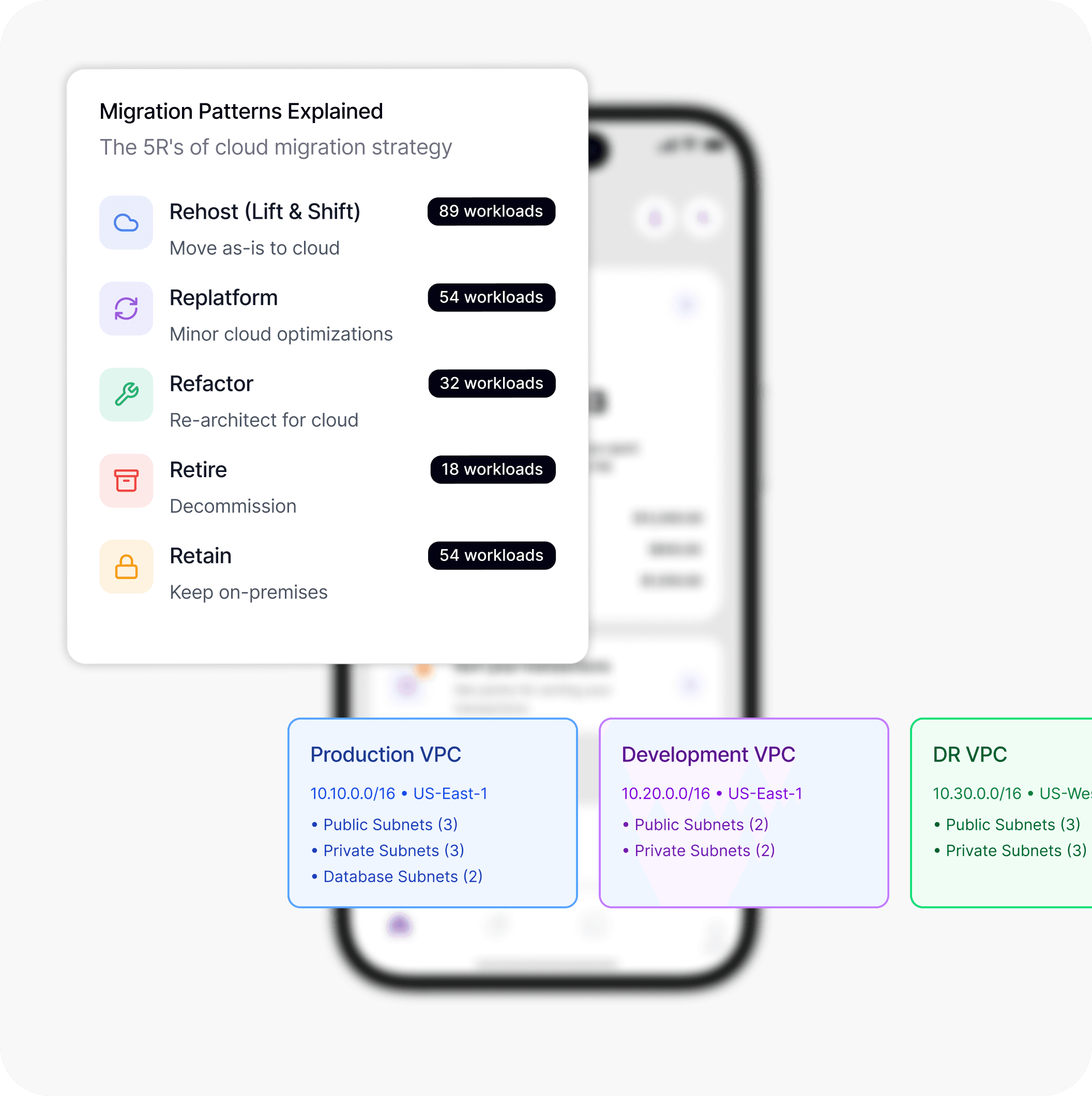
- Cloud fit analysis: Workload classification by migration pattern — rehost, replatform, refactor, retire, or retain
- Dependency chain identification: Inter-service communication, shared databases, and legacy integration points
- Network and connectivity planning: Latency requirements, hybrid connectivity options, and firewall migration considerations
- Application complexity scoring: Coupling levels, technology stack age, containerisation readiness, and refactoring effort estimates
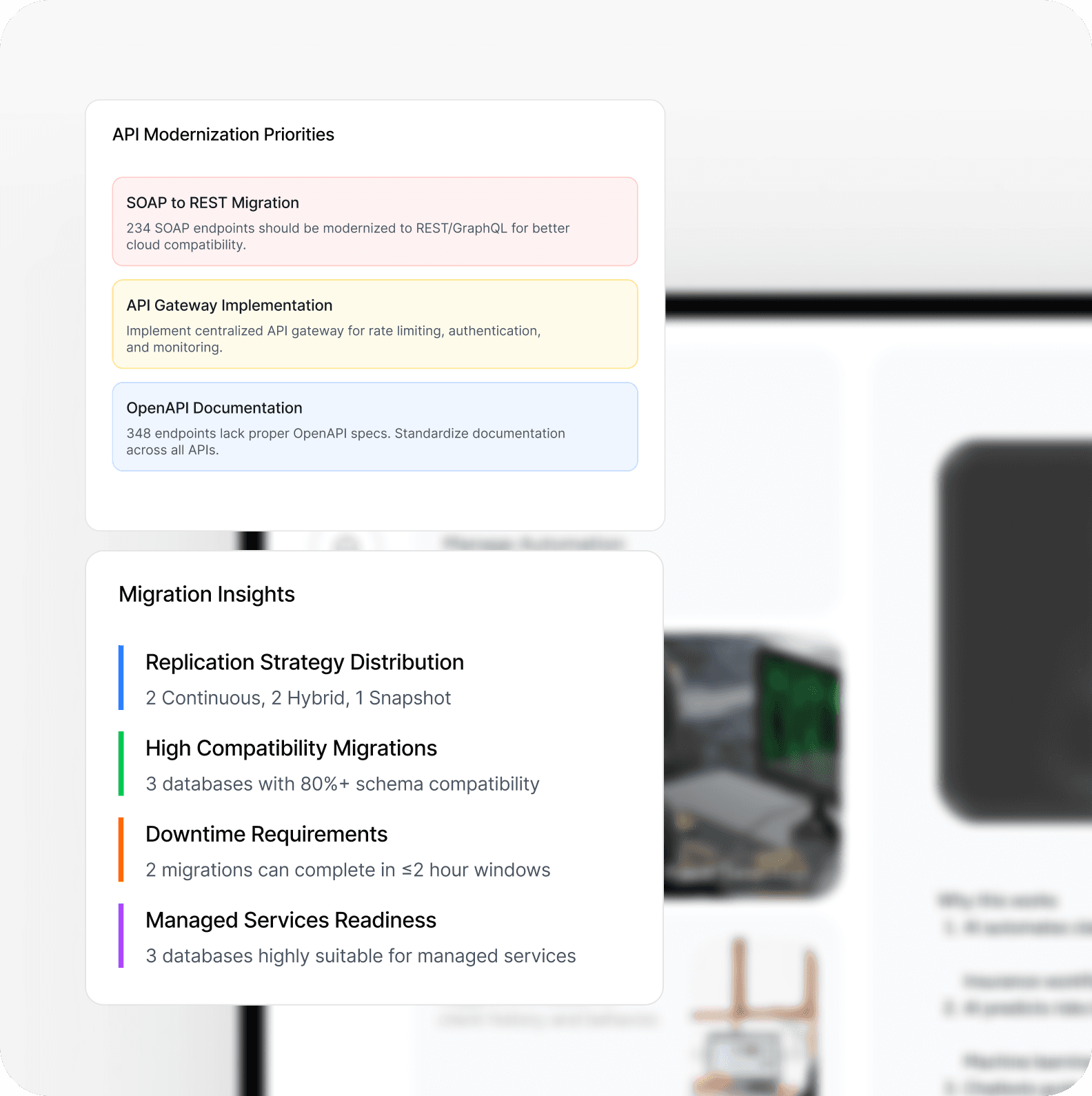
- Database migration assessment: Schema compatibility, replication strategies, cutover window requirements, and managed service suitability
- API and integration mapping: Third-party dependencies, internal service contracts, and breaking change risk analysis
- Modernization prioritization: Sequencing recommendations balancing business value, technical risk, and migration effort
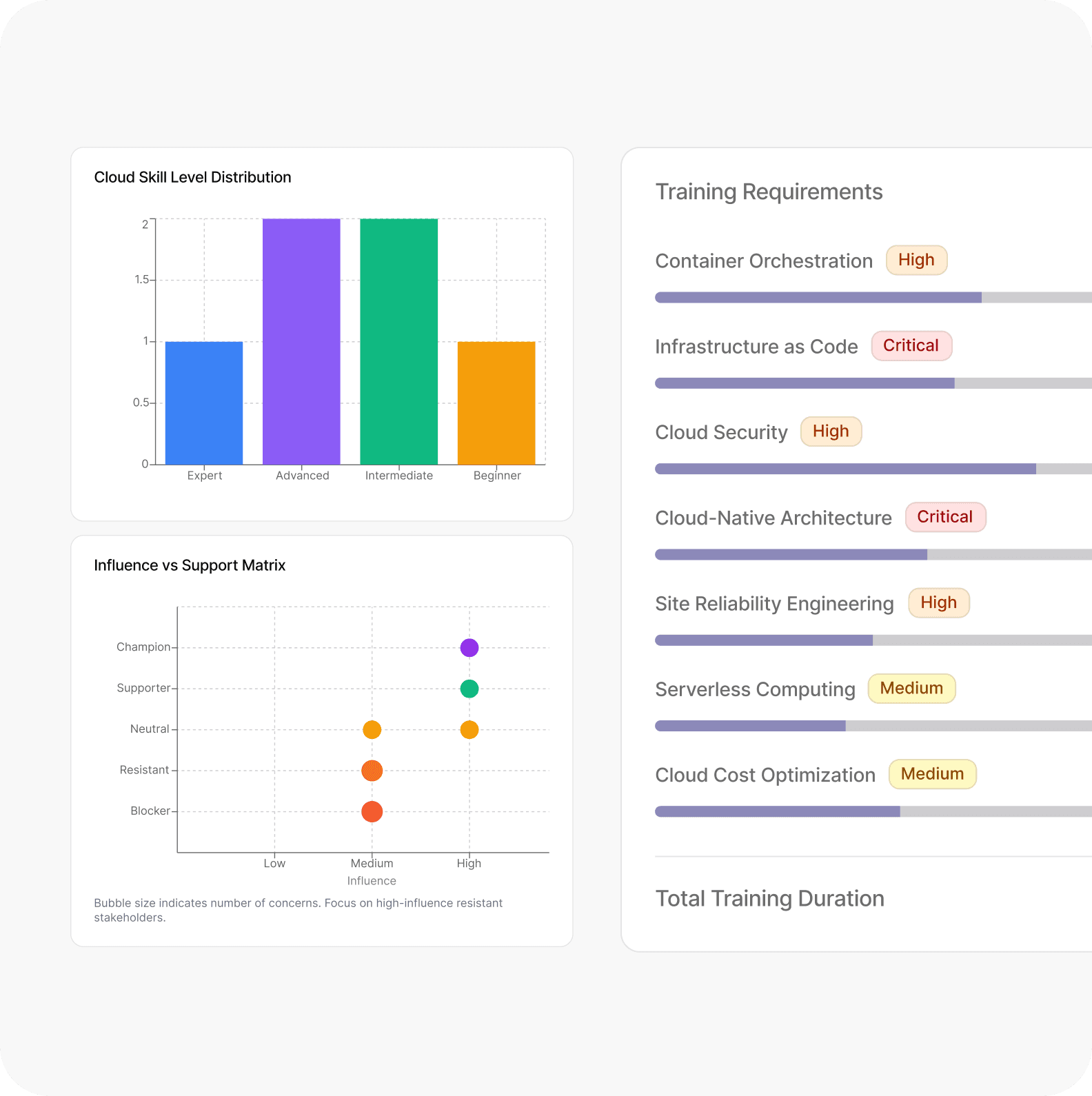
- Team capability assessment: Existing cloud skills, training gaps, and capacity available to support migration execution
- Governance and compliance alignment: Data residency requirements, regulatory constraints, and cloud policy frameworks
- Change management readiness: Stakeholder alignment, communication planning, and rollback decision authority
- Post-migration operating model: Target support structures, cloud operational tooling, and knowledge transfer requirements
Recurring Patterns We Uncover Across FinOps Engagements
12-16 wks
Average timeline extension caused by undiscovered dependencies during migration execution
60-70%
Proportion of application portfolios containing modernisation candidates misclassified as simple lifts
1 in 3
Migrations that encounter significant data migration complications not identified during planning
35%
Average reduction in post-migration costs when sequencing is planned rather than improvised
Migration Outcomes We Are Accountable For Delivering
Our assessment methodology surfaces every risk before it becomes a production incident. The deliverables we provide give your organization the clarity and confidence to execute migration at pace without gambling on outcomes.
Migrate Without Fear of What You Missed
Understand every dependency, every integration risk, and every cutover constraint before any workload leaves its current home — so nothing surprises you mid-migration.
Accelerate Cloud Adoption Without Business Disruption
Clear the planning ambiguity and sequencing uncertainty that stalls migration programmes so each phase progresses on schedule and without operational impact.
Land in a Cloud Architecture Built to Last
Arrive at a destination environment that reflects your actual performance, scalability, and compliance requirements — not a cloud-hosted version of your legacy problems.
Modernize While You Migrate, Not Years Afterward
Identify and act on modernization opportunities embedded within the migration programme itself so you capture cloud-native benefits immediately rather than deferring them indefinitely.
Industries Across Which We Deliver Migration and Modernization Impact
We design cloud migration strategies calibrated to the regulatory realities, performance demands, and operational constraints of each industry vertical. Our philosophy centres on positioning your organization for long-term architectural resilience rather than short-term migration completion. We understand compliance boundaries, data sovereignty requirements, and the commercial pressures shaping migration timelines across every sector we serve. Every industry in our portfolio reflects genuine hands-on migration delivery experience.
Migration Assessments Delivered by Engineers Who Have Moved 1000+ Production Systems to the Cloud
Our assessors bring migration pattern recognition developed through hundreds of live production transitions across every major cloud platform. Your assessment is an engineering diagnosis built from direct experience — not a methodology framework applied from a distance.
Our AI-enabled engineers and migration specialists have led production cloud transitions at scale across regulated and high-availability environments.
Every dependency, every compatibility gap, and every cutover constraint is expressed in terms of timeline risk, business impact, and remediation effort — not abstract technical observations.
We recommend migration patterns and destination architectures based on your workload characteristics and business requirements — never on platform partnerships or vendor incentives.
Every migration phase we define is scoped, sequenced, and specific enough to assign to a team and begin without further elaboration or interpretation.
We document every discovery, decision, and architectural rationale so your team carries full ownership of the migration programme from the moment the assessment concludes.
Our Offerings in DevOps Consulting and Services
Our Latest Thinking
FAQs About Cloud Migration & Modernization Assessment Services
A Cloud Migration Assessment is a comprehensive technical and organizational audit of your existing infrastructure, application portfolio, and team readiness. It identifies every workload, maps every significant dependency, classifies each application by the most appropriate migration pattern, and surfaces the risks, sequencing constraints, and modernization opportunities that determine whether your migration succeeds or stalls. You receive a complete picture of your current environment alongside a phased execution roadmap that reflects the realities of what you actually have — not a generalized template applied to your situation.
The duration varies based on the size of your infrastructure estate, the complexity of your application portfolio, and how many cloud accounts or data centres are involved. Most engagements conclude within 2 to 5 weeks. Larger organizations with extensive on-premise infrastructure, multiple business units, or complex regulatory requirements may require additional time to ensure complete coverage. We scope the engagement timeline precisely during the initial discovery session so you always know what to expect before work begins.
We work within the boundaries your security and legal teams define. Read-only access to your infrastructure inventory, network diagrams, CI/CD configurations, and cloud or hosting consoles is generally sufficient to conduct a thorough assessment. For organisations where production access is restricted, we design the engagement around the access level available and are transparent about any coverage limitations that result. We have worked within highly regulated environments including healthcare and financial services and are experienced in conducting assessments under strict access constraints.
Minimal disruption is a core principle of how we run assessments. We typically schedule 3 to 4 focused working sessions with key engineers, architects, and operations leads across the engagement period. Outside of those sessions, your teams continue their normal delivery commitments. Most engineering organizations we work with report spending fewer than 5 hours total in active participation across the full engagement.
Particularly so. Organizations with substantial on-premise footprints often benefit most from a structured assessment because the discovery phase surfaces dependencies and constraints that would otherwise derail a migration programme mid-execution. The assessment helps you determine which workloads are genuine cloud candidates, which should be modernized before migration, which should be retired entirely, and which are better retained on-premise for regulatory or performance reasons. You arrive at your migration strategy through evidence rather than assumption.
These three patterns represent meaningfully different levels of investment and outcome. Rehosting — often called lift-and-shift — moves workloads to cloud infrastructure with minimal changes, delivering speed but limited long-term benefit. Replatforming introduces targeted optimizations such as moving to managed databases or containerizing applications without rewriting core logic, striking a balance between speed and modernization value. Refactoring involves redesigning applications to take full advantage of cloud-native capabilities, delivering the greatest long-term benefit at the highest short-term investment. Our assessment classifies every workload by the pattern that best balances your timeline, budget, and target outcomes.
You receive a complete infrastructure and application discovery report, a workload classification matrix covering every significant system in scope, a phased migration roadmap broken into sequenced tranches with dependency-aware ordering, a risk register documenting every identified concern alongside recommended mitigations, and a modernization opportunity summary identifying where cloud-native services can replace legacy components during the migration itself. We conclude every engagement with a live readout session where our engineers walk your leadership and technical teams through every finding, recommendation, and decision rationale.
Data migration is one of the highest-risk components of any cloud transition and receives dedicated attention within our assessment. We examine your current data volumes, database technologies, replication capabilities, and consistency requirements to identify the appropriate migration strategy for each data store. We assess cutover window feasibility, evaluate managed database service suitability, and surface schema compatibility issues that could extend migration timelines. Where data sovereignty or regulatory constraints apply, we factor compliance boundaries directly into the migration sequencing recommendations.
We are fully platform-agnostic and have delivered migration assessments targeting AWS, Google Cloud Platform, Microsoft Azure, and hybrid multi-cloud architectures. Our recommendations are driven entirely by your workload characteristics, geographic requirements, existing licensing agreements, and long-term architectural goals. We carry no platform partnership obligations that could influence the objectivity of our recommendations.
The assessment is designed as a standalone, fully self-sufficient engagement that equips your team to execute independently if that is your preference. Many clients take the migration roadmap forward with their internal engineering teams, using our documentation as the authoritative reference throughout execution. Others bring us in to lead or support specific migration tranches, particularly for high-complexity or high-risk workloads. Either path works and we make that decision straightforward by ensuring the assessment output requires no interpretation to act upon.
This is one of the most important questions in any migration programme and one we address explicitly during the assessment. Our evaluation deliberately distinguishes between what your current architecture does and what it was designed to do — because migrating a poorly structured system without modernization just relocates your technical debt to a more expensive postcode. Where we identify structural problems in the source environment, we flag them as modernization candidates rather than migration candidates, and we present the cost and benefit trade-off of addressing them during migration versus deferring them to a later programme.
A pre-migration assessment typically costs a fraction of what undiscovered dependencies, failed cutovers, and extended migration timelines cost when they surface mid-programme. Our assessments routinely identify sequencing constraints that, if discovered during execution rather than planning, would have extended migration timelines by months and significantly inflated programme budgets. Beyond risk avoidance, the assessment gives your leadership team the credible, evidence-based business case needed to secure migration investment with confidence — because the scope, sequencing, risks, and expected outcomes are documented rather than estimated.