
Money Transfers & Payments
We build reliable payment systems that handle every major transfer type — from instant small payments to large bulk transfers. Our tech processes hundreds of crores in transactions every day with a 99%+ success rate, providing real-time tracking for every rupee and a secure way to manage paused or on-hold transactions.
Cut credit processing from days to minutes.











Banks bleed customer trust every time a transfer disappears into ambiguity. Users initiate a payment, receive no meaningful status update, and call support. When transactions go on hold — due to compliance flags, settlement windows, or beneficiary validation — users have no visibility into why or for how long. The result is high support volume, low confidence in the platform, and avoidable churn.
We build around these failure points. NEFT, RTGS, and IMPS are unified under a single transfer interface with mode-appropriate routing handled automatically. On-hold transactions surface with a clear reason, the entity responsible, and a timeline of up to 45 days — eliminating the most common driver of payment-related support calls. Scheduled and bulk transfers give users control over high-frequency and high-value payment needs without requiring branch assistance.
Client Results and Success

Healthcare SaaS Platform
We modernized Dentify’s onboarding workflows by introducing AI-driven automation and optimizing backend workflows, reducing friction in doctor onboarding and improving operational efficiency.
- Improvement in the doctor's efficiency for treatment planning
- 35%
- Reduction in onboarding completion time
- 40%
- Patient Management
- Real-Time

AI-Powered Mobile Banking App Modernization
We upgraded a public sector bank’s mobile app to improve performance, security, and customer experience using event-driven architecture and real-time processing.
- downtime updates
- 0
- real-time processing
- 100%
Fintech Admin Engine
We built a centralized, high-concurrency admin platform for this North American fintech to manage cross-border payments. The architecture allows for regional feature toggling and real-time monitoring across multiple countries from a single interface.
- Active Users in UK, Canada, Europe, and Australia
- 120k+
- Global Payments Processed Annually
- 400M+
- Downloads Across iOS and Android
- 350k+
Banking App for Finance Giant
We developed a modern banking app aimed at helping retail customers manage money, savings, and transaction workflows with an intuitive interface and seamless cross-platform performance.
- Reduction in cloud costs
- 60%
- Annual savings
- $57,000+
Business Impacts We Have Made
56%
Active Users Monthly active users
+50%
Self-Service Rate Reduced branch visits
+55%
User Engagement Increased app usage
Digital
PPF Opening: Fully digital process
Our Loan Service and Credit Transformation Services
NEFT, RTGS, and IMPS Transfer Support
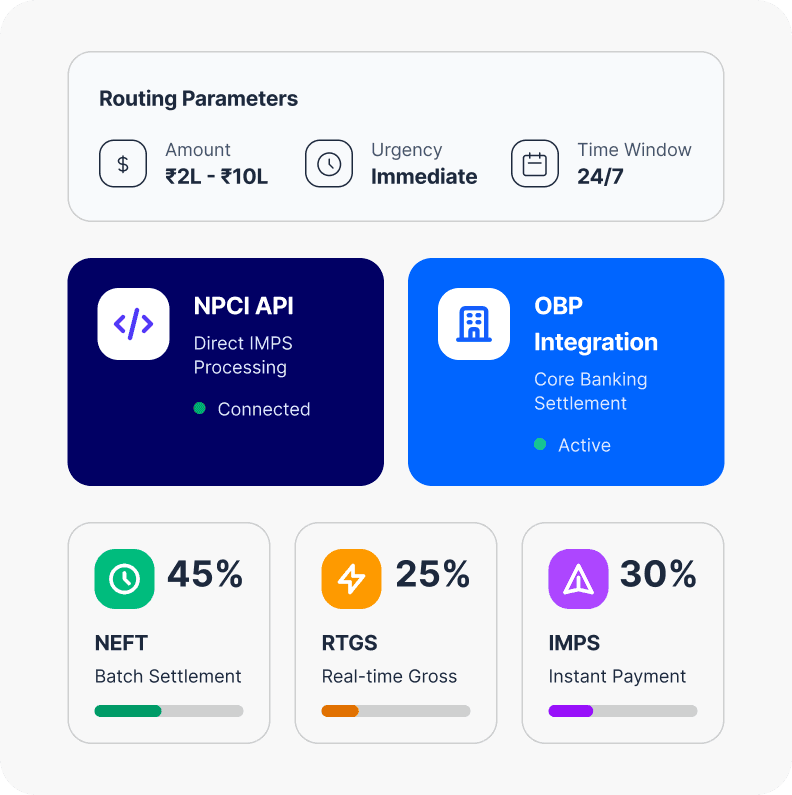
We implement all three RBI-regulated transfer modes within a single unified flow, with automatic routing to the appropriate payment rail based on transfer value, timing, and user preference.
Beneficiary Management with Quick Add
Users can add, verify, and manage beneficiaries in-line — without leaving the transfer flow. Quick-add functionality reduces the steps between intent and completed transfer for first-time payees.
Real-Time Transaction Status Tracking
Every transfer surfaces a live status from initiation through settlement. Users see exactly where their payment stands at any point, removing the uncertainty that drives unnecessary support contact.
On-Hold Transaction Visibility
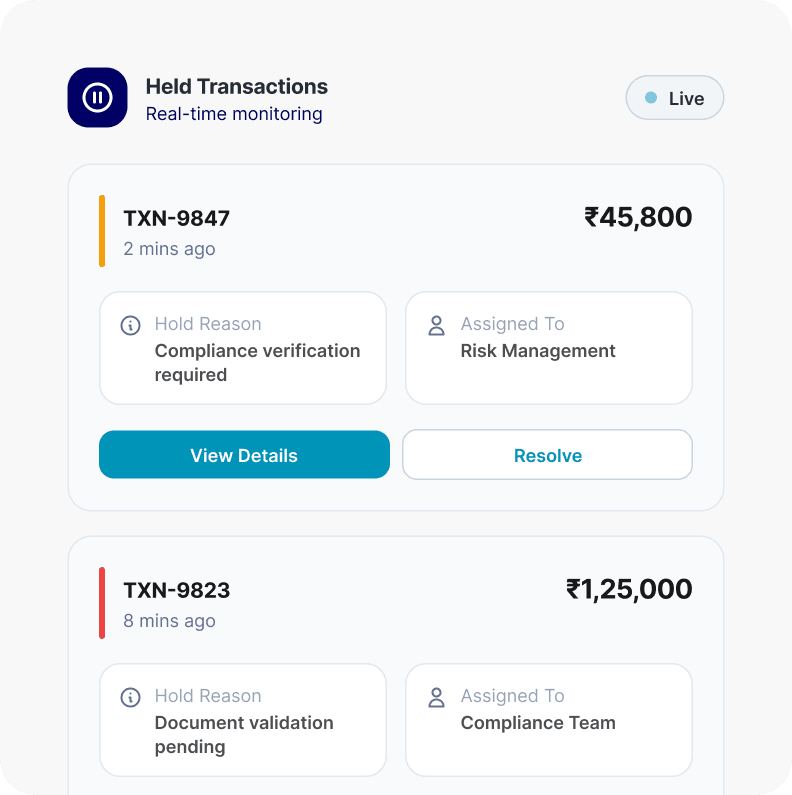
Paused or flagged transactions are displayed with a clear reason, the entity responsible for the hold, and a resolution timeline of up to 45 days — giving users the context they need without calling support.
Scheduled and Recurrig Transfers
Users can set up future-dated and recurring payments directly from the transfer interface, supporting regular obligations like rent, vendor payments, and loan EMIs without manual intervention.
Bulk Transfer Capability
We support high-volume batch payment initiation for business users, with status tracking at the individual transaction level within the bulk job — essential for payroll, supplier disbursements, and collections.
Complete Digital Transformation Services for Enterprises and Startups alike
Money Transfers and Payments Services by Engineers Who Have Delivered 1000+ Projects
Production-proven implementations with enterprise-grade architecture.
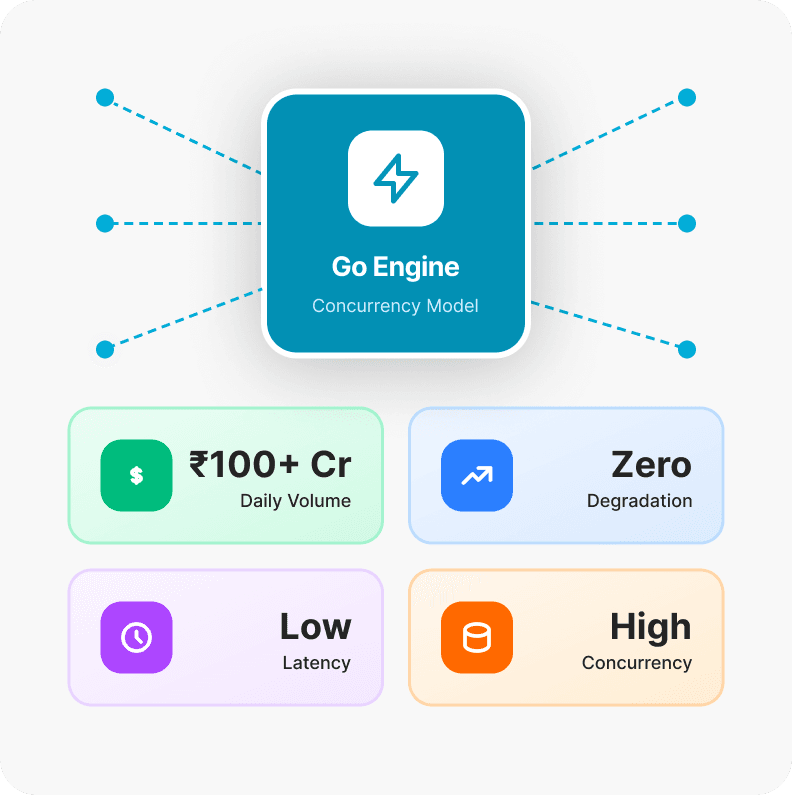
The transfer engine is built in Golang, selected specifically for its concurrency model and low-latency performance under high transaction volumes. This is what allows the system to sustain ₹100+ Cr in daily processing without degradation during peak periods.
A payment switch layer handles intelligent routing across NEFT, RTGS, and IMPS based on transfer parameters. NPCI API integration handles IMPS processing directly, while OBP integration manages core banking settlement — ensuring each transfer reaches the correct rail with accurate reconciliation.
Transactions in a held state are tracked with structured metadata — hold reason, responsible entity, and timestamp — surfaced to the user through the React Native interface in real time. This is what converts a support call trigger into a self-service resolution.
Our Latest Thinking in Money Transfers and Payments Services




Accelerate Your AI-Native Digital Banking Transformation
Speak with our digital banking experts about modernizing legacy systems, improving performance, or building a new banking platform without disrupting critical operations.
Contact us
FAQs About Our Money Transfers & Payments Service
When a transaction is placed on hold — for compliance review, beneficiary validation, or settlement timing — the system captures the hold reason and the responsible entity as structured data at the point of the hold event. This is surfaced to the user in real time within the transaction detail view. Users can see why the transfer is paused and who is responsible for releasing it, which answers the primary reason they would otherwise contact support. We have seen this reduce payment-related support call volumes by approximately 40% in production environments.
The Golang backend is designed for high-concurrency workloads. In current production deployments, the system processes millions of daily transactions while maintaining a 99%+ success rate. Load testing is part of our pre-launch validation process, benchmarked against the client's peak traffic projections before go-live.
We have production integration experience with the Oracle Banking Platform for NEFT and RTGS settlement. For other core banking systems — Finacle, Temenos, FIS — integration feasibility depends on the API surface available for payment instruction submission and status callbacks. We assess this during the discovery phase before committing to a delivery timeline.
Bulk transfer jobs are submitted as structured batches, with each constituent payment tracked individually within the job. Status is available at both the batch level and the individual transaction level, so users can identify which payments within a bulk run have settled, which are pending, and which have failed — without needing to contact support or reconcile records manually.
A greenfield money transfer module — covering NEFT, RTGS, IMPS, beneficiary management, on-hold visibility, and scheduled transfers — built on React Native with Golang backend and OBP integration, typically runs ten to fourteen weeks from architecture sign-off to production. Engagements involving migration from an existing transfer interface add a discovery and data-mapping phase of two to four weeks beforehand.
Yes. The implementation uses React Native for the shared application layer. Where platform-level access is required — specifically for secure credential storage and biometric confirmation on high-value transfers — we use native iOS and Android modules rather than relying on the cross-platform layer.
The system is handed over production-ready, benchmarked, and documented. Your team can maintain and extend it independently. We do not build on proprietary frameworks that require ongoing vendor involvement to operate. If your team wants a formal support arrangement post-launch, that is a separate conversation.