

Editor’s Note: This article was originally written by Amrit Saluja and published in November, 2025. It was revised and updated by Shivangi Agarwal in July, 2026 to include current technologies, implementation practices, industry requirements, and examples. The technical content was reviewed by Saurabh Sahu, Chief Technology Officer.
Key Takeaways
- Fraud Losses Are Rising: US consumers reported $15.9 billion in fraud losses in 2025, up roughly 25% from the previous year.
- AI Delivers Measurable ROI: Mastercard’s Decision Intelligence generated a reported 98% ROI over three years, with a 12% reduction in fraud losses and a 20% reduction in fraud alerts.
- Real-Time Detection Works: Mastercard reports an average 20% improvement in fraud detection, with transaction risk scores generated in approximately 125 milliseconds.
- Pilot Before Full Rollout: A focused 6–10 week pilot allows fintechs to measure false positives, detection rates, investigation time, compliance readiness, and potential ROI before scaling.
Can AI really solve fintech’s fraud problem? Or are we just automating our way into more expensive mistakes? The answer lies in the gap between the measurable gains delivered by AI-powered fraud detection and Block Inc.’s $80 million regulatory penalty.
Artificial intelligence is a core element of the financial industry's approach. According to the Mastercard, Decision Intelligence increases the effectiveness of the fraud detection process by 20% on average, while an economic impact assessment indicates that fraud alerts were reduced by 20% and fraud losses by 12%.
Block Inc.’s January 2025 settlement highlights that technology demonstrates an $80 million penalty stemmed from BSA/AML program violations—not the failure of an AI fraud system. It shows that fraud-detection technology must be backed by strong governance, monitoring, and regulatory controls. This is the dual reality of AI in fintech fraud detection.
AI can monitor transactions in real-time, adapt to new attack patterns, and eliminate human error at scale—all while being cost-efficient. It addresses the nightmares that keep fintech leaders awake: compliance gaps, cybersecurity threats, massive transaction volumes, and evolving customer fraud tactics.
But technology alone does not guarantee protection. The question is whether you are implementing AI correctly.
The main focus of AI in FinTech is to reduce fraud and ensure compliance while simultaneously delivering a positive ROI.
This blog aims to dissect how AI can make fraud prevention both compliant and cost-efficient, and what is the best way to implement it.
Why FinTech companies are using AI Fraud Detection
Companies like PayPal and Mastercard are implementing AI because it delivers faster, more accurate results while remaining cost-effective. AI minimizes human errors, increases operational efficiency through automation, and improves customer trust by reducing friction from unnecessary flags.
Fraud tactics evolve daily, and AI adapts just as fast. By monitoring millions of transactions in real time, it flags and blocks suspicious behavior before losses occur, turning fraud detection from reaction to prevention.
Traditional rule-based systems can not keep up with new fraud patterns. AI analyzes transaction data and behavioral patterns simultaneously, learning relationships that humans or static rules miss. The result delivered through this has fewer false positives and smoother approvals.
Operationally, AI reduces manual reviews, prioritizes high-risk alerts, and frees analysts for strategic work—improving speed and ROI. It also strengthens compliance with AML and KYC regulations through automated screening and audit-ready reporting.
Most importantly, AI learns continuously. Through anomaly detection and unsupervised models, it recognizes emerging fraud tactics in real time—staying ahead of evolving threats.
FinTechs are shifting to AI-driven fraud detection because fraud doesn’t wait anymore—it adapts. Only systems that learn in real time can keep pace with how fast money and risk now move.
 Saurabh SahuChief Technology Officer (CTO)
AI has become the core of proactive risk management, enabling FinTech to protect users, stay compliant, and maintain trust, without slowing transactions.
ROI of AI Fraud Detection: How much can you save, and earn more?
For fintechs, fraud detection is about economics. Every false flag drains time and customer patience. Every missed fraud hurts reputation.
AI is changing that equation. It is helping fintechs save millions, improve operational efficiency, and even unlock revenue that companies do not realize they were losing.
Let me break down how — and where — that ROI actually comes from.
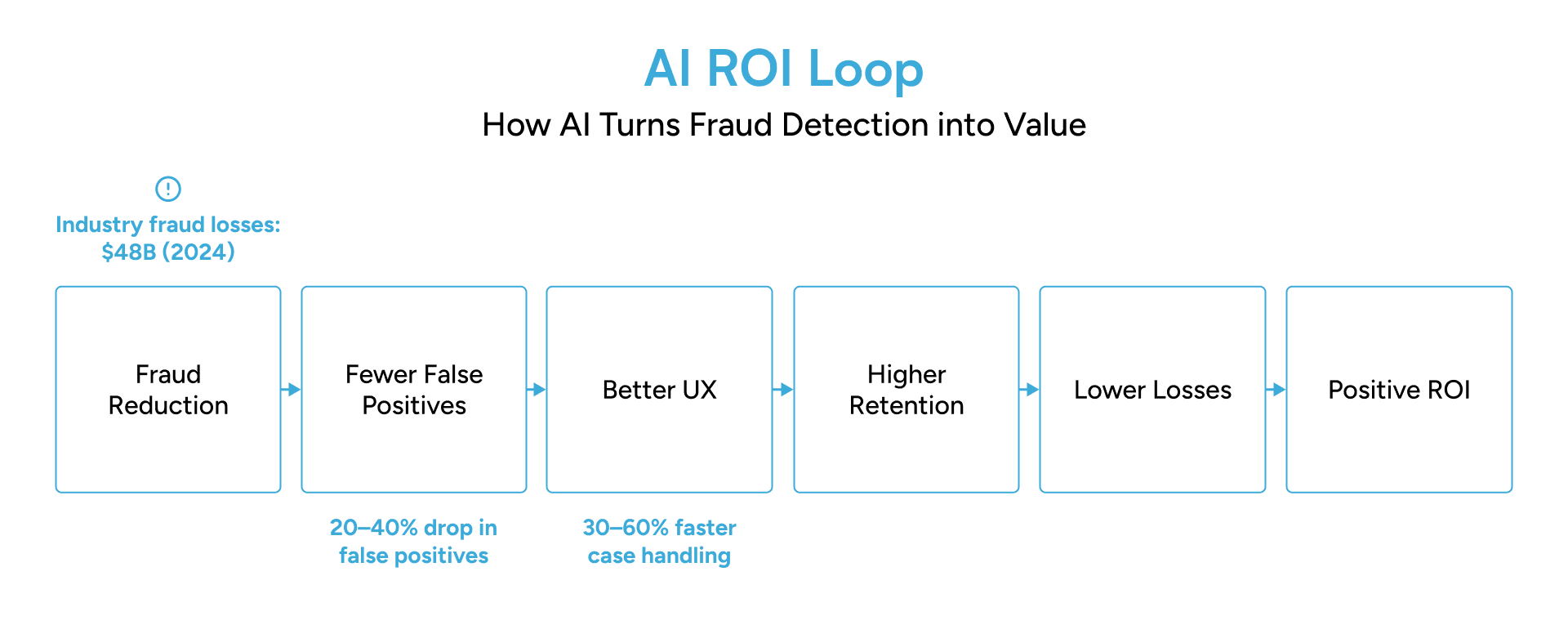
1. Fewer False Positives → Lower Operational Cost
Every false alert means another case to review and another legitimate customer delayed. AI minimizes those false alarms by learning what “normal” really looks like for each user.
In 2025, Mastercard’s Decision Intelligence system used this adaptive approach to screen over 160 billion transactions in milliseconds. This resulted in fewer false declines and smoother customer experiences — saving millions in review costs and recovering legitimate transactions that might have been wrongly blocked.
Similarly, TickPick, an e-commerce ticketing platform, reduced false declines so effectively with AI-powered risk scoring that it recovered over $3 million in legitimate sales within just three months.
When AI learns a business’s patterns, it prevents fraud and keeps genuine revenue flowing.
2. Fewer False Negatives → Reduced Fraud Losses
Every fraudulent transaction that slips through is money lost.
AI helps by analyzing transaction amounts, hundreds of hidden signals, device fingerprints, behavioral patterns, time-of-day anomalies, and even network relationships.
The company Visa stated in 2026 that their system named Visa Provisioning Intelligence which makes use of AI was 14 times more efficient in detecting token-provisioning fraud as compared to traditional token requestor scores.
This system provides real-time risk scoring while assisting issuers in distinguishing legitimate and illegitimate requests and minimizing false positives. It was estimated by Visa that $809 million worth of losses were incurred in 2025 due to token-provisioning fraud globally.
The smarter the detection, the fewer fraud losses and the more secure every transaction becomes.
3. Faster Case Handling → Greater Efficiency
By grouping similar alerts, prioritizing risky ones, and showing exactly why something looks suspicious, AI cuts down investigation time dramatically.
According to a Feedzai 2025 report, banks using AI-based triage systems saw manual review time drop by more than 50% — freeing analysts to focus on complex cases instead of repetitive checks.
At Mastercard, real-time AI decisioning allows analysts to handle thousands more transactions daily, reducing backlogs and boosting productivity without expanding headcount.
Efficiency gains like these turn fraud operations from a cost center into a competitive strength.
4. Fewer Dispute Losses → Direct Savings
Fraud ends when disputes are resolved — and that is where AI’s audit-ready transparency matters. Every AI model now logs why a decision was made, which risk signals contributed, and when human review occurred. This digital trail makes disputes faster and stronger.
In March 2026, Riskified introduced Dispute Resolve for Shopify. The feature utilizes AI to fill in dispute information via its evidence editor automatically. The technology has helped reduce the time spent preparing disputes from 30 minutes down to five minutes, allowing merchants to recover lost sales without additional work on their side.
AI prevents fraud and helps prove you did.
5. Higher Customer Trust → Long-Term Retention
Fraud protection is not visible until it fails. When customers see fewer false declines and faster approvals, trust quietly builds in the background.
TickPick’s customers, for instance, saw a dramatic drop in unnecessary declines after it switched to adaptive AI fraud detection. That not only recovered revenue but also increased repeat purchases, since users felt safer and less frustrated. Trust may be hard to quantify, but it is the most valuable ROI metric of all.
6. Lower Compliance Cost → Audit-Ready Confidence
One of the biggest misconceptions about AI is that it makes auditing harder. In fact, it does the opposite.
Modern AI models generate explainability reports, maintain version histories, and log every decision automatically, turning compliance into a continuous process instead of a yearly scramble.
When every fraud decision leaves behind a traceable explanation, compliance officers gain full visibility and peace of mind.
The ROI Equation, Simplified
When you add up the impact, the ROI of AI in fraud detection comes from both savings and prevention:
ROI = (Total Savings + Prevent Losses) / AI Investment Cost
Each of the levers, fewer false positives, fewer fraud losses, faster reviews, lower disputes, higher trust, and smoother compliance, compounds the return. Many fintechs see the investment pay for itself within months through operational savings, recovered revenue, and reduced fraud losses.
Loss Prevention to Value Creation
Fraud detection used to be about cutting risk. With AI, it has become about creating measurable value — saving costs, protecting brand trust, and even improving compliance all at once.
Risk Reduction Through AI
Legacy rules and human review can not keep up with multi-channel attacks and cross-product rings because Fraud in recent years is relational and fast. The answer to this is smarter systems: streaming ML for sub-second action, graph-based models to expose hidden networks, and explainability baked into every decision so teams — and regulators — can trust the results.
Real-time AI enables CISOs to move from reactive monitoring to proactive prevention, satisfying both internal audit and regulatory expectations. At GeekyAnts, our graph-based streaming models meet latency SLAs while keeping every decision explainable — that’s what makes AI operationally trustworthy.
Saurabh SahuChief Technology Officer (CTO)Why real-time matters
Time is of essence in payments and onboarding. Batch systems that detect fraud after many hours are too late; the money could have been moved, the dispute process has advanced, or the customer might have cancelled out of frustration. Streaming architectures using Kafka, Flink, and Spark allow for real-time updates of features and scoring of events as they happen.
Graph intelligence: finding what rules miss
Attackers hide in relationships: shared devices, circular transfers, mule clusters. Graph Neural Networks (GNNs) model these relations directly, surfacing communities and link-level anomalies that simple rule sets can not detect. Recent 2026 research shows that spatio-temporal GNNs can significantly outperform standard machine-learning baselines in detecting coordinated fraud by modelling changing relationships and transaction patterns over time.
Explainability = auditability
In regulated markets, “black box” models are a liability. Explainability tools (SHAP, counterfactuals, natural language summaries) plus strict model/version logging transform model outputs into audit evidence. Recent 2026 research reinforces that explainability is essential in regulated fraud and AML workflows, with SHAP-based attribution, evidence grounding and decision-level audit trails improving transparency, regulatory traceability and analyst confidence.
Practical architecture (what teams actually deploy)
A pragmatic production stack pairs:
1. Event ingestion (Kafka) → 2. Streaming feature store & enrichment (Flink/Spark, online feature store) → 3. Low-latency inference (model server / embedded models) → 4. Immediate policy decisions (block, challenge, allow) → 5. Deeper graph sweeps & model retraining nightly/periodically → 6. Case management & audit exports. 2025 implementations show this hybrid pattern is both performant and auditable.
Operational and compliance gains
Switching from manual/rule-only systems to an AI-first approach typically yields: reduced manual review queues, lower false positives, faster investigation times, and clear audit trails. Multiple 2025 field reports and academic studies document measurable reductions in loss and OPEX after AI adoption.
Caveats & readiness checklist
AI is powerful, but it requires: clean event streams, labeled feedback (disputes/chargebacks), governance (model registries, retraining cadence), and XAI tooling for auditors. Without these, models degrade and compliance risk rises. 2025 literature stresses governance and continuous monitoring as non-negotiable.
Move from reactive rules to proactive, auditable intelligence. With streaming ML, graph detection, and explainability, teams gain speed, visibility, and regulator-grade evidence, turning fraud defense into a measurable risk-reduction engine.

AI Fraud Detection vs Alternatives
As digital transactions scale, enterprises face a critical decision. Should they rely on rule-based systems, manual reviews, or AI-powered detection? Each approach carries distinct trade-offs in speed, accuracy, cost, and audit readiness.
Here is a comparison between Manual Reviews, Legacy systems, and AI Fraud Detection:
Dimension / Metric | Manual Reviews | Legacy Systems | AI-Powered Detection |
|---|---|---|---|
Complex Pattern Detection | Detects only what humans know; struggles with multi-layer, multi-channel fraud (e.g., synthetic identity, mule rings). Often reactive. | Detects known, predefined patterns; frequent blind spots for new tactics; rule explosion/brittleness. | Learns from data; detects unseen fraud patterns. Graph ML links entities to expose synthetic IDs and coordinated rings |
Latency and Real-Time Decisioning. | High latency (minutes to hours), depending on workload; real-time is not feasible. | Fast for simple rules (e.g., flag > $X transaction); but as rule volume grows, rule evaluation slows; sometimes leads to batching. Limited ability to scale with volume while maintaining low-latency | Built for streaming: real-time inference in milliseconds, sustaining high TPS at scale. |
False Positives and Negatives | Human reviewers may over-flag, fatigue leads to misses, and inconsistency; recall is low for subtle fraud rings. | Tends toward either high false positives (if rules are broad) or higher false negatives (if rules are too tight). Must manually maintain thresholds, rules. | Adaptive thresholds, probabilistic scoring, continuous retraining; graph ML cuts false negatives in networked fraud. |
Scalability (Data, Volume, Channels, Products) | Scaling means more human reviewers; steep human cost; often impractical to expand to new channels quickly. | Software scale but rule maintenance cost grows superlinearly; can’t easily adapt to new data types | Expands horizontally across data types, channels, and regions. Cloud-native models scale automatically with volume. |
Operational Overhead and Maintenance | Very high: hiring, training, consistency, QA of human work; subjectivity | Medium: creating, testing, deploying rules; false positive tuning; rule conflict resolution; versioning. | Initial setup high; ongoing automation lowers manual review and maintenance. |
Audit and Regulatory Compliance | Human notes—but often inconsistent; little feature traceability; audit depends on what was documented. | Rules are explicit, so it’s easy to explain when the rule is fired; but compound rules can become opaque; historically difficult to trace multiple rule interactions. | Built-in traceability: model versioning, feature importances, decision lineage; generates regulator-ready audit evidence. |
ROI Potential | Modest, incremental improvements; high cost per unit of fraud prevented | Good for known risk types; diminishing returns as attackers adapt; often high cost of maintaining rules without new gains | Cuts undetected fraud, manual load, and disputes. High ROI through automation and early pattern detection. |
Time to Deployment | Slow — hiring/training humans; policies/procedures; scaling takes months. | Faster for simple rules, but complex rule sets take time, especially when integrating new data sources or embedding them in real-time pipelines. | 6–10 week pilot possible; once live, retraining and iteration are near-continuous. |
Resilience to Fraud | Low — once a fraudster learns the process or human patterns, they can evade. | Moderate — rules get tweaked after attacks, but attackers can find rule holes; rule latency in response is high. | Learns attacker behavior; ensemble + anomaly models detect unseen tactics and hidden links |
Data Requirements and Feature Richness | Relies on whatever data humans see; often limited to transaction logs, simple flags, and little feature engineering. | Can use features that are easy to define (transaction size, time, geography), but scaling feature richness is hard; limited ability for relational or derived features. | Uses structured and behavioral data, embeddings, and feedback loops for richer signal extraction. |
Cost Predictability | Ongoing high human cost, unpredictable scaling costs | Software licensing / rule-maintenance costs are more predictable, but can balloon as the rule base grows; hidden costs in false-positives, customer churn. | Higher upfront cost; lower marginal cost per transaction. Predictable at scale. |
Integration with Broader Risk & Compliance Ecosystem | Often siloed; disconnected from KYC/AML risk scoring, regulatory reporting, and case management. | Moderate: rule outputs may feed into reporting, but less integration with graph network analysis, policy enforcement, and audit trail tooling | Natively connects with AML/KYC, case tools, and reporting systems for unified compliance. |
Where manual and rule-based methods struggle to keep pace with fraud velocity, AI systems offer real-time adaptability, graph-driven detection, and auditable decision-making that satisfies both compliance officers and CFOs.
Also, unlike legacy alternatives that react after losses, AI prevention frameworks reduce risk exposure proactively — aligning with enterprise SLAs, minimizing latency, and delivering measurable ROI within the first deployment cycle.
How AI Fraud Detection Strengthens Compliance Across Financial Regulations
2026 is the year regulators start auditing AI itself. Fintechs that use explainable and governed models stay ahead — both in compliance and trust. Audit readiness with XAI is continuous. Our teams ensure every model decision is regulator-traceable.
Saurabh SahuChief Technology Officer (CTO)AI is helping fintechs stay compliant in a landscape where every transaction, identity, and dataset is under scrutiny. From anti–money laundering to data privacy and audit readiness, AI makes compliance faster, more reliable, and more transparent.
1. AML (Anti–Money Laundering)
Prevent, detect, and report money laundering or suspicious transactions.
AI enhances AML programs by connecting dots that manual systems miss:
- Pattern recognition: Detects unusual fund flows, structuring, or layering behaviors across accounts and entities.
- Entity linking: ML models map customer relationships across devices, geographies, and transactions — surfacing hidden networks of suspicious activity.
- Reduced false positives: Smarter anomaly detection lowers noise, ensuring investigators focus on genuine risks.
- Real-time monitoring: AI systems flag high-risk transfers instantly for Suspicious Activity Report (SAR) filings.
Global players like Feedzai, Featurespace, and ComplyAdvantage are already using AI to reduce false alerts by up to 70%, improving both efficiency and regulatory reporting accuracy.
2. KYC (Know Your Customer)
Verify customer identity to prevent fraud and ensure legal onboarding.
- Automated ID verification: AI compares IDs, selfies, and biometric data for instant validation.
- Document fraud detection: Deep learning detects forgeries, tampering, or reused IDs.- Continuous
- KYC: AI triggers re-verification based on behavioral anomalies, not just on onboarding.
Neo-banks use AI-powered onboarding to approve users in minutes while maintaining compliance with FATF KYC norms.
3. PCI-DSS (Payment Card Industry Data Security Standard)
Secure handling of cardholder data to prevent breaches.
- AI threat detection: Monitors payment environments for unusual access or data-exfiltration patterns.
- Anomaly-based intrusion detection: ML models identify deviations in network traffic or endpoint behavior.
- Predictive compliance: AI identifies systems drifting from compliance posture (e.g., outdated encryption).
Card processors use AI-driven security analytics to detect compromised terminals before mass card data theft.
4. GDPR (General Data Protection Regulation – EU)
Protects personal data and the privacy of individuals.
- Automated data mapping: AI identifies personal data across systems to ensure lawful processing.
- Anonymization & minimization: AI automatically redacts or pseudonymizes sensitive info before model training.
- Breach detection: AI tools monitor unusual data access and prevent privacy violations.
Fintechs use NLP models to locate unprotected PII across datasets to ensure “right to be forgotten” compliance.
5. OCC / FINRA (US Office of the Comptroller of the Currency / Financial Industry Regulatory Authority)
Regulate risk management, data integrity, and operational resilience in financial institutions.
- Explainable AI: Provides audit trails showing why a decision (e.g., transaction blocked) was made.
- Model governance: AI lifecycle tracking ensures models meet OCC’s “sound model risk management” (MRM) standards.
- Automated audit readiness: AI systems maintain detailed logs for FINRA examinations and risk-based supervision.
Regulatory Area | How AI Tools Now Enable Audit Readiness | Compliance through Audit-Ready AI Systems | Example Tools / Layers |
|---|---|---|---|
Model Governance (OCC, FINRA | Every model is logged with version history, input sources, performance metrics, and bias checks. | Model Cards (summaries of how, when, and why a model was built) | Regulators can audit every AI decision and its evolution — no black box. |
Explainability & Decision Transparency (GDPR, OCC | AI generates human-readable rationales behind automated decisions. | Explainability Reports using SHAP, LIME, or IBM Watson OpenScale | Compliance officers can trace why a transaction was flagged — meeting “right to explanation” and OCC interpretability standards |
Data Protection & Privacy (GDPR, PCI-DSS) | Sensitive data is tracked, anonymized, and monitored continuously. | Cisco Secure AI Infrastructure + Zia Dashboards | AI systems run on trusted, encrypted networks with visual oversight of every data flow — reducing breach and audit risk. |
AML / KYC Monitoring | Real-time anomaly detection linked to explainable alert workflows. | Zia Dashboards / AI Ops layers | Every AML alert is timestamped, explainable, and traceable from detection to resolution — ensuring full SAR documentation. |
Operational Risk Management (OCC / Basel III) | AI monitors model drift, data lineage, and compliance gaps | AI Ops & Compliance Dashboards | Compliance teams see emerging risks in real time instead of post-audit discovery. |
How Fintechs Can Implement AI in Fraud Detection
Building production-grade AI fraud detection is a carefully orchestrated journey through compliance and operational validation. Most fintech companies fail at this because they skip critical steps around stakeholder alignment, audit readiness, and proper validation.
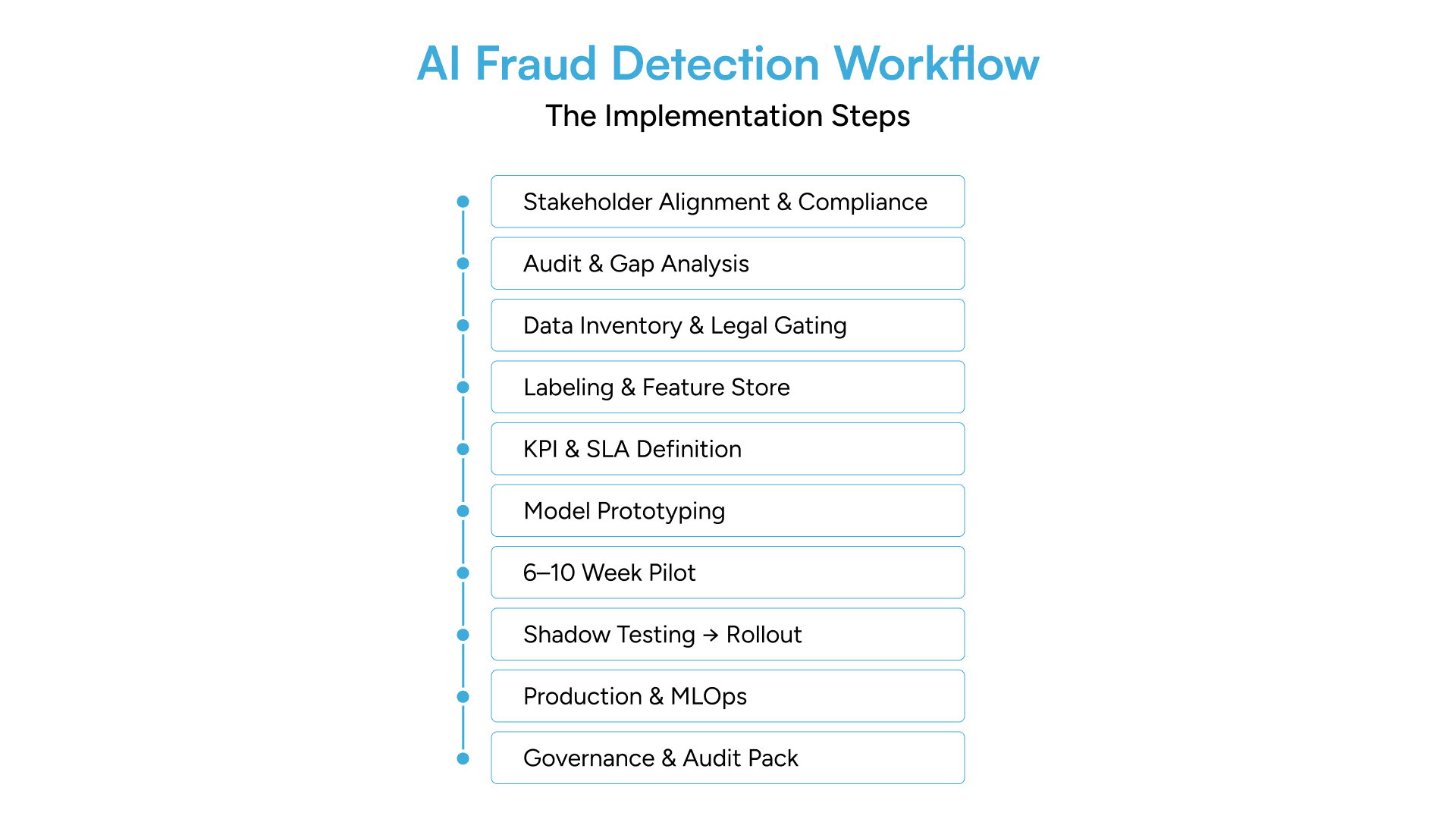
The following walks you through the complete process, with one critical recommendation: start with a 6–10 week pilot before scaling to full production. This pilot phase is your insurance policy against costly failures and the foundation for demonstrating ROI to leadership.
Step 1: Align Stakeholders & Get Compliance Sign-Off (Week 0)
Before using data, align leadership and obtain CISO/Compliance approval for model hosting and data governance (CIA: Confidentiality, Integrity, Availability).
Actions: Create a short charter defining scope, KPIs, and timeline; form a RACI with Fraud, Data, Compliance, Legal, and Product leads.
Deliverable: Signed CIA checklist and project charter.
Step 2: Audit Current Fraud Detection (Weeks 1–3)
Assess current systems to identify leaks, inefficiencies, and blind spots.
Actions: Review alert volumes, false rates, chargebacks, and manual review metrics; map under-monitored data or channels.
Deliverable: Fraud detection gap report ranked by financial impact.
Step 3: Data Inventory & Privacy Gating (Weeks 2–6)
Ensure all data sources meet legal, security, and retention standards.
Actions: Catalog KYC, transaction, and device data; secure DPO/legal approval for PII, retention, and cross-border policies.
Deliverable: Data lineage map, data contract, and privacy sign-off.
Step 4: Clean, Label & Build Feature Store (Weeks 4–8)
Use confirmed fraud outcomes for supervised learning and build feature consistency.
Actions: Define label rules, handle class imbalance, and create reusable features (velocity, behavior, KYC, device).
Deliverable: Labeled datasets + feature catalog.
Step 5: Define KPIs & SLAs (Concurrent)
Establish measurable targets for detection accuracy and efficiency.
Actions: Track false positive/negative rates, chargeback loss, case time, and model drift.
Deliverable: KPI dashboard wireframe with baseline benchmarks (e.g., -40% FP, -30% handling time).
Step 6: Build Baseline Rules & Prototype Models (Weeks 2–6)
Combine rule engines with ML models for layered detection.
Actions: Train baseline models (logistic regression, boosting, anomaly detection); document via Model Cards and SHAP explainability.
Deliverable: Baseline models + model cards + explainability samples.
Step 7: Run a 6–10 Week Pilot
Validate models in a safe test environment before live rollout.
Actions: Measure data stability, model drift, and dispute loss reduction; verify explainability and compliance posture.
Deliverable: Pilot report with FP/FN rates, ROI metrics, and risk assessment.
Step 8: Shadow Testing → Staged Rollout → A/B Testing (Weeks 4–12)
Move from observation to limited live deployment.
Actions: Run models in shadow mode, test partial traffic, and compare KPIs against control. Keep analysts in the loop.
Deliverable: Rollout report with conversion and acceptance metrics.
Step 9: Production Deployment & MLOps (Ongoing)
Operationalize models under version control and continuous monitoring.
Actions: Enable CI/CD, inference logging, rollback, and drift detection. Maintain audit-ready decision logs (features, model version, timestamps).
Deliverable: Production runbook and retraining cadence.
Step 10: Audit Pack, Governance & Partner Support
Ensure traceability and regulatory readiness.
Actions: Compile model cards, explainability reports, decision logs, bias checks, and SOC2/PCI evidence.
Engage expert partners early for labeling, governance tooling, and ROI modeling.
Deliverable: Complete audit pack + compliance officer sign-off.
When and Why to Bring in a Partner for AI Fraud Detection:
Engage a partner early to accelerate labeling, provide validated model governance tooling (including explainability, model registry, and audit export), and support ROI modeling. Partners should deliver audit-ready artifacts and references showing prevented loss or efficiency gains. This support is critical for ensuring both audit readiness and demonstrable ROI.
Deliverable: Complete audit pack, partner ROI report, compliance officer sign-off
The companies that win treat fraud detection as a strategic capability backed by rigorous processes. Follow this roadmap, and you will be one of them.
Why Choose GeekyAnts for AI Fraud Detection in Fintech Apps?
Winning at fraud prevention today is not only about model quality, but it is also tied to pipeline reliability and ROI. Our VO4 BPA stack brings fraud ML, XAI, and case tooling together so you run a transparent, auditable program from pilot to production in weeks.
Saurabh SahuChief Technology Officer (CTO)At GeekyAnts, we bring together AI innovation and fintech expertise, helping financial products transition from reactive fraud control to real-time, audit-ready risk intelligence.
We have partnered with leading fintechs like PayPenny, building scalable, compliant, and explainable fraud-detection systems that power safer cross-border transactions and instant trust with regulators and customers alike.
Here is what makes us the preferred AI partner for fintech risk teams:
- Enterprise-grade VO4 BPA Stack: A unified framework combining fraud ML, graph-based detection, XAI, and case management tooling, designed for end-to-end visibility and regulator-friendly traceability.
- 6–10 Week Pilot-to-Production Model: From data handshake to measurable ROI, our engagements are engineered for speed. We deliver working pilots in weeks — not quarters — showing real impact on false positives, detection accuracy, and manual review effort.
- Audit-First Engineering: Every decision, feature, and model version is traceable. Our pipelines generate verifiable audit logs that satisfy compliance reviews and internal risk governance with ease.
- Proven Results with PayPenny: We helped PayPenny implement a streaming fraud detection layer that monitors cross-border money transfers in real time, integrates with their existing KYC stack, and achieves sub-second anomaly detection — all while maintaining full audit readiness.
- Scalable & Compliant by Design: Whether it is AML screening, account takeover prevention, or transaction monitoring, our AI systems scale seamlessly across data sources, products, and jurisdictions.
- Fintech DNA: With deep experience across digital banking, lending, and payments, we design fraud solutions that understand both financial logic and regulatory nuance.
Next Step:
Share your anonymized fraud data → run a pilot → and watch measurable ROI unfold within weeks.
Conclusion
AI fraud detection reduces risk, cuts operational costs. It also improves compliance posture when built with streaming, graph ML, and explainability at the core. For enterprise stakeholders: choose an audit-ready, scalable, ROI-driven partner that proves value fast and keeps evidence ready for auditors and regulators. Expect pilot evidence in 6–10 weeks and measurable reductions in losses and manual overhead.
Future trends & innovation might include the wider use of dynamic graph neural nets to catch cross-product rings, as it improves streaming transformer models for sub-second decisions, and tighter collaboration between regulators and firms on AI testing sandboxes to validate approaches.
GeekyAnts is already moving in this direction. Its multi-agent fraud detection architecture combines layered risk scoring, real-time decisioning and explainable outputs, returning decisions in under 200 milliseconds while maintaining a clear audit trail. Explore GeekyAnts’ multi-agent fraud detection system
Research & Resources:
- https://www.ibm.com/think/topics/ai-fraud-detection-in-banking
- https://thedataexperts.us/insights/ai-investment-roi-analysis-2025
- https://arxiv.org/abs/2504.03750
- https://arxiv.org/abs/2509.19032
- https://www.ainvest.com/news/ai-driven-fraud-detection-q2-holdings-redefines-risk-management-roi-fintech-2509
- https://www.feedzai.com/pressrelease/ai-fraud-trends-2025/
- https://www.ijfmr.com/papers/2025/4/52236.pdf
- https://www.researchgate.net/publication/392529228_Explainable_AI_XAI_in_Financial_Fraud_Detection_Systems
- https://www.researchgate.net/publication/394414635_Graph_Neural_Networks_for_Fraud_Detection_in_Complex_Financial_Transaction_Networks