

Editor's Note: This article was originally written by Amrit Saluja and published in June, 2025. It was revised and updated by Shivangi Agarwal in July, 2026 to include recent technology updates, industry practices, industry requirements, and examples. The technical content was reviewed by Pratik Gautam, Lead Account Manager.
Key Takeaways
- AI Spending Surge: Worldwide AI spending is forecast to reach $2.59 trillion in 2026, reflecting 47% year-on-year growth.
- Wide Cost Range: An AI proof of concept may cost $10,000–$100,000, while MVPs typically range from $50,000–$150,000 and complex enterprise builds can exceed $500,000.
- Data Is a Major Cost Driver: Data preparation and engineering can consume 15%–30% of the total budget, especially when large datasets require cleaning, labelling, or enrichment.
- Model Complexity Changes the Budget: AI chatbot projects may begin around $10,000, while advanced generative AI, computer vision, and predictive platforms can reach $300,000–$500,000+.
- Regulated Apps Cost More: Finance applications may range from $100,000–$800,000+, while compliance-heavy healthcare AI products can cost $80,000–$600,000+.
- Ongoing Costs Matter: Cloud hosting can account for 20%–30% of the budget, with mid-sized AI apps spending approximately $5,000–$20,000 per month on infrastructure and processing.
- Regional Rates Vary Sharply: Development rates range from around $30 per hour in Asia to $145 per hour in the US, making team location and delivery model major cost factors.
- Maintenance Must Be Budgeted Early: Annual maintenance commonly equals 15%–25% of the original build cost and may reach 50% during the first year for rapidly evolving products.
Introduction
In 2026, AI app development costs in the United States is powering a wave of transformative growth and becoming an active business priority. Worldwide AI spending is forecast to reach $2.59 trillion in 2026, representing 47% year-on-year growth. The broader artificial intelligence industry is growing even faster, from $371.71 billion in 2025 to $2.4 trillion by 2032, shaped by a 30.6% CAGR and accelerating U.S. investment.
On the consumer side, the ChatGPT app crossed one billion monthly active users in May 2026, showing that AI-powered apps have moved from early experimentation into everyday use.
Nevertheless, building an AI-based solution is far from being a simple business investment decision. This depends on the range of the product, its model complexity, data preparation, integration needs, security requirements, and more. An AI MVP might be used to prove a single application case, whereas the AI SaaS product could require all of the above and much more.
The smartest U.S. companies build lean. They launch MVPs, rely on open-source AI frameworks, choose cloud-native infrastructure, and partner with domain-focused teams. Because today, AI is infrastructure—and the businesses that get that are already moving.
The smartest AI apps feel invisible—fast, responsive, and quietly powerful. Building them demands deep alignment between data, design, and delivery.
 Sanket SahuCo-founder
Why It Is Still the Right Time to Invest in AI- Integrated App Development
The United States continues to lead the global AI revolution. According to a report by Stanford, in 2025, US companies account for $285.9 billion—23.1 times greater than China’s $12.4 billion. AI adoption has passed its tipping point, and the US is setting the pace.
By 2034, it will reach $221.9 billion. The broader AI market follows an even steeper curve—$375.93 billion in 2026, scaling to $2.48 trillion by 2034, at a CAGR of 26.60%. Now the growth compounds.
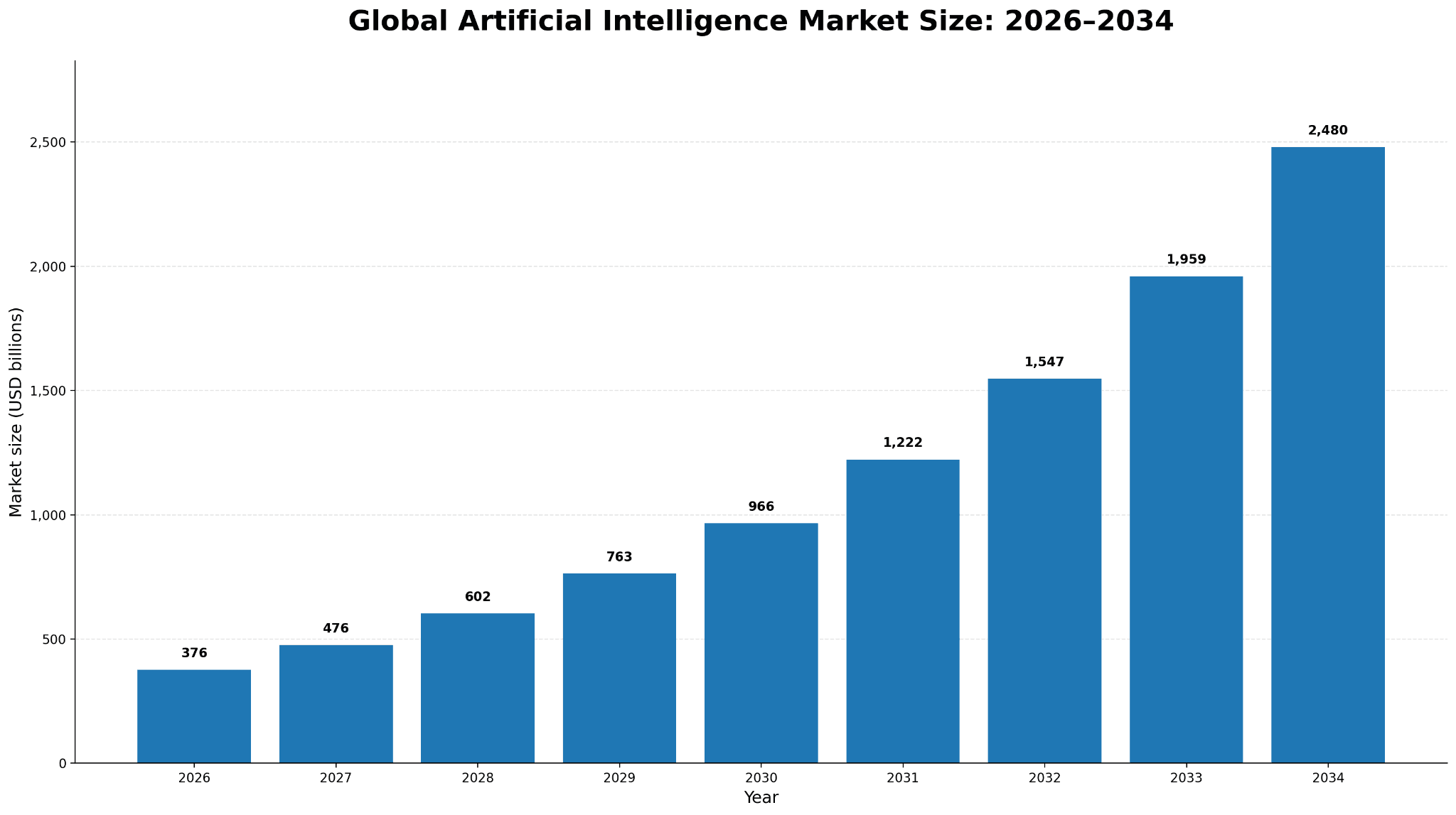
Note: Fortune Business Insights directly reports a market size of $375.93 billion in 2026, a projected value of $2.48 trillion in 2034 and a CAGR of 26.60%. The figures shown for 2027–2033 are calculated compound-growth estimates, as the source does not publish individual figures for those years.
Organisational AI adoption rose to 88% in 2025. At the same time, generative AI app downloads doubled year on year to reach 3.8 billion, while in-app purchase revenue nearly tripled to exceed $5 billion.
The shift is driven by what AI apps do differently. They adapt to user behavior, personalize experiences, and respond in real time. This solves a core problem: 71% of users abandon apps that feel generic.
In the first half of 2026 alone, consumer spending through in-app purchases on generative AI-powered apps is expected to exceed $4 billion, representing 36% growth over the previous six months- PR Newswire’s Sensor tower State of AI 2026 Report.
The impact is measurable. Productivity growth is 40% higher among companies most exposed to AI than among those least exposed. AI replaces guesswork with precision. It turns days of work into seconds. It strengthens security through behavioural biometrics and adaptive risk detection.
Enterprise-grade AI tools are already shaping delivery. Generative AI creates content. Edge AI improves performance on-device. Explainable AI makes adoption possible in regulated sectors. AI-assisted coding slashes dev cycles and cost. No-code platforms bring rapid iteration.
Industry leaders—Amazon, IBM, JPMorgan, DHL—are scaling faster with AI at the core. Delay is no longer safe. Global corporate AI investment reached $581.7 billion in 2025, increasing by 130% from the previous year, while private investment rose by 127.5%.
The standard for building, optimizing, and scaling digital products has shifted. AI is not next. It is now.
Factors influencing the AI app development cost in 2026
In a world where every business is chasing digital transformation, understanding the variables affecting AI app development costs is key. Here’s how you can strategically budget and navigate your AI journey.
1. Project Scope Defines Cost Structure
AI app development costs scale significantly based on project complexity and purpose. A Proof of Concept (PoC) serves as a swift, economical approach to validate ideas and assess technical feasibility without large upfront investments.
Cost escalates sharply as projects move from validation to full implementation:
- Proof of Concept (PoC): Early-stage validation within weeks costs between $10,000 and $100,000. Ideal for preliminary feasibility checks without heavy financial exposure.
- Minimum Viable Product (MVP): Market-ready apps built in 3-6 months average $50,000 to $150,000. MVPs enable early market entry, user feedback, and risk mitigation.
- Full-Scale Implementation: Robust, enterprise-grade AI deployments typically exceed $100,000, often surpassing $500,000 for complex integrations lasting 6-12 months or longer.
2. Development Stages Dictate Budget Allocation
Every AI app goes through a lifecycle—from initial research and precise data preparation to rigorous model training, seamless integration, and relentless testing. Allocating the budget smartly across these stages ensures smoother development and avoids unexpected expenses later in your project journey.
- Discovery & Planning: Commands 5-15% of total spend ($5,000–$15,000) for initial market analysis, strategy formation, and PoC testing.
- Data Preparation & Engineering: Crucial data curation and structuring absorb 15-30% of costs ($5,000–$100,000+), significantly impacting AI accuracy.
- Model Development & Training: Core AI training phase claims 20-40% of budgets due to computational demands, especially with advanced models like GPT-4, which may require thousands of GPU hours.
- Integration & Deployment: Connecting models to existing infrastructures consumes 10-20% ($2,000–$4,000), essential for smooth, functional rollouts.
- Testing & QA: Rigorous validation and security audits account for 10-15% ($8,000–$50,000+), critical for reliability and performance assurance.
3. AI Solution Complexity Drives Price Variability
Different AI solutions come with varying levels of complexity and cost. From simple chatbots that handle FAQs efficiently to highly sophisticated recommendation engines, predictive analytics, and advanced Generative AI applications, costs scale with functionality, data complexity, and the power needed to run your solution.
- AI Chatbots (NLP & GenAI): Chat assistants range from $10,000 for rule-based bots to over $50,000 for sophisticated conversational AI using large language models.
- Recommendation Engines: Solutions targeting retail or media personalization average between $50,000 and $150,000+, reflecting extensive data analysis needs.
- Predictive Analytics Platforms: High-performance forecasting tools deployed in finance or logistics range between $60,000 and $300,000+, heavily dependent on quality data.
- Computer Vision Applications: Image processing and object recognition solutions cost from $80,000 up to $400,000+ due to complex modeling requirements.
- Custom NLP Solutions: Tailored language processing apps such as sentiment analysis and entity recognition typically run $100,000 to $300,000+, reflecting algorithmic complexity.
- Generative AI Platforms: Advanced generative applications generating text, code, or images command premium pricing from $50,000 (basic MVP) to $500,000+ for sophisticated enterprise solutions.
4. Industry Regulations Inflate Development Costs
Industries have unique regulatory landscapes. Navigating sector-specific regulations and the sensitivity of data considerably impacts AI development expenses.
Industry-specific regulations and data sensitivity significantly elevate project budgets:
- Healthcare AI: Compliance-intensive solutions, governed by stringent HIPAA regulations and clinical accuracy, typically cost $80,000–$600,000+.
- Finance Applications: High-security standards and rigorous regulatory scrutiny push costs from $100,000 to $800,000+.
- Retail & E-commerce: Personalization engines, dynamic pricing tools, and inventory management AI range between $50,000 and $400,000+.
- Manufacturing Sector: IoT integration, predictive maintenance, and quality-control computer vision systems typically span $60,000–$500,000+.
Strategically budgeting for AI apps demands clear insight into these cost drivers, enabling informed decisions that maximize return and competitive advantage in an AI-centric future.
Strategies for Optimizing AI App Development Costs
Building AI applications demands capital discipline without sacrificing product excellence. The following strategies balance financial efficiency with long-term scalability.
1. Start with an MVP, Not the Full Stack
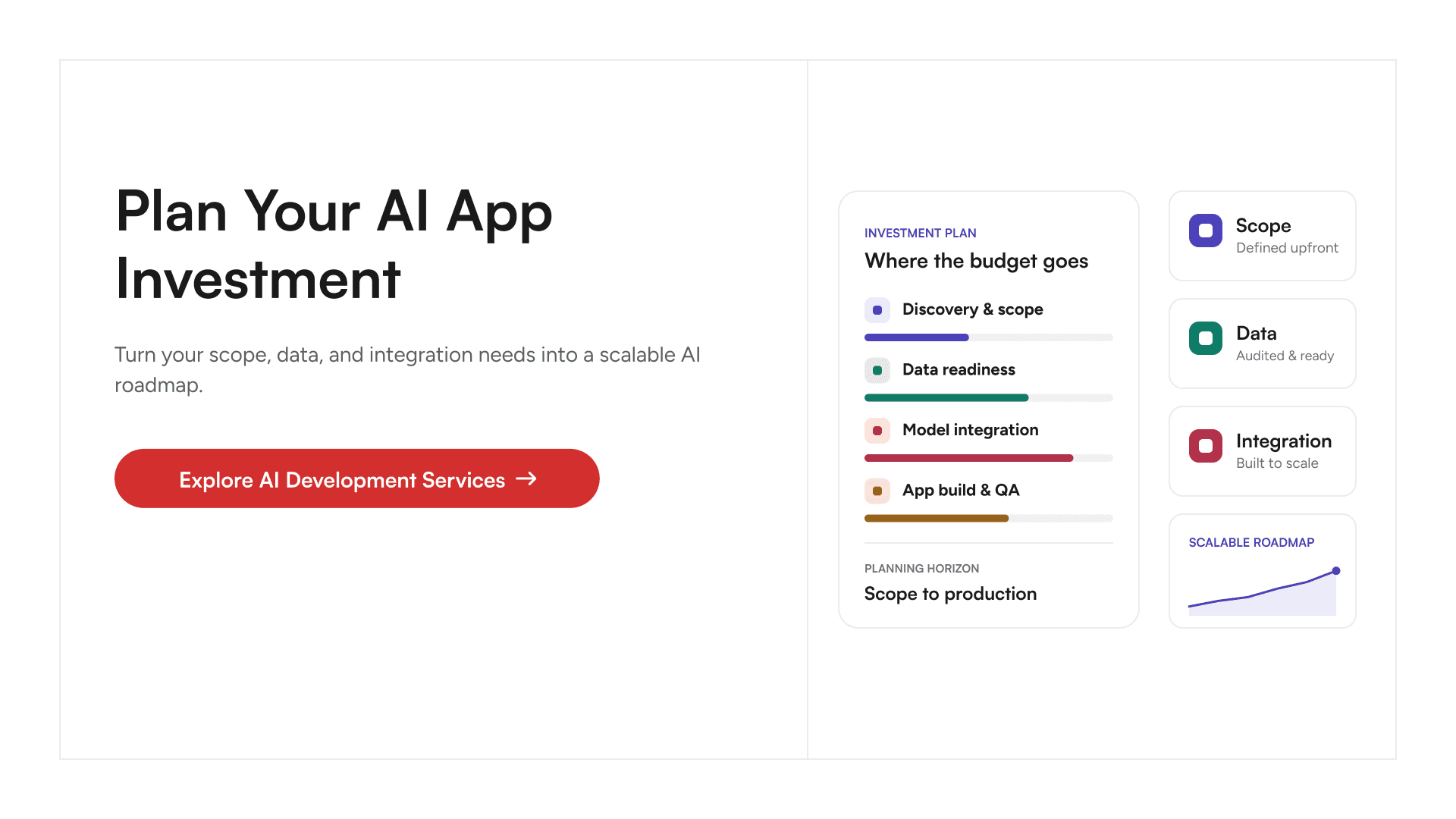
Build what matters first. A Minimum Viable Product focuses on core AI features. It ships fast, collects real-world data, and proves value early. Feedback loops reveal model gaps and user needs before deeper investment. This avoids overbuilding and reduces the risk of costly rebuilds later.
2. Use Pre-Trained Models and Open-Source Tools
Do not reinvent what already works. Frameworks like TensorFlow, PyTorch, and Scikit-learn offer tested architectures and active community support. Pre-trained models reduce development time and cost. Instead of training from scratch, fine-tune to fit the problem. This shifts focus from research to results.
3. Shift Infrastructure to the Cloud
AI needs compute power, but not hardware headaches. Cloud platforms like AWS, Google Cloud, and Azure offer on-demand AI services, elastic scaling, and usage-based pricing. No upfront infrastructure costs. No delays. Cloud platforms provide GPUs, security, and ML pipelines ready to deploy.
4. Outsource Strategically and Build in Sprints
Outsourcing to AI-focused teams educes overhead and accelerates output. Combine this with Agile sprints—short cycles, clear goals, and fast feedback. Teams stay lean, focused, and aligned with changing priorities. Agile prevents waste. Outsourcing adds speed and expertise.
These strategies turn AI app development from a capital-heavy challenge into a lean, iterative process. The goal is to cut noise. Build what proves value. Use what already exists. Scale with control.
Must-Have Features for Next-Gen AI Mobile Apps
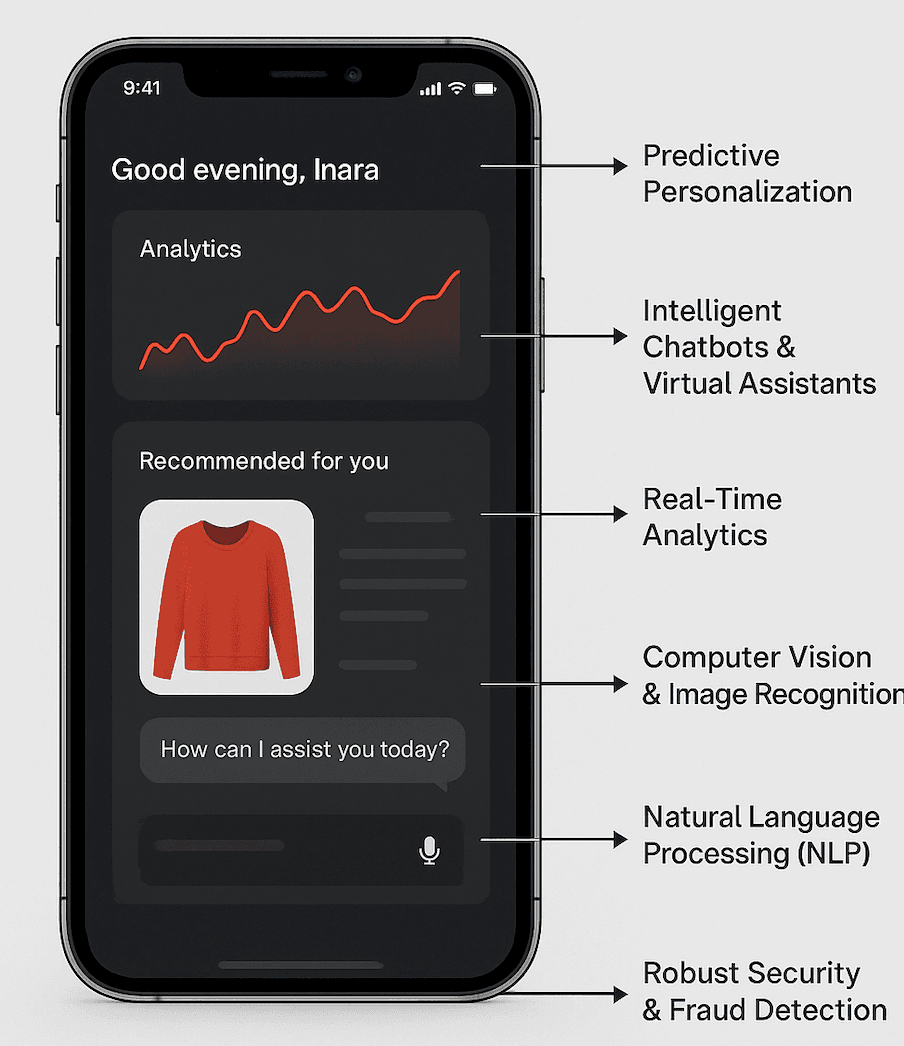
Unlock next-level business impact and captivate your users by powering your mobile apps with strategically integrated AI. Elevating your mobile app with cutting-edge AI features is a strategic necessity for market dominance.
1. Predictive Personalization:
Anticipate user preferences with data-driven recommendations, boosting engagement and retention by providing tailored interactions at every touchpoint.
2. Intelligent Chatbots & Virtual Assistants:
Deploy advanced conversational AI capable of human-like dialogue, handling complex queries seamlessly, and scaling customer support efficiently.
3. Real-Time Analytics:
Leverage instant, actionable insights through predictive analytics to drive informed business decisions, optimize user experiences, and quickly pivot strategies.
4. Computer Vision & Image Recognition:
Enhance user interactivity by integrating accurate visual search capabilities, facial recognition authentication, and immersive augmented reality experiences.
5. Natural Language Processing (NLP):
Enable apps to accurately interpret human language nuances, powering functionalities such as sentiment analysis, voice-driven commands, and context-aware interactions.
6. Robust Security & Fraud Detection:
Implement AI-driven anomaly detection and biometric security features to proactively safeguard sensitive data, building trust through superior protection.
Integrating these sophisticated AI features positions your app ahead of the competition, translating technology into measurable business success.
The Edge of AI: How AI Projects Surpass Traditional Software?
Traditional software follows rules. AI learns from data. That core difference reshapes how software is built, how it performs, and the value it delivers.
AI projects adapt in real time. Instead of running on fixed logic, they evolve through continuous training. Each data input improves prediction, accuracy, and personalization. The system gets better, not outdated. This makes AI ideal for dynamic environments where user behavior, market trends, or system complexity change frequently.
The development lifecycle also changes. AI depends on structured data pipelines, ongoing model monitoring, and iterative improvements, not fixed release dates. Traditional software stops at deployment. AI improves with every use.
AI enables features that traditional systems cannot offer. Natural language understanding, recommendation engines, generative content, and predictive analytics are built into the core, not added as modules. This supports personalization, retention, and automation at scale.
Cost efficiency improves, too. AI reduces manual effort, cuts labor costs by up to 20%, and increases productivity by 30%. Business models shift from static licenses to AI-as-a-Service, offering continuous updates without rebuilding infrastructure.
AI delivers scalable, intelligent operations. It handles tasks in minutes that once took days, without adding headcount. It reallocates resources, reduces waste, and boosts margins.
Security is also stronger. AI identifies fraud in real time and uses behavioral biometrics to spot threats that traditional systems miss. Risk analysis becomes proactive, not reactive.
App Development Trends 2026: How Emerging Tech Will Reshape Costs
Building the app is only half the battle. Emerging tech introduces silent cost drivers that scale fast and hit margins hard. Here is what adds up.
1. AI & ML Learning
AI demands high-performance backends. Cloud hosting alone can take 20–30% of your budget. Mid-sized apps spend $5,000 to $20,000 monthly on AI processing, data pipelines, and growth. Wrong architecture causes runaway cloud bills.
The GeekyAnts guide to designing workflows for enterprises with managed agents provides more information on this topic.
2. Blockchain & Decentralized Apps
Blockchain brings layers of cost—$40,000 to over $1 millio, depending on scope. Smart contracts, tokenization, and frequent audits push budgets up. Each audit costs $1,500 to $6,000. Public chain gas fees are permanent and unpredictable..
3. Real-time features
Chat, video, and live sync demand real-time databases and compute-heavy infrastructure. As users grow, cloud and storage costs spike. Without clear scalability plans, these features quickly become budget risks.
4. Data Security & Compliance
Handling sensitive data means meeting high compliance standards. Penetration testing costs $20,000–$30,000. Annual audits in finance or healthcare can exceed $500,000. Ignoring GDPR or HIPAA risks multimillion-dollar fines. Clean, labeled data—essential for AI—consumes 20–40% of budgets. Inadequate data leads to biased models, costly rework, and project derailment.
5. Wearables & IoT
IoT apps need seamless hardware integration, device sync, and custom backend logic. Cost: $50,000 to $500,000+, driven by security, real-time performance, and device complexity.
The GeekyAnts guide to integrating AI with wearable healthcare apps explains the additional architecture, compliance and return-on-investment considerations involved in wearable products.
Cost Breakdown by Development Phase
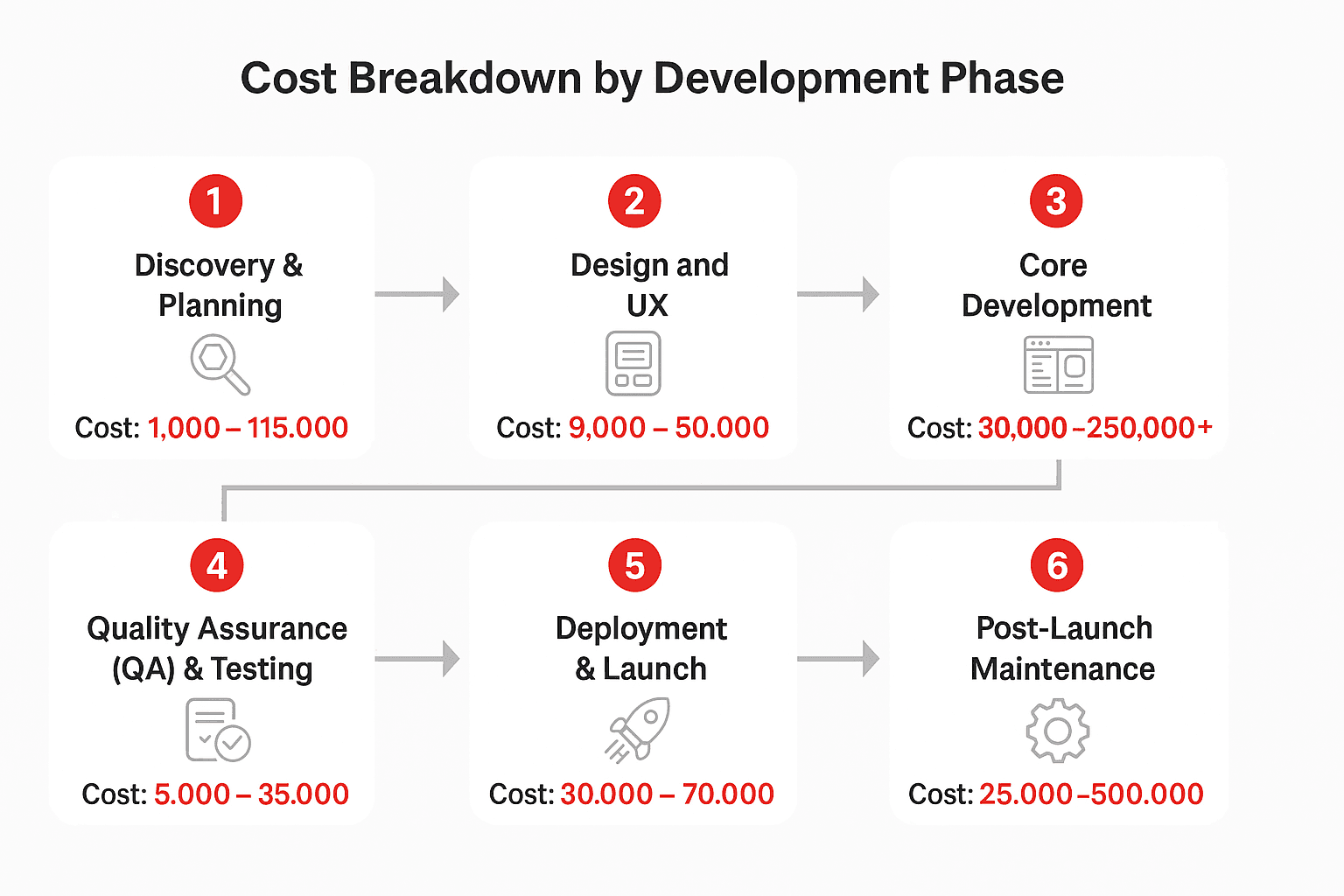
You are budgeting for a living system, an evolving digital product that demands continuous capital long after its first release. Each phase demands its investment. Cost clarity keeps margins intact and investors aligned.
STEP 1- Discovery & Planning
Cost: $1,000 – $15,000
Scope, risk analysis, market research, and roadmap. Clarity here prevents rework later. Early planning flags talent gaps, compliance needs, and budget pitfalls before they spiral.
STEP 2- Design and UX
Cost: $9,000 – $50,000
Wireframes, prototypes, and user flows shape first impressions. Screen complexity, animations, and custom brand elements inflate costs. Custom animations or AR bump design costs past $75,000. Strong UX cuts churn.
STEP 3- Core Development
Cost: $30,000 – $250,000+
Heavy build phase. Complex native apps reach $500,000. Backend logic, real-time data, and APIs increase scope.
- Native: $50,000–$300,000
- Cross-platform: $10,000–$200,000
- Third-party APIs: $5,000–$20,000
STEP 4- Quality Assurance (QA) & Testing
Cost: $5,000 – $35,000
Functional, performance, security, and compliance testing ensure stability across devices. IoT and wearable support increase QA load. Early testing cuts post-launch repair costs.
STEP 5- Deployment & Launch
Cost: $30,000 – $70,000
Fees include app store submissions, blockchain setups, and go-to-market pushes. Marketing and App Store Optimization (ASO) drive early adoption, requiring $35,000 to $65,000 for visibility at launch.
STEP 6: Post-Launch Maintenance
Cost: $25,000-$500,000
Annual maintenance equals 15–25% of initial development costs, reaching 50% during year one. Maintenance covers bug fixes, performance tuning, new features, security patches, compatibility updates, and hosting fees. Technical debt from rushed launches inflates these costs long term, making upfront code quality a cost-saving investment.
Cost clarity is not a finance exercise—it is a strategic weapon. B2B leaders who master this granular cost structure avoid runaway budgets, secure investor confidence, and sustain product momentum.
Regional Pricing Comparison for AI App Development Cost
Low hourly rates often hide steep operational expenses. True regional cost depends on more than labor rates—it includes quality control, timezone overlap, legal compliance, and project management bandwidth. Smart B2B leaders leverage hybrid outsourcing: keep strategy and architecture in-house, delegate development to the right global partners for both cost and control.
REGION | Rates( $/hr) | MVP Budget | Version 1.0 Budget |
USA | $145 (120-250) | 90K-150K | 150K-250K |
Western Europe | $110(100-150) | 70K-100K | 120K-200K |
Eastern Europe | $55(45-70 | 30K-55K | 60K-110K |
Latin America | $60 (50-85) | 35K-60K | 65K-120K |
Asia | $30 (30-60) | 18K-45K | 50K-95K |
Hidden and Ongoing AI Mobile App Development Costs Explained
Behind every AI-powered app lies a layer of hidden costs that quietly shape its financial reality. Ignoring these unseen factors can disrupt budgets and stall long-term success.
1. Infrastructure Overheads
AI apps demand robust, scalable backends for data storage, processing, and delivery. Hosting expenses on cloud platforms often consume 20-30% of the total budget, with monthly costs for mid-sized applications ranging from $5,000 to $20,000. Rising user traffic, complex AI models, and real-time data handling amplify these costs. Without efficient architecture and resource optimization, infrastructure can turn into a runaway expense.
2. Continuous IT Support
AI applications evolve constantly with changing data streams and system updates. Ongoing technical support—spanning security updates, model fine-tuning, OS upgrades, and third-party API maintenance—becomes a permanent cost center. Support fees typically range from $125 to $250 per hour, making sustained operational integrity a substantial investment over time.
3. App Store and Distribution Fees
Publishing AI apps on major marketplaces involves recurring costs. Apple charges $99 annually for developer accounts, Google demands a $25 one-time fee, and Apple's Enterprise Program costs $299 per year. Though modest individually, these fees are essential for continuous public and enterprise distribution.
4. Security and Compliance Costs
Handling user data in AI apps introduces high stakes. Beyond basic security, businesses face continuous vulnerability monitoring, penetration testing, and regulatory compliance costs. Penetration testing alone can range from $20,000 to $30,000, while annual audits in regulated industries like healthcare or finance may escalate from $50,000 to $500,000. Cutting corners risks reputational damage and penalties.
5. Marketing and User Acquisition
No AI app succeeds in obscurity. Strategic marketing campaigns, including ASO, paid ads, influencer outreach, and PR, are crucial to user growth. Marketing budgets often run between $35,000 and $65,000 per campaign. Without sustained user acquisition efforts, even the most advanced AI app risks being overlooked.
The real cost of a mobile app goes well beyond development. Long-term success demands full visibility into ongoing operations, security, and growth investments from day one.
Hiring Models & Their Cost Implications
Selecting the right hiring model defines not only the project’s budget but its long-term trajectory. Businesses typically consider three primary models: in-house teams, outsourcing agencies, and freelance developers. Each model carries trade-offs in cost, quality, and risk.
1. In-House Development Teams: Highest Cost, Maximum Control
Hiring full-time developers means full ownership. Annual costs range from $60,000 to $150,000, not counting benefits, equipment, or recruiting overhead. You gain real-time collaboration, a tighter culture fit, and better long-term continuity. But building internally takes time, budget, and access to scarce senior talent.
2. Outsourcing Agencies: Balanced Cost with Expertise
Agencies offer ready-to-deploy teams across design, development, QA, and strategy. Project costs start around $50,000 and scale past $500,000 for large builds. They manage compliance, NDAs, and delivery timelines. Agencies often ship faster, reduce revision cycles, and future-proof your architecture. The trade-off: higher up-front pricing and the need to align across time zones and management styles.
3. Freelancers: Low Cost, High Risk
Freelancers work well for focused tasks. Rates start at $0 to $50/hour, with mid-level specialists commanding more. While cost-effective, this model lacks structure. Project management, testing, and delivery oversight fall on you. For complex apps, this risk compounds—single points of failure and lack of scalability slow momentum.
But Why Is Choosing the Right App Development Company Critical?
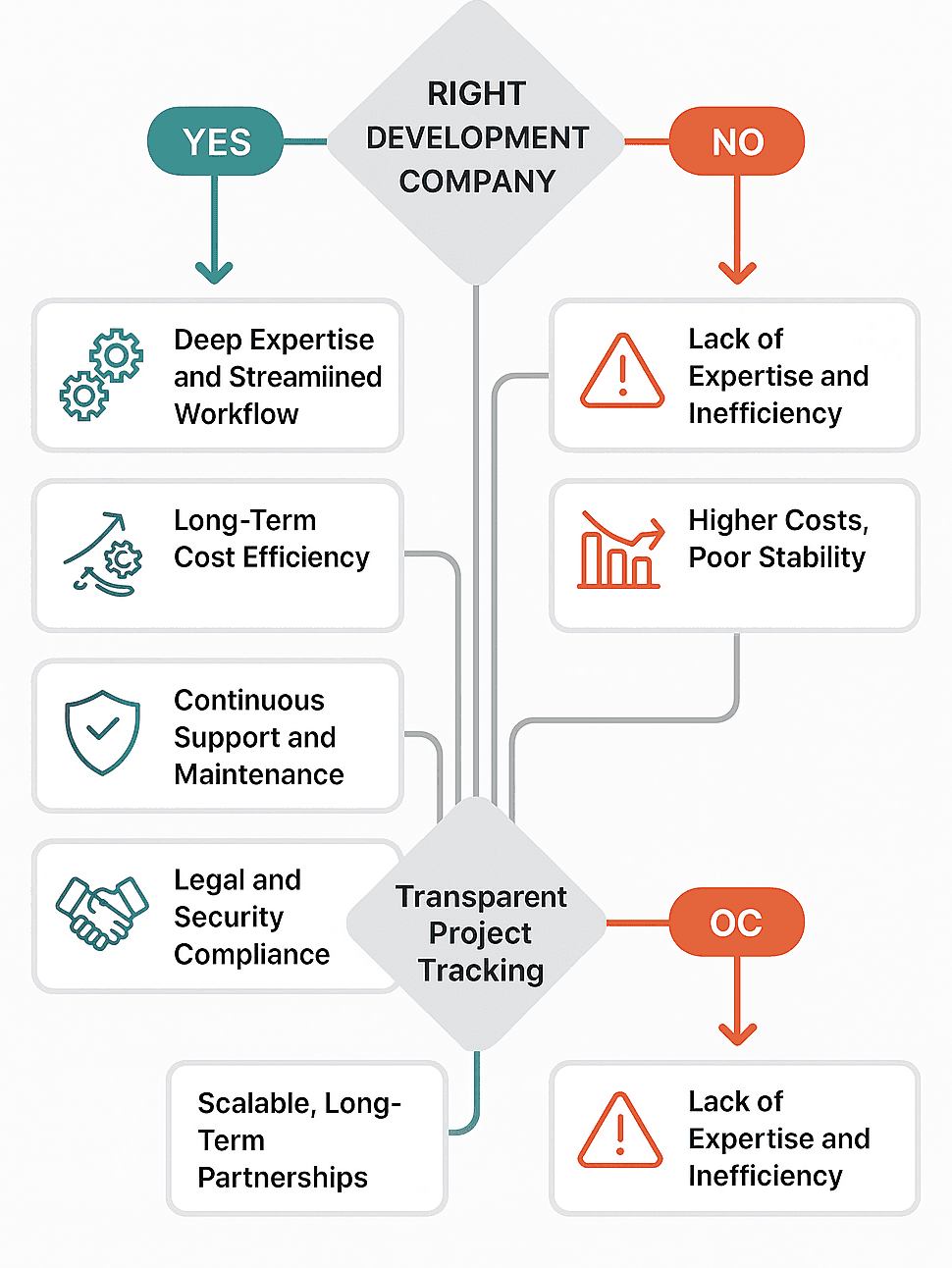
Choosing the right app development partner extends far beyond cost; it defines success, scalability, and long-term stability.
1. Deep Expertise and Streamlined Workflow
Experienced agencies bring certified talent with proven workflows. Dedicated project managers ensure transparent communication, strategic alignment, and consistent delivery. Their expertise helps avoid costly missteps and delays, leading to a smoother build and launch.
2. Long-Term Cost Efficiency
Reputable agencies optimize resources, reduce development rework, and future-proof architecture. Initial quotes may seem higher than freelancers, but lower failure rates and faster time-to-market often generate long-term savings. Agencies design scalable systems that adapt as business demands evolve.
3. Continuous Support and Maintenance
Professional companies offer 24/7 support, handling updates, security patches, and feature enhancements post-launch. Continuous maintenance preserves app health, user retention, and revenue stability.
4. Legal and Security Compliance
Agencies mitigate legal risks with enforceable NDAs, licensed operations, and robust security protocols. They build apps that comply with evolving data privacy regulations, protecting businesses from costly breaches or litigation.
5. Transparent Project Tracking
With advanced project management tools, agencies offer real-time progress tracking, detailed reporting, and milestone visibility. This transparency enables proactive course correction before small issues escalate.
6. Scalable, Long-Term Partnerships
The best software and app development companies evolve into strategic partners. As business needs shift, they scale features, optimize performance, and align technology with long-term growth goals, ensuring business continuity.
Why Choose GeekyAnts for AI-integrated App development?
GeekyAnts brings over six years of experience in building AI-powered platforms across multiple industries. The team specializes in full-cycle product development with deep expertise in machine learning, data science, and scalable architecture.
From predictive analytics and generative AI to fraud detection and smart assistants, GeekyAnts delivers production-ready systems that align with specific business goals. Teams choose us for clarity, speed, and precision.
Our Experience with Applied AI
We have built end-to-end platforms that solve real business problems:
- Voice and Chat Assistants – Built with LLMs, deployed on cloud-native infrastructure, integrated with CRM and customer support pipelines.
- AI Recommender Systems – Designed to power personalization, product discovery, and content ranking for digital platforms.
- Fraud Detection Engines – Developed for fintech platforms to detect anomalies and prevent high-risk transactions in real time.
- Predictive Analytics Dashboards – Delivered to track operations and forecast performance in sectors like logistics, finance, and healthcare.
All solutions are built cloud-native, modular, and ready to scale. Every product is aligned with data privacy laws and compliance frameworks from day one.
Built for Scale. Aligned with Regulation.
Our expert developers and engineering teams build systems that follow security-first principles and industry compliance standards like GDPR, HIPAA, and FDA Part 11. We integrate with LIMS, EHRs, and other enterprise systems using clean APIs. Each AI model is trained on curated data pipelines, tested for bias, and optimized for production.
AI That Grows with Your Business
GeekyAnts provides long-term support, model maintenance, and system upgrades. Our expert app developers work in sprints with dedicated product managers, clear deliverables, and continuous delivery. This ensures rapid iterations and sustainable growth.
Schedule a call to explore how we deliver measurable impact with every AI build.
Conclusion
AI app development in 2026 will demand capital management, engineering excellence, and market maturity. The total cost is not just about writing code but also about having good data, using models well, cloud computing, security, scalability, governance, and constant optimization.
As AI adoption and investment increase, companies that manage these components not only develop apps but create growth engines for the future. Begin with a specific use case, invest prudently, and partner with a competent AI product development firm to transform complexity into a competitive advantage.