Digital Banking Transformation Services
We help banks modernize core systems with cloud-native services and enable neobanks to build greenfield digital banking platforms from the ground up. Our digital transformation in banking services support faster launches, scalable operations, and seamless customer experiences.











Modernize Core Banking Systems Without High-Risk Replacement
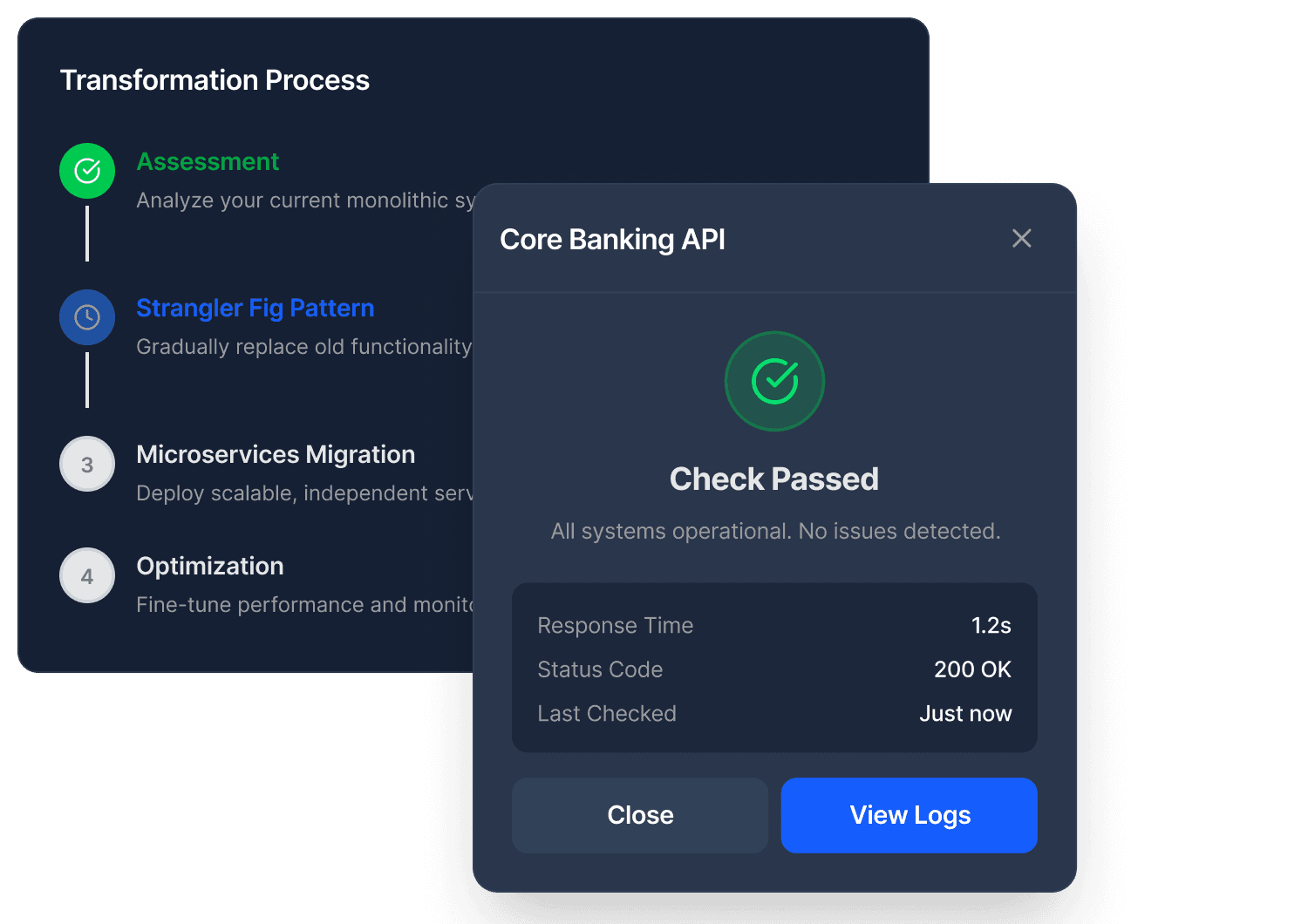
We modernize legacy banking environments through phased transformation rather than high-risk replacement. Our teams have moved SOAP-based services to modern protocols, introduced high-performance caching and integration layers, and improved the responsiveness of critical banking workflows without disrupting live operations.
For platforms such as Oracle FLEXCUBE, we progressively expose and replace legacy capabilities through secure APIs, modular services, and controlled traffic migration. Each phase of your digital transformation journey is validated for data integrity, auditability, regulatory reporting, and operational continuity before wider rollout.
Digital Banking Transformation Outcomes
See how we have helped banks improve core performance, execute high-risk regulatory migrations, and modernize customer-facing banking platforms without compromising security or operational continuity.
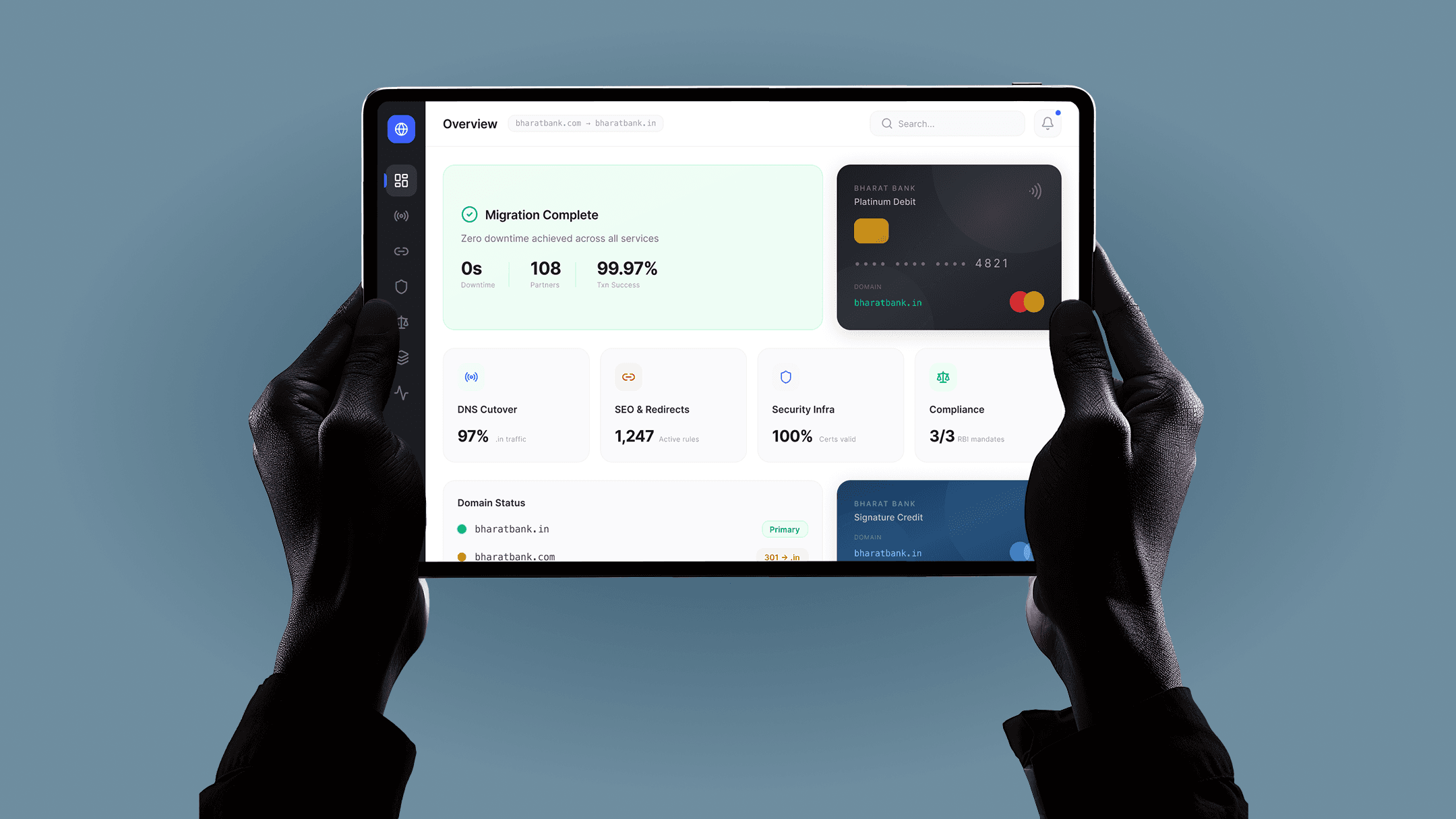
RBI Domain Migration For India’s Largest Private Bank
GeekyAnts executed a large-scale domain migration for Reserve Bank of India compliance, enabling one of India’s largest private banks to transition its digital infrastructure to RBI-mandated domains without disrupting live banking services.
- reduction in manual effort
- 99%
- pages processed in ~2 minutes
- 10,000
- response accuracy
- 85%+

AI-Powered Mobile Banking App Modernization
We upgraded a public sector bank’s mobile app to improve performance, security, and customer experience using event-driven architecture and real-time processing.
- downtime updates
- 0
- real-time processing
- 100%
Fintech Admin Engine
We built a centralized, high-concurrency admin platform for this North American fintech to manage cross-border payments. The architecture allows for regional feature toggling and real-time monitoring across multiple countries from a single interface.
- Active Users in UK, Canada, Europe, and Australia
- 120k+
- Global Payments Processed Annually
- 400M+
- Downloads Across iOS and Android
- 350k+
Banking Challenges We Help You Solve
Digital banking transformation can stall when legacy architecture, regulatory obligations, partner integrations, and customer journeys are modernized in isolation. We help banks and neobanks address these connected challenges without compromising critical operations.
Legacy Core Constraints
Modernize rigid architectures and outdated protocols that slow releases, increase latency, and make change difficult.
High-Risk Migrations
Reduce disruption through phased modernization, controlled traffic migration, fallback planning, and production validation.
Regulatory Continuity
Preserve audit trails, regulatory reporting, data integrity, and security controls throughout the transformation.
Complex Integrations
Connect payment networks, KYC providers, credit bureaus, partner APIs, and downstream systems reliably.
Performance at Scale
Improve speed and availability through modern APIs, caching, asynchronous processing, observability, and load testing.
Fragmented Journeys
Unify onboarding, lending, accounts, cards, and servicing into secure, consistent digital experiences.
Banking Digital Transformation Services Built for Enterprise Change
GeekyAnts brings experience across banking and digital transformation to guide complex programs from assessment and migration planning through production rollout and continuous improvement.
Coordinate core services, integrations, data, operations, and customer-facing journeys through one transformation roadmap.
Break complex programs into measurable releases with dependency mapping, validation gates, fallback plans, and clear ownership.
Preserve auditability, reporting continuity, data integrity, and security controls as systems, providers, and traffic change.
Bring architecture, product, backend, mobile, cloud, QA, security, and DevOps specialists into one integrated delivery team.
Document architecture, APIs, runbooks, decisions, and operating processes to support internal ownership and future change.
Continue improving reliability, performance, cost efficiency, and product capabilities after the initial transformation goes live.
Our Journey
- 2019
Enterprise Banking Delivery Begins
Started building and modernizing digital products for large banking institutions. - 2022
10x Higher Throughput via Core Modernization
Modernized legacy SOAP/XML services using Golang, gRPC, and multi-tier caching, reducing response times from 500 ms to 220 ms. - 2024
Banking Platforms Scaled to Millions
Expanded digital banking ecosystems supporting more than 5 million active users. - 2025
RBI-Mandated Migration Delivered Without Disruption
Migrated more than 100 partner integrations while maintaining complete regulatory adherence and zero customer disruption - 2026
Expanding the Next Generation of Digital Banking
Advancing cloud-native core services, AI-assisted banking operations, and greenfield platforms for banks and neobanks.
Our Digital Banking Transformation Services
Modernize critical banking systems and build secure digital AI products across the customer lifecycle. Our digital transformation banking expertise helps institutions improve agility, scalability, and customer experience.
Core Banking Modernization
Modernize legacy cores through secure APIs, modular services, and phased migration. Our work has reduced API latency by 56% and improved service performance by 10x.
Customer Experience and Onboarding
Build KYC-integrated onboarding, resilient registration, and secure authentication for banking platforms operating at more than 5 million active-user scale.
Retail Banking Products
Build self-service products for account management, savings, PPF, lockers, statements, and real-time balances, with compliance embedded into critical customer journeys.
Looking for payment infrastructure?
Explore our Money Payments & Transfers solutions for UPI, real-time payment rails, gateway orchestration, cross-border transfers, wallets, and bill payments.

Regulatory Continuity at Every Stage of Digital Banking Transformation
We modernize banking systems without separating engineering decisions from regulatory obligations. Every migration phase in the digital transformation project is designed to preserve auditability, reporting continuity, data integrity, and security before production traffic is moved.
Audit Trails Maintained
Preserve complete records of transactions, system changes, user activity, and migration decisions across legacy and modern environments.
Regulatory Reporting Continuity
Keep RBI and other applicable regulatory reporting workflows operational while services, integrations, and data flows are progressively migrated.
Compliance Sign-Off Before Cutover
Validate each migration phase against security, operational, and regulatory requirements before shifting live customer traffic.
Data Integrity and Reconciliation
Reconcile records across old and new systems to prevent transaction loss, duplication, or inconsistencies during the transition.
Security Controls Preserved
Maintain encryption, access controls, monitoring, vulnerability checks, and incident-response processes throughout the migration lifecycle.
Third-Party Integration Validation
Test payment networks, KYC providers, partner APIs, and downstream systems before cutover to protect compliance and service continuity across the ecosystem.
Tech and Engineering Capabilities For Digital Banking Transformation
Technology expertise across core banking, mobile and web platforms, APIs, cloud infrastructure, security, observability, QA, data, and AI-enabled banking operations.
- React Native

- React

- Flutter

- Angular

- VueJS

- SvelteJS

- Expo

- gluestack-ui

- MongoDB
- PostgreSQL
- MariaDB
- Firestore
- Amazon DynamoDB
- MySQL
- Manual Testing
- Automation Testing
- Selenium
- Performance Testing
- Security Testing
- Compliance Validation
- Figma
- Illustrator
- Design Systems
- UX Research
- LangChain
- LlamaIndex
- Prompt Engineering
- Firebase Genkit
- ADLC Framework
- RASP Tools
- SSL Pinning
- Biometric Authentication
- Encryption & Key Management
- Anjuna Secure Enclaves
- Dynatrace
- Hypertrace
- APM Dashboards
- Alerting & Incident Workflows
Digital Transformation Across BFSI Industry
Ideas Shaping Banking & Digital Transformation Leaders

Accelerate Your AI-Native Digital Banking Transformation
Speak with our digital banking experts about modernizing legacy systems, improving performance, or building a new banking platform without disrupting critical operations.
Contact us
FAQs on Digital Banking Transformation Services
We modernize legacy banking systems in controlled phases rather than replacing the entire platform at once. New APIs, services, and workflows are introduced alongside the existing core using approaches such as the Strangler Fig Pattern. Traffic moves only after shadow testing, reconciliation, security validation, and production-readiness checks. Fallback routes remain available throughout the transition to protect live banking operations.
Performance gains depend on the existing architecture and transaction bottlenecks. In one banking engagement, replacing SOAP/XML service communication with gRPC and REST, supported by Golang services and multi-tier caching, reduced API response times from 500 ms to 220 ms and improved transaction-processing performance by 10x.
Yes. Oracle FLEXCUBE can be modernized incrementally by exposing core functions through secure APIs, introducing modular services around selected domains, and progressively replacing high-friction components. This allows banks to improve digital journeys, integrations, and performance while retaining FLEXCUBE as the system of record where replacement is unnecessary or too risky.
Audit events are captured across both legacy and modern environments throughout the migration. Transaction records, system changes, user actions, approvals, rule versions, and reporting data remain traceable. Each migration phase is validated for data integrity, reporting continuity, security controls, and regulatory requirements before live traffic is shifted.
We map every dependency connected to the provider, including APIs, payment flows, data exchanges, callbacks, reconciliation processes, and downstream systems. The replacement provider runs in parallel while responses and transaction outcomes are validated. Traffic is shifted gradually using routing controls, with fallback paths retained until the new integration meets performance, security, and operational requirements.
Banks should prioritize functions that create the greatest operational risk, customer friction, performance issues, or release delays. Common starting points include authentication, payments, account information, onboarding, lending, and partner integrations. A modernization assessment evaluates business value, technical dependencies, regulatory impact, transaction criticality, and migration complexity before defining the sequence.
Platforms can scale efficiently through modular services, autoscaling, caching, asynchronous processing, database optimization, and workload-specific infrastructure. Observability helps teams identify expensive services, unused capacity, and performance bottlenecks. Capacity planning and cloud cost controls should be built into the architecture so growth does not automatically lead to proportional infrastructure spending.
Banks should introduce AI through governed, auditable workflows with defined human oversight. Each use case needs approved data access, model validation, explainable outputs, security controls, monitoring, and escalation rules. High-risk decisions should retain human review, while prompts, model versions, data sources, and outcomes are recorded for audit and compliance purposes.
A focused domain or integration phase may take several months, while broader core modernization is usually delivered as a multi-phase program. The timeline depends on data dependencies, third-party integrations, regulatory approvals, testing requirements, and the number of services being changed. Discovery establishes the migration sequence, release plan, governance model, and measurable outcomes.
Both engagement models are available. Fixed-scope delivery is suitable for assessments, proofs of concept, architecture planning, and clearly defined migration phases. Time-and-materials or dedicated-team models work better for complex digital banking transformation programs where priorities, dependencies, and technical findings may evolve during implementation.