Golang Performance Systems
Memory leaks and inefficient goroutine management quietly throttle application throughput until the latency spikes in production.
We take ownership of your backend architecture and concurrency patterns from the ground up, so the performance your users depend on is the last thing your team ever has to worry about.
Move Beyond Bloated Runtimes to High-Efficiency Systems











Performance debt does not get seen dramatically. It builds through unoptimized garbage collection, blocking operations in hot paths, or a microservices mesh that stopped being efficient so long ago nobody remembers why. The bill usually comes due through a system crash that profile-guided optimization would have made impossible.
Our Golang Performance service exists to break that cycle. We begin by understanding exactly where your request handling and data processing are creating lag, then replace them with lean, benchmarked systems that give your platform a foundation it can genuinely grow on.
Client Results and Success

400M+ global payments processed annually
The system provides the scalability required to handle millions of transactions while maintaining data integrity and administrative control.
- Active Users in the UK, Canada, Europe, and Australia
- 120k+
- Global Payments Processed Annually
- 400M+
- Downloads Across iOS and Android
- 350k+

3x faster AI feature iteration
The modular backend architecture allowed the team to deploy new AI capabilities and personalized features significantly faster than industry benchmarks.
- Reduction in meal decision time
- 40%
- Increase in daily active usage during pilot
- 2x
- Faster iteration on new AI-driven features
- 3x
$57,000+ Annual Savings
The project achieved a 60% reduction in monthly cloud costs (from $8,100 to $3,300) without any loss in transaction speed or system security.
- Reduction in monthly cloud costs
- 60%
- Saved per month
- $4800
- Annual savings
- $57,000+
50% reduction in manual validation cycles
The integration of automated benchmarking frameworks and AI-driven process automation also resulted in 30% faster internal testing workflows.
- faster internal testing
- 30%
- reduction in manual validation
- 50%
Our Golang Performance Engineering Services
Runtime complexity should not be a tax your engineers pay every day. Our services eliminate the friction that comes from slow startup times, bloated binaries, and code that only runs fast on a local machine.
Full system design covering channel patterns, worker pools, and context management across your entire service mesh.
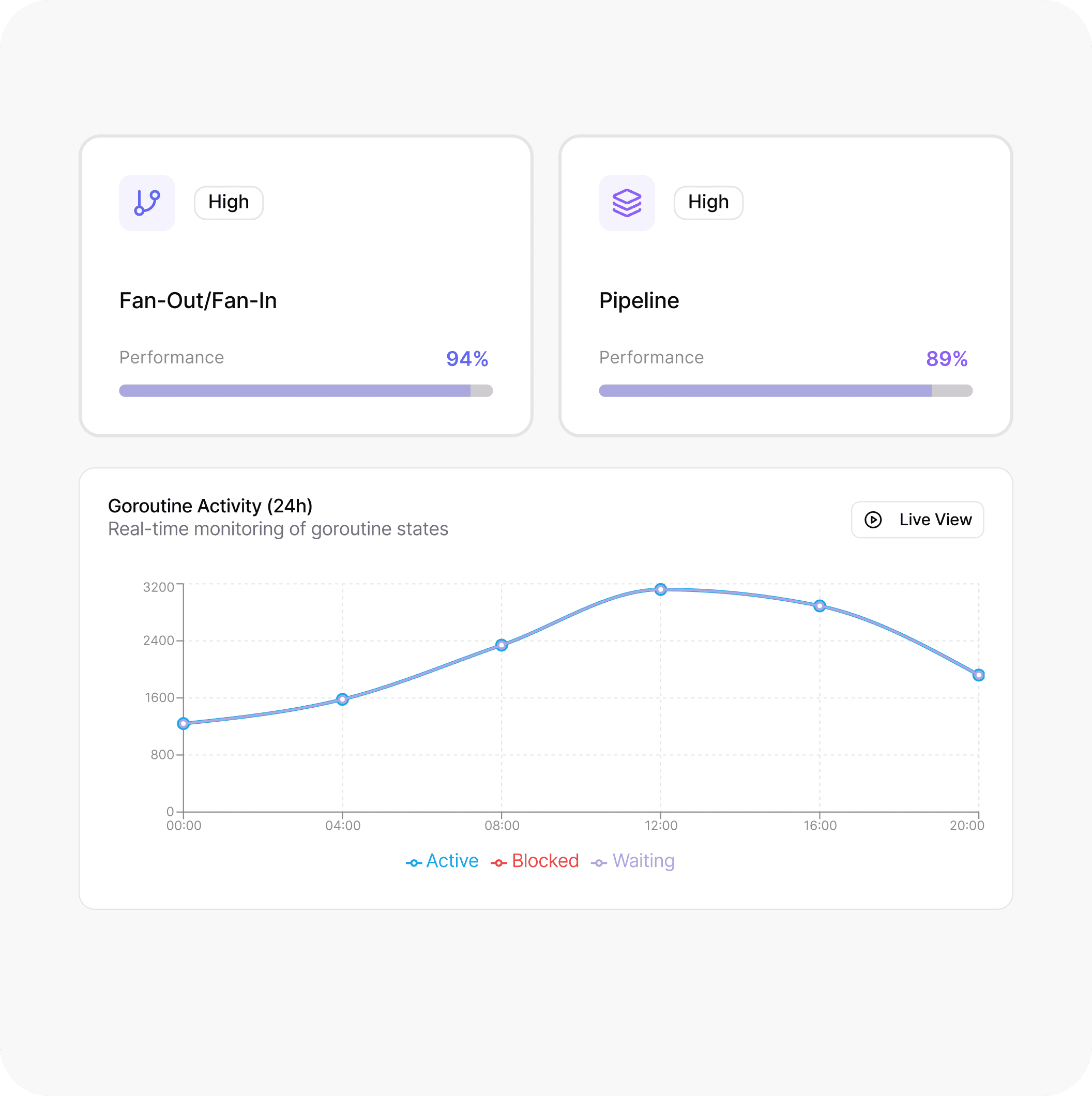
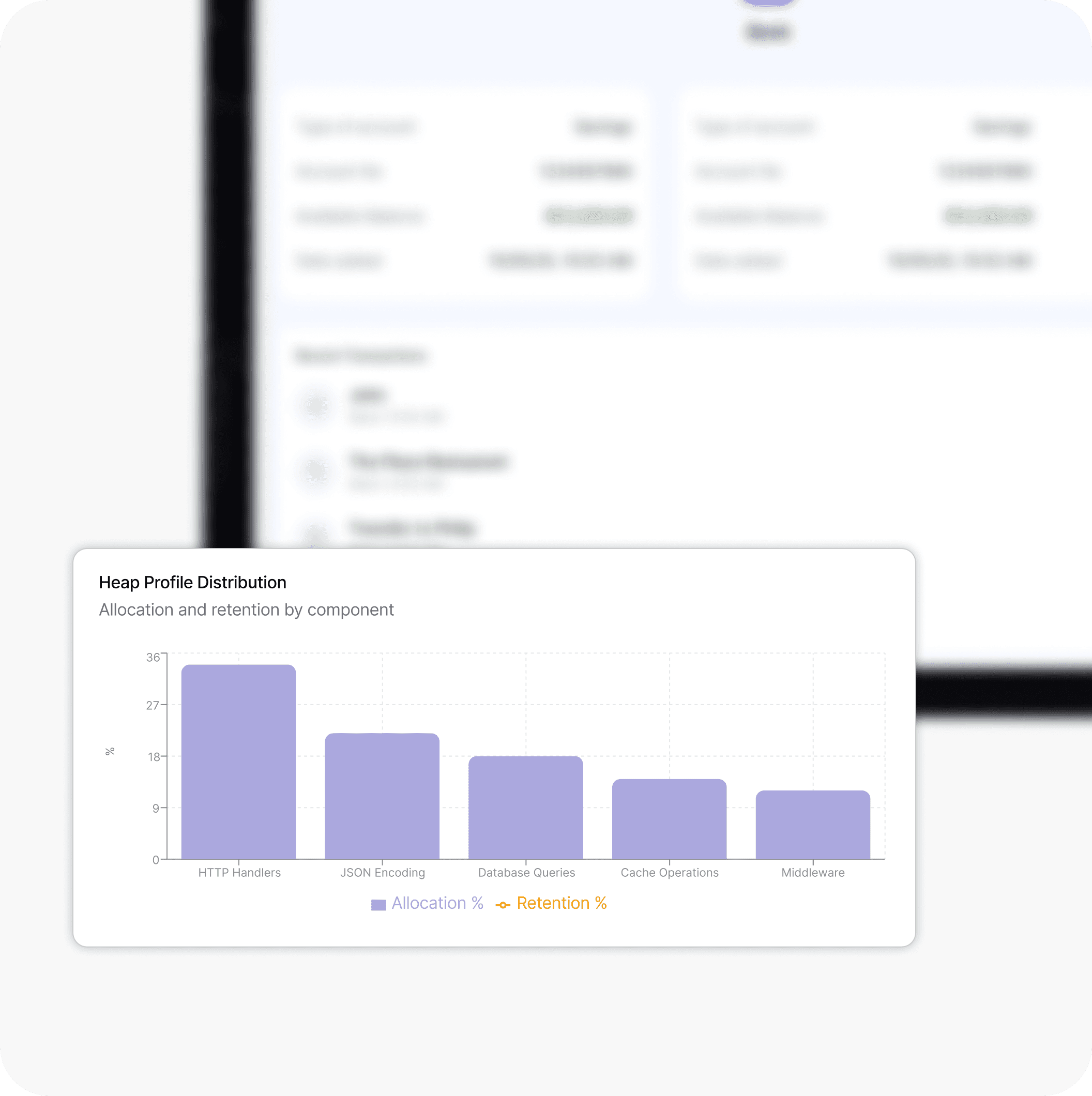
Strategy built around zero-allocation patterns and escape analysis suited to your specific heap profile and traffic.
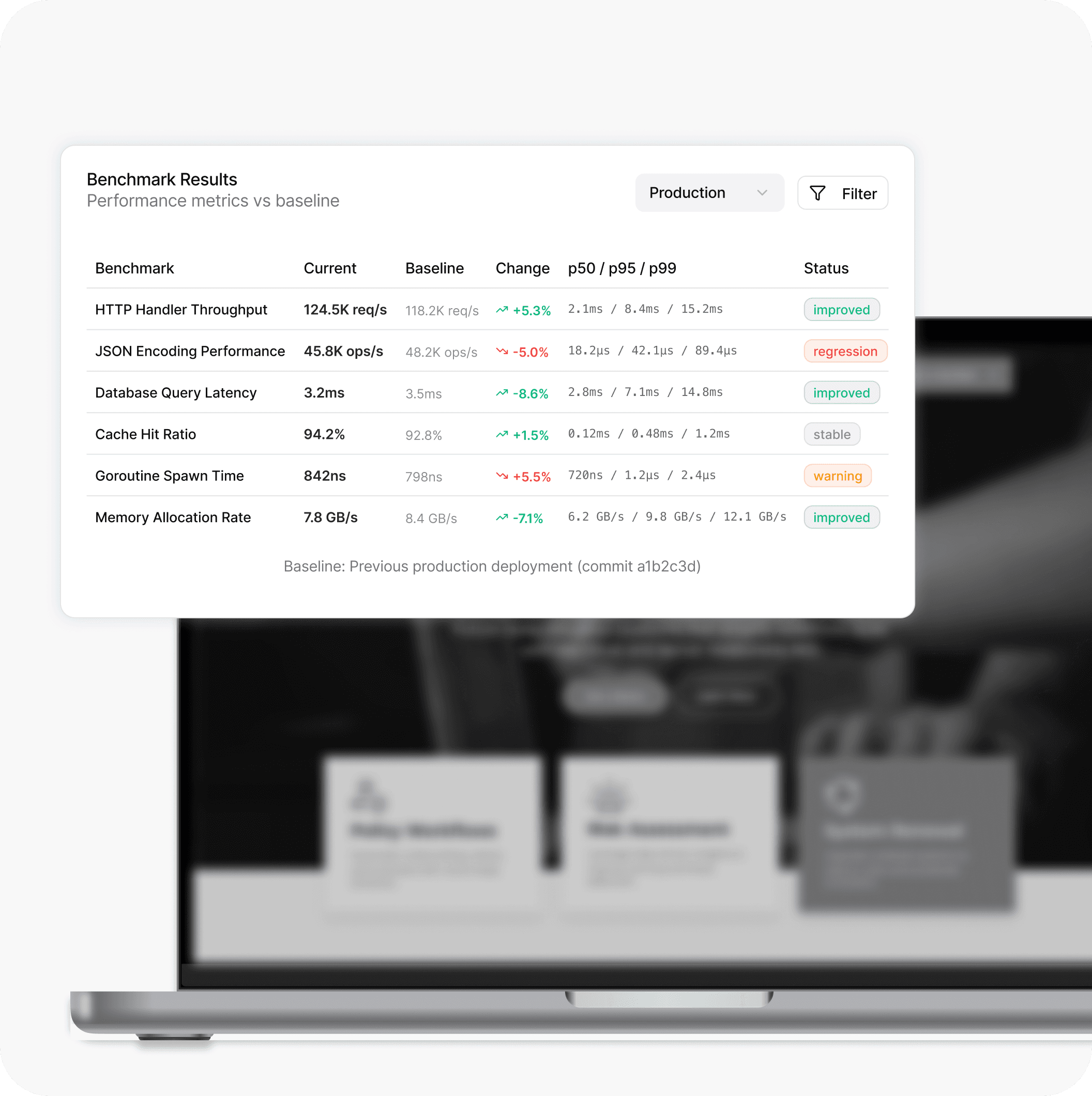
Continuous profiling with regression detection built into the CI/CD pipeline from development through to production.
Complete Backend Engineering Services for Enterprises and Companies
Industries-Based Golang Performance Systems
The way a high-performance Go system needs to behave varies enormously depending on its operational environment. Memory management strategies, concurrency limits, garbage collection tuning, and latency sensitivity in a regulated fintech ledger look nothing like those in a high-volume social media feed. We design Golang backend architectures around the real execution constraints your team lives within—not a generalized codebase applied regardless of context.
Golang Performance Systems by Engineers Who Have Delivered 1000+ Projects
The same senior Go developers who audit your code are the ones rewriting your hot paths and managing your pointers.
We work across Gin, Echo, Fiber, or standard net/http with deep experience in gRPC, NATS, PostgreSQL, and Redis. The right tool is whatever hits your latency targets.
Everything delivered is production-ready, benchmarked, and designed to be maintained by your team independently.
Our Latest Thinking
FAQs About Golang Performance Systems
We cover everything from initial code profiling to fully optimized runtime execution—concurrency orchestration, memory allocation tuning, garbage collection strategy, dependency slimming, and distributed tracing setup. The end state is a high-performance backend your team can scale without relying on trial-and-error tuning or optimizations that live only in one developer's head.
Most are wrapped up within three to six weeks. The timeline depends on how many microservices are in scope, the current condition of your codebase and benchmark coverage, and whether low-latency or high-throughput requirements are involved.
We start from where you are. Refactoring and optimizing existing Go services is almost always the faster path. When a structural change to your concurrency model or data structures makes sense, we make the case clearly and handle the transition in a way that doesn’t disrupt your production traffic.
That’s the whole point. Every engagement is designed to leave your team with a system they understand and can maintain. Performance benchmarks, profiling runbooks, and architectural documentation are standard—not optional extras.
Writing idiomatic Go and writing high-performance Go are two different things. Most codebases that grew organically carry hidden mutex contention, excessive heap allocations, and inefficient goroutine patterns that accumulate latency with every feature release. Those gaps tend to stay invisible until your system hits a scaling wall.
Optimized Go source code across all services, configured continuous profiling, performance runbooks, latency and throughput alerting, a documented architecture overview, and a structured handover session with your engineering team.
We’re framework-agnostic across Gin, Echo, and Fiber, with hands-on experience in gRPC, Protobuf, NATS, Redis, pprof, Datadog, and Prometheus. Tool recommendations are based on what hits your latency targets—not what we’re most comfortable with.
Yes. Tail-latency optimization (P99), lock-free data structures, zero-allocation serialization, and resource-aware scaling are part of how we build for teams operating under high-frequency trading, real-time bidding, or internal performance frameworks.
Most teams see meaningful change within the first couple of weeks—reduced CPU cycles, lower memory footprints, and faster request handling. The full optimization suite is typically complete and handed over within four to six weeks.
A new hire needs months to develop the context required to safely optimize production hot paths. Our team arrives with that context already built, delivers a benchmarked and documented system in weeks, and does so without the recruiting timeline, onboarding overhead, or slow ramp-up curve.