PostgreSQL High Availability Services
GeekyAnts provides PostgreSQL high availability services for production databases that require reliable failover, recovery, and performance under load. Our engineers design, implement, and maintain PostgreSQL clusters using Patroni, Etcd, WAL-G, PgBouncer, and workload-specific tuning to reduce downtime, protect data, and simplify ongoing operations.
Database downtime kills your growth.











Configuration errors, replication gaps, untested recovery points, and poor connection management can leave production databases vulnerable during failures or traffic spikes.
Our PostgreSQL clustering services address these risks through automated failover with Patroni and Etcd, point-in-time recovery with WAL-G, connection management, and database and operating-system tuning based on your workload.
Client Results and Success

400M+ global payments processed annually
The system provides the scalability required to handle millions of transactions while maintaining data integrity and administrative control.
- Active Users in the UK, Canada, Europe, and Australia
- 120k+
- Global Payments Processed Annually
- 400M+
- Downloads Across iOS and Android
- 350k+

3x faster AI feature iteration
The modular backend architecture allowed the team to deploy new AI capabilities and personalized features significantly faster than industry benchmarks.
- Reduction in meal decision time
- 40%
- Increase in daily active usage during pilot
- 2x
- Faster iteration on new AI-driven features
- 3x
$57,000+ Annual Savings
The project achieved a 60% reduction in monthly cloud costs (from $8,100 to $3,300) without any loss in transaction speed or system security.
- Reduction in monthly cloud costs
- 60%
- Saved per month
- $4800
- Annual savings
- $57,000+
50% reduction in manual validation cycles
The integration of automated benchmarking frameworks and AI-driven process automation also resulted in 30% faster internal testing workflows.
- faster internal testing
- 30%
- reduction in manual validation
- 50%
PostgreSQL High Availability and Clustering Services
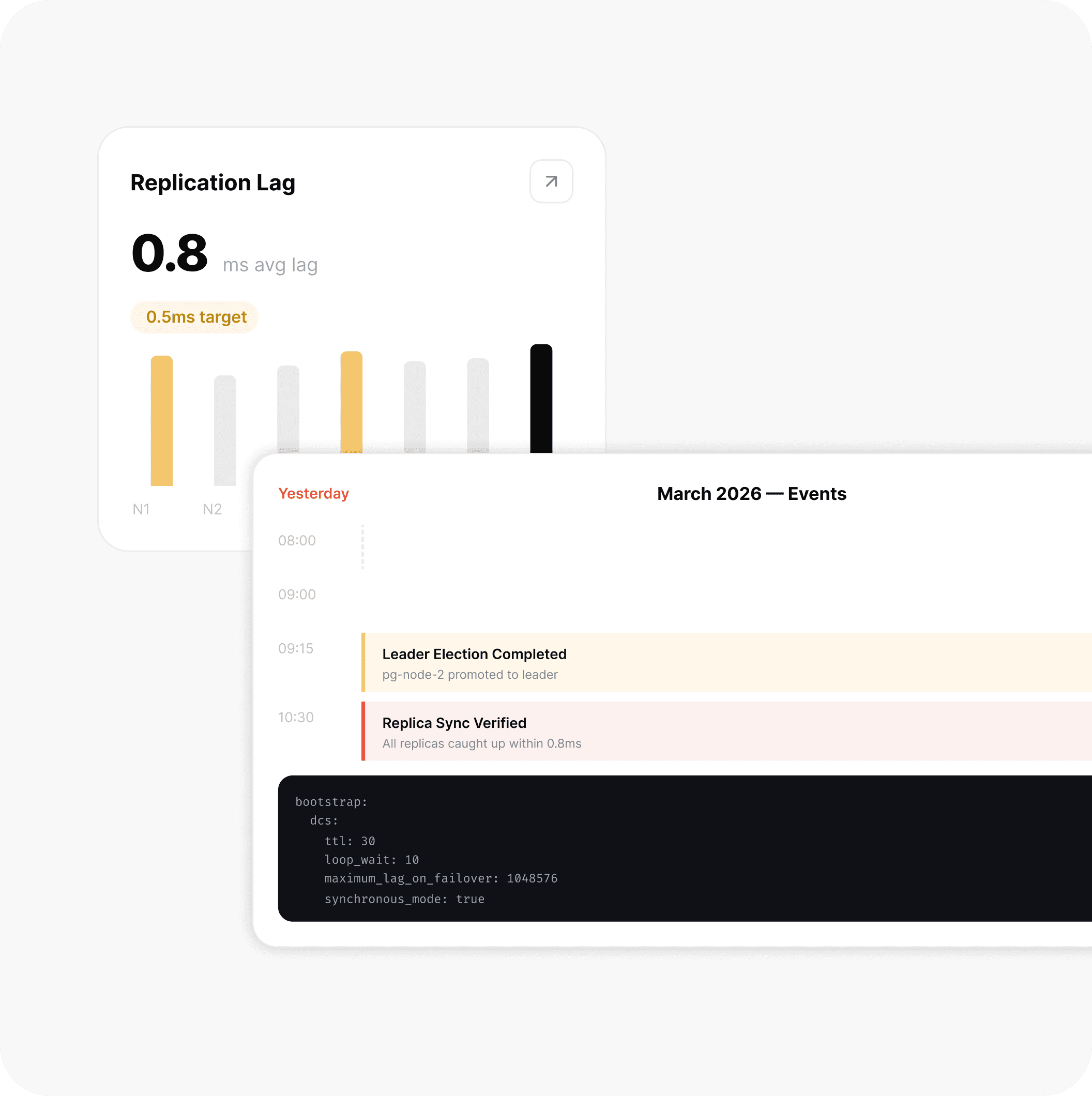
We build clusters that fix themselves. If the leader server fails, a backup server takes over instantly. This happens automatically so your app stays online while your team receives the alert.
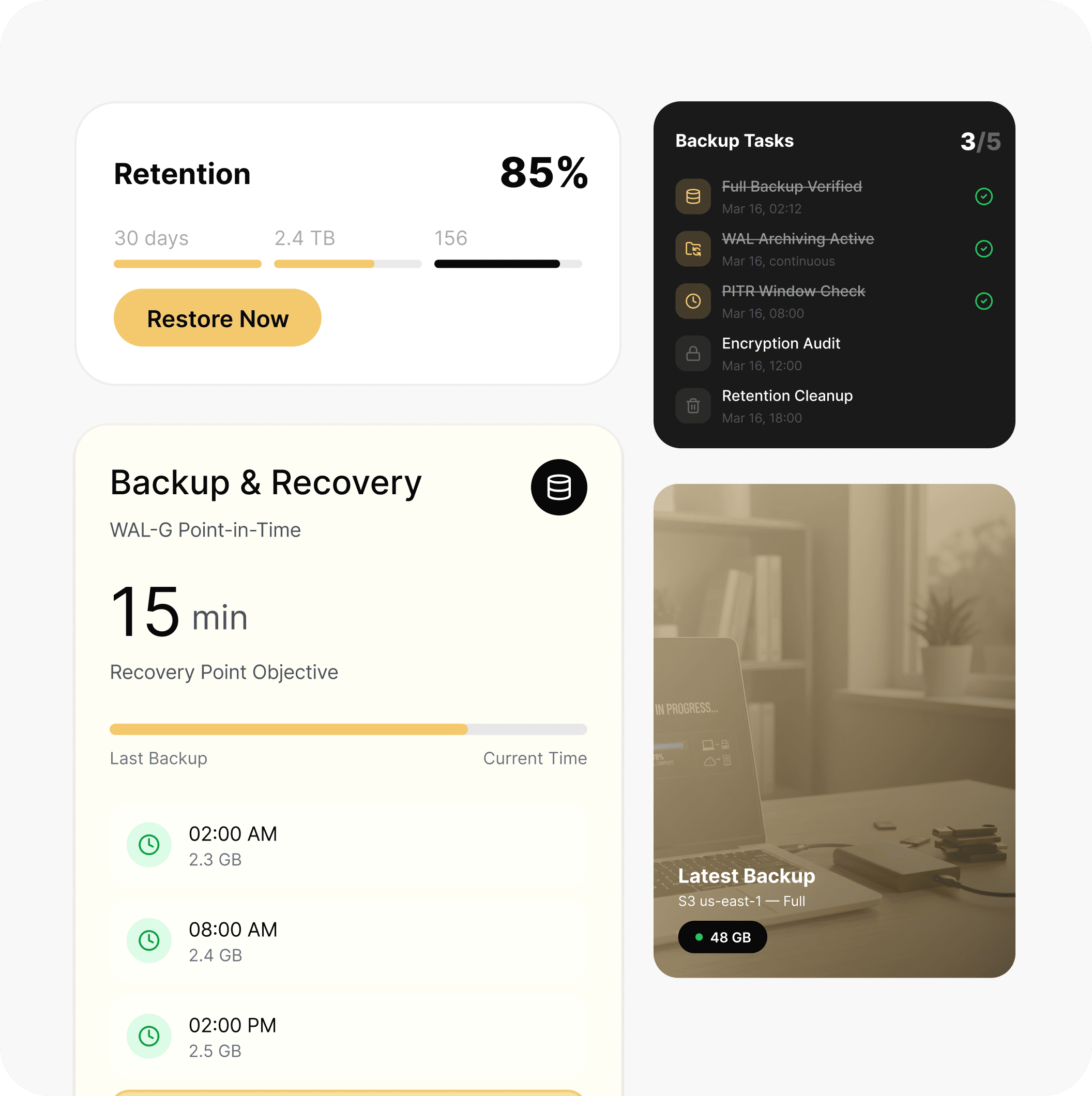
We use WAL-G to manage backups across different storage locations. You are not limited to the last daily backup; you can restore your data to any exact moment, such as the second before a human error occurred.
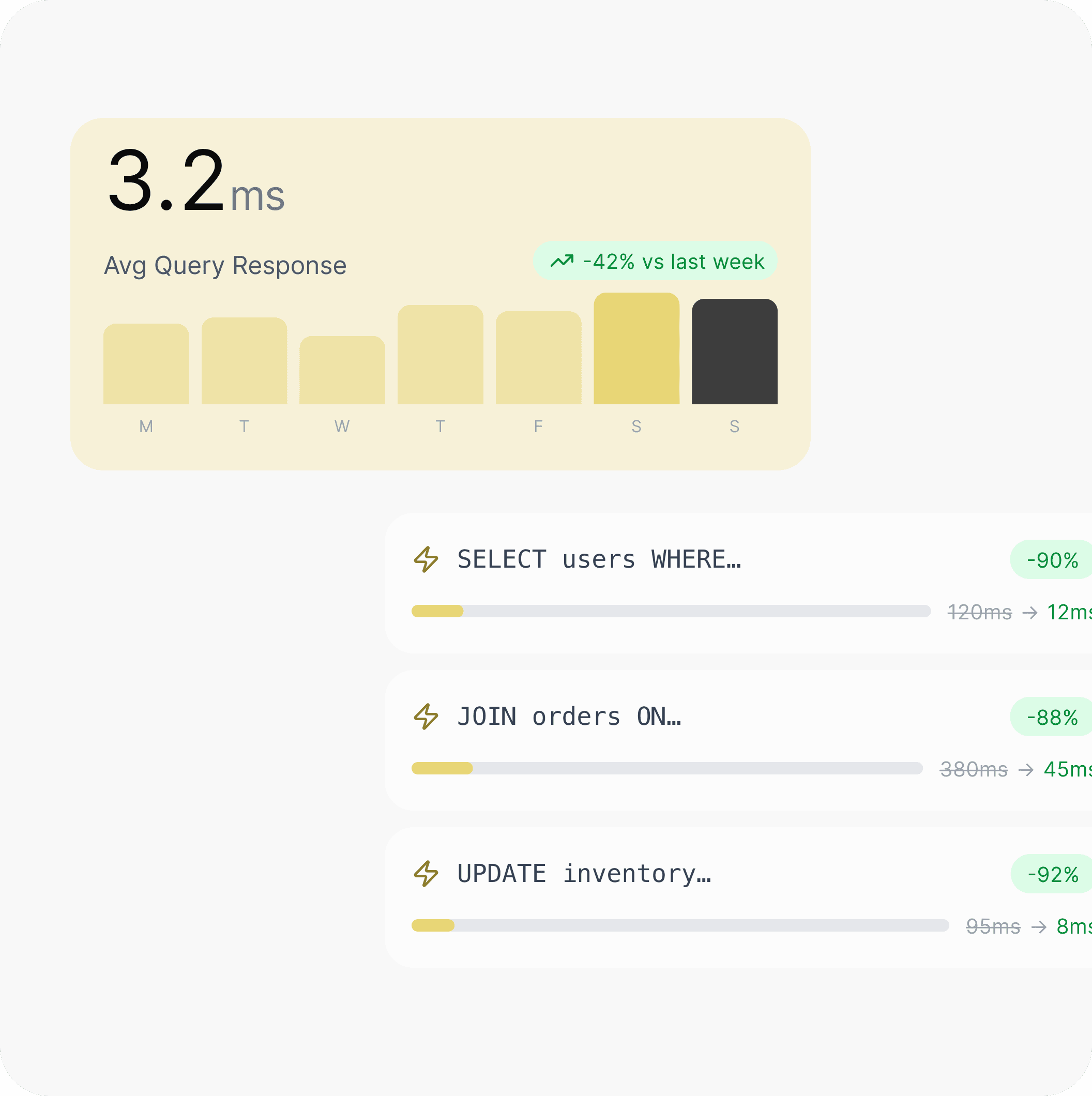
We adjust deep system settings like HugePages and kernel parameters to speed up data flow. We also analyze your most frequent database searches to fix slow spots before they cause a system crash.
Complete Backend Engineering Services for Enterprises and Companies
PostgreSQL Infrastructure for Industry Sectors
Database availability, performance, security, and recovery requirements vary by industry. They can include strict data controls for banking, compliance and privacy for healthcare, and faster searches for retail.GeekyAnts configures PostgreSQL infrastructure around your workload, operational requirements, and applicable security or compliance controls instead of applying a standard cluster configuration.
PostgreSQL Infrastructure by Engineers Who Have Delivered 1000+ Projects
Configuring a basic cluster is the starting point. Understanding how to keep it stable during a real failure takes experience. We have managed databases where backups were never tested, and lag was never measured; we know how to fix those risks.
The senior engineers who study your system are the same ones who write the code and set up the servers.
We use tools like PgBouncer and pgBadger to customize every setting for your workload. We never use a standard copy-paste configuration.
We deliver a finished, tested system that your team can run. Every project includes clear manuals and recovery steps
Our Latest Thinking
FAQs About PostgreSQL Infrastructure Services
We cover cluster architecture, high availability configuration, backup and recovery strategy, performance tuning, and connection management. The end state is a PostgreSQL environment your team can operate and scale without relying on manual interventions or configurations that only one person understands.
Most engagements are completed within three to six weeks. Duration depends on the current state of the cluster, the number of databases in scope, whether PITR coverage needs to be established from scratch, and whether performance tuning requires extended query analysis under production load.
We start from your existing environment. Restructuring what is in place is almost always faster than starting over. When a structural change — moving from a single-node setup to a Patroni cluster, or replacing a backup strategy that lacks PITR coverage — is necessary, we make the case clearly and execute the transition without downtime.
That is the objective. Every engagement delivers runbooks covering failover procedures, backup verification, and routine maintenance tasks. The cluster is documented and your team is walked through the operational procedures before handover.
PostgreSQL high availability services are appropriate when a production database requires automatic failover, tested recovery, controlled replication, connection pooling, or stronger performance under peak traffic. GeekyAnts assesses the existing environment and improves the cluster architecture, backup coverage, recovery procedures, and operational documentation without rebuilding systems unnecessarily.
A production-ready cluster with HA configuration validated, backup and PITR coverage tested, performance parameters tuned to your workload, connection pooling configured, and full documentation covering architecture decisions, operational runbooks, and recovery procedures.
We work across Patroni, Etcd, PgBouncer, WAL-G, pgBadger, pg_stat_statements, and pg_upgrade for major version migrations. Tool selection is based on your workload requirements and operational model — not on what we default to regardless of context.
Yes. Audit logging, data residency constraints, encryption at rest and in transit, and access control configurations are part of how we build for organisations operating under PCI-DSS, SOC 2, HIPAA, or internally defined security frameworks.
Performance tuning and connection pooling improvements are visible within the first week. HA validation and PITR testing are complete within two to three weeks. Full cluster documentation and handover are typically completed within four to six weeks, depending on the scope.
An internal hire needs ramp time before safely making changes to a production cluster. Our engineers arrive with that experience established, deliver a documented and tested environment on a fixed schedule, and carry none of the overhead of recruiting, onboarding, or an extended period before they are effective on production systems.
High availability reduces service interruption during infrastructure or database failures, while disaster recovery restores operations after larger failures or data-loss events. PostgreSQL HA commonly relies on replicas and automated failover, whereas disaster recovery adds backups, point-in-time recovery, geographically separate environments, and documented recovery procedures. Businesses with strict uptime requirements generally need both rather than treating HA and disaster recovery as interchangeable. GeekyAnts can also integrate database resilience with broader Cloud and Platform Engineering Services.