

Executive Summary: Why Build an In-App Canvas Editor?
Modern SaaS applications increasingly require users to create visually rich documents directly inside the browser. Whether it is travel itineraries, reports, certificates, brochures, or marketing collateral, users expect the same drag-and-drop experience offered by tools like Canva—but without leaving the application.
Our challenge was straightforward:
“How do we build a Canva-like editor that feels native, performs smoothly, and integrates seamlessly with our product?”
After evaluating multiple approaches—including embedded design tools, HTML-based editors, and a fully custom canvas engine—we built our editor on Konva.js + React-Konva.
The result was a production-ready editor capable of:
- 60 FPS interaction
- 250+ canvas objects
- Rich text editing
- Autosave
- Multi-page documents
- Responsive previews
- Pixel-perfect rendering between editor and viewer
This article presents the architecture, design decisions, production challenges, and engineering lessons behind building a production-ready canvas editor.
Business Objectives
Beyond replicating Canva-like functionality, the primary objective was to eliminate dependence on external design tools and bring document creation directly into our platform. By integrating editing, previewing, and publishing into a single workflow, the editor reduces operational overhead, shortens content turnaround time, and enables teams to create
production-ready documents without switching between multiple applications. This also gives the product team complete control over the editing experience, data ownership, and future feature development.
Why We Chose Konva.js Over Other Alternatives
When we started designing the editor, we evaluated three possible approaches.
At first glance, embedding a tool such as Canva or Figma looked attractive because this approach reduced implementation effort. However, licensing costs, limited customization, and data ownership concerns quickly ruled it out.
Next, we experimented with HTML-based editors built using absolutely positioned <div> elements. Although this worked for simple layouts, performance degraded significantly as documents became more complex.
Ultimately, we chose Konva.js because it provided a scene graph architecture, high-performance rendering, and complete control over the editing experience.
When evaluating how to build this visual editor, we assessed three architectural paths:
Architectural Approach | How It Works | Why It Succeeded or Failed in Production |
1. Third-Party Embeds (e.g. Canva / Figma SDK via iFrame) | Embeds an external design tool inside our web page using an iFrame. | Failed: High recurring per-user licensing fees; user data lives on external servers; inability to build custom domain features (like custom torn image frames, Unsplash search panel, and specific Google Font pickers). |
2. HTML/DOM-Based Editors (e.g. GrapesJS / Absolute CSS Divs) | Renders elements as standard HTML <div> tags positioned with CSS. | Failed: When a document contains 50+ elements with rotations, drop shadows, and masks, DOM repaints cause noticeable lag during dragging. Rotation and corner resize handle math also glitch across different web browsers. |
3. Custom Engine on Konva.js + React-Konva | Renders all elements on an | Selected (Best Choice): Provides smooth 60 FPS performance, complete control over the UI toolbar/sidebar, zero licensing costs, and exact rendering fidelity between the editor and viewer |
Practical Benefits of Our Konva.js Architecture
- 100% Visual Fidelity (Zero Rendering Drift): Both the admin design editor and the public viewer application use the exact same Konva shape primitives (Konva.Text, Konva.Image, Konva.Rect). What the creator designs on their screen is 100% identical to what end-users see – no displaced text, shifting margins, or browser-specific rendering bugs.
- Lightweight Universal Canvas Format (UCF JSON): Instead of saving heavy image files or fragile HTML, our editor serializes document pages into clean, portable JSON (e.g. item coordinates, font size, fill colors). A complete 10-page document is under 15 KB, loads instantly, and is stored securely in our cloud database and object storage.
- Production Impact: Beyond the technical architecture, the editor delivered measurable improvements to our internal workflow: Reduced document creation time from 1–2 days to under 15 minutes by eliminating external design tools. Supports 250+ canvas objects while maintaining smooth 60 FPS interactions. Replaced fragmented designer-to-operations workflows with a fully integrated in-app editing experience. Enabled creators to design, preview, and publish documents without leaving the platform.
- Customer Value: Enables operations teams to publish customer documents 95% faster. Eliminates dependence on external design tools. Keeps customer data inside the platform. Reduces onboarding time for non-design users.
What the Editor Does
The editor operates inside the web application workspace and enables users to:
- Compose multi-page visual documents featuring text, vector shapes, high-resolution photography, video clips, buttons, and hyperlinks.
- Drag, resize, rotate, and layer elements with pixel-level precision on an interactive 2D canvas.
- Apply custom Google Fonts, decorative frames (torn edge, square borders), mask clippings (circle, star, heart, diamond), image cropping, and character-level rich text formatting.
- Preview responsive layouts in real-time across web and mobile device viewports.
- Autosave design state with debouncing and publish completed documents directly to the client viewing application.
Primary users: The editor is designed for internal operations teams, content creators, and administrators responsible for producing customer-facing documents. Instead of relying on external design software, users can create, review, and publish visual content directly within the application, reducing context switching and simplifying day-to-day workflows.
Application scope: Integrated visual design module within the Admin Web Workspace.
Why Konva?
Konva provides decisive technical advantages for our production requirements:
- Scene Graph Hierarchy: A clean Stage → Layer → Group → Shape tree that maps 1:1 to document pages and layered canvas items.
- Built-in Drag, Transform & Hit Detection: Accelerated mathematical routines for drag-and-drop, multi-node rotation, corner scaling, and pointer hit detection.
- Interactive Transformer: Customizable bounding box with 8 anchor handles, rotation anchor, and aspect-ratio constraints out of the box.
- Declarative React Bindings: Allows canvas elements to be composed declaratively with standard React props, state hooks, and component lifecycles.
- Universal Canvas Format Serialization: Rather than storing the document as an image, we store every object as JSON. Each element records information such as position, size, color, font, rotation, and opacity. This lightweight format allows us to recreate the exact same document anywhere using Konva.
Konva Fundamentals
For developers exploring Konva, four foundational primitives form the foundation of our canvas architecture:
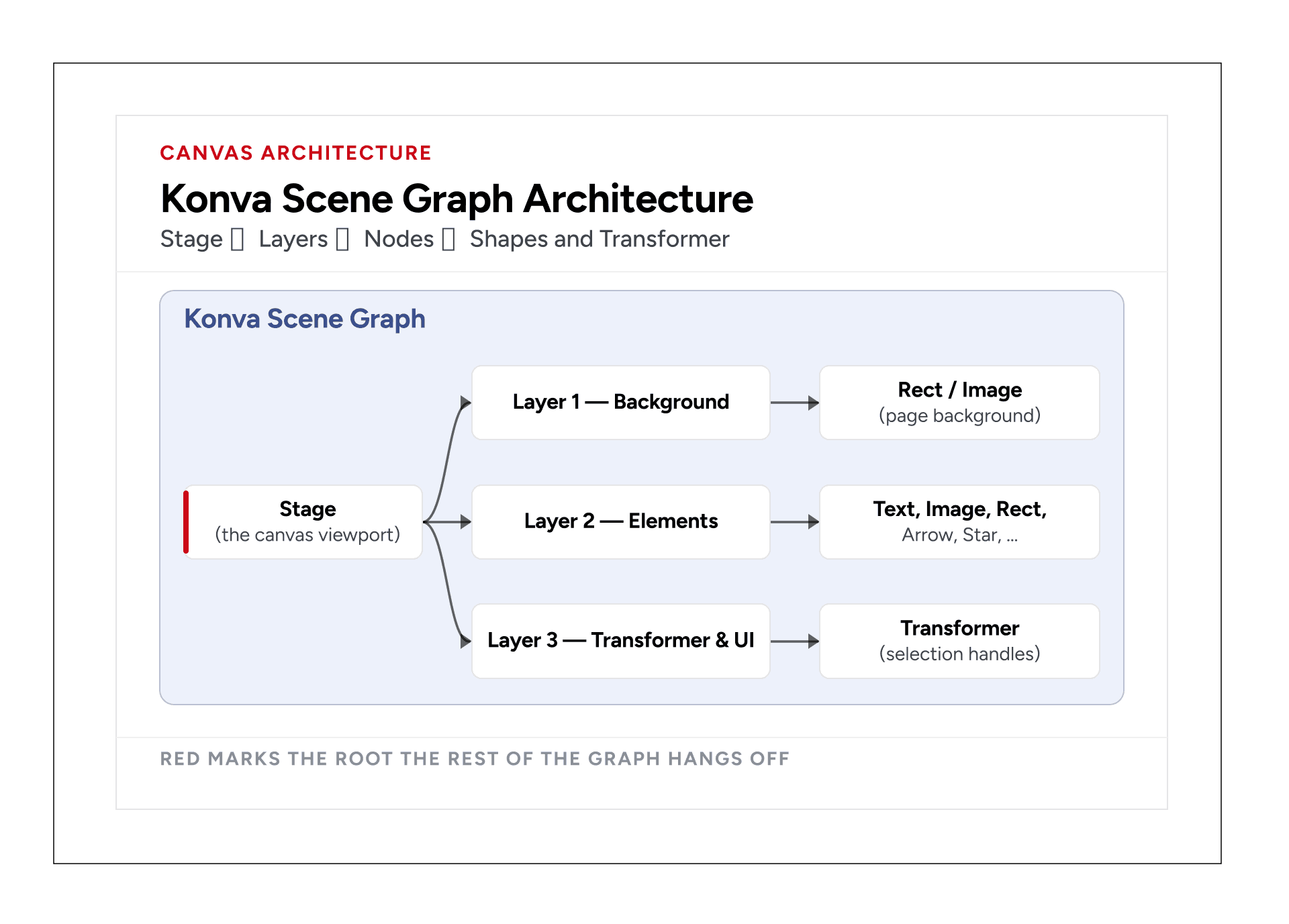
Konva Concept | Core Responsibility | Implementation in Our Editor |
Stage | The root canvas container managing global dimensions, viewport scaling, and top-level mouse/touch events | One Konva Stage per document page inside our canvas container |
Layer | An independent HTML5 2D canvas drawing surface with isolated redraw loops | Three discrete layers: Background layer, elements layer, and transformer/UI overlay layer |
Shape | Drawable nodes on the canvas (Text, Rect, Circle, Line, Arrow, Image, Star, etc.) | One Konva shape per document element dispatched dynamically via our shape rendering engine |
Transformer: Interactive selection bounding box that provides drag, resize, and rotation handles and attaches to active selections through our transformer wrapper for live manipulation.
Shape Registration: All required Konva shapes are registered at app initialization — including Rect, Circle, Ellipse, Text, Image, Line, Arrow, RegularPolygon, Star, Wedge, and Arc — ensuring tree-shaking keeps bundle size minimal while guaranteeing all element types render without runtime errors.
Editor Architecture at a Glance
The editor is engineered as a hybrid Next.js/React application wrapped around a high-performance Konva canvas. React governs the outer UI chrome, toolbar actions, sidebar panels, and state management, while Konva drives the 2D visual layout surface.
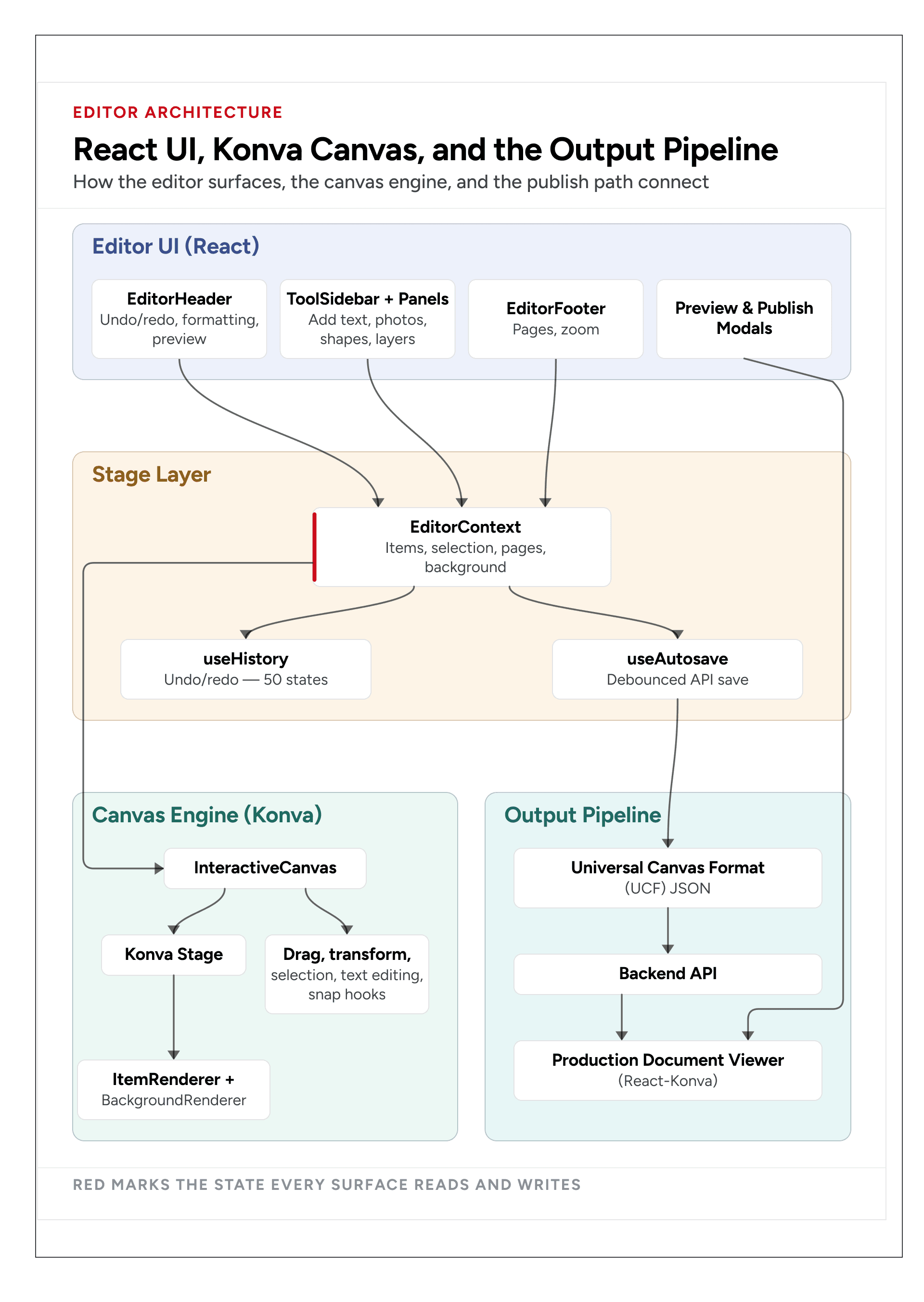
The Hybrid Canvas Model
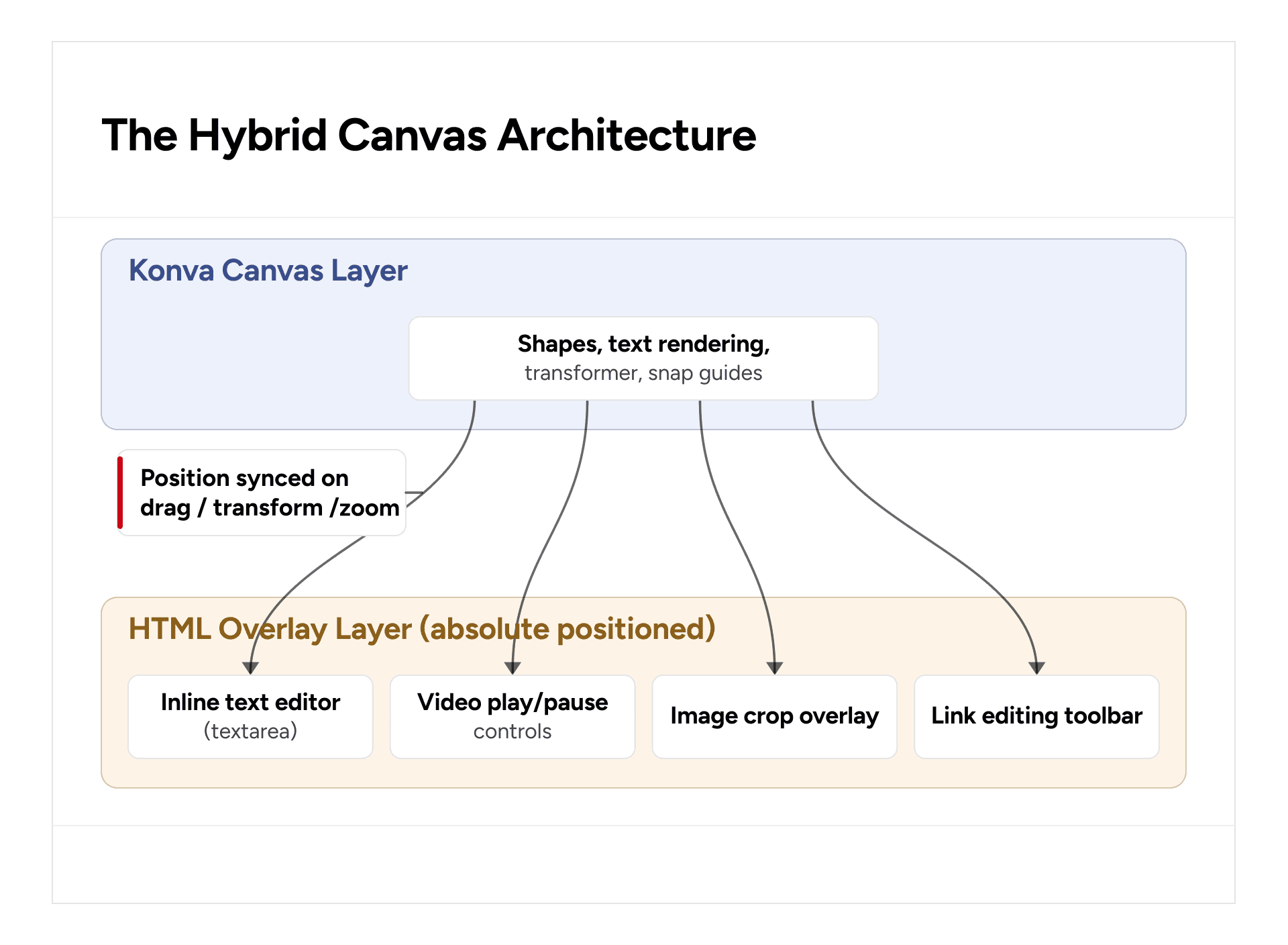
One of the biggest engineering decisions was not using the canvas for everything. At first, we tried rendering every interaction directly inside Konva. It quickly became obvious that some browser features simply work better in the DOM.
Examples include:
- Blinking text cursor
- Spell check
- Video controls
- Copy/paste
- Text selection
Instead of fighting the browser, we built a Hybrid Canvas Architecture where Konva renders graphics while temporary HTML overlays handle editing.
To combine the performance of canvas with the rich UX of the DOM, our editor implements a Hybrid Canvas Architecture:
Why the Hybrid Model Matters
- Inline Text Editing: When a user double-clicks a text item, an invisible HTML <textarea> is mounted at the exact bounding box and rotation of the Konva text node — providing native cursor blinking, typing, and keyboard shortcuts.
- Rich Text Formatting: Multi-range formatted text (bold, italic, underline per character slice) is painted directly onto the canvas via a custom ceneFunc (drawFormattedTextOnCanvas) — ensuring correct z-ordering without persistent DOM elements.
- Video Playback: Video items display a poster thumbnail on canvas, while interactive playback, trimming, and audio controls appear in a synchronized DOM overlay.
- Real-Time Overlay Synchronization: Floating toolbars and editing inputs continuously recalculate their CSS transforms during canvas panning, zooming, and item dragging.
Architectural Takeaway: By keeping DOM overlays transient (active only during direct editing) and painting all normal elements inside Konva, we preserve 60 FPS canvas performance while giving users full browser editing ergonomics.
How a User Action Becomes Canvas State
Every user interaction follows a strict unidirectional loop: UI event → Global Editor State → Konva re-render → history push → debounced autosave.
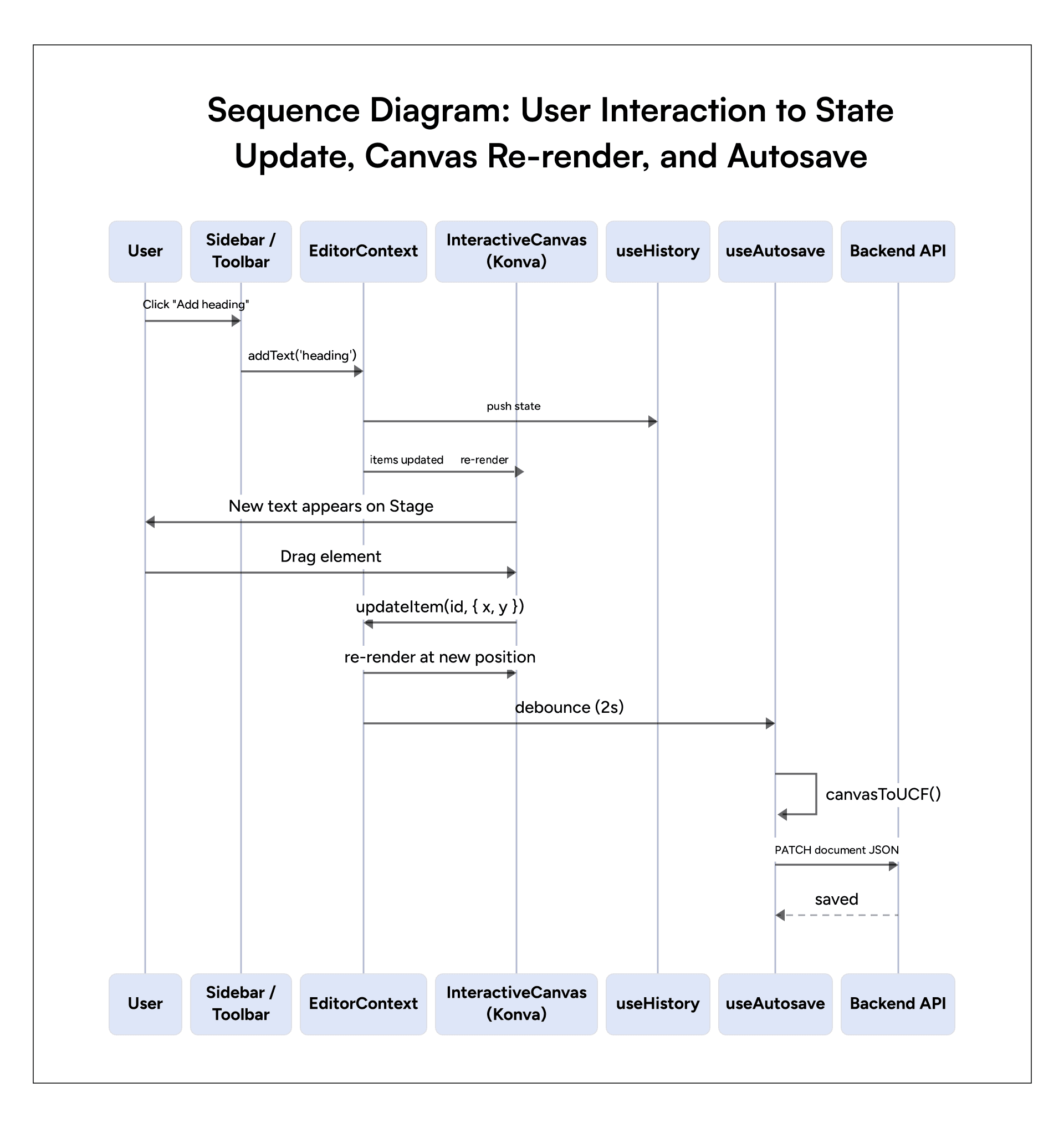
Interaction Loop Steps:
- User Triggers Action: User clicks 'Add heading' in the sidebar or drags an element on canvas.
- Context Mutation: The action invokes addItem() or updateItem() in the global editor state.
- History Recording: The history manager pushes the previous snapshot onto the 50-state undo stack.
- Canvas Re-draw: React-Konva receives updated props and re-renders the modified shapes on the elements layer.
- Debounced Serialization: The autosave pipeline serializes canvas items to JSON and dispatches a debounced (2-second) PATCH request to the backend API.
Key User Flows
Flow 1 — Adding and Editing Text
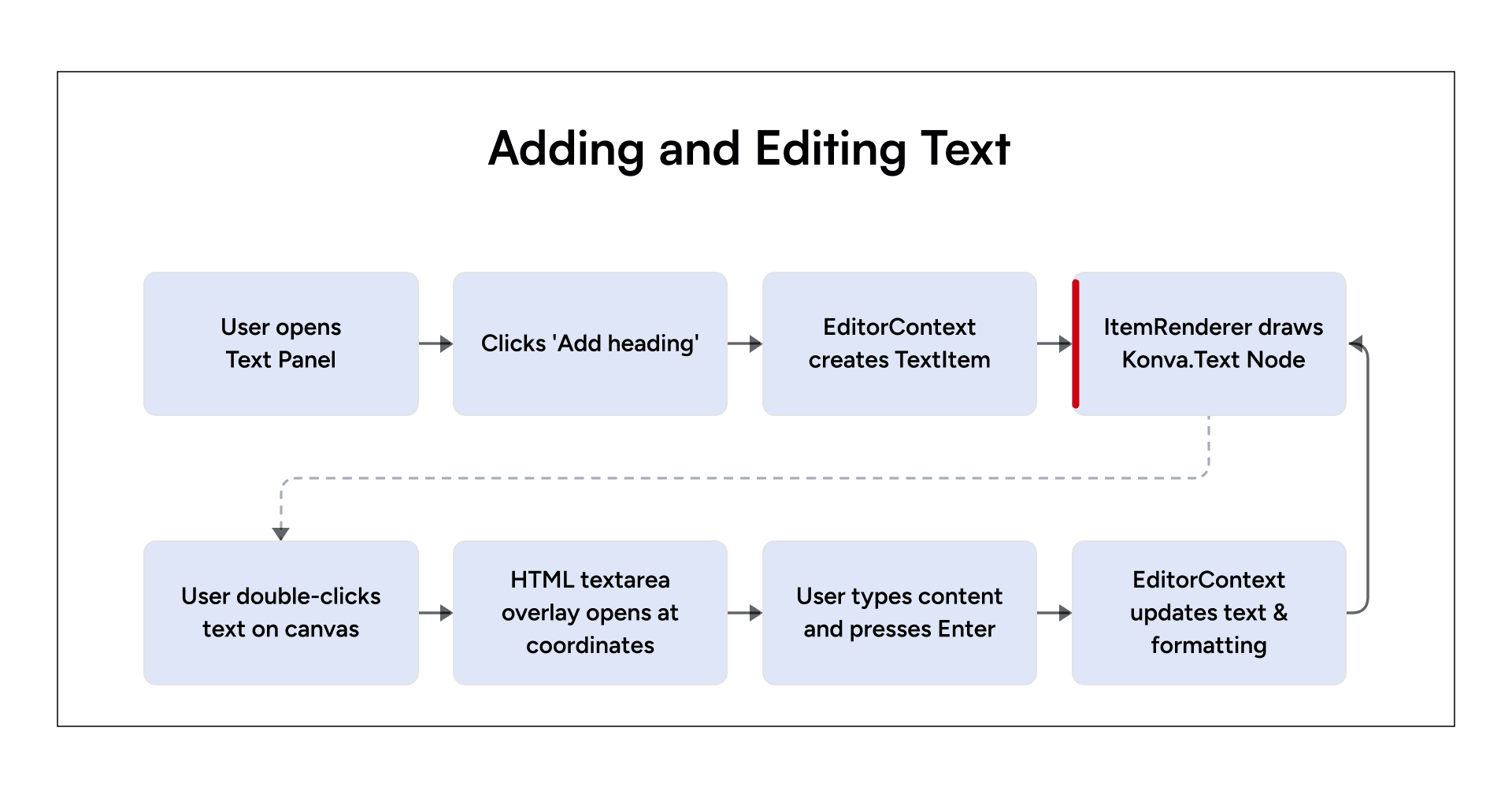
Konva Touchpoints: Konva.Text node, custom sceneFunc for formatted character ranges, and Transformer with scale-to-fontSize baking (scaling corner anchors adjusts fontSize directly to avoid pixelated text).
Flow 2 — Adding an Image from Unsplash
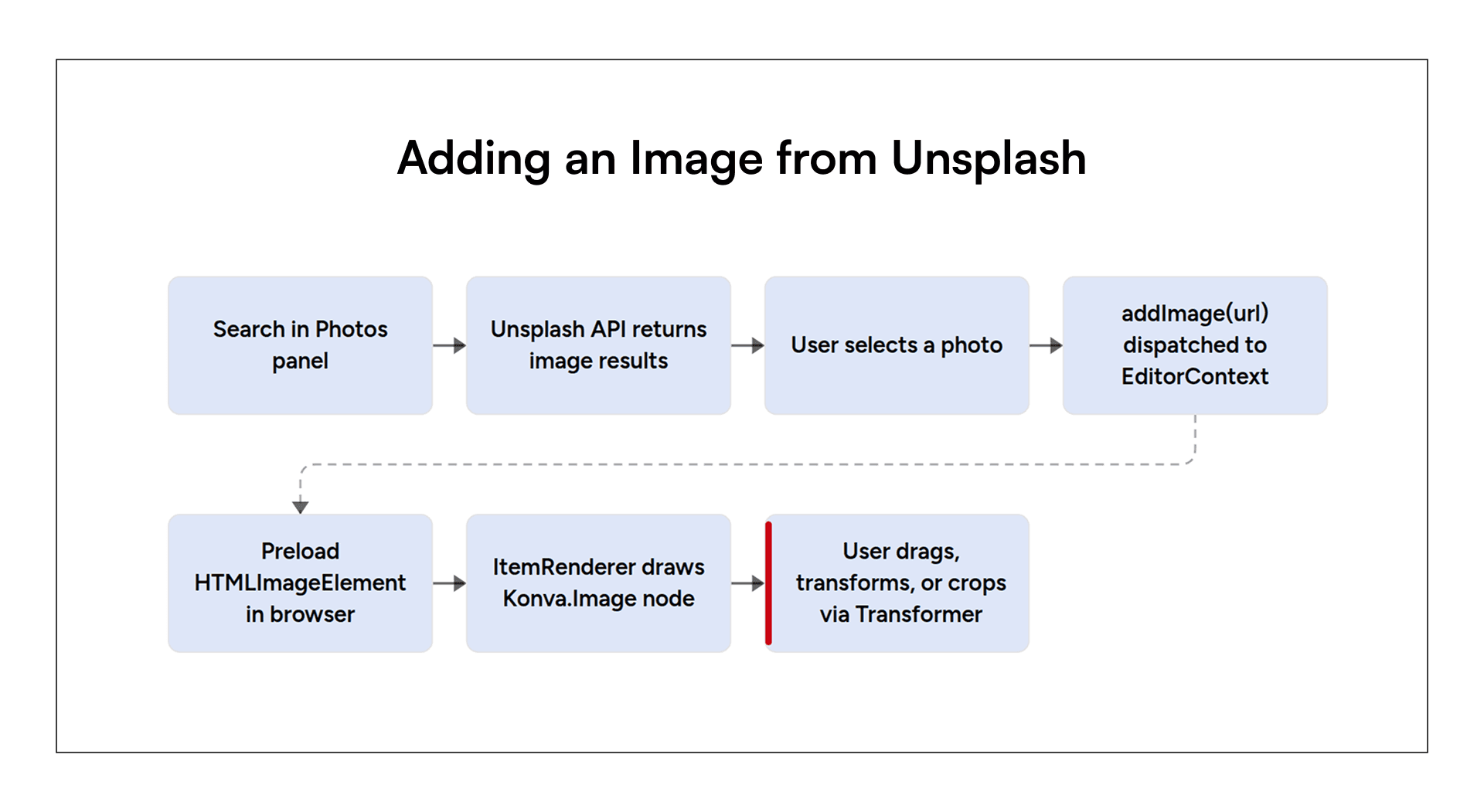
Konva Touchpoints: Konva.Image node with HTMLImageElement source; mask clipping via custom clipFunc; aspect ratio preservation during transform handles.
Flow 3 — Selection, Transform, and Snap
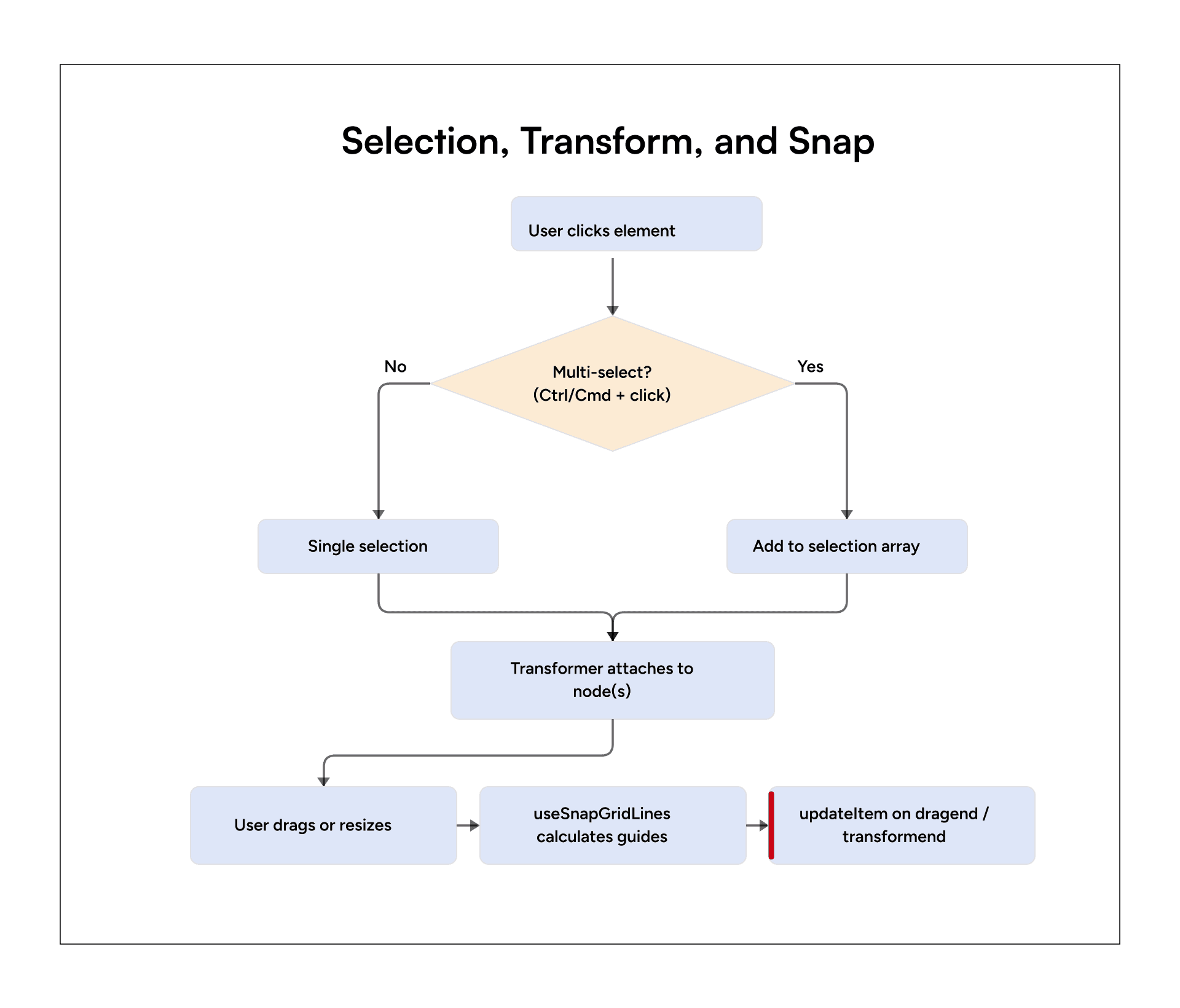
Konva Touchpoints: Canvas Transformer with 8 anchor handles, real-time snap grid logic calculating alignment guidelines against canvas edges and sibling elements; arrows bypass Transformer and use 2-point anchor handles.
Flow 4 — Save, Preview, and Publish
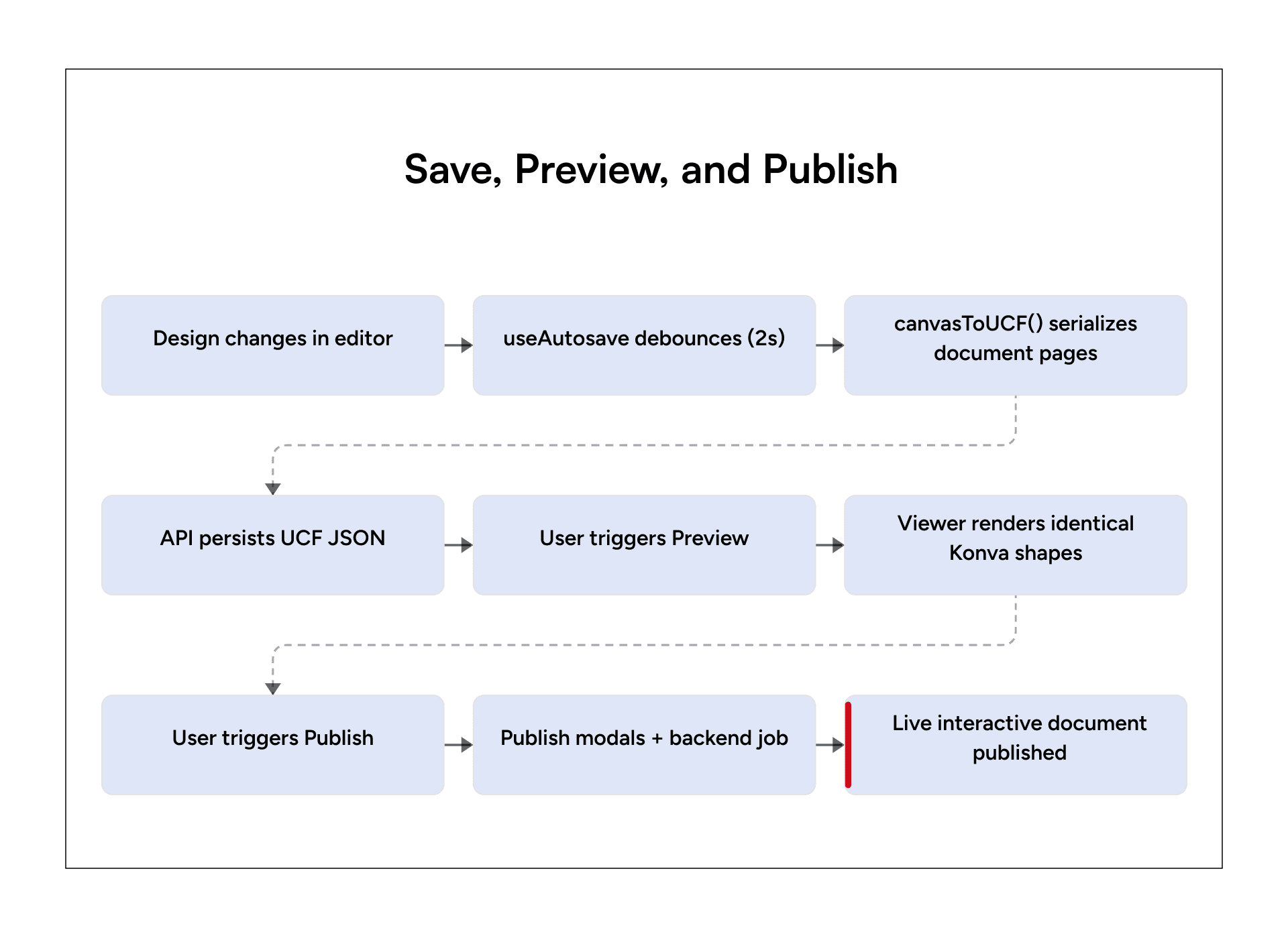
Konva Touchpoints: Serialization transforms page scenes into Universal Canvas Format (UCF) JSON. The same Konva shape vocabulary is reused in the client viewer for 100% visual fidelity between editor preview and production viewer.
Supported Element Types
The editor supports 12 distinct element types, each mapped to a Konva primitive or custom renderer:
Element Type | Konva / Custom Renderer | Technical Implementation Notes |
Text | Konva.Text + custom sceneFunc | Inline HTML textarea editing; rich formatted character ranges (bold/italic/underline) painted on canvas |
Rectangle | Konva.Rect | Solid and gradient fills, border strokes, customizable corner radius, opacity |
Circle / Ellipse | Konva.Circle | Uniform and non-uniform radial scaling with aspect lock support |
Line | Konva.Line | Point coordinate array scaling and rotation handling during transform |
Arrow | Konva.Arrow | Custom 2-point anchor editing (head and tail moved independently) |
Polygon / Star | Konva.RegularPolygon / Konva.Star | Configurable vertex count, inner/outer radius ratio |
Wedge / Arc | Konva.Wedge / Konva.Arc | Custom selection overlay with start/end angle dragging |
Image | Konva.Image | Crop rectangle math, shape masks (circle, star, heart, diamond), opacity, filters |
Video | Konva.Image frame + HTML overlay | Video poster on canvas; synchronized DOM player (max 3 videos per document) |
Button / Link | Custom Group (Rect + Text) | Clickable interactive hotspot, URL navigation, document action binding |
Frame | SquareFrameRenderer / TornFrameRenderer | Decorative organic image container with clipping masks |
Background | Konva.Rect or Konva.Image | Full-canvas element positioned behind all items with aspect cover math |
Dispatch logic operates using a clean TypeScript discriminated union (CanvasItem).
What Worked Well & Architectural Strengths
Dev–Prod Parity for Rendering
Designs export to UCF JSON and render in the client viewing app with the identical Konva primitives. Creators see in preview exactly what end-users experience in production — zero rendering drift or font mismatches.
Hook-Based Interaction Logic
Complex canvas behaviors are decomposed into dedicated, testable custom React hooks rather than one monolithic component:
Custom React Hook | Core Responsibility |
useDragHandlers | Single-item drag, multi-selection drag, and transformer drag coordination |
useTransformHandlers | Resize, rotate, scale commit per item type with aspect ratio constraints |
useSelectionHandlers | Single click, shift/cmd multi-select, background click deselect |
useTextEditing | Double-click text editing activation, textarea placement, keyboard commit |
useArrowHandlers | Two-point arrow anchor handle dragging and coordinate calculation |
useSnapGridLines | Real-time alignment guide calculation and snapping against canvas & elements |
useCanvasEffects | Transformer attachment lifecycle, keyboard nudge handling (arrow keys) |
useSnapGridLines | Real-time alignment guide calculation and snapping against canvas & elements |
useCanvasEffects | Transformer attachment lifecycle, keyboard nudge handling (arrow keys) |
useHistory | 50-state undo/redo stack with state compression and debounced push |
useAutosave | Debounced 2-second canvas serialization and PATCH API save pipeline |
useKeyboardShortcuts | Global keyboard hotkeys (Ctrl+Z, Ctrl+Y, Ctrl+C, Ctrl+V, Delete, Nudge) |
This modular structure keeps canvas orchestration clean, readable, and maintainable.
Production Performance Benchmarks & Metrics
To maintain smooth interactions on resource-constrained client machines, the canvas engine underwent rigorous benchmarking:
Performance Dimension | Production Metric Achieved | Engineering Mechanism |
Interaction Frame Rate | Solid 60 FPS across 250+ canvas elements | Node ref mutations bypass React virtual DOM during active dragging and transform cycles |
Transformer Rotation Latency | < 12 ms per frame redraw cycle | Layer splitting: transformer anchors render on an isolated canvas layer without invalidating elements |
Autosave Network Reduction | 94% reduction in API write volume | 2-second debounce timer on state mutations; payload diffing prevents redundant PATCH requests |
History Heap Memory | < 14 MB for 50-state undo/redo buffer | Structured cloning of lightweight UCF state trees with debounced 300ms snapshot intervals |
Footprint Client Rehydration | < 85 ms initial stage render time | Pre-warmed Google WebFont cache + TTF binary prefetching in localStorage |
Production War Stories & Solved Edge Cases
Building a production canvas editor revealed complex graphics and browser synchronization edge cases that standard documentation overlooks:
Challenge 1: Solving Text Blurriness on High-DPI / Retina Displays
Symptoms: Vector shapes rendered crisply, but canvas text and stroke borders appeared slightly blurry on Apple Retina screens and 4K displays.
Root Cause: Browser window.devicePixelRatio (2x or 3x) scales canvas CSS display dimensions without automatically scaling the underlying canvas backing buffer resolution.
Production Fix: Konva automatically handles pixel ratio scaling, but custom formatted text painted via HTML5 2D Canvas context (sceneFunc) required explicit scale normalization: ctx.scale(pixelRatio, pixelRatio) to ensure sub-pixel font anti-aliasing matching native DOM text.
Challenge 2: The Google Fonts Asynchronous Loading Race Condition
Symptoms: When opening a document with custom fonts (e.g., Playfair Display, Montserrat), text elements briefly measured with default fallback fonts, resulting in incorrect line wraps, clipped bounding boxes, and transformer handle misalignments.
Root Cause: Konva renders immediately on mount before document.fonts.load() resolves webfont TTF files.
Production Fix: We implemented a font management provider that prefetches document fonts, listens to document.fonts.ready, and triggers an atomic stage batchDraw() with text node bounding box recalculations once font glyphs are resident in GPU memory.
Challenge 3: Transformer Corner Scaling vs. Text Box Aspect Distortion
Symptoms: Dragging a transformer corner handle on a text box caused font characters to stretch non-uniformly (ovaled glyphs) instead of reflowing text naturally.
Root Cause: Konva Transformer applies scaleX and scaleY matrix multipliers to the target node during transform.
Production Fix: On transformend, our transform handling hook intercepts the event, resets node.scaleX(1) and node.scaleY(1), and bakes the scale multiplier directly into the text element's fontSize and width properties: newFontSize = Math.round(oldFontSize * scaleX). This guarantees crisp, undistorted font rendering.
Challenge 4: CSS Zoom Matrix Decoupling
Symptoms: When users zoomed the viewport using the footer slider (50% to 200%), inline text editing text areas and crop overlays drifted away from their target shapes.
Root Cause: Canvas pan and CSS scale zoom apply outside Konva's internal coordinate matrix.
Production Fix: In our UI position calculator, overlay screen coordinates are computed by multiplying the shape's absolute Konva transform matrix by the stage's parent CSS transform scale factor: clientPos = shape.getAbsolutePosition() * zoomScale + stageOffset.
Exporting UCF JSON into High-Resolution Image Views for End Users
Once a visual document is designed and saved as Universal Canvas Format (UCF) JSON, end users need to view, share, and consume it across various client devices. Our architecture supports two distinct consumption modes:
Real-Time Interactive Canvas Rehydration
In web applications across desktop and mobile devices, the document viewer mounts a lightweight, read-only Konva Stage. It consumes the UCF JSON directly and renders the scene graph using the same shape dispatchers — with zero editor overhead (no toolbars, no transformer handles, no editing textarea overlays). This enables buttery-smooth interactive page flips, video playback, and clickable hyperlink hotspots.
Headless Offscreen Image Generation (PNG/WebP/PDF)
For generating static thumbnails, social sharing cards, downloadable PNGs, and print-ready PDFs, the application executes a client-side headless rendering pipeline:
- Offscreen Stage Mount: An invisible DOM container is dynamically created outside the visible viewport (left: -10000px) with the exact width and height of the document page.
- Asset Preload Verification: The headless viewer renders the UCF scene graph and pauses capture until all remote assets (Unsplash images, Google Fonts TTF files, custom shape masks) have fully resolved.
- Frame Settling: Double requestAnimationFrame() cycles allow font kerning, image decodes, and canvas clipping paths to paint completely.
- High-DPI Raster Capture: We execute stage.toDataURL({ pixelRatio: 2, mimeType: 'image/png' }) on the rendered Konva stage. Setting pixelRatio: 2 produces ultra-sharp, publication-grade 300 DPI raster images without any blurriness or distortion.
- Automatic Cleanup: Once the image data URL / Blob is resolved for download or preview, the offscreen root is safely unmounted to prevent browser memory leaks.
Engineering Lessons
After building this editor, five lessons stood out:
1. Don't fight the browser
Use the DOM for text editing.
2. Keep rendering deterministic
The editor and viewer should use the same rendering engine.
3. Performance starts with architecture
Optimizations matter less than choosing the right rendering model.
4. Serialize state, not pixels
JSON scales better than images.
5. Invest in reusable interaction hooks
Hooks kept our codebase maintainable as the editor grew.
Tech Stack & Further Resources
The editor is built on a modern React ecosystem centered around Next.js 15 (App Router) and Konva.js with React-Konva, which together provide a scalable foundation for high-performance 2D canvas rendering, scene graph management, and interactive editing. React Context manages editor state, selections, history, and document metadata, while TanStack Query and an internal API client handle data fetching, caching, and debounced autosave operations. The interface is styled with Tailwind CSS, typography is powered by the Google Fonts API with a custom TTF loader for accurate font rendering, and media assets are sourced through the Unsplash API and stored in cloud storage backed by a CDN. Documents are serialized into a lightweight Universal Canvas Format (UCF) JSON, enabling fast persistence, portability, and pixel-perfect rendering consistency between the editor and viewer.
Developers interested in exploring the underlying technologies can refer to the official Konva.js documentation including the Getting Started guides, React-Konva integration guide, API Reference, Performance Tips, Select & Transform documentation, Interactive Sandbox examples, and the Konva and React-Konva GitHub repositories. These resources provide comprehensive guidance for building high-performance canvas applications and extending the techniques demonstrated throughout this article.
Core Engineering Takeaways
Building a production-grade canvas editor requires coordination across rendering, state management, browser APIs, networking, and user experience.
Konva.js provided the rendering engine, while the surrounding architecture handled hybrid editing, history management, autosave, performance optimization, and rendering fidelity across the editor and viewer. Beyond solving interesting engineering problems, the editor transformed our document creation workflow. Tasks that previously required external design tools and lengthy collaboration can now be completed entirely within the application in minutes, while maintaining consistent rendering between editor and viewer.
The current architecture was intentionally designed for extensibility. Planned capabilities include collaborative real-time editing, reusable templates, version history, AI-assisted layout generation, reusable design components, and plugin-based extensibility. Because the editor is built around a scene graph and serialized document model, these features can be introduced without fundamental architectural changes.
The architecture and lessons shared in this article can help engineering teams avoid similar pitfalls when building scalable, production-ready canvas applications.
For teams building web applications with complex interactions and demanding performance requirements, the right frontend architecture can shape how the product scales. Our Next.js Development Services support teams in building web applications designed for performance, maintainability, and growth.