

Key Takeaways
- Banks can build AI-Powered Banking CRM Platforms without replacing the core, using an integration layer that keeps account and transaction processing untouched.
- The highest-value use cases, relationship manager copilots, next-best-action recommendations, and fraud alert enrichment, carry a clear, measurable business case.
- Governance, including access controls, audit trails, and human-in-the-loop approvals, works best when built into the platform from the start.
- A phased roadmap, starting with data unification and ending with autonomous workflows, lets banks prove value at each stage before committing budget to the next phase.
Why Are Banks Modernizing CRM Before Replacing Core Banking Systems
Banks are pouring resources into artificial intelligence, and the returns fail to appear. McKinsey's research on AI-powered banking points to a specific reason: institutions layer AI onto legacy operating models and automate processes that needed a redesign. The technology works, but the approach around it does not. The same story holds across CRM, lending, and fraud detection, where automation without redesign multiplies inefficiency without solving it.
This gap surfaces in customer relationship management. Banks hold decades of transaction history, service records, and product data inside core banking systems built for stability. Adding AI capabilities to these systems without a plan for how customer data moves, gets governed, and reaches relationship managers in real time creates fragmented recommendations and delivers no measurable value.
The efficiency question banks ask has changed, moving past cost tracking as the sole measure of success. The pace at which a bank turns data into personalized action is becoming the sharper measure of competitive standing.
I have sat through enough steering committee meetings to know the moment a core replacement conversation turns into a two-year budget fight. The AI question does not need to trigger that fight. Every bank I talk to has the data the AI needs sitting inside a core system built decades ago, they have not connected it to anything that can use it. That is the real gap, not the technology. Close that gap first, and the core conversation can wait until the bank is ready to have it
 Kunal KumarChief Revenue Officer
What I see in the room when we sit with banking leadership is a split reaction to that number: the CFO leans in, the risk officer leans back. Both reactions are correct. The number is real, and so is the exposure if a bank chases it by touching systems that hold every account and transaction record. The banks moving quickest separate the AI decision from the core decision, and run them as two projects with two different risk profiles.
This guide is for banking and fintech leaders exploring AI-powered banking CRM platforms built on top of the systems they run, without a replacement of the core banking systems holding customer truth.
What Should an AI-Powered Banking CRM Platform Do?
An AI-powered banking CRM platform connects customer data, transaction signals, service interactions, product eligibility, risk indicators, and relationship history into a single actionable layer. The difference from a standard CRM lies in the constant flow of live banking data feeding every screen a banker touches. Relationship managers, call center teams, and branch staff work from one connected view spanning every system that touches the customer.
This platform builds a customer 360 view across retail, commercial, wealth, and lending relationships. AI-assisted workflows guide relationship managers through each account, surfacing lead scores and next-best-action recommendations that point toward the right conversation at the right time. Service case triage and routing move customer issues to the correct team without manual sorting. KYC and onboarding intelligence speed verification while compliance stays intact.
The platform predicts churn, delinquency, and cross-sell opportunity, and generates conversational summaries for branch, call center, and relationship manager teams, replacing long case histories with a clear picture of the customer relationship. Every recommendation carries an audit-ready log, giving banks a system built for both intelligence and accountability.
Why Is Replacing Core Banking Systems the Wrong First Move?
Core banking systems hold the truth for every account, transaction, loan, balance, and customer record a bank maintains. Replacing this infrastructure introduces operational risk, migration risk, downtime risk, compliance risk, and cost escalation, all at once and across a system the entire bank depends on. Most CRM modernization goals do not require this level of risk. Integration, orchestration, data enrichment, and AI workflow layers achieve the same outcomes without touching the core.
Core banking integration works by introducing AI at the edges of existing infrastructure. In core systems integration banking, the system keeps processing transactions, managing accounts, and handling settlements the way it has, while AI operates at the boundary. API-layer integration lets AI components consume data and return outputs without touching core logic or transaction processing. Event-driven AI processing reads transaction streams in real time, flagging anomalies and triggering routing decisions while the core runs on its own track. Isolated development and validation environments keep AI components separated from production during build and testing, protecting live operations from disruption. Capabilities roll out one at a time, each validated against clear performance and governance criteria before the next moves forward.
Core modernization remains a valid long-term goal. It stops being the dependency standing between a bank and a working, intelligent CRM.
What Architecture Supports AI-Powered Banking CRM Platforms Without Core Replacement?
I build architecture diagrams under production traffic that cannot go down. The pattern in this section is the one we used wrapping a core banking system under an RBI mandate: keep the core running as it is, and put every new capability at the edge where it can be tested and rolled back without reaching into a live transaction. That discipline holds whether the new capability is AI or a REST API. If a vendor pitches an AI layer that requires touching the core, ask what their rollback plan looks like during a live production incident. Most cannot answer that question.
 Saurabh SahuChief Technology Officer (CTO)
The four-layer split described in this section reflects real delivery work. We used a version of it to migrate more than 100 partner integrations for one of India's largest private banks during a live regulatory deadline, with zero downtime and zero customer disruption. The governance layer running beneath the AI and integration work, logging every change before it reached production, made that outcome possible. Banks that skip that layer to move faster on the AI side pay for it in an audit finding or a production incident nobody can trace. Build the governance layer before the AI layer.
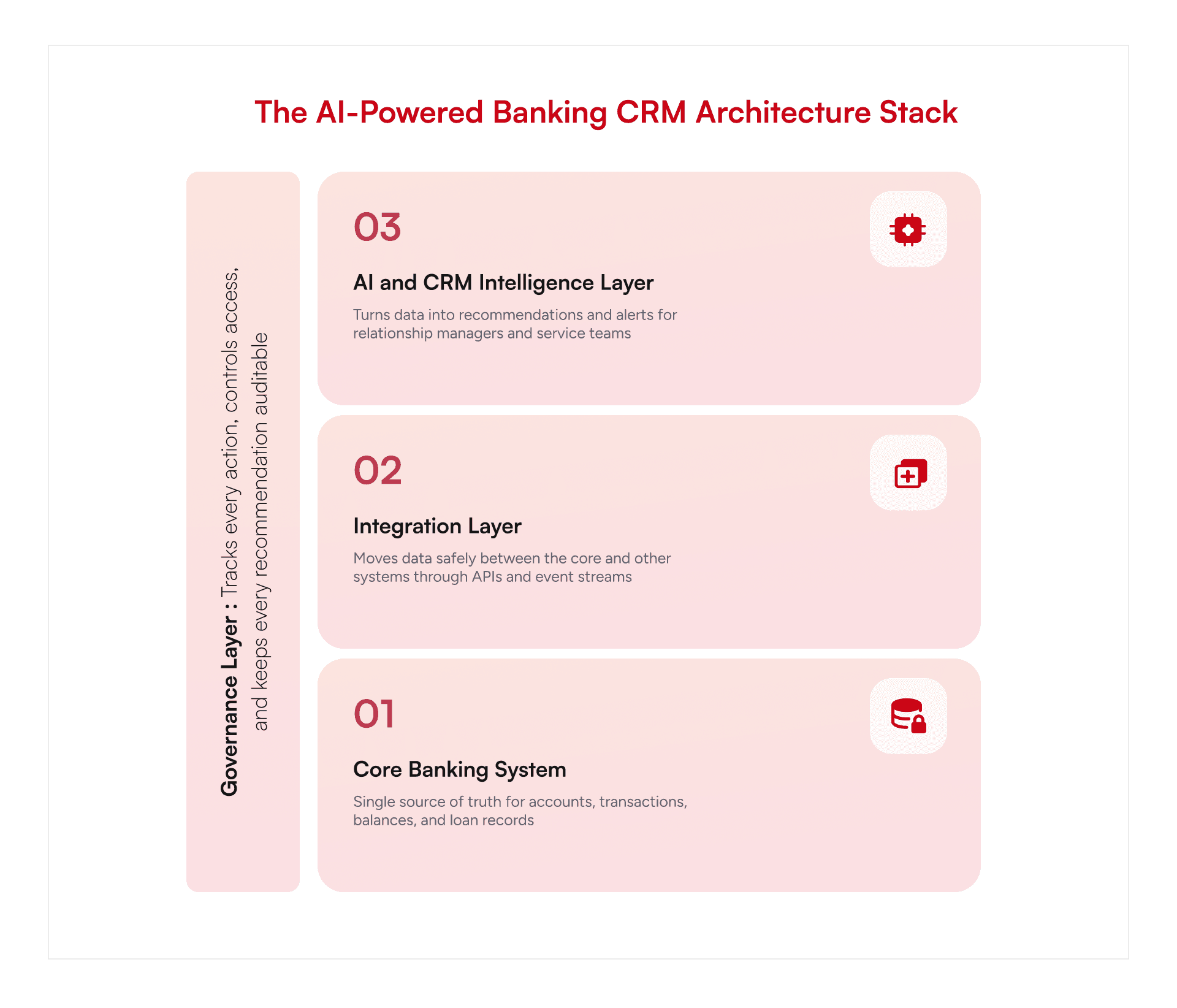
Banks that modernize CRM without disturbing the core rely on four layers, each carrying a distinct responsibility and a clear boundary against the others. This architecture answers the question banking leaders raise: how a bank adds AI-powered CRM intelligence while keeping the core system untouched.
Core Banking System as the System of Record
The core banking system remains the single source of truth for accounts, transactions, balances, and loan records. This role does not change under the architecture described here. Every AI capability and CRM workflow built on top of the core reads from this record through controlled channels and writes back the same way, without processing transactions or altering how the core manages settlement. This separation matters because auditors and regulators trace every customer-impacting decision back to system-of-record data, and a core that continues functioning without disruption removes the largest source of implementation risk.
Integration Layer for Safe Data Movement
An integration layer operates between the core and every system that touches customer data, enabling controlled movement rather than direct access. APIs, event streams, and message queues carry data out of the core into CRM and AI systems, and carry approved actions back in. This layer absorbs the complexity of connecting to core systems that predate real-time data sharing, translating rigid legacy formats such as fixed-width mainframe records into structures a CRM or AI model can read. For banks running core platforms from vendors that never anticipated large language models or agentic AI, this layer becomes the point where modern capability meets legacy constraint, without asking the core to change.
AI and CRM Intelligence Layer for Customer-Facing Workflows
This layer carries the work relationship managers, branch staff, and call center teams handle: lead scoring, next-best-action recommendations, service case triage, churn and cross-sell prediction, and customer 360 views spanning retail, commercial, and wealth relationships. This layer consumes enriched data from the integration layer and shapes it into output built for each team's workflow. The intelligence generated here stays specific to context, shifting tone and content between a retail account and a commercial relationship carrying multiple products and covenants.
Governance Layer for Auditability and Control
A governance layer runs across the other three, tracking every data movement, every model recommendation, and every action taken on that recommendation. Role-based access controls, audit trails, and human-in-the-loop approval points give banks a record they can present to regulators and internal risk teams without reconstruction after the fact. Without this layer, a bank facing a regulatory inquiry into a specific customer decision has no consolidated trail connecting the recommendation to the data behind it, and must piece the history together from separate system logs. Model monitoring and bias checks run inside this layer, catching drift in recommendation quality before it reaches a customer-facing team.
Together, these four layers give banks a path to AI-powered banking CRM platforms that respect the constraints of a regulated institution while equipping customer-facing teams with speed and intelligence the core alone cannot provide. Banks that build in this order reduce implementation risk while giving relationship teams a system that keeps pace with customer expectations.
Which High-Value Banking CRM Use Cases Do Not Require Core Replacement?
The use cases below deliver a measurable business outcome without touching the core banking system, giving budget holders a clear justification for investment.
Next-Best-Action and Cross-Sell Recommendations
Relationship managers recommend products without a clear signal from the customer's own transaction pattern, relying on judgment where data could guide the decision. Next-best-action and cross-sell recommendations close this gap by combining transaction data from core banking, product holdings, and life-event signals inside the CRM, surfacing the offer a customer is likely to accept within the relationship manager's workflow. Recommendation logic and outcome data stay logged for fair-lending review. Banks measure this through cross-sell conversion rate and revenue tied to AI-surfaced recommendations.
Fraud and Risk Alert Enrichment Inside CRM
Fraud analysts and relationship managers switch between separate fraud systems and the customer record to investigate an alert, adding delay to cases that need a fast response. Fraud and risk alert enrichment brings core banking alerts, transaction anomalies, and account risk scores into the CRM case a fraud analyst or relationship manager has open, removing that switch and giving both roles the same data in one place. Every alert and analyst action logs for regulatory reporting. Banks measure this through faster alert response time and reduced fraud loss.
AI-Assisted Onboarding and KYC
Onboarding and KYC checks span identity verification systems, sanctions and watchlist databases, and application forms, and the delay slows account activation for retail and commercial customers alike. AI-assisted onboarding pulls documents and data from these systems into a single CRM workflow, giving the relationship manager visibility into onboarding status as it happens rather than after account opening. Every verification decision logs its supporting evidence for regulator review. Banks track this through reduced time to account activation and lower manual review volume.
Commercial Banking Account Planning
Commercial teams assemble account context from core banking, product usage records, and covenant data by hand before every renewal or expansion conversation, a manual effort that slows account planning. Commercial banking account planning combines this data into a single account plan inside the CRM, ready for the relationship manager ahead of the conversation rather than assembled the day of. Account plan data and any AI-suggested actions log for internal audit. Banks track this through account plan completion rate and revenue growth on well-planned accounts.
Relationship Manager Copilot
Relationship managers spend time searching account history and past interactions before each client conversation, leaving less time for the conversation itself. Relationship manager copilot pulls this history, product holdings, and recent service interactions from core banking and CRM systems into one pre-call briefing, replacing manual lookup inside the existing CRM workflow. Every suggested talking point carries an audit trail for compliance review. Banks measure this through reduced prep time per account and more client meetings per relationship manager.
Customer 360 Intelligence
Retail, commercial, and wealth teams keep separate views of the same customer in separate systems, producing duplicate outreach and missed cross-sell opportunity. Customer 360 intelligence assembles transaction data, product eligibility, risk indicators, and relationship history from these systems into one CRM profile, replacing scattered records with a single reference point for every team. Role-based access controls limit exposure to sensitive fields by team function. The outcome is a single customer record accessed across every channel, cutting duplicate contact.
What Data, Compliance, and Governance Requirements Does an AI-Powered Banking CRM Platform Need?
Risk-conscious leaders raise the same question at the start of an AI banking CRM conversation: how does a bank keep control over what a model sees, recommends, and does. Governance stops being a checklist item and becomes a platform requirement built into the CRM from the first design decision.
Access to customer data starts with role-based access controls, limiting each user to the fields their role requires. Data masking and tokenization protect sensitive fields such as account numbers and identification data as they move between core banking, the CRM, middleware, and any AI service. Consent management tracks what a customer has authorized for each use of their data, and secure API access keeps every connection between these layers authenticated and monitored. Logging across core, CRM, middleware, and AI services gives compliance teams one trail to review rather than four separate systems to reconcile.
Oversight of the AI layer itself follows a parallel set of requirements. Every AI recommendation carries an audit trail showing the data behind it and the logic used to generate it. Human-in-the-loop approval points keep a person in the decision path before a customer-impacting action takes effect. Model monitoring tracks recommendation quality over time, and bias and fairness checks catch drift before it reaches a customer. Explainability turns a model's output into a reason a compliance officer or regulator can review and understand.
Financial regulators worldwide expect the same combination: transparency, auditability, explainability, continuous evaluation, and human-in-the-loop governance, treated as one connected requirement rather than separate initiatives. A banking CRM platform built around these requirements gives risk teams a system they can trust before the first AI recommendation reaches a customer.
Should a Bank Build, Buy, or Modernize Its AI-Powered Banking CRM Platform?
The decision comes down to what exists and the size of the gap that remains.
- Extend an existing CRM when the platform holds most customer data and needs AI capability layered on top.
- Build a custom AI CRM intelligence layer when a bank's product structure or integration needs go beyond what a packaged platform can match.
- Buy a banking CRM platform when starting from a fragmented or outdated system, where a proven platform closes the gap faster than an internal build.
- Integrate a platform such as Salesforce, Dynamics, BusinessNext, or Backbase with custom AI workflows when the CRM itself fits but the AI layer needs to reflect the bank's own data and risk rules.
- Plan core modernization on its own timeline, rather than bundling it into CRM decisions.
- Hold off on AI when data quality, governance maturity, or integration readiness remains weak.
What Is the Implementation Roadmap for Building an AI-Powered Banking CRM Platform Without Replacing the Core?
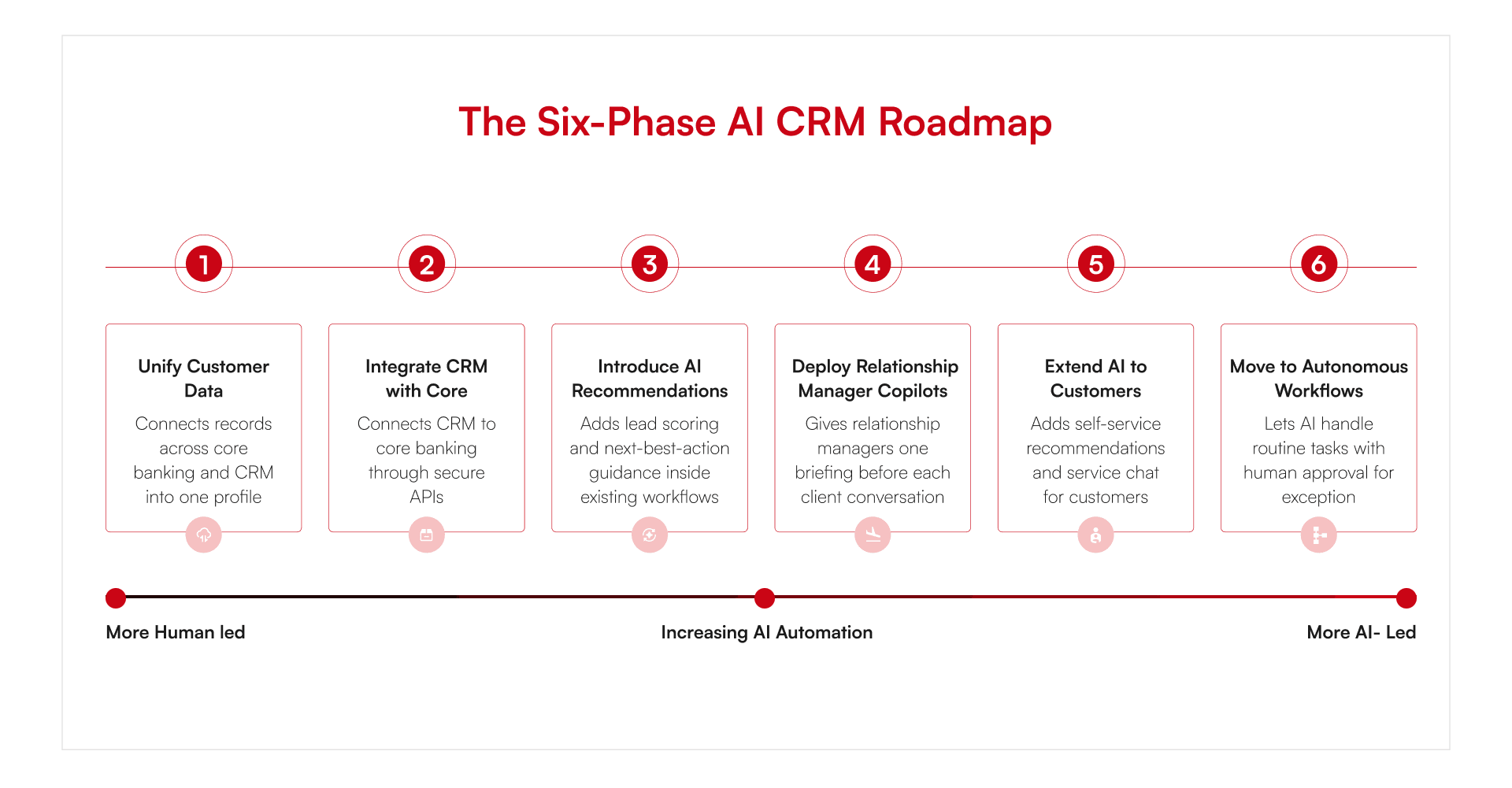
Banks that succeed with AI-powered CRM follow a sequence rather than a single rollout, building each capability on the data and trust established in the phase before it.
Every bank leadership team wants to start at phase four, the copilots and the customer-facing AI, because that is the part that shows up in a board deck. I have sat in enough planning sessions to know how this goes: skipping to that phase without the data unification beneath it produces a copilot that recommends things based on the same fragmented data that caused the problem to begin with. The roadmap in this blog reflects the order failure teaches a team to follow. Phase one is unglamorous and that is the reason the other five phases work.
 Jani Hardik SanjayProduct Owner I
McKinsey's research on core banking transformations found that about 30% of institutions completed a full migration of leaders and products to a new system, based on an analysis of more than 50 transformations over the past decade. I have watched that pattern play out inside real programs for years. The CRM roadmap in this blog avoids that trap by design, each phase produces a working result before the next one gets funded, so the business case gets tested six times instead of once. That approach explains why phased delivery beats big-bang delivery for something this complex. A bank that waits until phase six to prove value is measuring success at the one point where recovery is hardest.
Phase 1: Unify Customer Data Across Core and CRM Systems
Phase one unifies customer data across core banking, CRM, and service systems into a connected profile, resolving the duplicate and fragmented records that block every AI use case that follows. This phase produces the foundation the rest of the roadmap depends on, since a recommendation engine or copilot built on inconsistent data produces inconsistent output. Relationship managers stop pulling one answer from three separate screens to serve a single customer question. The business value appears in fewer data errors and faster reporting before any AI capability goes live.
Phase 2: Integrate CRM With Core Banking and Surrounding Systems
Phase two integrates the CRM with core banking and surrounding systems through the API and event layer described earlier, giving relationship teams a live view of account and transaction data without a core rebuild. This phase carries the most technical risk in the roadmap, since it establishes the connections every later phase relies on. Banks see this phase pay off through faster case resolution and fewer manual lookups across systems that required separate logins.
Phase 3: Introduce AI Recommendations Inside Existing Workflows
Phase three introduces AI recommendations inside existing CRM workflows, starting with lead scoring and next-best-action guidance relationship managers know how to act on without new training. This phase ties to revenue in a way the first two phases do not, since recommendation quality shows up in cross-sell conversion within weeks of rollout, giving leadership a measurable signal that the roadmap is working.
Phase 4: Deploy Relationship Manager Copilots
Phase four deploys relationship manager copilots, pulling account history and service context into one briefing ahead of each client conversation. The business case rests on time saved per relationship manager and the resulting increase in client-facing hours across the team, a metric branch and call center leaders can track without a data science background.
Phase 5: Extend AI to Customer-Facing Interactions
Phase five extends AI into customer-facing interactions, including self-service recommendations and service chat grounded in the same governed data used across the phases before it. Banks track this phase through customer satisfaction scores and reduced call center volume, since customers resolve more questions without waiting for an agent.
Phase 6: Move Toward Autonomous AI Workflows
Phase six moves toward autonomous AI workflows, where governed AI agents handle routine service and onboarding steps such as document collection or standard status updates, with human approval reserved for exceptions and anything customer-impacting. This phase depends on the governance layer built earlier in the architecture, and it compounds the value built across every prior phase, turning a modernized CRM into a system that scales without proportional headcount growth.
What Common Pitfalls Should Banks Avoid When Building an AI-Powered Banking CRM Platform?
Banks that treat AI as a standalone project rather than a platform capability lose momentum once the pilot ends and no delivery structure carries the work forward. The same instinct pushes some institutions toward full core banking replacement before a single AI use case gets validated, risking the entire transformation on one high-stakes migration instead of building toward it in stages.
Execution mistakes compound the strategic ones. Ignoring data quality and customer identity resolution means every AI recommendation inherits the fragmentation sitting beneath it. Building AI without human oversight or governance removes the accountability regulators and customers expect from a customer-impacting system. Neglecting API scalability and integration resilience turns a working pilot into a bottleneck once transaction volume grows. Overlooking change management and user adoption among relationship managers leaves a capable system unused, since a tool nobody trusts earns nobody's business. Failing to define measurable business outcomes from the outset leaves a finished project with no way to prove it worked to the leadership team that funded it.
Banks that avoid most of these mistakes share one pattern: they scope AI to a single business domain, prove the outcome, and use that evidence to fund the next phase. The sequence itself builds the governance, adoption, and data discipline that a single sweeping rollout tends to skip.
Why Choose GeekyAnts as Your AI-Powered Banking CRM Platform Partner?
Banking and fintech leadership teams hire GeekyAnts because delivery discipline shows up in the first conversation, not the contract. We ask about a bank's rollback plan, data lineage, and audit requirements before we ask about scope, the same questions most vendors save for after a project runs into trouble. That habit is why banks bring us back for the next phase rather than shop the market.
Kunal KumarChief Revenue OfficerBanks choosing a partner for AI banking solutions and AI-powered CRM platform engineering need a team that operates inside regulated, high-stakes environments as a default. GeekyAnts works as a digital product engineering and consulting partner, helping banks design, integrate, and scale AI-enabled CRM systems around the platforms they run, rather than proposing a rebuild from scratch.
Case Studies
Zero-Downtime Core Banking Migration for India's Largest Private Bank:
GeekyAnts executed a domain migration under an RBI mandate, updating more than 100 partner integrations during a festive code freeze without a single customer disruption or compliance gap.
Digital Banking App Modernization for a Younger Generation of Customers:
GeekyAnts rebuilt the mobile banking experience on a modern technology stack for a digital-first fintech, an engagement that grew into an ongoing product partnership.
How Should Banks Modernize Their CRM Without Replacing the Core Banking System?
Banks do not need to replace the core to compete on AI. The path that works starts with the architecture, moves through the highest-value use cases, and builds governance in from the first phase rather than added as an afterthought. Banks that follow this sequence turn CRM into an intelligence layer their relationship teams use every day, without the risk a core replacement carries.
The banks ahead on this front treat modernization as a series of proven phases rather than a single large bet. Each phase pays for itself before the next one starts, giving leadership a working system and a measurable result at every stage.