


Cost Optimization and FinOps
We examine your cloud spending patterns, resource allocation strategies, and financial governance so you gain complete clarity on where the budget is leaking. You also understand what inefficiencies are draining your runway, and the most direct route to sustainable, optimized cloud expenditure.
Make Your Cloud Spending Work As Hard As Your Team Does










Most finance and engineering teams only discover wasteful cloud spending when the invoice arrives, and the damage is already done. Our FinOps Assessment brings hidden inefficiencies, oversized resources, and forgotten spend to the surface before they hollow out your budget. Your purchasing decisions become deliberate and data-backed, unnecessary expenditure disappears, and every cloud dollar gets justified. You leave holding a concrete, sequenced action plan your team can begin executing straight away.
Client Results and Success

Production-Ready Kubernetes Architecture
The platform was designed to support scalable production deployments with minimal resource consumption, enabling faster environment provisioning and operational stability.
- environments K8s setup
- 3
- environments K8s setup
- 95%
- savings over managed Kubernetes alternatives
- 35%

40% Faster Onboarding Completion
The redesigned system achieved a 40% reduction in onboarding completion time, directly improving platform adoption and reducing operational bottlenecks.
- Improvement in the doctor's efficiency for treatment planning
- 35%
- Reduction in onboarding completion time
- 40%
Production-Grade AI Infrastructure
The system supports scalable AI inference and automated inspection workflows, reducing manual intervention and enabling consistent performance under growing usage.
Read case study3× Faster Feature Iteration
The platform achieved 3x faster AI feature iteration cycles, significantly reducing time-to-release for new recommendation
- Reduction in meal decision time
- 40%
- Increase in daily active usage during pilot
- 2x
50% Fewer Manual Validation Cycles
The system achieved a 50% reduction in manual validation cycles, improving throughput and accelerating delivery timelines.
- Reduction in manual validation cycles
- 50%
- Faster internal testing workflows
- 50%
60% Cloud Cost Reduction
The platform achieved a 60% reduction in monthly cloud costs while maintaining uptime and transaction stability during and after optimization.
- Saved per month
- $4,800
- Annual savings
- $57,000+
Our FinOps Assessment Spans Three Foundational Pillars
Every project begins with a rigorous, detail-oriented financial audit covering three essential dimensions of your cloud financial management: your spending visibility, your resource efficiency, and your governance maturity.
We never rely on surface-level billing exports and call the work finished. Our AI-empowered practitioners dig directly into your account configurations, your purchasing agreements, your tagging structures, and your team's workflows. The outcome is an unambiguous picture of where your cloud spending is justified, where it's hemorrhaging value, and where poor governance is silently compounding your bills month after month.
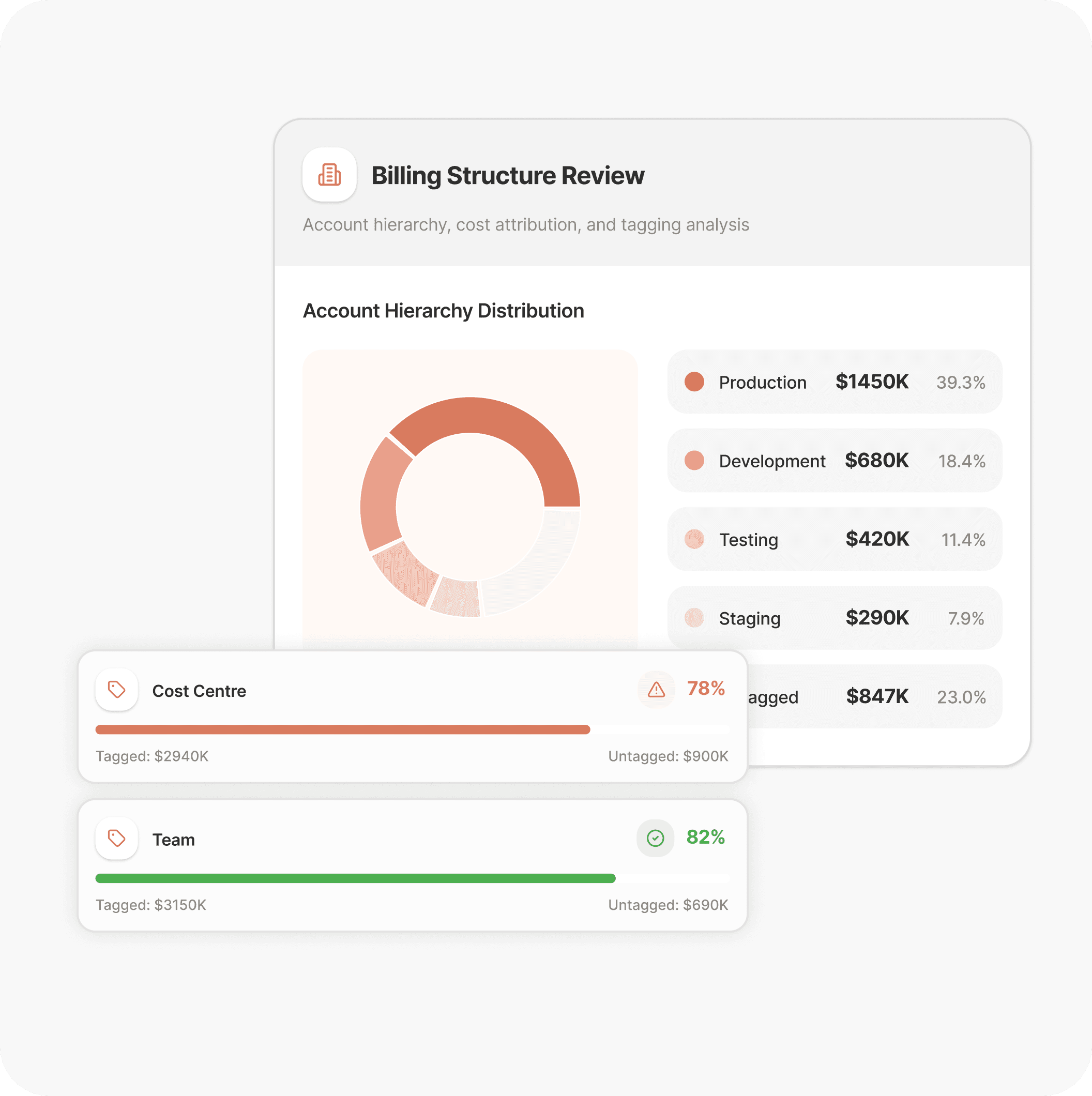
- Billing structure review: Account hierarchy, cost centre attribution, tagging consistency, and reporting gaps
- Unallocated expenditure identification: Spend that cannot be attributed to a team, product, or business unit
- Reserved capacity utilisation: Coverage rates, expiring commitments, and missed savings opportunities
- Third-party and marketplace spend: SaaS tools, data transfer charges, and hidden per-request fees
- Compute right-sizing: Instance families, vCPU-to-memory ratios, and utilisation-based downsizing candidates
- Storage tier optimisation: Object lifecycle policies, snapshot retention, and redundant volume identification
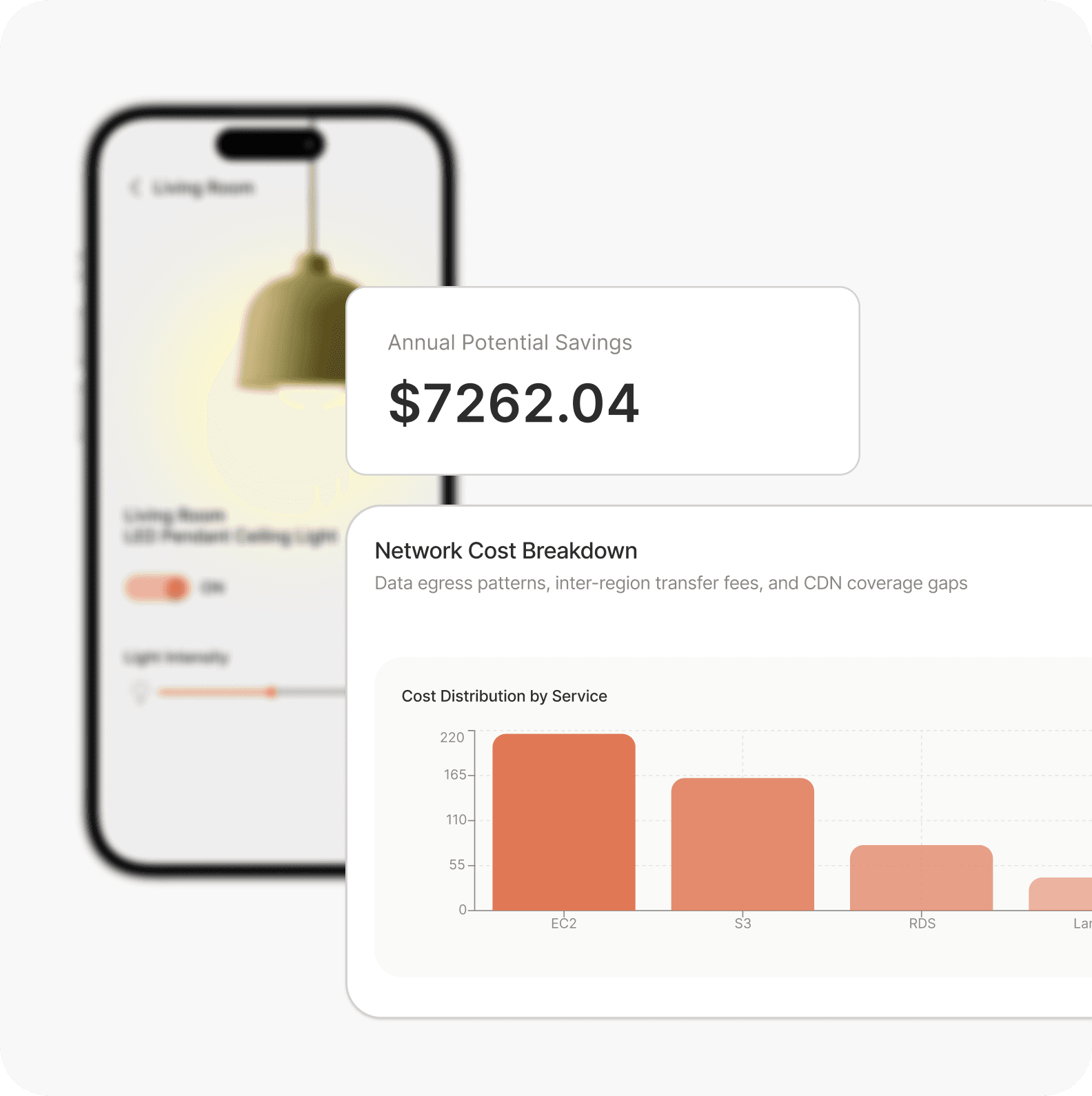
- Network cost breakdown: Data egress patterns, inter-region transfer fees, and CDN coverage gaps
- Idle and zombie resource sweep: Running assets generating cost with zero active consumption
- Budget alerting coverage: Threshold policies, escalation recipients, and anomaly detection configuration
- Purchasing model strategy: On-demand versus reserved versus spot allocation across workload types
- FinOps process maturity: Team accountability structures, showback versus chargeback models, and review cadences
- Policy enforcement gaps: Automated guardrails preventing budget overruns before they register on invoices
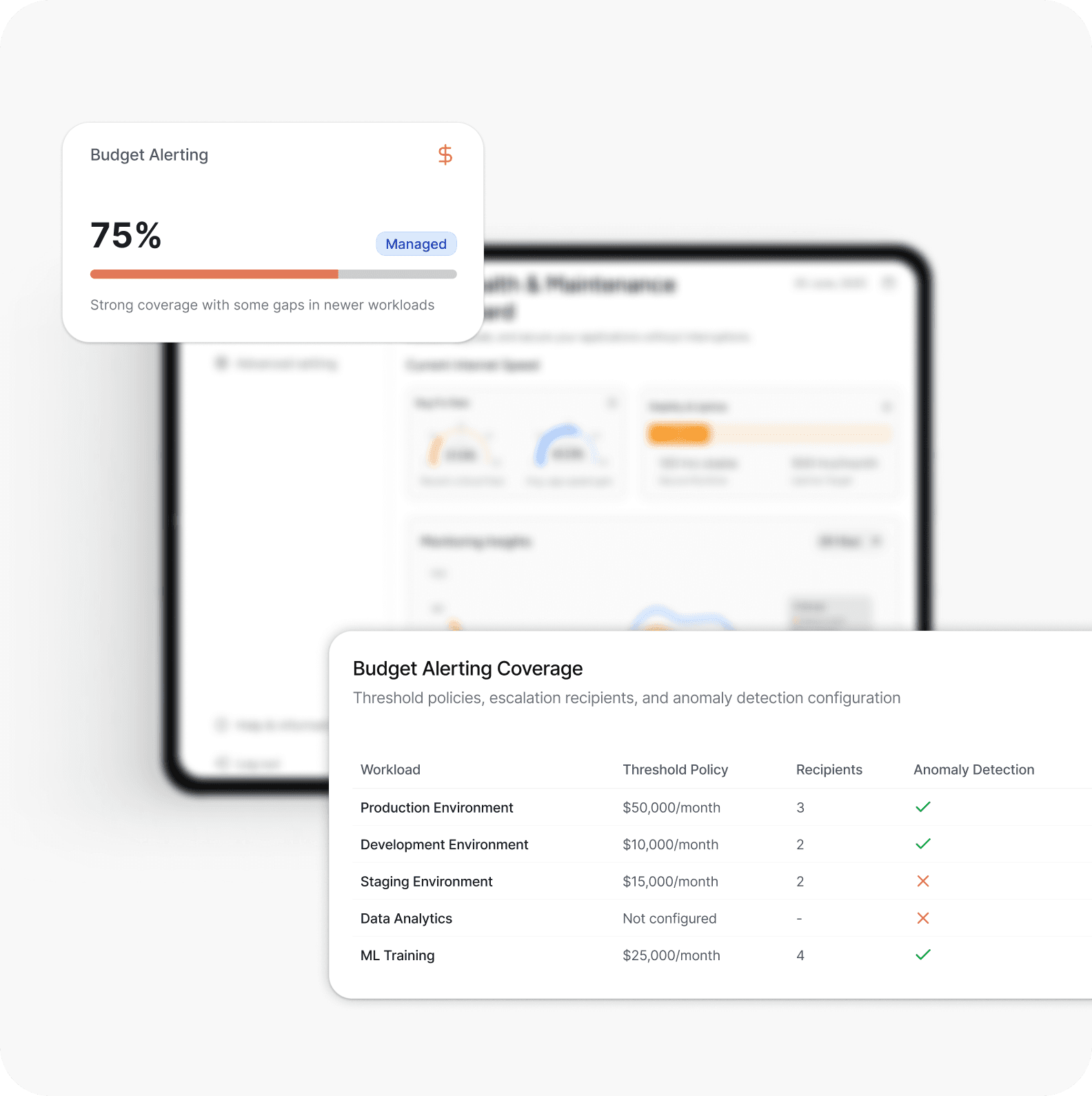
Recurring Patterns We Uncover Across FinOps Engagements
4-8 hrs
Average delay before overspend is detected and acted upon
60-70%
Percentage of cloud accounts lacking meaningful budget alerting
1 in 3
Resources provisioned but never actively utilized in production
35%
Proportion of total cloud spend that can typically be reclaimed
Tangible Financial Outcomes We Deliver
Our FinOps assessment process surfaces exactly where your cloud budget is underperforming. Every report we produce brings financial transparency and hands you a sequenced, prioritized plan to reclaim wasted capital.
Eliminate Budget Surprises Permanently
Understand precisely where overspend originates and who is accountable for resolving it — so month-end reconciliation becomes routine rather than reactive.
Accelerate Delivery Without Inflating Spend
Remove the financial friction slowing your release cadence so deploying to production carries no hidden cost penalty.
Align Every Environment to Its True Financial Footprint
Bring spending discipline to development, staging, and production environments alike so no workload operates outside budget visibility.
Recover Capital Tied Up in Wasteful Infrastructure
Receive an itemized breakdown of recoverable spend so every dollar you commit to cloud infrastructure is generating proportionate business value.
Industries Across Which We Deliver FinOps Impact
We develop financially sustainable cloud strategies tailored to the operational realities of each vertical. Our philosophy is always to position you for long-term viability and disruption-resilience. We account for regulatory constraints, margin sensitivity, and the commercial nuances that vary across sectors. Every industry represented in our portfolio reflects genuine, hands-on delivery experience — not theoretical expertise.
FinOps Assessments Backed by Teams Who Have Optimised Spending Across 1000+ Global Deployments
Extensive experience across large-scale engineering organisations has taught us that no two billing profiles are identical. Yet the root causes almost always converge: untagged resources accumulating unnoticed, reserved capacity purchased without utilisation data, development environments left running through weekends, and purchasing decisions made without finance and engineering ever sitting in the same room.Our practitioners bring financial pattern recognition forged through hundreds of real cost optimisation engagements — not theoretical frameworks. So your assessment delivers a genuine financial diagnosis, not a recycled set of generic recommendations.
Our AI-enabled engineers and FinOps specialists have led cloud cost transformations at significant scale across multiple industries.
Every inefficiency is quantified in dollars, not percentages alone — because engineering decisions only change behaviour when they carry a visible price tag.
We recommend the purchasing and architectural strategies that serve your business model, not the ones that benefit a vendor relationship.
Every recommendation we produce is specific, scoped, and ready to assign — no translation layer required between assessment output and engineering action.
We document every finding and framework so your team internalizes the FinOps discipline long after the engagement concludes — with zero residual dependency on our involvement.
Our Offerings in DevOps Consulting and Services
Our Latest Thinking
FAQs About FinOps Assessment Services
A FinOps Assessment is a structured financial audit of your cloud accounts, purchasing agreements, resource utilization, and governance processes. It surfaces recoverable spend, attribution gaps, and purchasing inefficiencies — then delivers a sequenced action plan your team can begin executing immediately.
Most projects conclude within 2 to 4 weeks, depending on the number of cloud accounts, the breadth of services in use, and the complexity of your current tagging and attribution model.
We operate within whatever boundaries your data governance policies permit. Read-only access to your billing dashboards, account structures, and resource inventory is generally sufficient to conduct a thorough financial assessment.
Very little. Typically, we schedule 2 to 3 focused sessions with relevant stakeholders and rely on existing documentation for the remainder of the analysis. The vast majority of teams contribute fewer than 4 hours total across the entire engagement.
Disproportionately so. Smaller organizations typically lack dedicated FinOps functions, which means waste compounds undetected for longer. A structured assessment gives lean teams the financial clarity needed to prioritize the highest-return infrastructure improvements first.
You receive a comprehensive findings document, a tiered improvement roadmap segmented into 30, 60, and 90-day execution windows, a full cloud spend breakdown by category, and a collaborative readout session where we walk your team through every finding and recommendation.
Independent consultants typically arrive to implement specific changes. A FinOps assessment is diagnostic by design — we identify what needs changing, in which sequence, and for what financial reason, equipping you to make fully informed decisions about internal execution versus outside engagement.
We maintain no vendor preferences and deliver assessments across AWS, Google Cloud, and Microsoft Azure, alongside cost management tooling including CloudHealth, Apptio Cloudability, AWS Cost Explorer, and native GCP and Azure cost management interfaces.
That decision rests entirely with you. Certain clients take the roadmap forward independently with their internal teams. Others bring us in to execute targeted optimizations. The assessment is designed to be a fully standalone, self-sufficient deliverable regardless of what follows.
Across our engagements, clients typically recover 35% or more of their existing cloud spend through direct optimization actions. Beyond direct savings, teams consistently reclaim dozens of engineering hours monthly that were previously absorbed by manual cost reviews and reactive billing investigations. The majority of our clients offset the full cost of the assessment within their first two months of acting on the findings.
