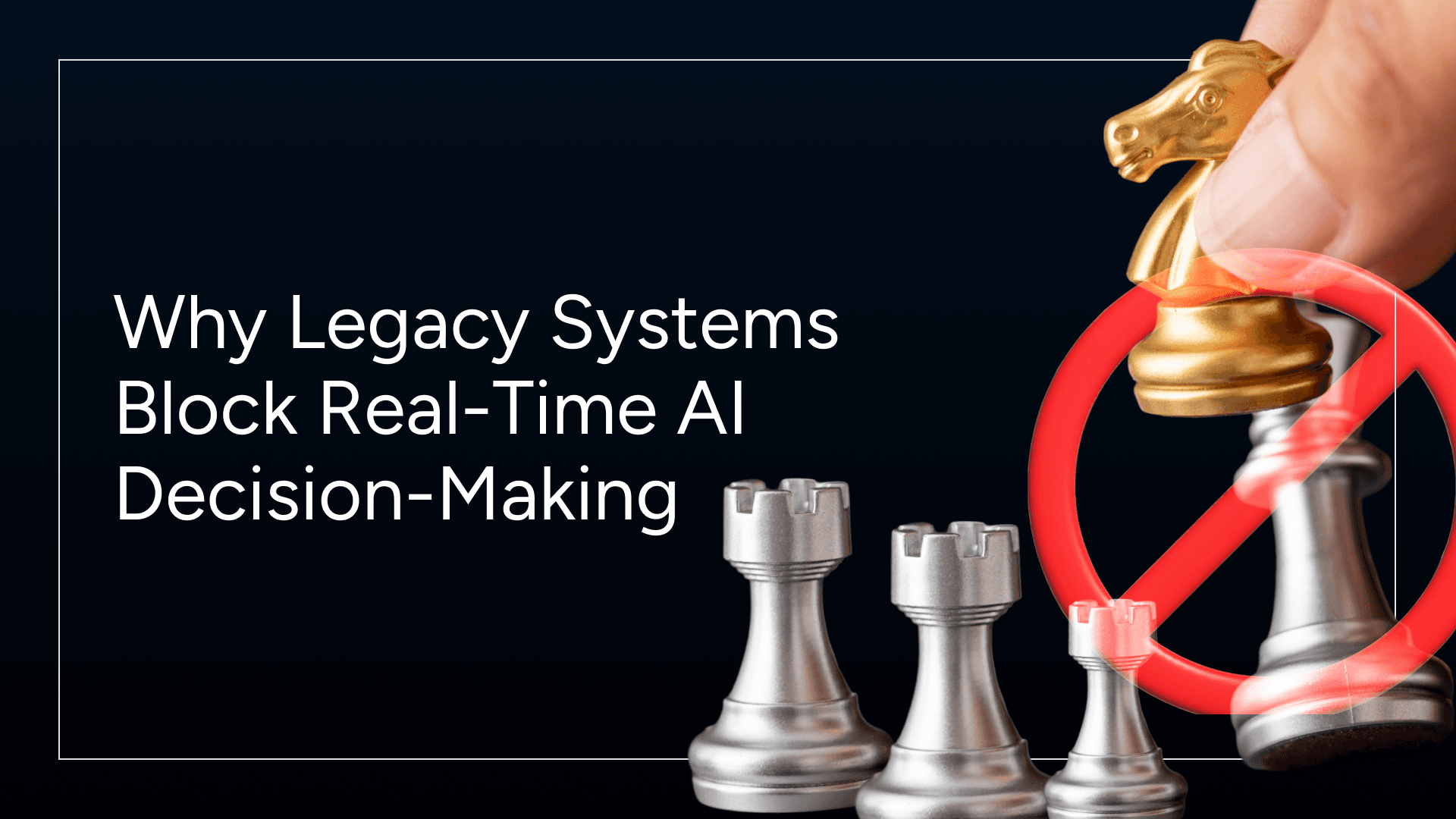

AI is Moving Faster than Enterprise Systems
More than 70% of firms used AI, but only 7% say they were using it intensively in their core operations.
Artificial intelligence (AI) has moved from being an experimental technology to an engine that drives business growth. Today, businesses are utilizing AI to provide better customer experiences and automate everyday operations. However, despite investing in the technology, businesses are struggling to convert usage of AI into a business value. This points to the gap between using the technology and getting the actual value out of it.
The friction isn’t the AI model itself. The systems utilized by businesses are also the reason for such frictions. Imagine a bank is using AI to point out fraudulent transactions; the AI model could be capable of tracking suspicious activity in seconds, but if the user data is spread across disconnected legacy systems or updated in batches, the AI has to wait for the information it needs. By the time a decision is made, the fraudulent transaction may already have been processed.
A lot of businesses, operating in different industries, are running into the same problem and are getting into a pattern of a constant loop of investing and not getting the value in return. AI may require immediate access to the data to take the next step, which may not be supported by older systems. They may work perfectly for everyday operations but may lag behind when it comes to operating with AI.
So, in what other ways are legacy systems holding back AI? and what can businesses do to find their way out of this loop?
What Does AI Decision-Making Actually Mean?
Real-time AI decision-making is when AI systems analyze the data and respond immediately, without waiting for any manual round of review or scheduled updates. Rather than creating reports after a particular task, AI helps businesses make decisions as they unfold so that they can act quickly and make better decisions beforehand.
Let’s say when a customer makes an online payment, AI can access the transaction in seconds by checking location, device information, expenditure patterns, and other signals. If something is unusual, it flags or blocks the transaction before the process is completed. Similarly, an e-commerce platform recommends products based on what a customer is browsing at that moment, while a customer support chatbot can instantly access account information to provide answers instead of routing every query to an agent.
The same is applicable to inventory management. AI can monitor stock levels, predict demand, and alert teams to replenish products before shortages occur, which reduces delays and improves operational efficiency.
Why Do Legacy Systems Struggle to Support AI?
Many organizations may be under the impression that adopting AI is about choosing the right model or platform, which may not be entirely wrong, but AI is only as effective as the systems and data that hold it strongly. If the infrastructure doesn’t provide fast, connected information, then even the most advanced AI models will struggle to deliver the desired results.
- Disconnected Data: It is one of the biggest challenges. Over the years, businesses tend to add new applications without replacing older ones. As a result, customer, operational, and financial data end up spreading across multiple systems that may not be connected with one another. When AI has to gather information from various sources, it may take longer to generate information, work with incomplete data, or reduce the quality of its recommendations.
- Slow Data Updates: Most of the legacy systems were designed to process information in scheduled batches and not in a continuous manner. While this may work perfectly for end-of-the-day reports, it doesn’t really meet the demands of AI, which relies on live information to respond to events as they happen. If the data is outdated, then the decisions may not be aligned with the current business circumstances.
- Limited Integration Capabilities: This is a major blocker as well since modern AI platforms connect with customer databases, cloud services, enterprise applications, and third-party platforms. However, older systems lack modern interfaces or require complex custom integrations, which makes it difficult to share information quickly. This leads to increased implementation costs due to delays in AI projects.
- Modification Issues: Many organizations are relying on applications that have been personalized over several years to support critical business processes. Introducing new AI capabilities into these tightly coupled systems needs redevelopment cycles, increased project timelines, and operational risk. Businesses need systems that adapt with AI models.
- Technical Debt: Over a period of time, technical debt reduces flexibility, which makes every new integration or upgrade more complex than the last. This leads to accumulation in the cost of maintaining outdated software, temporary fixes, and aging infrastructure. In addition to this, teams spend an insurmountable amount of time in maintaining existing systems.
How Does Delay In AI Adoption Affect Businesses Today?
Legacy systems impact more than one particular department. If AI cannot access the required information at the right time, the effects may be felt across the entire business. Take financial services as an example. If there are delays in accessing transaction data, it can reduce the effectiveness of AI-powered fraud detection, which increases both financial and reputational risk.
Similarly, in customer services, if AI assistants cannot retrieve a customer’s latest order, payment, or support history since the information is stored across multiple systems, it may provide incomplete or inaccurate responses. This leads to longer resolution times and a frustrating customer experience.
How Companies Are Preparing Their Systems for AI:Building an AI-Ready Business
A business’s existing system must be ready to support AI decision-making. Before considering further investments in AI it is necessary to know that it is not just about catching up with the latest AI tools but to have a solid foundation in place. If the business’s infrastructure doesn’t provide quick access to business data, AI will struggle to deliver results.
A few important questions to assess an organization’s AI readiness:
- Can the systems share data in real time, or is there reliance on manual transfers and scheduled updates?
- Can AI tools integrate with existing applications without needing months of development?
- Is business data accessible from a single view, or is it in multiple systems?
- Are important business decisions delayed because teams are waiting for reports from different departments?
- Can your infrastructure scale as AI use expands across teams?
If the answer is ‘no’ to most of these questions, then your AI strategy may be limited by your infrastructure. These gaps don't necessarily mean replacing every legacy system. Improving connectivity, data accessibility, and system flexibility creates a stronger foundation for AI for faster business outcomes.
Building an AI-Ready Business
The good news is that becoming AI-ready doesn’t always require replacing every existing system. Many organizations are taking a phased approach by modernizing critical applications, improving system integrations, and making business data more accessible. These incremental improvements create a stronger foundation for AI while reducing the risks and costs associated with large-scale implementation.
At GeekyAnts, we help organizations bridge the gap between legacy infrastructure and modern AI capabilities. Whether it’s modernizing legacy applications, integrating disconnected systems, building cloud-native platforms, or developing AI-powered solutions, our focus is on creating technology ecosystems that enable faster, smarter business decisions. As AI continues to reshape industries, businesses that invest in modern, connected systems today will be better positioned to innovate, compete, and scale in the years ahead.