
In May 2025 Builder.ai filed for bankruptcy after raising $450 million from Microsoft, SoftBank and other investors. The company had promised to build software through AI. Instead much of the work was done by developers behind the scenes and when that became public more than a thousand employees lost their jobs and hundreds of clients were left asking for refunds. The lesson is not that AI cannot build software. Tools like Lovable, Bolt.new and Base44 generate working applications from an English prompt in minutes, and have become the default starting point for founders building a first version of a product. The lesson is that a working demo and a product that survives contact with users are different things, and founders who skip the gap between them often find out at the worst time.
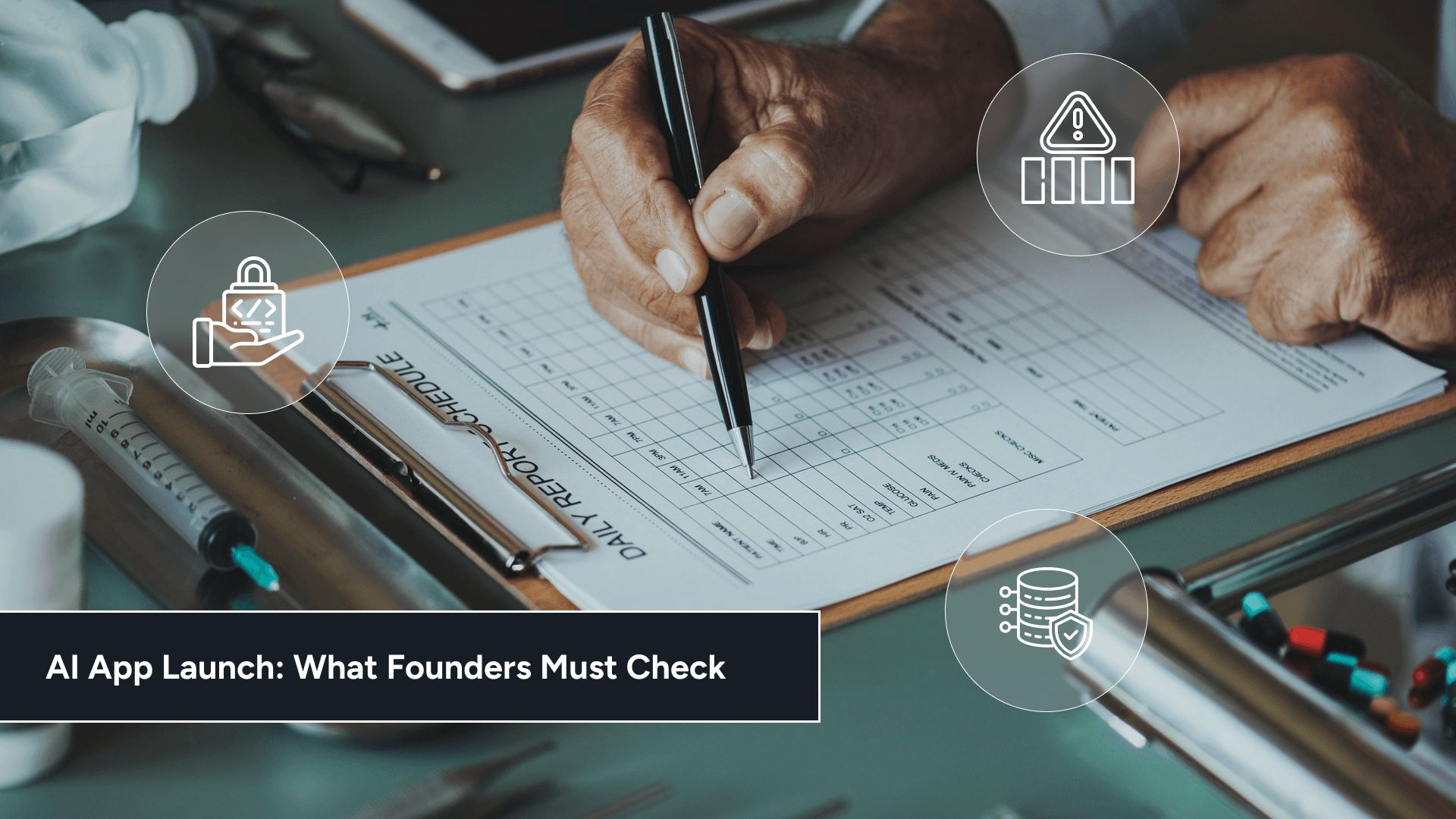
Before any app goes live four questions decide whether it holds up:
- Who owns the code?
- What happens once the easy 80% is built?
- Where user data actually lives?
- Whether the app can pass a real audit?
Who Owns the Code
Most AI app builders generate the application inside their own platform, and what founders get to take with them when they leave varies a great deal. Some platforms function closer to a coding environment than a hosted product and hand over standard code from the first line written. Others offer export through services like GitHub. A few give no way to export a working version of the app at all, and leave vague how prompt data gets used and stored, which matters more once a founder has built a customer base on top of it. It is the first thing to check, because switching platforms after six months of customer growth costs far more than switching before a single user signs up.
A founder who asks "can I export this and run it anywhere" before writing the first prompt avoids a decision that gets harder to undo every week the app stays live. If the answer involves a software development kit tied to one vendor's infrastructure, that is the moment to weigh convenience against risk.
What Happens at the 80% Mark
AI app builders are good at the early stretch of a project. Most can take a plain description and turn out a working prototype within 30 minutes, and the first results often feel close to magic. The trouble tends to show up later. Custom business logic, complex workflows, and integrations outside the platform's original scope start breaking down once a build hits a ceiling, around 80% completion. At that point some teams end up rebuilding the application in custom code, a process that can take 3 to 4 months depending on how much of the original build has to be redone.
This affects a founder's timeline as much as the engineering budget. An investor pitch that promises a launch date based on the speed of the first prototype prices the wrong 80% of the work. The real question to ask before committing to a platform is what the team plans to do once prompt-based generation stops being enough, and whether the months that follow are already budgeted for.
Where the Data Lives
A finished app collects user data the moment it goes live, names, payment details, sometimes health or financial records depending on the product. Independent reviews of AI app builders in 2026 point to authentication and database design as the two weakest areas across nearly every major platform, even as frontend code quality has improved. The average global cost of a data breach reached $4.4 million in 2025 according to IBM, and application-layer attacks, the kind that target weak points in a backend built fast and reviewed less, continue to rise.
A founder evaluating an AI-built app should ask a direct question before launch: who set up the authentication, and did that person understand how it could fail, beyond confirming it lets users log in. A login screen that passes a test in five minutes and a login screen that resists a real attack get verified by different standards.
What the AI Builder Cannot Tell You
An AI app builder can confirm that the code runs. Whether that code passes a security review, meets the compliance requirements of an industry, or holds up under a sudden spike in users is a separate question, one that comes from experience with production systems rather than from a tool built to generate a working demo fast. Genuine AI-assisted development partners worth hiring in 2026 name the specific tools they use at each stage of a build and show which parts were AI-generated and which a human engineer reviewed or rewrote. A vague answer like 'we use AI throughout our process' sidesteps the question rather than answering it.
A second technical opinion before launch, even a short one, costs far less than discovering a security gap after a breach or rebuilding a backend after a customer complaint. Skipping that review is a bet that the hidden parts of the app are as solid as the parts a founder can see and test.
Before the Launch Button
None of this argues against using AI to build software faster. Low-code and no-code tools are expected to power most new enterprise applications by the end of 2026, up from less than a quarter in 2020, according to Gartner. The argument is for treating an AI-built app the way any experienced founder treats a contract before signing it, by reading what it actually commits them to. Check who owns the code before the first prompt. Ask what happens at the 80% mark before setting a launch date. Confirm who reviewed the authentication and database before a single real account gets created. Get a second technical opinion before the app goes live.
GeekyAnts has reviewed AI-generated codebases for founders before launch and found this same gap, the space between a demo and a product built to last. If a launch date is close and that review hasn't happened yet, it's worth a conversation before the button gets pushed.