
Editor's Note: Hackathons provide a platform to build innovative solutions, and Team Hackerno Matara showcased their skills with Trend Analyzer Tool, an AI-powered system designed to track and analyze real-time trends from multiple sources. In this blog, Priyesh Nayak, a member of Team Hackerno Matara, walks us through the journey of building this tool, highlighting its functionality, key features, and future enhancements. While the language has been refined for clarity, the content remains true to the original vision and enthusiasm of the team.
Team Composition: Mithun K, Priyesh, Charan, Girish
Hey guys, I'm Priyesh Nayak from Team Hakuna Matata, and my team members are Mithun K, Charan and Girish. Our hackathon project is the Trend Analyzer Tool, which focuses on real-time trend analysis. In today’s world, organizations and businesses struggle to keep up with rapidly changing market trends. The process of manually analyzing such data is time-consuming and lacks real-time insights. With the increasing adoption of automation and AI-driven solutions, there is a strong need for a tool that can process and analyze large amounts of data and provide actionable insights.
Problem Statement
The main challenge businesses face is staying updated with real-time market trends. Traditional data analysis methods involve manual efforts and often fail to deliver insights quickly. Organizations need a tool that can automate data collection from multiple sources, analyze trends efficiently, and provide real-time insights.
Our Solution: AI-Powered Trend Analyzer Tool
To address this issue, we developed an AI-driven tool that collects data from various online sources, including social media platforms, news websites, Google Trends, and community forums. The collected data is then processed using OpenAI’s AI models, segregated into structured formats, and analyzed to generate insights. We use data scraping techniques to extract valuable information from multiple platforms, which is then converted into a JSON format for further processing. The tool applies AI-driven analysis to categorize and rank trending topics based on relevance and frequency of mentions.
System Architecture and Workflow
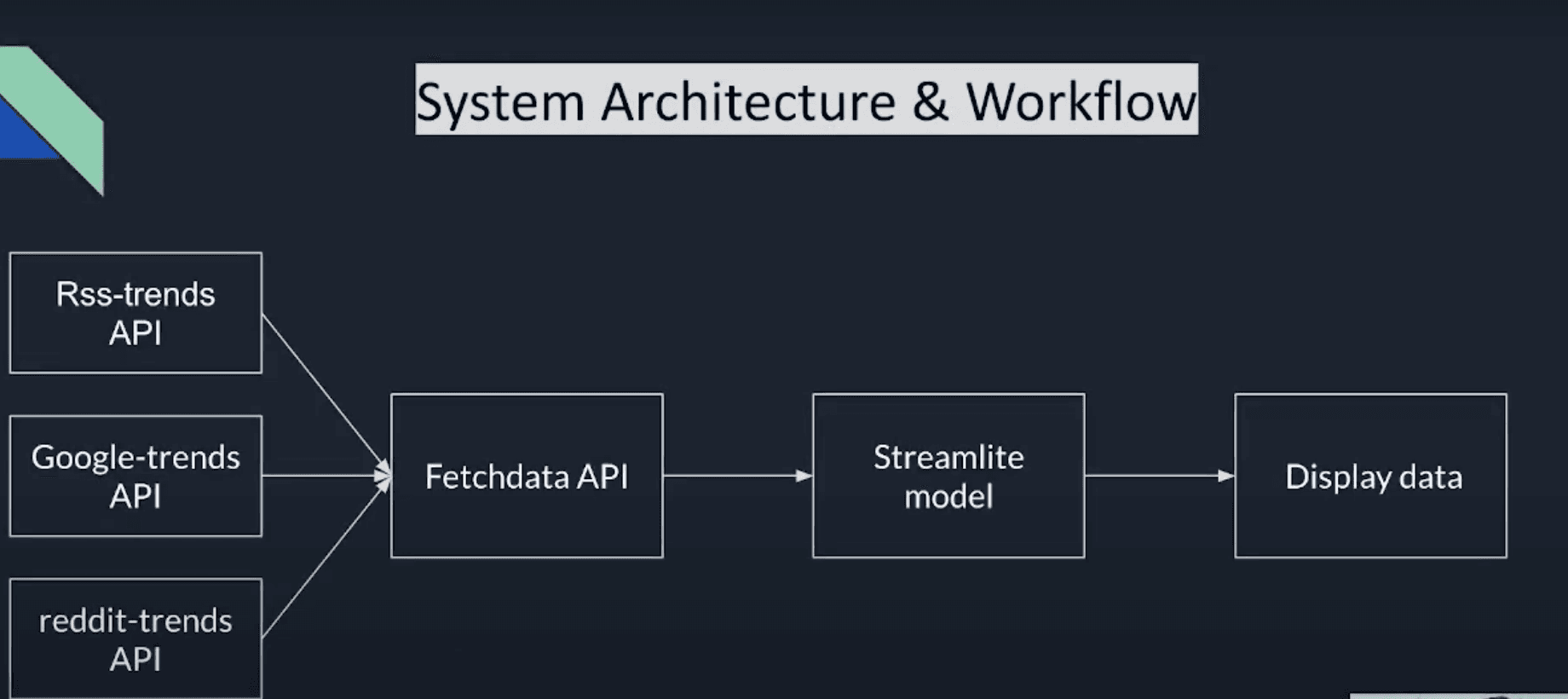
The Trend Analyzer Tool follows a structured workflow consisting of multiple APIs for data collection and AI-driven analysis. The tool integrates three key APIs to fetch data from various sources: the RSS Trends API extracts data from social media platforms, public websites, and online news sources; the Google Trends API fetches trending data from Google’s ecosystem, Hacker News, and community-driven platforms; and the Reddit Trends API gathers real-time discussions from Reddit, including user-generated content and trending topics. Once the data is collected through these APIs, it is fed into the Fetch Data API, which converts it into a JSON format and stores it in a structured file for processing.
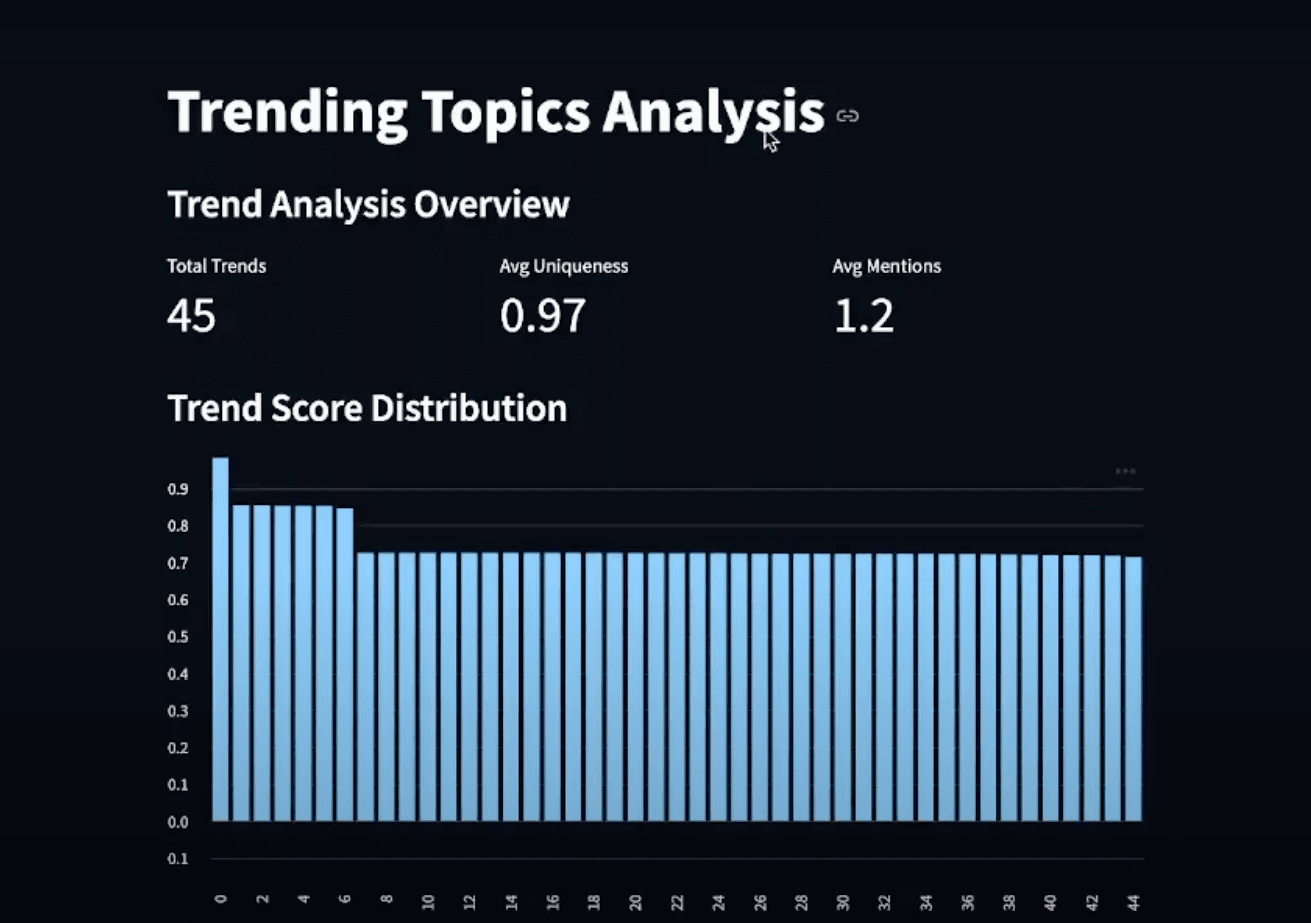
The AI processing stage is handled by the Streamlit model, which extracts data from the JSON file and performs an in-depth analysis to generate insights. The Streamlit model also provides an interactive dashboard where users can visualize trends and track topic rankings in real-time. The dashboard displays the total number of topics analyzed, the average number of mentions per topic, and the uniqueness of the topics being tracked.
Key Features of the Trend Analyzer Tool
Our tool is designed to provide real-time, AI-powered trend analysis with multiple features. It integrates data from multiple platforms such as social media, news websites, and online communities, ensuring a comprehensive view of market trends. The system processes and updates live data streams dynamically, allowing businesses to track emerging trends instantly. Users can customize data sources, adding or modifying websites from which data is fetched. The tool uses an AI-driven ranking mechanism to assign a score to each topic based on the frequency of mentions and relevance, ensuring that the most important trends are prioritized. Additionally, the interactive dashboard provides a graphical representation of trending topics, frequency of mentions, and overall topic rankings, making data interpretation easier.
Live Demo: How the Tool Works
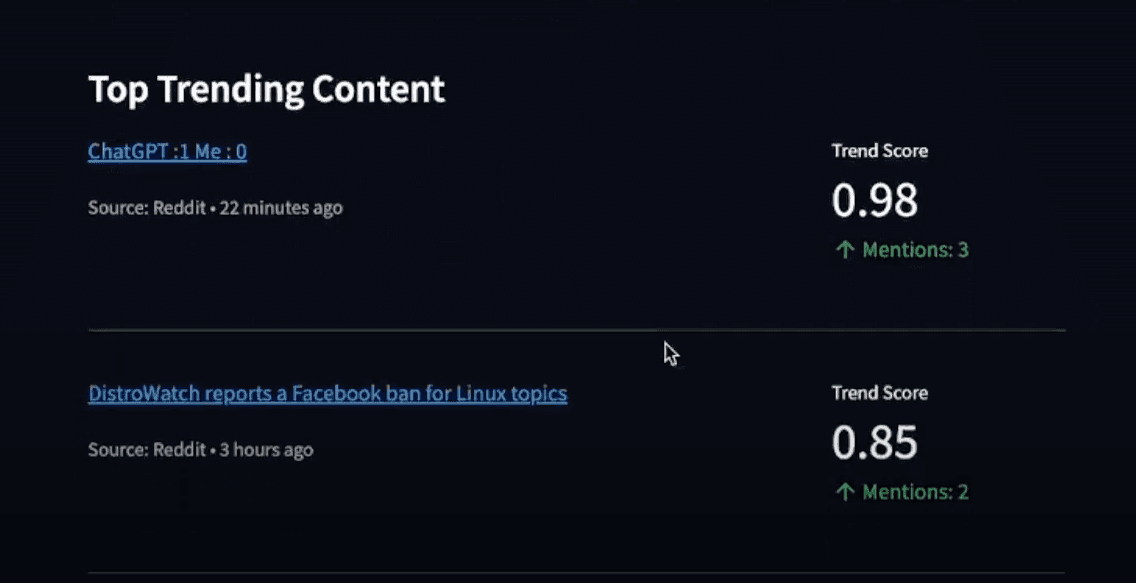
The Streamlit dashboard serves as the user interface for the Trend Analyzer Tool. It provides an overview of the data analysis, displaying key insights in an easy-to-understand format. For example, the system detects 45 trending topics, with an average mention count of 1.2 per topic. The graph visualization shows how frequently topics are repeated, with each topic assigned a score based on its relevance. If a topic is mentioned more frequently across different sources, its trend score increases, pushing it to the top of the ranking. A topic that has been mentioned three times across multiple sources will have a higher score, making it more relevant than those with fewer mentions. The ranking system updates dynamically as new data is collected. As topics gain more traction, their scores increase, ensuring that businesses always have access to the most relevant and up-to-date market trends.
Future Enhancements
While the Trend Analyzer Tool is already effective in tracking and analyzing real-time trends, there are several improvements we plan to implement in the future. Expanding data sources to include platforms such as Twitter, LinkedIn, and financial news portals will enhance the breadth of trend analysis. Incorporating advanced metrics such as sentiment analysis, engagement tracking, and predictive analytics will refine trend insights and make them more actionable. Customizable reports and real-time alerts will allow businesses to generate insights tailored to their specific needs and receive instant notifications on emerging trends. Additionally, automated content generation using AI will enable the creation of summary posts based on trending topics and market movements.
Reflections and Acknowledgments
Building the Trend Analyzer Tool in such a short time was a challenging yet rewarding experience. We successfully developed a system that can automate trend tracking, analyze real-time data, and provide valuable insights for businesses and organizations. A big thank you to GeekyAnts, Pratik, and Sanket for organizing the Geekathon and allowing us to showcase our skills. Special appreciation to my teammates Mithun, K HRNP, and Girish Yash for their hard work and contributions in making this project a reality.
What’s Next?
We are excited to further enhance the Trend Analyzer Tool by improving its data sources, analysis capabilities, and AI-driven insights. If you have any suggestions or feedback, we would love to hear from you. Stay tuned for updates as we continue refining and expanding the tool.
Project GitHub link: https://git.geekyants.com/mithun.k/trend-analysis-hackuna-matata.git