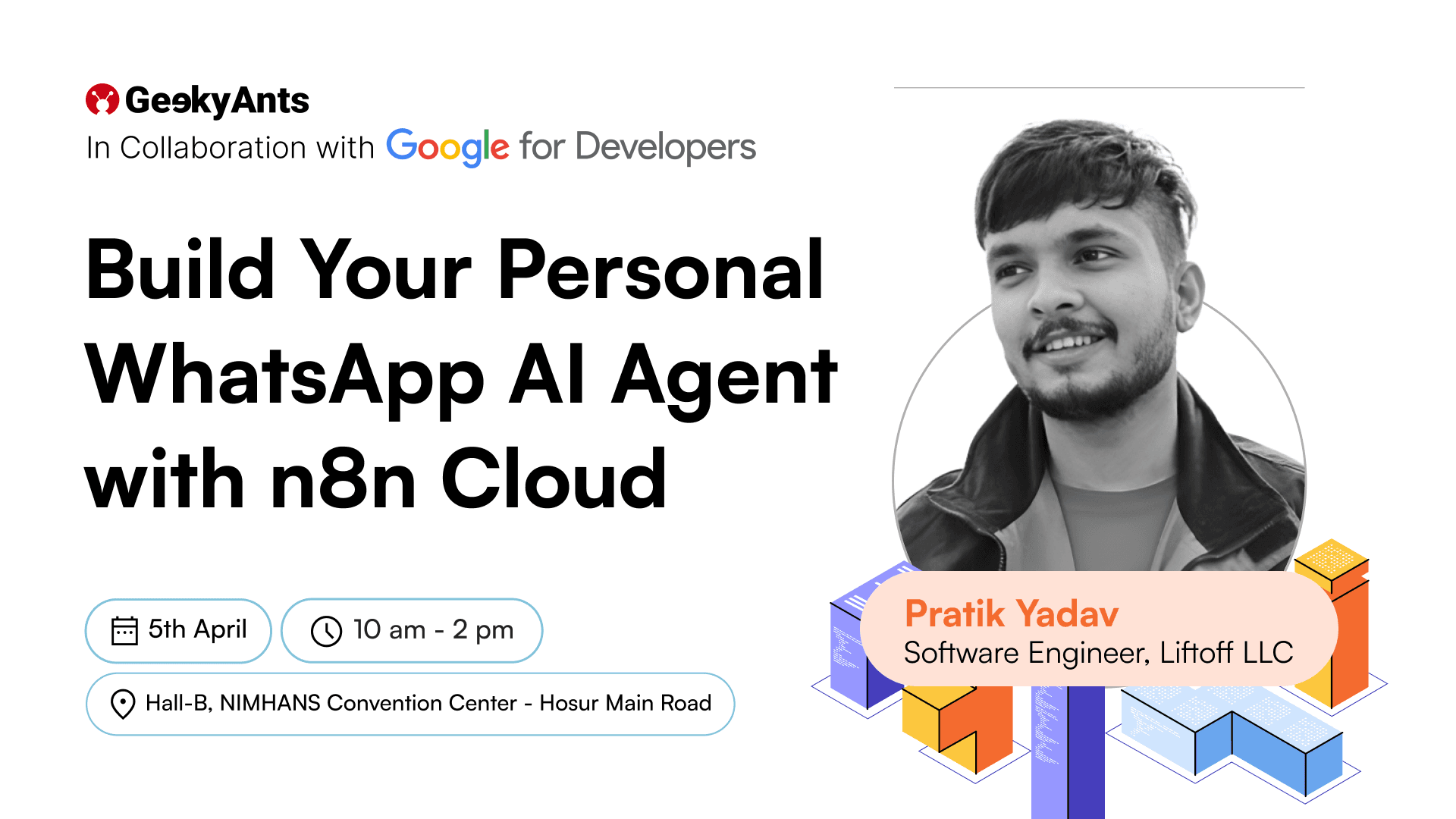

Editor’s Note: This blog is adapted from a talk by Pratik Yadav, a full-stack software engineer at Liftoff LLC and ex-GeekyAnts team member. In this lively session, he walked us through how to build a real-time AI voice agent using n8n Cloud, Nestjs, Twilio, and ElevenLabs—complete with a live demo and use case. From scheduling events to cancelling them mid-call, this was Iron Man-level automation brought to life.
Imagine if you were Tony Stark, sitting in your high-tech lab, and all you had to say was, “Hey Jarvis, book me a flight to New York.” And it’s done.
Well, I might not be Tony Stark, but I figured—why not build a Jarvis of my own?
That’s where the idea for this project came from. I wanted to create an AI-powered calling system that could make real phone calls, handle full conversations in real time, and even reschedule appointments or answer FAQS on the fly. And I’m here to show you how you can do it, too.
Quick Intro Before We Dive In
Hi, I’m Pratik Yadav, a full-stack engineer currently working at Liftoff LLC. I specialize in React, React Native, and Nest.js, and I love exploring how AI can enhance digital experiences. In this blog, I will walk you through how I built a smart AI voice agent, the architecture behind it, and a few fun use cases, including a live demo I did during the session.
What Exactly Is an AI Voice Agent?
At its core, a smart AI voice agent is software that can understand, interpret, and respond to human speech using Natural Language Processing (NLP) and Machine Learning. But to understand how it works, let’s break down the key components:
- ASR (Automatic Speech Recognition): Converts spoken input into text.
- NLP: Understands the context and intent behind the text.
- TTS (Text to Speech): Converts the AI-generated text response back into audible speech.
- ML: Helps the agent learn and improve from each interaction for more accurate responses over time.
Tools I Used to Build My Agent
I used a stack of tools that made this whole project not just possible but surprisingly smooth:
- Nestjs: For creating backend APIs and handling the logic.
- Twilio: To trigger and manage phone calls.
- ElevenLabs AI: To synthesize natural-sounding speech responses.
The entire system uses WebSocket connections to stream audio and manage live interactions between Twilio and the AI engine. I even used GPT-4 (Gemini Flash 2.0) to handle the core language processing.
Use Case: Calling Meetup Attendees to Confirm Participation
Let’s say you are organizing a tech meetup. You want to call every registered participant a day before the event to confirm attendance, provide event details, and answer questions—all without doing it manually.
Here’s what happens:
- A call is triggered to the attendee using Twilio.
- The AI agent introduces the event and asks if they’re attending.
- Based on the user's response, the agent confirms, cancels, or reschedules.
- It also answers questions like who’s speaking, the dress code, or whether snacks are included.
During my demo, I gave the AI all the event details (location, date, speakers) and set up a script to test live. And guess what? It worked. The AI responded naturally, answered questions, and even updated the RSVP.
Architecture: How Everything Connects
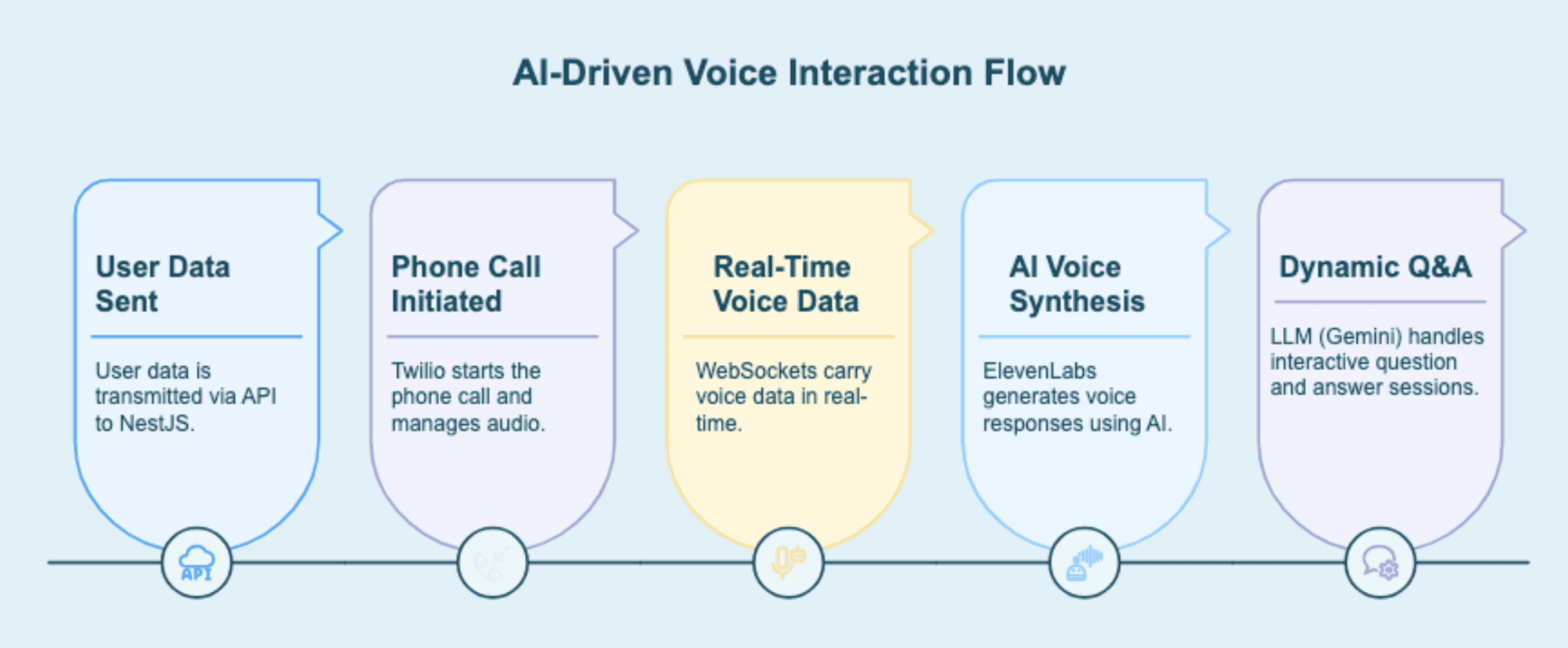
Here’s a simplified version of the flow:
- User data is sent via an API call to NestJS.
- Twilio makes the phone call and manages the audio stream.
- WebSockets carry the real-time voice data.
- ElevenLabs generates responses using AI voice synthesis.
- The LLM (Gemini) handles dynamic Q&A.
The system can handle interruptions, switch between intents, and act more like a human than a bot. If the user speaks mid-response, the AI adapts.
Real-World Applications
AI voice agents like this one are already transforming industries:
- Healthcare: Reminding patients of appointments or collecting feedback.
- Banking & Telecom: Replacing outdated IVR systems with smarter conversations.
- E-commerce: Confirming orders or gathering feedback through natural conversation.
- Customer Support: Automating common questions and escalations.
One of my favorite use cases? Ordering a smartwatch with a voice prompt. I built an AI tool that visited Amazon, logged in, searched for the product, and placed the order—hands-free.
Future Enhancements I’m Exploring
Looking ahead, I see several opportunities to elevate this AI voice agent further. Adding multi-language support will help expand its reach to diverse user bases. Personalizing voice responses using user-trained samples can create more human-like interactions. Integrating dynamic FAQ handling and voice-based survey collection will enhance engagement, while syncing with CRM systems can ensure real-time data updates based on user responses. These enhancements aim to bridge convenience with capability—because if it can be imagined, it can certainly be built.
Final Takeaway: Your Own Jarvis Isn’t That Far Away
AI voice agents are changing the game—from improving business workflows to redefining human-AI collaboration.
Whether it’s a voice-powered assistant that schedules meetings, answers customer queries, or places online orders, the tech is no longer experimental. It’s real. It’s now.
And with the right stack, you can build it.