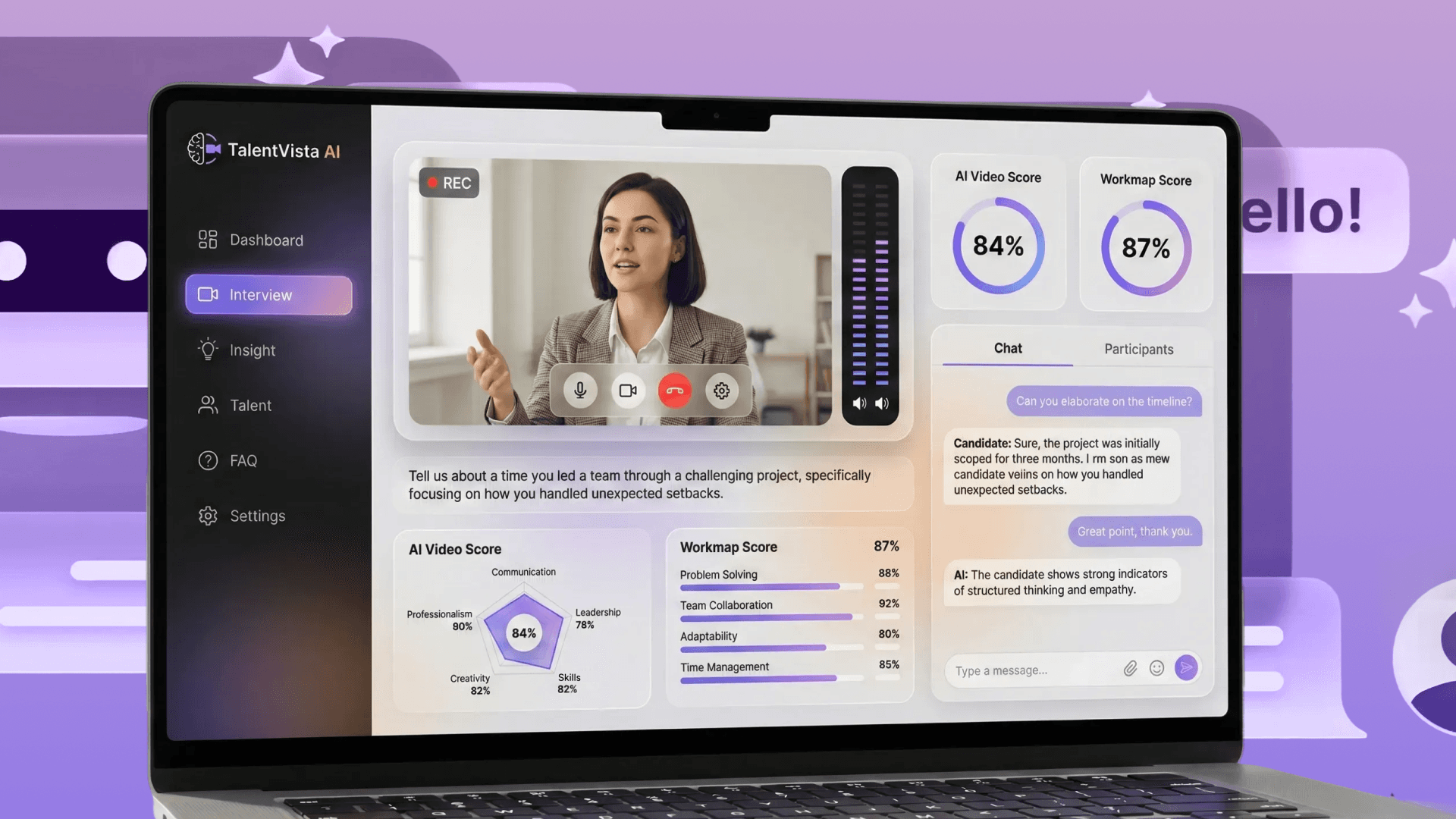


At GeekyAnts, our R&D team is constantly pushing the boundaries of what is possible with artificial intelligence. We are excited to reveal our latest initiative: an AI-powered Interview Bot designed for live, autonomous technical screening.
This project focuses on transforming the recruitment process by leveraging the power of WebRTC and LLMs to deliver intelligent, structured assessments directly in the browser.
Our Vision behind this R&D
The goal of this initiative is to examine how AI-driven interviewing can enhance evaluation quality and create consistent, unbiased assessment paths for various roles. Unlike traditional platforms, our bot adapts in real-time based on candidate responses, uncovering their reasoning process.
Automation in interviews increases consistency and scale in evaluation. AI can objectively assess skills across hundreds of candidates while freeing up human recruiters for other tasks. This is the direction modern talent intelligence is heading.
 Kumar PratikFounder & CEO
The Business Impact of an AI Interview Bot
Our R&D specifically addresses the high cost of open roles. By automating the initial screening, enterprises can transform their hiring from a cost center into a competitive advantage.
- Faster Hiring Cycles: AI interview bots typically reduce time-to-hire by 30%–50%, with high-volume sectors seeing gains up to 75%.
- Direct Cost Savings: Reducing a standard 40-day hiring cycle by half saves an average of $8,000 in vacancy costs per hire.
- Recovered Productivity: For an organization making 100 hires a year, this equates to $800,000 in recovered annual productivity.
- 24/7 Edge: By an AI interviewing a candidate at 8:00 PM on a Sunday, your team can move them to a final round by Monday morning—securing top talent before the typical hiring friction sets in.
Technical Architecture and Scale
This project advances our AI roadmap by developing practical hiring applications that leverage WebRTC and LLMs to deliver intelligent, structured assessments. WebRTC provides reliable real-time communication within the browser, while the LLM engine supports deeper reasoning and structured scoring.
The current prototype facilitates a secure browser session where an AI agent conducts a live interview, producing transcripts and summaries in real time.
- Real-Time Interaction: The MVP integrates speech-to-text (STT) and text-to-speech (TTS) for seamless candidate interaction.
- Built for Scale: Our architecture is designed to handle up to 10,000 interviews per day by expanding AI compute resources.
- Concurrency: We have successfully tested the system with five parallel sessions using a role-based system.
- Efficiency: The bot includes early-exit logic; if a candidate consistently answers incorrectly, the interview ends automatically to save on AI token usage.
Our goal is to create an AI interviewer that listens, learns, and evaluates like a human while remaining transparent in its scoring process. The focus is on fairness and accuracy — every question, response, and score should be explainable. With the current version, we can even render our own avatar with an Indian look, making the experience more relatable and culturally aligned.
 Konakanchi Venkata Suresh BabuPrincipal Technical Consultant.
What’s Next for Our Interview Bot?
While currently in its MVP phase with internal trials underway, our roadmap for the Interview Bot includes upgrades:
- Enhanced Intelligence: Future versions will include video intelligence features such as facial-expression cues, screen-share monitoring, and real-time fraud detection.
- Detailed Reporting: We are developing role-based evaluation reports that score clarity, correctness, and reasoning depth for easier integration with ATS systems.
- Administrative Control: New versions will allow administrators to configure interviews by seniority, duration, and specific evaluation criteria.
This development underscores our commitment to building intelligent, scalable systems that support enterprise-level hiring while addressing the global trend toward standardized, AI-led recruitment.
Security & Reliability of our AI Interview Bot
Scalability is only half the battle; the other half is security and data integrity. Our R&D team prioritized a "security-first" architecture to ensure that enterprise-grade screening is both safe and stable.
Feature | How it Works | The Benefit |
|---|---|---|
Secure Sessions | Encrypted peer-to-peer browser connections using WebRTC | Keeps data safe without needing extra software. |
Clear AI Logic | AI scores are designed to be explainable and transparent | You can see exactly why the AI gave a certain score. |
Budget Control | The bot ends interviews early if the candidate fails repeatedly | Saves money by not wasting AI processing power. |
Access Control | Admins set exactly who can see reports and edit roles | Ensures only authorized people see sensitive info. |
Fraud Checks | Future updates include screen-sharing and facial cues | Prevents cheating to ensure you hire the best person. |
Building for the 2026 Talent Market
The goal is to move beyond simple automation toward a future where "Talent Intelligence" is a core driver of business growth and engineering excellence.