

Getting a product to launch is the work most people picture when they think about product engineering.
GeekyAnts takes a validated idea through discovery, design, and development, builds and tests it across the platforms it needs to run on, sets up the infrastructure and release pipeline, and ships it to real users.
By launch day, the product works, the environment is stable, and the first users are coming in.
Launch is also the point where the assumptions made during design and development start meeting real traffic, real users, and conditions no plan fully predicts. Dependencies change, platforms update, vulnerabilities appear, and business needs move on.
This article covers what post-launch support can include, how support hours and severity levels are agreed, who owns monitoring and incident resolution, how changes reach a live system safely, and how ownership transfers if you decide to run the product in-house.
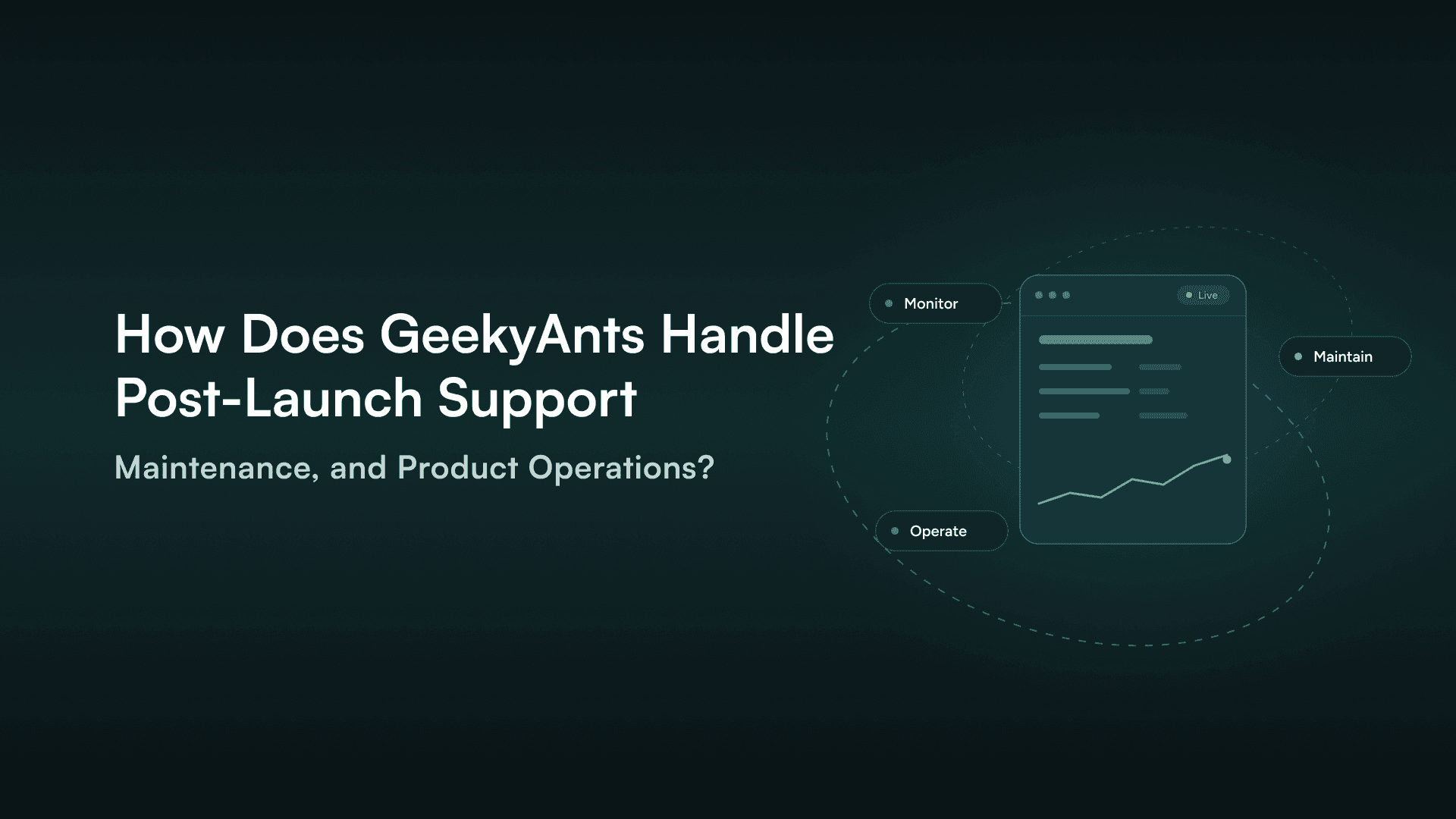
What Monitoring, Maintenance, Incident-response, and Roadmap Support Covers
Post-launch support runs across several connected layers, and a given engagement draws on the ones the product needs rather than a fixed package.
The work answers two separate questions at once: how the product stays reliable, and how it keeps improving.
Area | What it can involve |
Availability, errors, latency, crashes, and critical user journeys, alongside CPU, memory, database, and cloud-service health | |
Corrective maintenance | Production bugs, broken workflows, regressions, and integration failures |
Preventive maintenance | Dependency updates, health checks, and technical-debt work that lowers future risk |
Detection, severity assessment, escalation, mitigation, restoration, and root-cause analysis | |
Vulnerability remediation, patches, dependency reviews, and configuration hardening | |
Frontend and backend latency, database tuning, and scaling | |
Product evolution & roadmap | Feature enhancements, UX improvements, and prioritising work from user feedback and business needs |
The distinction is between monitoring and alerting.
Monitoring tells the team what the production system is doing.
Alerting tells the team when something needs action.
A temporary resource spike stays as telemetry and a sustained payment-service failure becomes an incident someone is called to handle. Support built this way moves the team away from waiting for a customer complaint and towards catching the signal early, which reduces the impact before users feel it.
How Support Hours, Severity levels, and Escalation are Defined
These terms are settled during the support engagement rather than assumed from a standard template, because a consumer content app, an internal portal, and a revenue-critical payment system do not need the same coverage.
The support and maintenance contract sets out the SLAs: how issues are categorised, how quickly each category is acknowledged, the escalation path, the communication channels, and the hours the product is covered.
Severity is based on business impact. The model below is an illustrative example, not a fixed GeekyAnts SLA, since the exact targets attach to the individual contract.
Severity | Typical interpretation | Expected handling |
Sev 1 — Critical | Production down, widespread transaction failure, or a serious security or data-integrity event | Immediate escalation, senior ownership, active mitigation, frequent updates |
Sev 2 — High | A major feature or workflow badly impaired while the system stays partly operational | Priority investigation and an accelerated fix or workaround |
Sev 3 — Medium | A limited defect or degraded non-critical feature with a viable workaround | Handled within the agreed support queue |
Sev 4 — Low | Cosmetic issues, minor requests, or low-impact improvements | Planned into the backlog or normal release cadence |
One point keeps SLAs honest: the contract states which metric each commitment refers to. Response time is how quickly the team acknowledges and starts acting, mitigation is how quickly user impact is reduced, and resolution is the return to normal service.
A fixed resolution time is harder to promise than a response target because the cause is often unknown when the incident starts, so the wording is agreed rather than left open.
Who Owns Production Monitoring and Incident Resolution?
Ownership follows the engagement model and can sit with GeekyAnts, the client, or both, so the responsibilities are mapped before support begins rather than worked out during the first serious incident.
A shared model names, for each task, the team that holds it.
Responsibility | Possible owner |
Application monitoring and alert triage | GeekyAnts |
Cloud account ownership | Client |
Incident investigation | GeekyAnts |
Emergency production deployment | GeekyAnts, with agreed authorisation |
Customer communication | Client |
Business-priority decisions | Client product owner |
The value of settling this early shows during an outage, when the team already knows who investigates, who can deploy a rollback, who talks to the client, and who escalates to a third-party vendor. Those decisions are made once, in the support model, so no one improvises them under pressure.
How Releases, Patches, Infrastructure, and Performance are Managed
Changing a live system carries its own risk, so every change moves through an agreed release and change-management process rather than going straight from an engineer's machine to production.
Work is prioritised by urgency, risk, product impact, and the agreed roadmap, then built, reviewed, tested, deployed, and observed, with rollback ready where the change allows it.
- Bug fixes and hotfixes can be fast-tracked, though a severe fix is still tested against the affected path and watched after release.
- Routine releases follow the normal cadence with QA, regression testing, stakeholder approval, and a release record.
- Security patches are ranked by severity, exploitability, and exposure, then scheduled against the risk they carry.
- Infrastructure changes cover capacity, scaling, database work, and cost efficiency as demand grows.
- Performance work runs continuously, because added features gradually raise load, and field data and release checks catch regressions before users report them.
Handled this way, production becomes a source of engineering evidence.
Monitoring shows what to improve, the change process delivers it safely, and monitoring afterwards confirms whether it worked.
How Ownership Transfers if you Take Support In-House
A post-launch partnership does not have to be permanent, and a structured handover gives the internal team the operational knowledge to run the product, not only the source code. The transfer covers the code and repositories, architecture and infrastructure, deployment and rollback procedures, monitoring dashboards and alert thresholds, the incident and severity model, security and access, and the open backlog, supported by knowledge-transfer sessions and access transfer across cloud, repositories, and third-party systems.
The transition can run in stages rather than all at once:
- Your team can shadow us first
- Take primary ownership while we stay on for escalation
- Finally move to independent operation.
The aim is a team that can deploy the product, monitor it, diagnose common failures, manage infrastructure, and apply changes without depending on knowledge held only by the outgoing team.
The Operating Model you Leave With
Post-launch support produces working artifacts: a monitoring and alerting setup, an agreed ownership model, severity and SLA rules, a security-patch schedule, release records, service reports, and an evolving roadmap.
The precise shape of all of it is agreed for your product, so the support model matches what the product actually needs from the day it goes live.