
What was once a premium feature is now a baseline demand—today’s consumers expect personalization. According to McKinsey, 71% of consumers expect companies to deliver personalized interactions, and 76% get frustrated when that does not happen. This expectation has reshaped the retail landscape, especially in the digital realm. For example, two users browsing Amazon from the same city will likely see different product suggestions, offers, and content—tailored entirely to their behavior and preferences.
AI sits at the center of this transformation. From offering tailored shopping experiences to powering dynamic pricing strategies that adjust in real time, artificial intelligence is fundamentally altering how online businesses operate. In this blog, we explore how AI is shaping personalization, driving competitive pricing, improving business outcomes, and what lies ahead in the future of retail.
The Rise of AI in Online Shopping
Over the past five years, AI has moved from novelty to the core pillar of e-commerce operations. Retailers of all sizes have begun embedding AI into their platforms to streamline decision-making, enhance customer experiences, and increase margins.
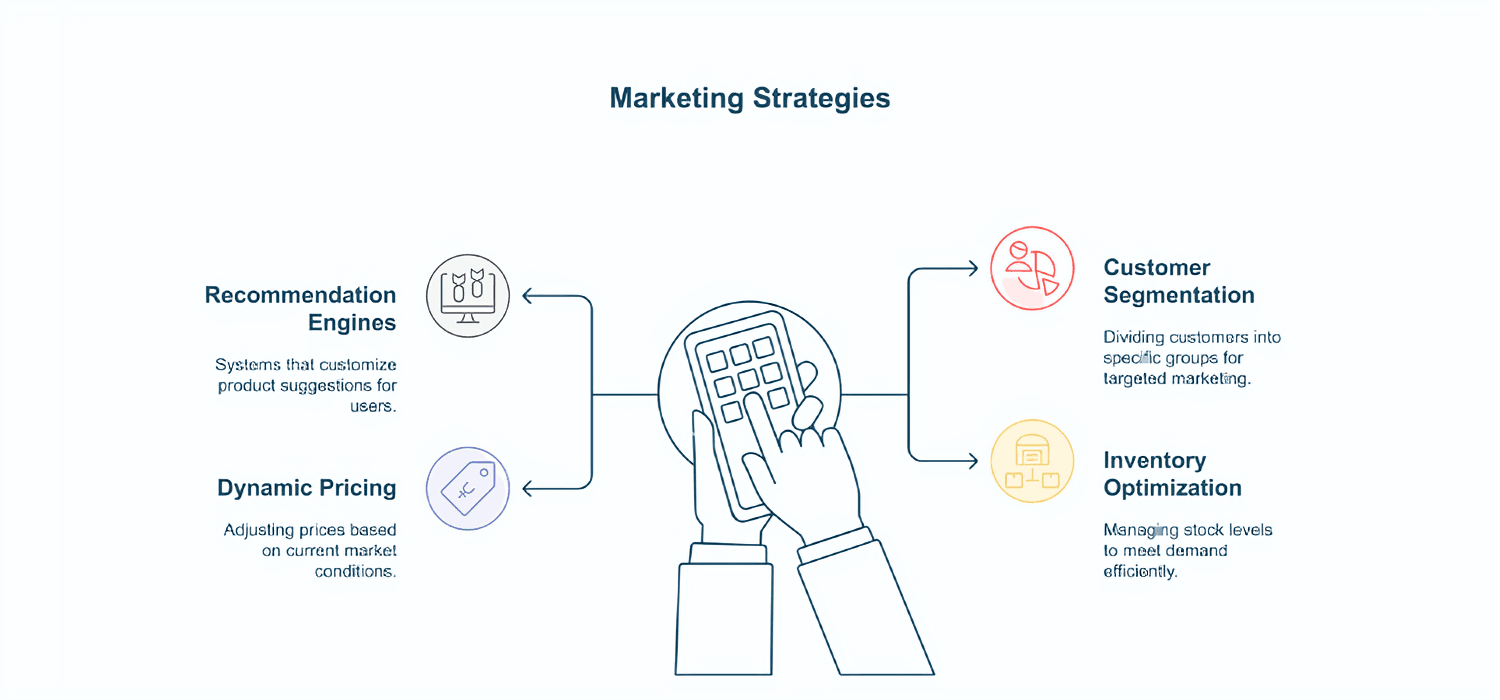
The most prominent use cases include:
- Recommendation engines that tailor product suggestions
- Customer segmentation for precise targeting
- Dynamic pricing based on real-time factors
Inventory and supply chain optimization
What’s enabled this growth? A combination of increased consumer demand for personalization, abundant behavioral data, maturing cloud infrastructure, and accessible AI tools.
According to Precedence Research, the global AI in the retail market is projected to reach USD 45.74 billion by 2032, underlining its growing role in shaping e-commerce innovation and scalability.
Hyper-Personalization at Scale: AI’s Front-End Magic
Modern consumers expect more than a generic shopping experience. AI helps retailers deliver hyper-personalized journeys, leveraging browsing history, past purchases, real-time interactions, and contextual cues to guide users toward what they are most likely to want.
For example, Sephora’s AI-powered beauty assistant analyzes user preferences and behavior to make tailored recommendations, leading to a 14% increase in conversions. This kind of personalization is not limited to product suggestions. It extends to search filters, homepage layouts, and even email campaigns.
AI-powered recommendation engines rely on two primary models:
- Collaborative filtering, which uses crowd behavior to predict preferences.
- Content-based filtering which analyzes user behavior and product features.
Natural Language Processing (NLP) also plays a critical role. Klarna’s AI shopping assistant, for instance, interprets conversational queries to refine results and guide users seamlessly through the buying process.
Retailers like ASOS are also leveraging visual AI, using image recognition to suggest clothing items that match uploaded photos—blending visual style with personalization.
Together, these capabilities deliver not only increased engagement but also significantly higher conversion rates.
AI-Driven Competitive Pricing: The Backend Revolution
While personalization grabs headlines, AI is also quietly transforming the backend economics of e-commerce—most notably through dynamic pricing.
Dynamic pricing refers to adjusting prices in real time based on variables like demand, competitor pricing, inventory levels, and customer behavior. It ensures that businesses remain competitive while maximizing margins.
Retail giants like Walmart have already embedded AI into their pricing engines. Their systems track thousands of data points, continuously adjusting prices to maintain competitiveness and meet revenue goals. Smaller retailers can now do the same using AI SaaS platforms with similar capabilities.
AI models for pricing often rely on reinforcement learning and predictive analytics to test various pricing scenarios and optimize for outcomes like margin, sales volume, or conversion rate. These systems can even detect when a customer is likely to make a purchase at a slightly higher price and adjust accordingly.
According to McKinsey, businesses using AI in pricing have achieved a 2–5% increase in margins and up to a 10% improvement in conversion rates—clear indicators of its bottom-line impact.
Business Impact: AI as a Strategic Lever
The dual power of personalization and pricing optimization has made AI a strategic asset for modern retail organizations. Personalization directly improves customer satisfaction and loyalty, while dynamic pricing ensures profitability and agility in a volatile market.
Take Zalando, for example. By integrating AI into both its personalization engine and pricing strategy, the company reported a 20% increase in customer satisfaction. Customers felt seen and valued, while the company maintained margin efficiency.
Moreover, AI contributes to better customer lifetime value (CLV) by increasing repeat purchases and reducing churn. It also reduces cart abandonment, enhances average order value (AOV), and provides insights that shape smarter marketing and inventory decisions.
McKinsey reinforces this with data: “Companies that personalize at scale can drive 10–30% more revenue and reduce marketing and service costs by 20%.” Far from being a mere upgrade, AI now plays a pivotal role in defining business success and differentiation.
What the Future Holds
AI’s influence in online shopping is entering a more advanced phase—one driven by intelligence, anticipation, and precision. The next frontier is predictive personalization, where AI doesn’t just react to behavior but proactively understands user intent—offering what customers need before they even begin searching.
We are also on the cusp of immersive commerce, with AR/VR integrations enabling personalized virtual shopping environments—digital try-ons, real-time product visualization, and interactive experiences that mirror physical retail but sare marter.
At the same time, eco-conscious pricing models are emerging. AI will soon adjust pricing based on sustainability metrics like carbon footprint or ethical sourcing, aligning with the values of today’s conscious consumers.
And the best part? Advanced AI capabilities are no longer limited to enterprise giants. With the rise of SaaS-based AI platforms, even small and mid-sized retailers can access tools that personalize at scale and price competitively—without heavy technical investment.
The future of AI in retail is not on the horizon—it is unfolding now. The question is not whether to adopt it—it is how fast you can integrate and lead with it.
Conclusion: Competing in the Age of AI Starts Now
In an industry driven by speed, relevance, and data, AI has become essential. It redefines how online retailers work and grow. From hyper-personalized user experiences to real-time pricing strategies, AI unlocks competitive advantages that were once out of reach.
The message is clear: brands that embrace AI today are setting the standards their competitors will chase tomorrow. The time to act isn’t next quarter—it’s now.
At GeekyAnts, we help forward-thinking retailers harness the full potential of AI—building custom, scalable solutions that drive personalization, pricing intelligence, and bottom-line growth.
Talk to our AI experts to future-proof your eCommerce strategy.